

Piezoelectric Staircase for Sustainable Energy Generation
Learn how piezoelectric elements in staircases can harvest energy from footsteps to power IoT devices and smart buildings through micro-harvesting.
PIEZOELECTRIC STAIRCASE SYSTEM FOR SUSTAINABLE ENERGY GENERATION
EA02-TNPID | Engineering Advances 2025
Shreesha, Akshatha Rao L, Sathwik, S R Shripada Rao, Shrikrishna Hebbar
Shri Madhwa Vadiraja Institute of Technology and Management, Bantakal
Abstract
The transition toward sustainable and decentralized energy systems has motivated the development of micro-harvesting technologies for public infrastructure. This study introduces a footstep-activated staircase energy harvester using an array of 25 piezoelectric elements. The system converts mechanical force into electrical energy through a spring-supported tile structure. The generated AC output is stabilized using a Schottky rectifier, varying capacitors, and a DC-DC boost converter to charge a lithium-ion battery. Experimental evaluation confirms the feasibility of powering low-power electronics and IoT-based sensing applications in smart building environments.
Introduction
There is a growing global need for clean and sustainable energy sources. Piezoelectric energy harvesting is gaining attention for its ability to convert mechanical pressure directly into electricity effectively. Metropolitan areas with heavy foot traffic—such as public staircases, footpaths, and railway stations—offer significant untapped kinetic energy. This system aims to harness that energy to power local lighting modules or street lights, reducing reliance on the main grid.
Research Gaps in Existing Systems
Low Output Voltage: Existing works often use limited sensors creating insufficient power.
Unstable Power Generation: Lack of boosting mechanisms leads to rapid voltage drops.
Inefficient Storage: Many designs fail to demonstrate safe charging of Li-Ion cells.
Lack of Monitoring: Absence of IoT integration to validate energy flow and efficiency.
Project Objectives
1. Increase overall output efficiency by optimizing sensor placement (Series-Parallel) and mechanical pressure transmission.<br><br>2. Generate stable output using a Power Conditioning Unit (PCU) comprising a bridge rectifier, filter, and voltage regulator.<br><br>3. Implement IoT monitoring using ESP32 and INA219 sensors to analyze real-time performance.<br><br>4. Validate safe energy storage in Lithium-Ion batteries for practical applications.
Methodology & Architecture
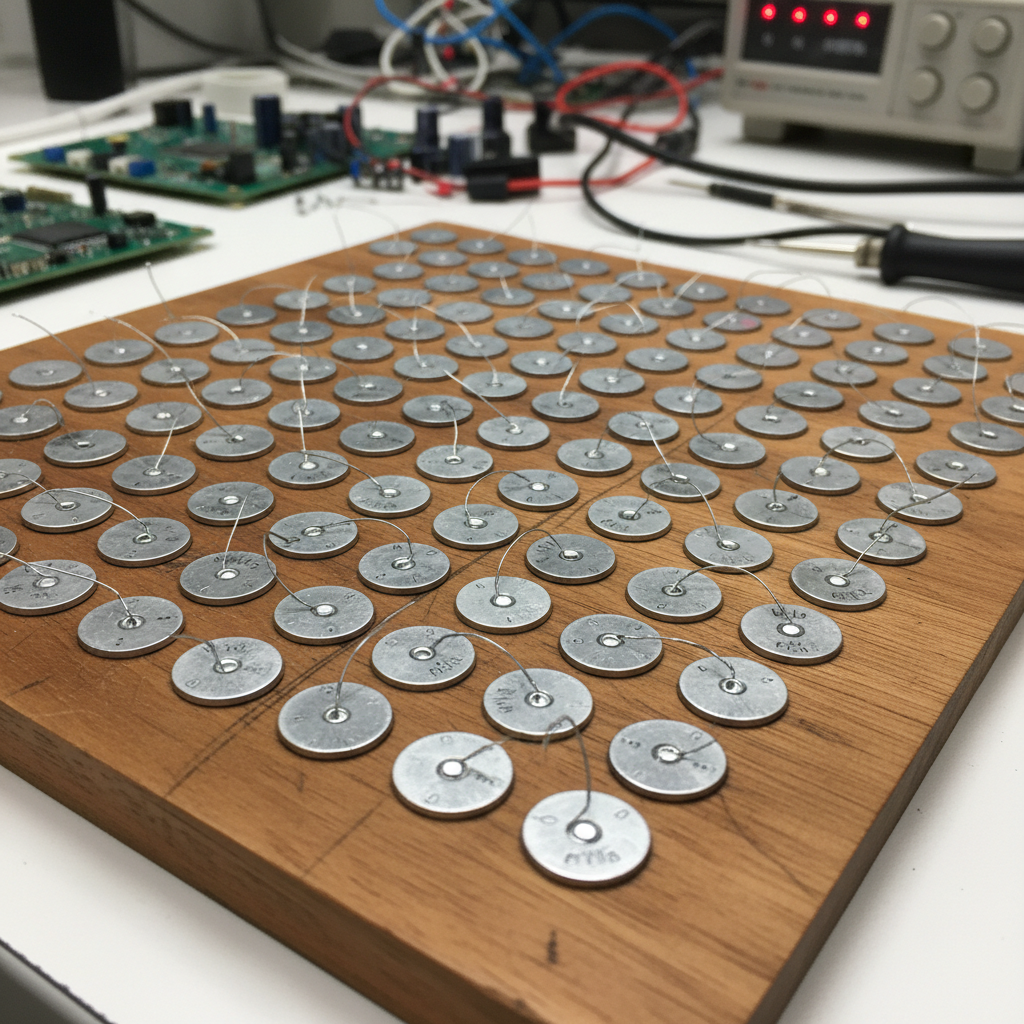
Mechanical Input: Dual wooden plate mechanism with spring supports ensures uniform pressure distribution on the sensors.
Energy Generation: Array of 25 PZT-5 piezoelectric ceramic discs (25mm diameter) connected in series-parallel to balance voltage and current.
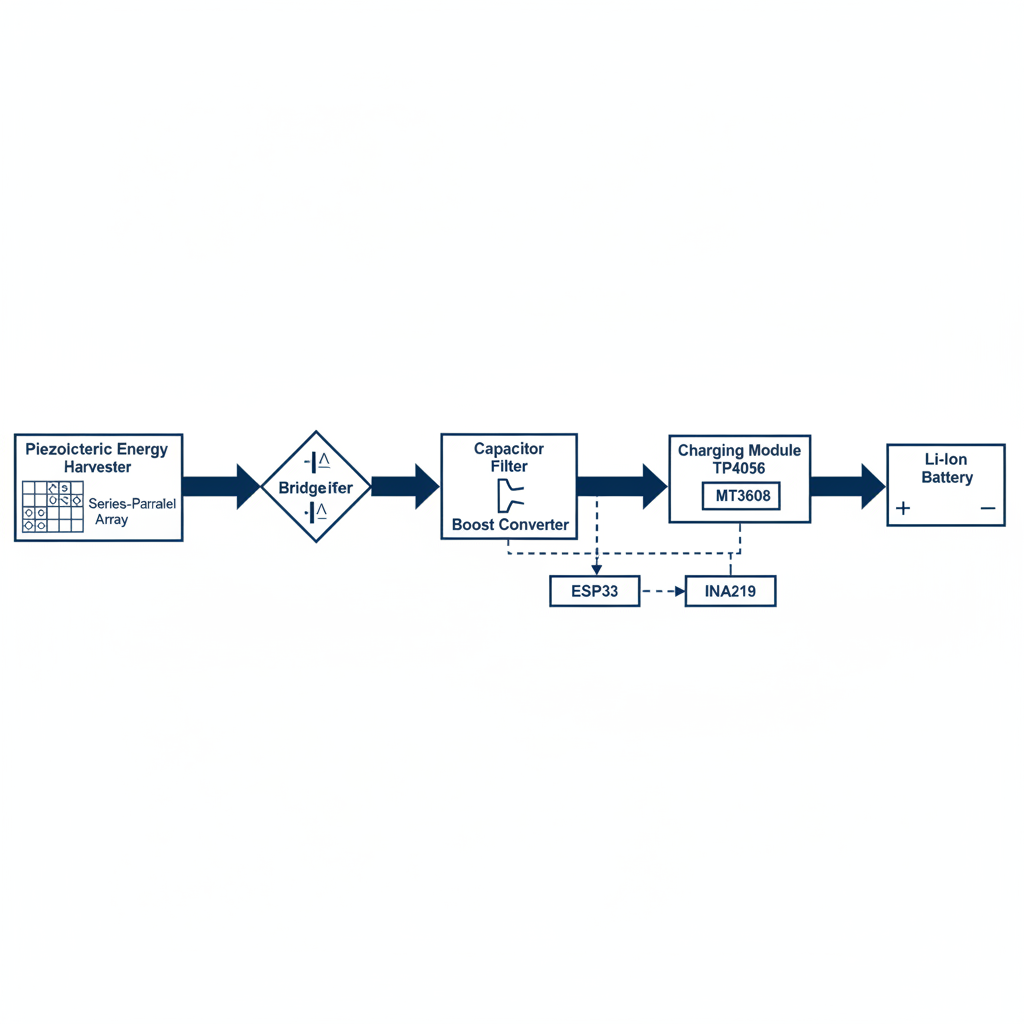
Conditioning: Schottky diode bridge rectifier for AC-DC conversion, followed by a capacitor filter (1000µF/50V) to smooth voltage spikes.
Boosting & Storage: MT3608 DC-DC Boost Converter regulates output to 5V, feeding a TP4056 module to charge a 3.7V Li-Ion battery.
Fig 1. System Circuit Block Diagram (From Paper)
Results: Voltage Progression
The experimental results demonstrate the effectiveness of the conditioning stages. While the raw AC output from the piezo discs under 64kg weight can peak at 40V, it is unstable. The rectification and filtering stage stabilizes this to approx 12V across the capacitor. The DC-DC Boost converter then regulates this to a steady 5V for the charging module, which safely charges the 3.7V Li-Ion battery.
Conclusion
The study successfully demonstrated a functional staircase-based piezoelectric energy harvester.
Consistent AC voltages up to 45V were produced, with 12V DC captured across the capacitor under repeated loading.
A significant challenge remains the low current output, which limits the rate of battery charging.
Future work will focus on integrating supercapacitors for better surge handling and applying the system to smart building IoT networks.
Thank You
Questions & Discussion
- piezoelectric
- energy-harvesting
- sustainable-energy
- iot
- smart-building
- renewable-energy
- engineering
- circuit-design