



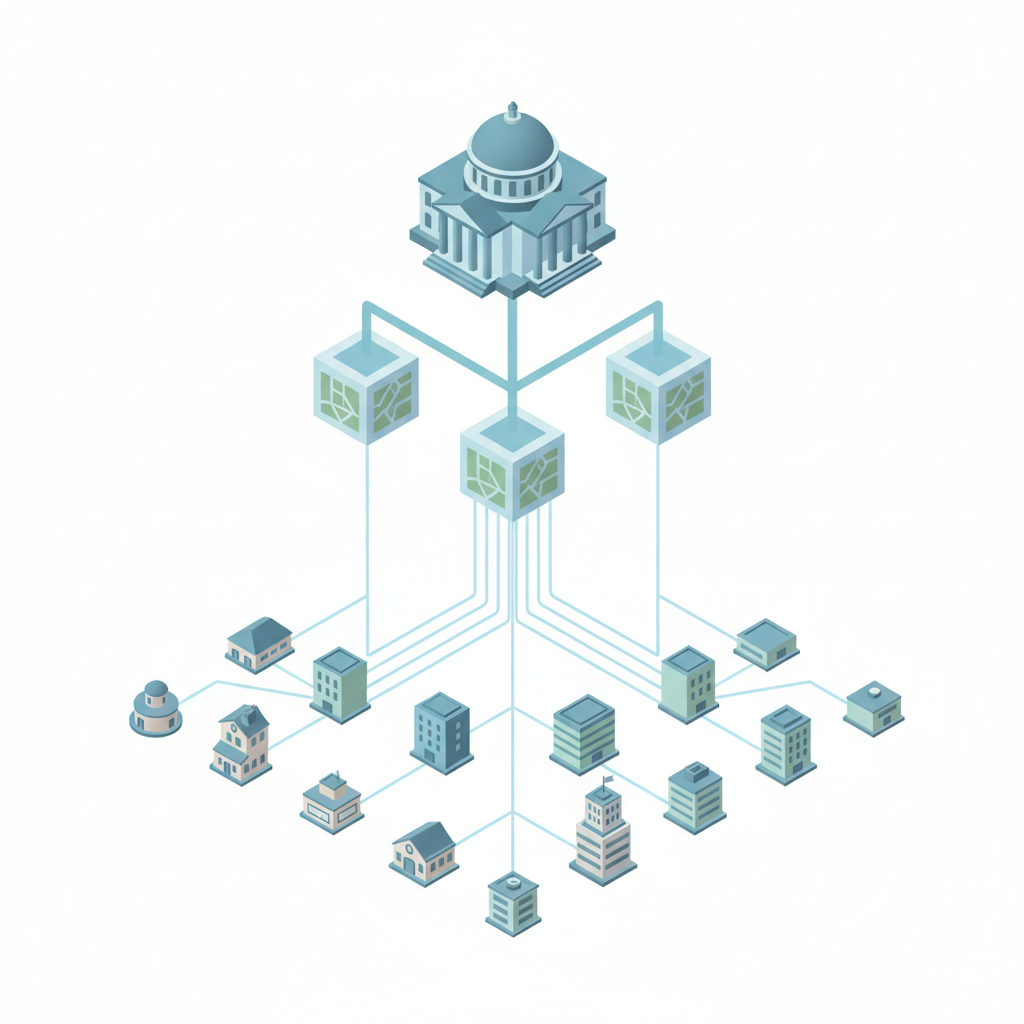

Portugal's Multilevel Climate Governance and Local Action
An analysis of Portugal's climate governance system, identifying bottlenecks in local delivery and implementation capacity across government levels.
From Climate Ambition to Local Delivery in Portugal
Multilevel Climate Governance and Implementation Capacity
Arthur Franco Pereira
Joint project with ADENE – Portuguese Energy Agency | MSc Thesis | Nova SBE | Advisors: Ana Fontoura Gouveia, Maria João Proença
Structure of the presentation
Context and motivation: the ADENE problem
Research question and project goal
Methodology and analytical steps
Climate governance as a system: analytical frameworks
Diagnosing Portugal’s governance structure
Explaining outcomes through three drivers
Context & Motivation (ADENE Project)
Climate policy challenge has shifted from ambition to delivery.
Local and regional authorities implement most mitigation and adaptation measures.
Implementation outcomes vary strongly across territories.
Legal obligations alone do not guarantee effective action.
Project developed in collaboration with ADENE (Portuguese Energy Agency)
ADENE’s Challenge
National climate ambition is clear
Local delivery remains uneven and difficult
Need to understand how Portugal’s governance system enables or constrains local climate action
Core Problem
How to move from planning obligations to effective territorial delivery
Research Questions
How is climate governance structured across levels in Portugal?
How do national, regional, intermunicipal and municipal actors interact?
What type of multilevel governance system characterises Portugal?
Which factors explain gaps between planning and implementation?
Main Research Question
To what extent does Portugal’s multilevel climate governance system enable effective local climate action delivery?
Project Goal
Diagnose Portugal’s governance architecture
Identify strengths and weaknesses in implementation capacity
Provide an analytical basis for future recommendations to ADENE
(One core question focused on system interconnectedness)
Methodology & Analytical Steps
1. Actors: who is involved at each level<br>2. Decision-making: where authority is and competencies lie<br>3. Interactions: coordination and cooperation mechanisms<br>4. Dependencies: financial, technical and political reliance<br>5. Accountability: monitoring, reporting and enforcement
Used to systematically diagnose governance structure and functioning (Heinen et al.)
Development of an analytical framework grounded in the literature
Systematic diagnosis of Portugal’s climate governance system
Comparative discussion informed by selected European cases
Iterative validation through discussions with ADENE
Identification of structural strengths and bottlenecks
Why this step matters
Information was fragmented
No existing system-level diagnosis of Portugal’s climate governance
Climate Governance as a System (I)
Framework 2: Types of MLG
<b>Type I:</b> Hierarchical, territorially bounded, general-purpose.<br><br><b>Type II:</b> Task-specific, flexible, network-based.
Framework 3: Drivers of Effectiveness
• Institutional driver<br>• Political driver<br>• Relational driver
(Used to classify the system and explain performance differences)
Framework 1: Five dimensions of multilevel governance
who is involved at each level
where authority and competences lie
coordination and cooperation mechanisms
financial, technical and political reliance
monitoring, reporting and enforcement
Used to systematically assess structure and functioning
Climate Governance as a System (II)
Frameworks 2 and 3: Types & Drivers
Framework 2: Types of Multilevel Governance
Hierarchical, territorially bounded, general-purpose
Task-specific, flexible, network-based
Framework 3: Drivers of Effectiveness
Institutional driver
Political driver
Relational driver
Used to classify the system and explain implementation outcomes
Diagnosing Portugal’s Governance Structure (I)
• Central government<br><span style='font-size:0.8em; color:#666'>Targets, strategy, supervision</span><br><br>• Regional coordination bodies<br><span style='font-size:0.8em; color:#666'>Regional planning and coordination</span><br><br>• Intermunicipal communities<br><span style='font-size:0.8em; color:#666'>Territorial articulation and shared action</span><br><br>• Municipalities<br><span style='font-size:0.8em; color:#666'>Local climate action plans and implementation</span><br><br>• Supporting agencies & non-state actors
Diagnosing Portugal’s Governance Structure (II)
<b>Actors:</b> Multiple levels involved, uneven capacity
<b>Decision-making:</b> Strategic authority remains centralised
<b>Interactions:</b> Coordination required but weakly operationalised
<b>Dependencies:</b> Strong vertical financial and technical dependence
<b>Accountability:</b> Reporting obligations exist, enforcement unclear
Diagnosing Portugal’s Governance Structure (III)
<h3 style='color:#00796b'>Dominant Type I Features</h3><ul><li>Centralised goal-setting</li><li>Territorial jurisdiction logic</li></ul>
<h3 style='color:#00796b'>Required Type II Features</h3><ul><li>Cross-level coordination</li><li>Task-specific collaboration</li></ul>
<div style='background:#efebe9; padding:20px; border-left:5px solid #8d6e63;'><b>Structural Mismatch:</b> Hierarchical design vs network-dependent implementation</div>
From Structure to Explanation
Why structure alone is not enough?
Formal responsibilities do not ensure effective coordination. Capacity asymmetries shape real implementation outcomes. The same legal framework produces uneven territorial performance.
Drivers of effectiveness are needed to explain outcomes.
Explaining Outcomes through the Three Drivers
From structure to performance
Institutional Driver
Responsibilities devolved faster than support instruments
Limited operational guidance
Decentralisation without full enablement
Political Driver
Agenda-setting power concentrated at the centre
Limited influence of subnational levels
Weak feedback loops from implementation
Relational Driver
Absence of permanent multilevel coordination arenas
Coordination depends on ad hoc initiatives
Bridging actors exist, but mostly project-based
Fragile networks limit learning and consistency
- climate-governance
- portugal
- adene
- sustainability
- multilevel-governance
- public-policy
- environmental-policy
- urban-governance