
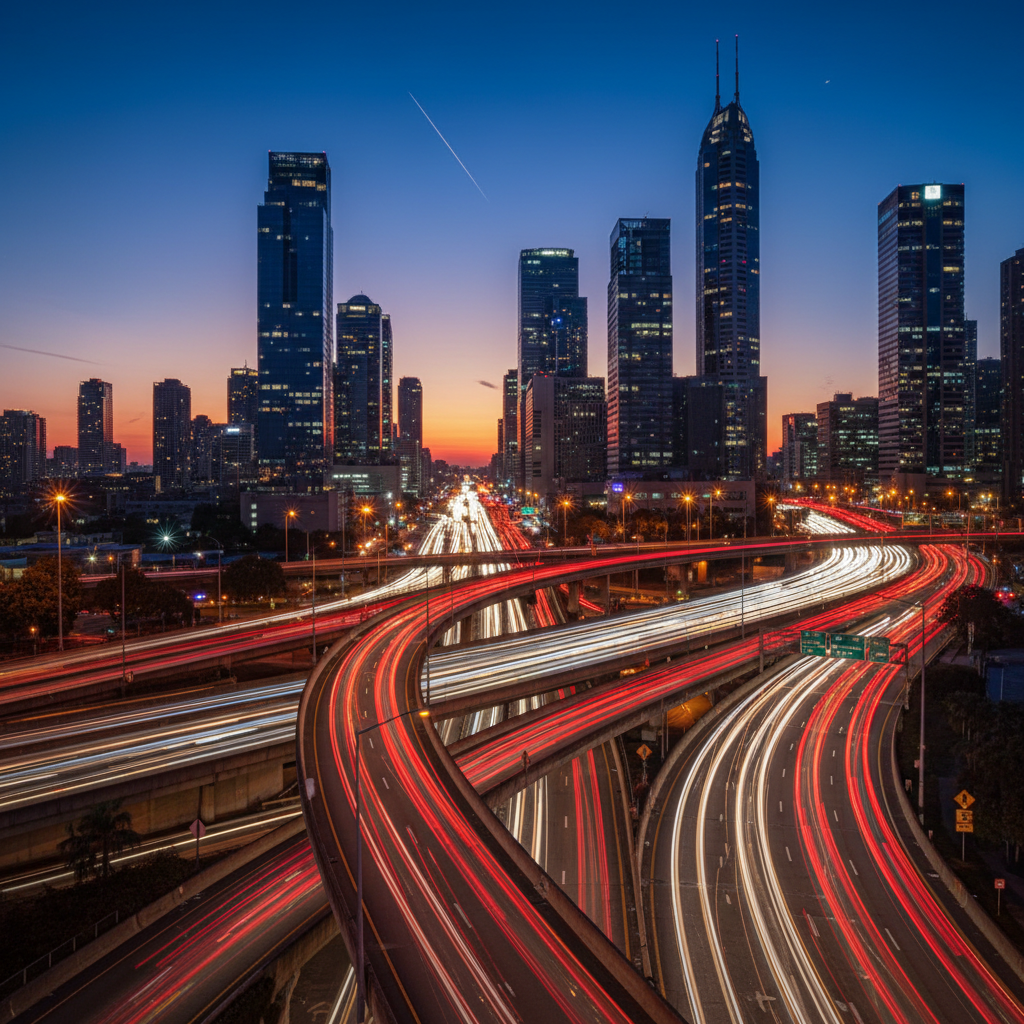

AI for Urban Mobility: Machine Learning Thesis Defense
Explore a thesis on optimizing urban traffic signals using Deep Q-Network (DQN) reinforcement learning to reduce commuter delays and CO2 emissions.
Optimizing Urban Mobility: A Machine Learning Approach
Thesis Defense | Dept. of Civil Engineering
Candidate: James A. Thorne
December 29, 2025
Problem Statement
Current static traffic signal systems operate on pre-timed cycles that fail to adapt to real-time fluctuations. This inefficiency leads to a 32% increase in average commuter delays and contributes significantly to excess carbon emissions in metropolitan areas. The lack of responsive infrastructure creates a bottleneck in smart city evolution.
Research Objectives
Develop a Deep Q-Network (DQN) reinforcement learning model tailored for multi-intersection signal control.
Quantify the reduction in average intersection waiting times compared to standard fixed-time controllers.
Evaluate the computational feasibility of deploying the algorithm on edge computing devices.
Literature Review Highlights
<b>Smith et al. (2019):</b> Established limitations of SCATS systems in high-density unpredictable traffic scenarios.
<b>Chen & Wu (2021):</b> Proposed MARL (Multi-Agent Reinforcement Learning) but faced issues with convergence speed.
<b>Research Gap:</b> Lack of integration between synthetic simulation training and real-world noisy sensor data capabilities.
Methodology
The study utilizes the SUMO (Simulation of Urban MObility) platform. A 4x4 grid network was constructed to simulate rush hour patterns. The agent uses a reward function penalized by cumulative vehicle halt-time and queue length. Training occurred over 1,500 simulation episodes.
Simulated Efficiency Results
Comparison of Average Waiting Time per Vehicle across three scenarios: Static Timing, Actuated (Sensor), and the Proposed AI Model. The AI Model reduced wait times by nearly 45% compared to static systems.
Throughput vs. Density
As vehicle density increases (Vehicles per Lane per Hour), the throughput of the proposed model remains more stable than the baseline. While the Baseline collapses at high congestion, the AI maintains flow.
Discussion of Findings
<b>Adaptive Capability:</b> The model successfully identified 'phantom jams' and adjusted upstream signal timing to dissipate them.
<b>Throughput Metrics:</b> Sustained throughput at high density signifies a 20% improvement in network capacity utilization.
<b>Environmental Impact:</b> Extrapolated data suggests a potential 12% reduction in idling-related CO2 emissions.
Limitations
The simulation assumes ideal sensor accuracy (100% detection rate), which differs from real-world inductive loops. Furthermore, pedestrian jaywalking behaviors and emergency vehicle priority overrides were not fully integrated into the reward function.
Future Work & Recommendations
Incorporate V2I (Vehicle-to-Infrastructure) communication data streams to improve predictive accuracy.
Field testing in a controlled closed-campus environment to validate hardware durability and latency.
Expand the reward function to include pedestrian safety metrics and multi-modal transit prioritization.
A smart city is not defined by how much data it collects, but by how intelligently it acts upon it.
Closing Remark
Thank You
Questions & Answers
- thesis-defense
- machine-learning
- smart-city
- traffic-management
- reinforcement-learning
- urban-mobility
- ai