


Mechanistic Conformational Profiles in Enzyme Evolution
Learn about the parallel evolutionary trajectories of Homo sapiens kynureninase and differences between specialist and generalist enzymes.
Mechanistic Conformational Profiles in Enzyme Evolution
Emerging parallel trajectories of substrate selectivity in Homo sapiens kynureninase
The Evolutionary Puzzle
Laboratory evolution studies demonstrate that parallel evolutionary trajectories can yield genetically distinct enzymes with high activity towards non-preferred substrates. A critical question remains: Do these distinct enzymes share convergent conformational dynamics and mechanistic features, or do they achieve similar results through fundamentally different molecular means?
Model System: HsKYNase
Homo sapiens kynureninase (HsKYNase) is a pyridoxal-5'-phosphate dependent enzyme vital for tryptophan metabolism and cancer immunotherapy. It catalyzes the hydrolysis of L-Kynurenine (KYN) or 3-hydroxykynurenine (OH-KYN). Understanding its evolution helps design better therapeutic enzymes.
Two Divergent Trajectories
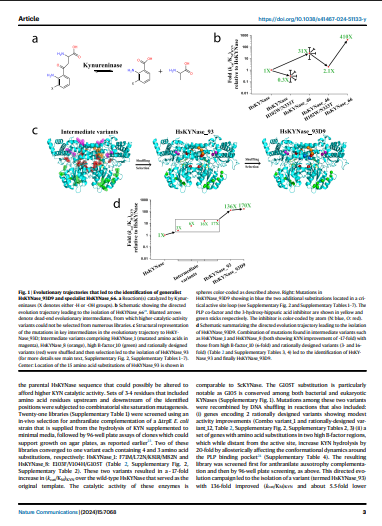
The 'Specialist' (HsKYNase_66): Evolved to have a 410-fold increase in activity for kynurenine (KYN), becoming highly selective.
The 'Generalist' (HsKYNase_93D9): Evolved comparable KYN activity but retains the ability to accept OH-KYN.
Investigation: Using pre-steady-state kinetics and HDX-MS to map the mechanistic differences between these two outcomes.
Trajectory of the Specialist (HsKYNase_66)
This evolutionary path involved a specific set of mutations leading to a massive 410-fold increase in catalytic efficiency for KYN. Note the dramatic jump in the final selection step.
Structural Evolution
Through shuffling and selection, intermediate variants (like HsKYNase_93) paved the way for the emergence of the generalist 93D9. The mutations are distributed throughout the structure, often distal to the active site, affecting global conformational dynamics.
Trajectory of the Generalist (HsKYNase_93D9)
The generalist pathway shows a steady accumulation of activity improvements. Unlike the specialist, this variant achieves high KYN activity (~170x fold) while maintaining its ability to process the original substrate.
HDX-MS shows that the conformational dynamics of the two enzymes are markedly different and distinct from ortholog prokaryotic enzymes.
Nature Communications, 2024
Mechanistic Divergence
A key finding is the difference in rate-determining steps. The specialist (HsKYNase_66) evolution was accompanied by a change in the rate-determining step of the reaction. In contrast, the generalist (HsKYNase_93D9) retained the same catalytic mechanism as the parental enzyme, despite its enhanced activity.
Conclusions & Implications
Parallel evolutionary trajectories can produce solution sets that are genetically and mechanistically distinct.
Active site potentiating mutations (e.g., H102W-N333T) are crucial for optimizing the chemical step in specialists.
Generalists can evolve high activity without sacrificing original function or altering the fundamental rate-limiting kinetic step.
- enzyme-evolution
- biochemistry
- kynureninase
- structural-biology
- biotechnology
- cancer-immunotherapy
- hdx-ms