











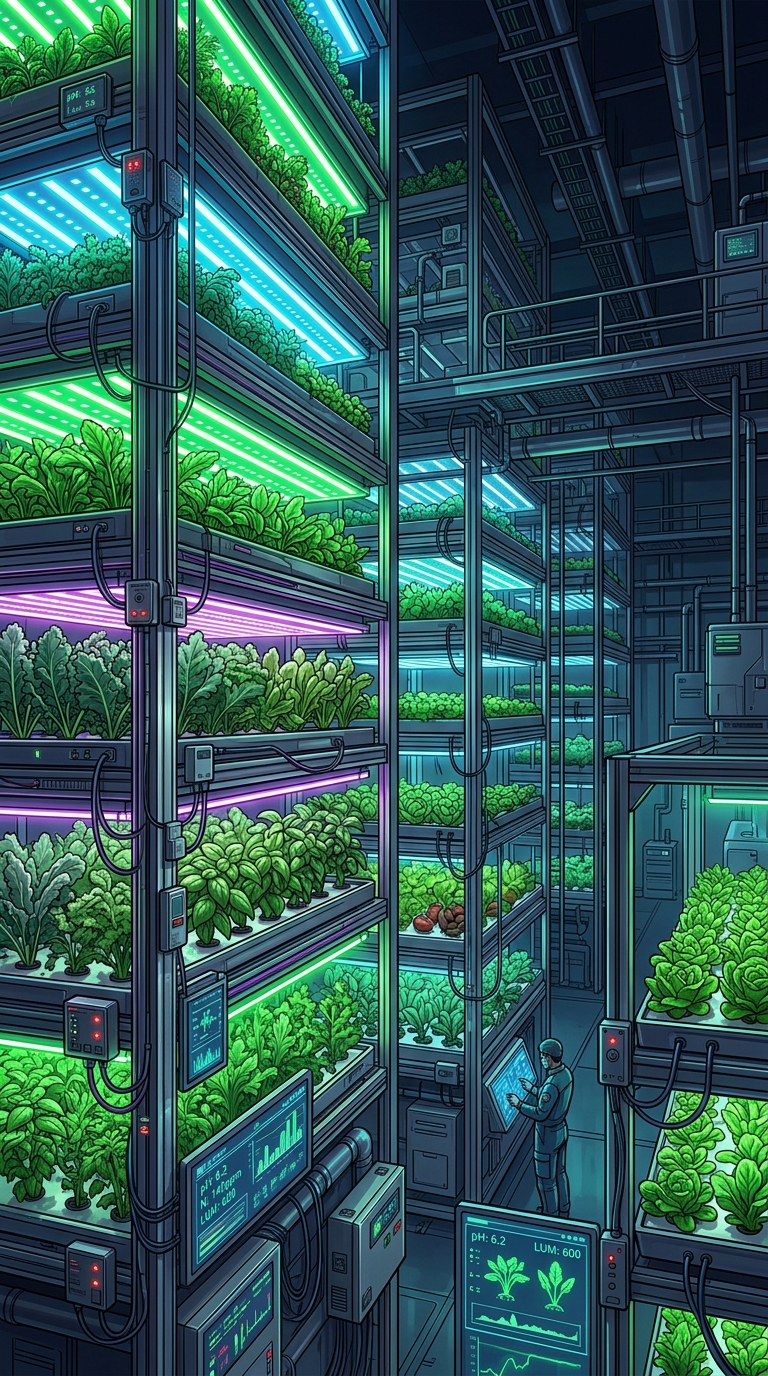




The Future of Vertical Farming: 2026 Industry Overview
Explore the growth of vertical farming, including market trends, core technologies like hydroponics, and key industry leaders like AeroFarms and Plenty.
THE FUTURE OF AGRICULTURE
Vertical Farming
Growing Up: How Vertical Farms Are Reimagining Food Production
2026 Industry Overview
Introduction
What Is Vertical Farming?
Vertical farming is the practice of growing crops in stacked layers inside controlled indoor environments. Instead of spreading out across land, crops grow upward — using technology, artificial lighting, and soilless cultivation methods to produce food efficiently in urban spaces.
Hydroponics
Growing in nutrient-rich water
Aeroponics
Misting roots with nutrients
Aquaponics
Fish and plants in symbiosis
MARKET SIZE & GROWTH
The Global Market Opportunity
$8.5B
Global market size in 2025
$124B
Projected by 2035
27.3% CAGR
Projected annual growth rate
41.4%
North America market share
Asia-Pacific
Fastest growing region
ADVANTAGES
Key Benefits of Vertical Farming
90% Less Water
Uses up to 95% less water than traditional farming methods.
Pesticide-Free
Controlled environments eliminate the need for chemical pesticides and herbicides.
Year-Round Harvest
Crops grow 365 days a year, completely independent of seasons or weather patterns.
Urban-Ready
Easily installed in warehouses, shipping containers, or directly inside city buildings.
Reduced Food Miles
Fresh food is grown close to consumers, drastically cutting transport emissions.
Higher Yields
Produces up to 100x more fresh produce per square foot than traditional farming.
INNOVATION
Core Technologies
LED Grow Lights
Spectrum-tuned lighting that replaces sunlight, reducing energy by 40%
IoT Sensors
Real-time monitoring of temperature, humidity, CO₂, and nutrient levels
AI & Automation
Machine learning optimizes growing conditions and robotic harvesting
Hydroponics Systems
Soilless growing delivering water and nutrients directly to roots
COMPARISON
Vertical vs. Traditional Farming
Traditional Farming
Vertical Farming
🌍 Land Use:
Requires vast land areas (millions of acres globally)
🏢 Land Use:
Minimal — stacks vertically in small footprint
💧 Water Usage:
High — 70% of global freshwater consumption
💧 Water Usage:
90–95% less water needed
🌦️ Weather Dependent:
Yes — vulnerable to droughts, floods, frost
☁️ Weather Dependent:
No — fully climate-controlled
🚛 Transport:
Long supply chains, days from farm to shelf
🏙️ Transport:
Located in cities, hours from farm to table
🐛 Pesticides:
Required to manage pests and disease
🌿 Pesticides:
None needed in controlled environments
📆 Seasons:
Limited to growing seasons
📅 Seasons:
Year-round, 365 days
INDUSTRY LEADERS
Global Leaders & Case Studies
AeroFarms
🇺🇸
World's largest indoor vertical farm. Produces 2 million lbs of greens per year in a converted steel mill in Newark, NJ.
2M lbs/year
Annual Production
Bowery Farming
🇺🇸
Uses 100x less land than traditional agriculture. Supplies major US grocery chains with locally-grown greens.
95% Less Water
Resource Efficiency
Plenty
🇺🇸 🇯🇵
Backed by SoftBank and Walmart. Building a massive vertical farm in California to supply Walmart stores nationwide.
$400M Raised
Capital Secured
Infarm
🇩🇪
Operates distributed micro-farms inside supermarkets and warehouses across Europe, North America, and Asia.
1,400+ Stores
Retail Footprint
CHALLENGES
Challenges & Limitations
High Energy Costs
Artificial lighting and climate control consume significant electricity. Energy can account for 25–30% of operating costs.
High Capital Investment
Building a vertical farm requires $10M–$100M+ in upfront infrastructure and equipment costs.
Limited Crop Variety
Currently most viable for leafy greens, herbs, and microgreens. Staples like wheat and corn are not yet economical.
Skilled Labor
Requires specialized expertise in agronomy, engineering, and data science — not traditional farming skills.
Despite these challenges, innovation continues to drive down costs — LED efficiency has improved 40% over the past decade.
FUTURE OUTLOOK
The Road Ahead
Vertical farming is poised to become a cornerstone of sustainable food systems by 2035
2026
AI-Driven Farms
Fully autonomous farms managed by AI with zero human labor in growing operations
2028
Staple Crops
Breakthroughs in growing wheat, rice, and legumes at commercial scale indoors
2030
Energy Independence
Vertical farms powered 100% by renewable solar and wind energy
2035
$124B Market
Vertical farming becomes a mainstream global food industry worth over $124 billion
Vertical farming won't replace traditional agriculture — but it will play a vital role in feeding 10 billion people sustainably.
The Future is Growing Up
Vertical farming represents one of humanity's most promising solutions to food security, climate change, and sustainable urban living.
🌱 Sustainable
🏙️ Urban
🚀 Scalable
Thank You
Questions & Discussion
- vertical-farming
- agtech
- hydroponics
- sustainable-agriculture
- food-security
- indoor-farming
- smart-farming