
Discrete Mathematics in AI: Function Impact & Mapping
Explore how one-one, onto, and bijective functions control AI decisions, identity preservation, and data compression in machine learning models.
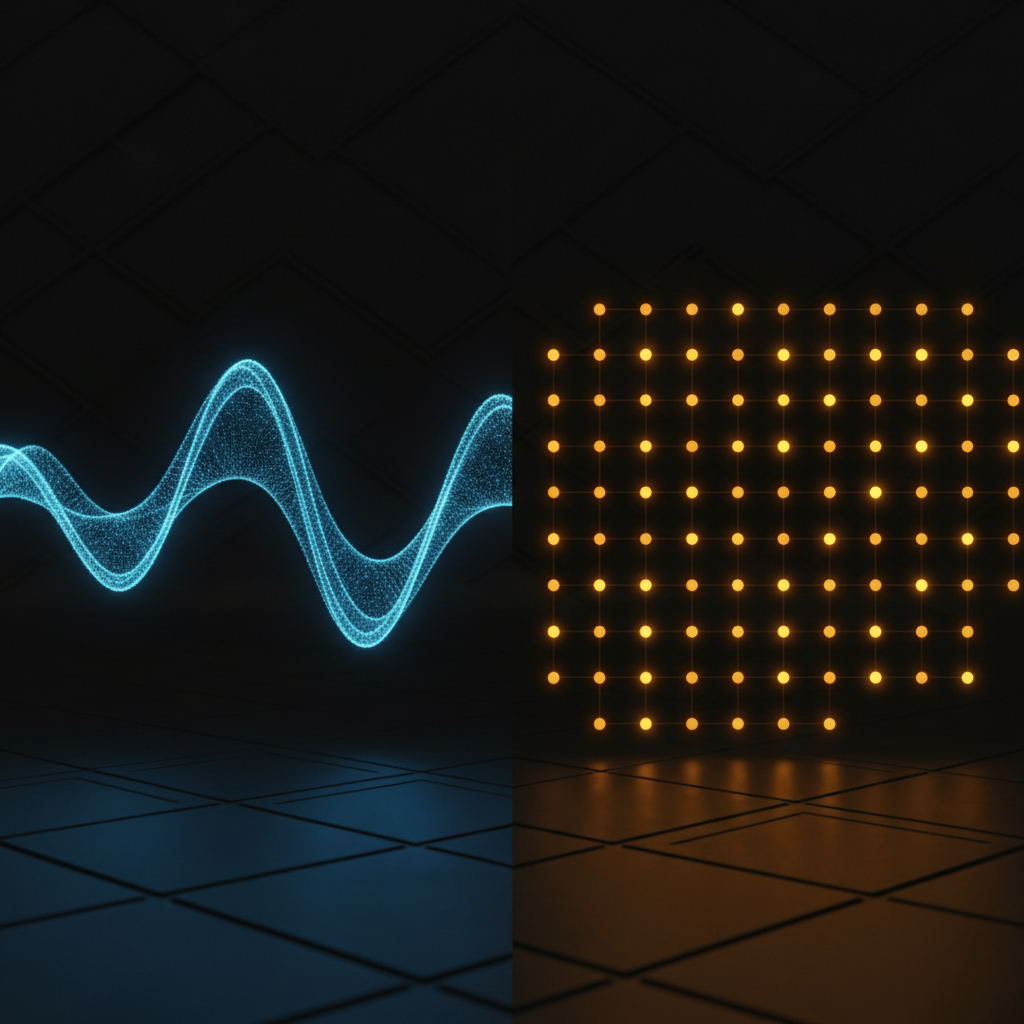
Calculus vs. Discrete Math in AI
Graphical & Conceptual Understanding of One-One, Onto & Bijective Functions
Why Discrete Math Controls AI
Most assume AI is purely calculus and gradients. Wrong. AI decisions—labels, IDs, tokens, and classes—are discrete sets. Every AI classifier operates as a discrete function: f: A → B, where A and B are finite sets.
The Discrete View of Mapping
Graphically, the X-axis represents the Input Set (A) and the Y-axis represents the Output Set (B). The lines connecting them are the mapping rules. Discrete math determines if these connections are safe.
1. One-One (Injective): Identity Preservation
Definition: Each input maps to a unique output. No two elements share the same image.
Graph Rule: Each dot on the Y-axis accepts at most one arrow.
Fact: Injective functions preserve information. Non-injective functions destroy it forever.
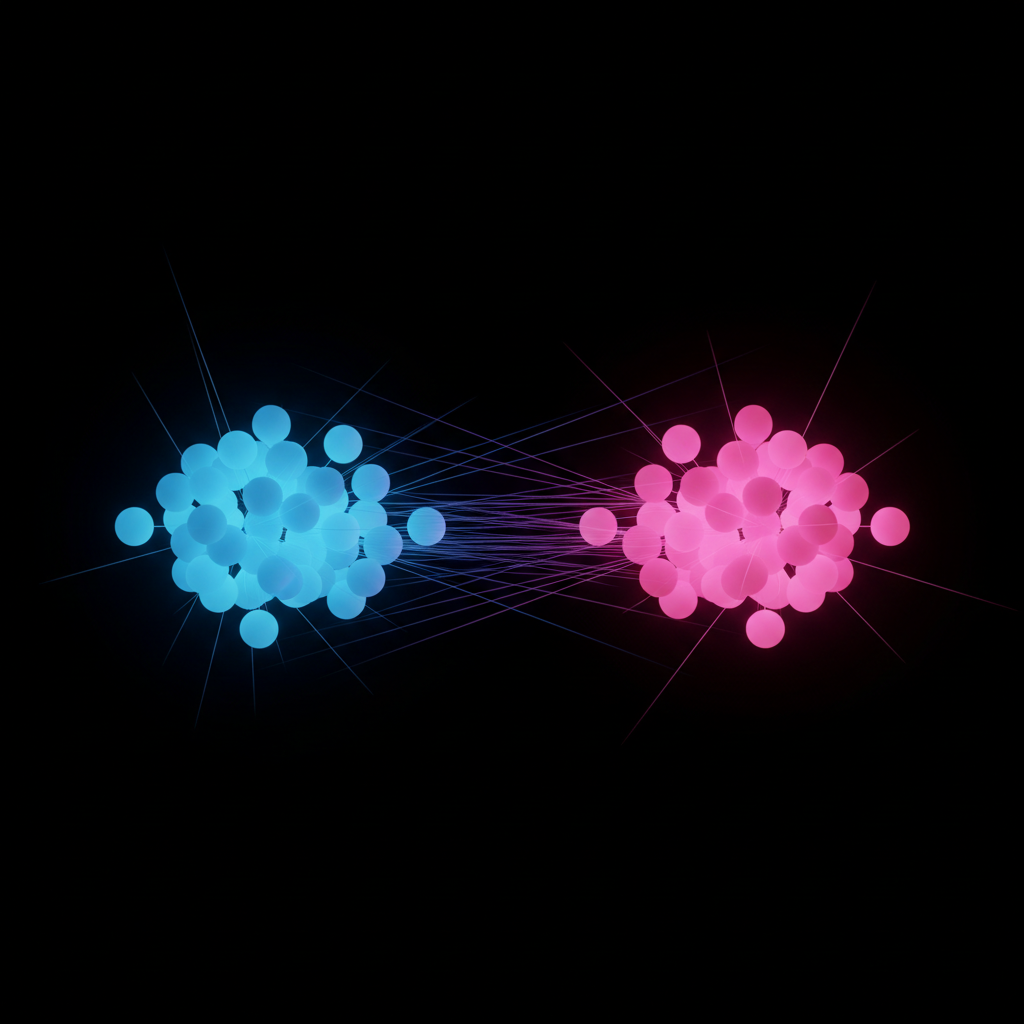
Injective Failure: Face Recognition
When Face1 and Face2 map to the same ID, a 'Discrete Collision' occurs. Identity is permanently lost. This explains false arrests and biometric failures. It is not just a bug; it is a mathematical violation of injectivity.
2. Onto (Surjective): Coverage of Reality
Definition: Every element in the output set (B) has at least one source. No output is left 'unused'.
Graph Rule: Every dot in the output set must have an incoming arrow. No dry spots.
Critical: If an output exists but is never used, the AI is effectively 'blind' to that possibility.
Surjective Failure: The Forgotten Disease
Consider a medical AI where the output set includes 'Rare Disease B'. If the model never outputs this label (probability 0), it violates surjectivity. The disease becomes mathematically impossible to diagnose, leading to critical real-world blindness.
3. Bijective: The Perfect Discrete Pairing
A function is bijective if it is BOTH one-one and onto. Every input corresponds to exactly one output. |A| = |B| (Cardinality must match). Bijective functions are the only ones that are reversible (like encryption).
Most AI models are NOT bijective. They compress data and drop information to optimize speed. This is why you get blur, noise, and hallucination.
The Autoencoder Problem
Discrete Comparison Matrix
ONE-ONE: No Collisions. Unused outputs allowed. Reversible? NO.
ONTO: Collisions allowed. No unused outputs. Reversible? NO.
BIJECTIVE: No Collisions. No unused outputs. Reversible? YES.
Use Cases: IDs (One-One) vs Classifiers (Onto) vs Encryption (Bijective).
Discrete mathematics decides what AI is allowed to see, what it is allowed to ignore, and what it is allowed to forget.
"If your function collides, AI confuses. If it skips outputs, AI ignores. If it can’t reverse, AI can’t be trusted."
- discrete-mathematics
- ai-logic
- machine-learning
- function-theory
- data-science
- biometrics
- mathematics