
Made byBobr AI

Molecular Dynamics of the Silica-Water Interface

Explore ab initio MD simulations of the silica-water interface. Learn about Density Functional Theory (DFT), atom density profiles, and H-bond analysis.

#molecular-dynamics#silica-water-interface#computational-chemistry#dft#ab-initio-md#surface-science#nanotechnology
Watch
Pitch

The Silica-Water Interface

from the Analysis of Molecular Dynamic Simulations

Sheikha Faisal Lardhi
Master of Science Thesis
King Abdullah University of Science and Technology (KAUST)
Thuwal, Kingdom of Saudi Arabia · May 2013
Made byBobr AI

Research Overview & Objectives

Core Question:

How does liquid water interact with a silica surface at the molecular level?

1.

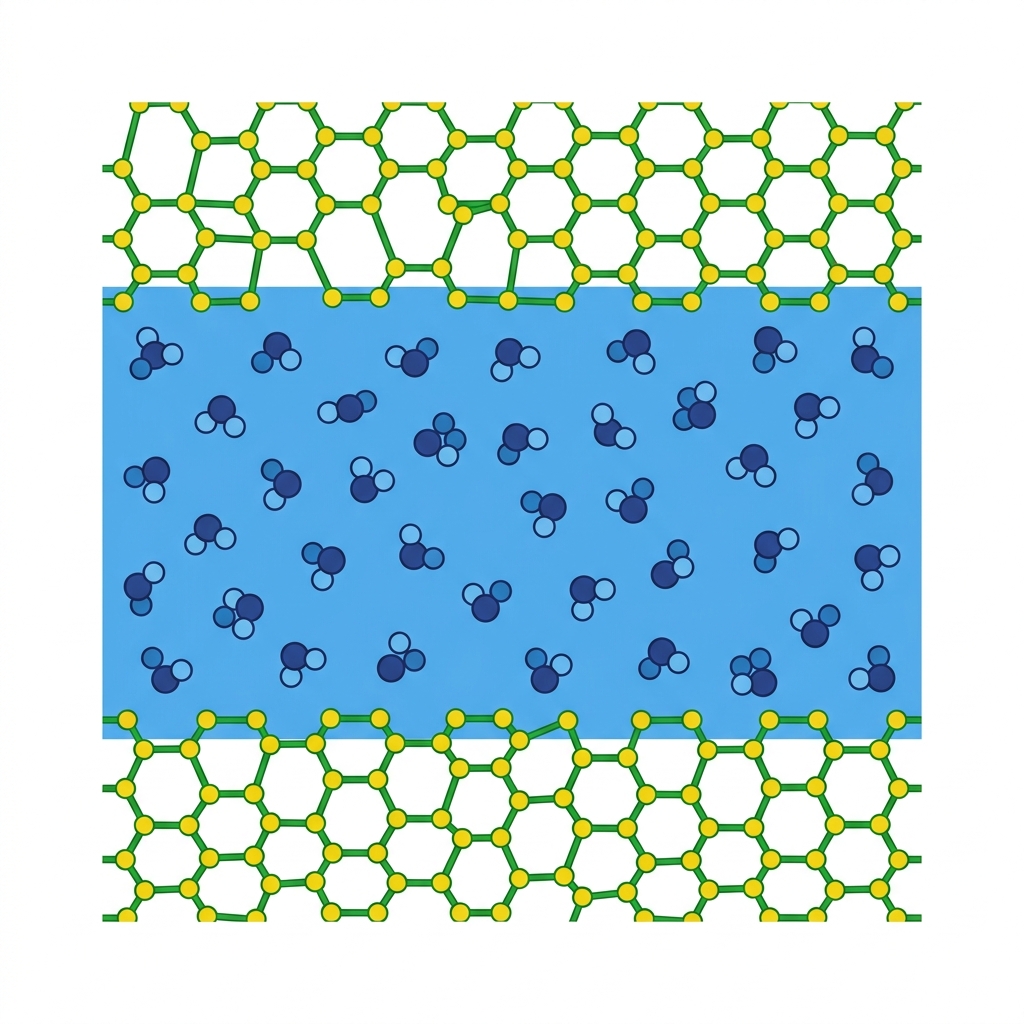
Investigate the silica-water interface microscopically using ab initio MD simulations

2.

Calculate atomic density profiles of water layers near the β-cristobalite surface

3.

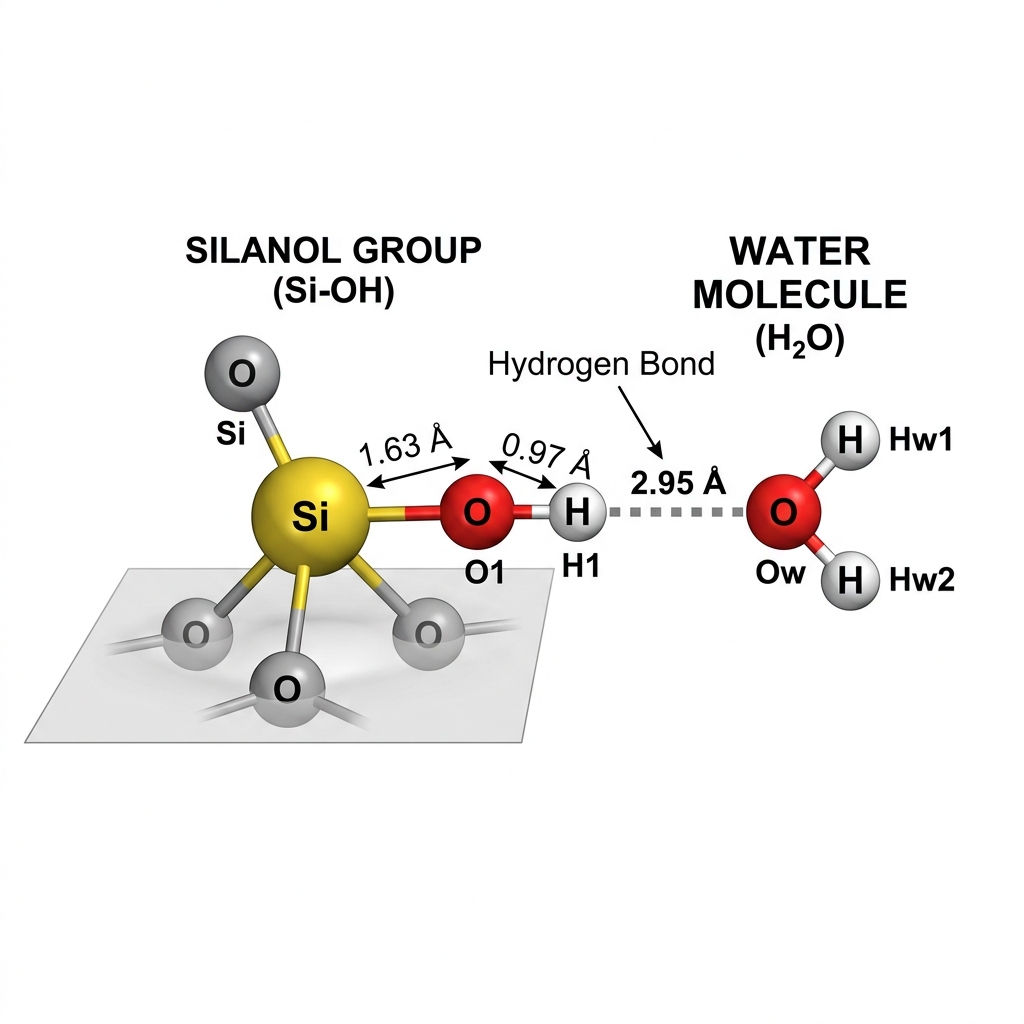
Analyze radial distribution functions (RDF) of hydrogen bonds at surface silanols

β-cristobalite SiO₂ surface
Liquid water layer
β-cristobalite SiO₂ surface
H-bond interactions ↙
H-bond interactions ↖

System: bulk liquid water confined between two β-cristobalite silica surfaces · CP2K ab initio MD · 25 picoseconds

Sheikha Faisal Lardhi · KAUST 2013 2
Made byBobr AI

Molecular Dynamics: Principles & Applications

What is MD?

Initial Positions & Velocities
Calculate Forces (Newton's Laws)
Integrate Equations of Motion
New Positions & Trajectory
First applied by Alder & Wainwright, 1950s

MD Applications

MD
Structural Biology
(protein folding)
Materials
Science
(thin films, nanotech)
Surface
Chemistry
(silica-water)
Chemical
Reactivity
(bond breaking)
Biophysics
(NMR refinement)
Example: 1 million atom simulation of Satellite Tobacco Mosaic Virus (STMV), 2006 — 50 ns using NAMD
Computational Chemistry Group
3
Made byBobr AI

The Silica-Water Interface: Background & Importance

Why Silica?

  • Most abundant solid oxide on Earth
  • Key role in catalysis & nanotechnology
  • Present in semiconductors and medical sensors
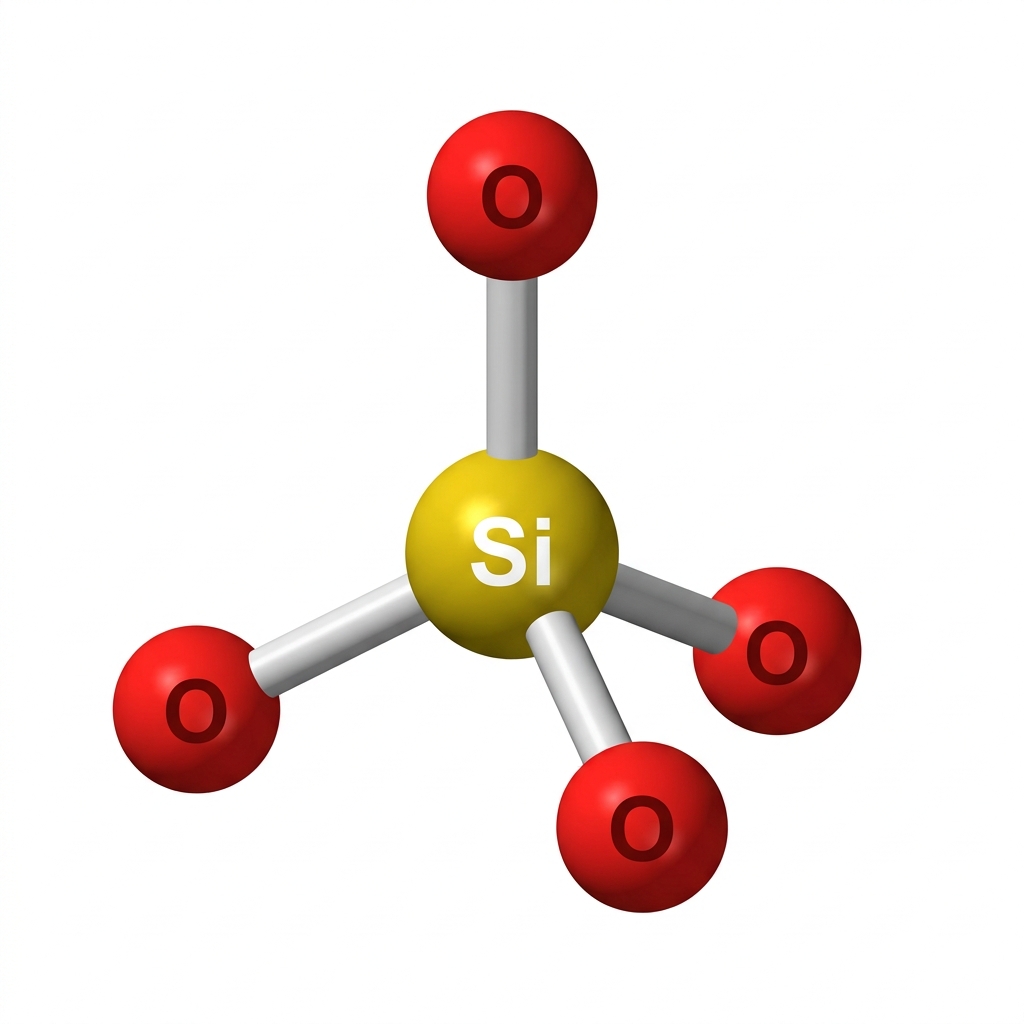
  • β-cristobalite polymorph used in this study
β-cristobalite: Si-O distance = 0.151 nm,
Si-O-Si angle = 151°

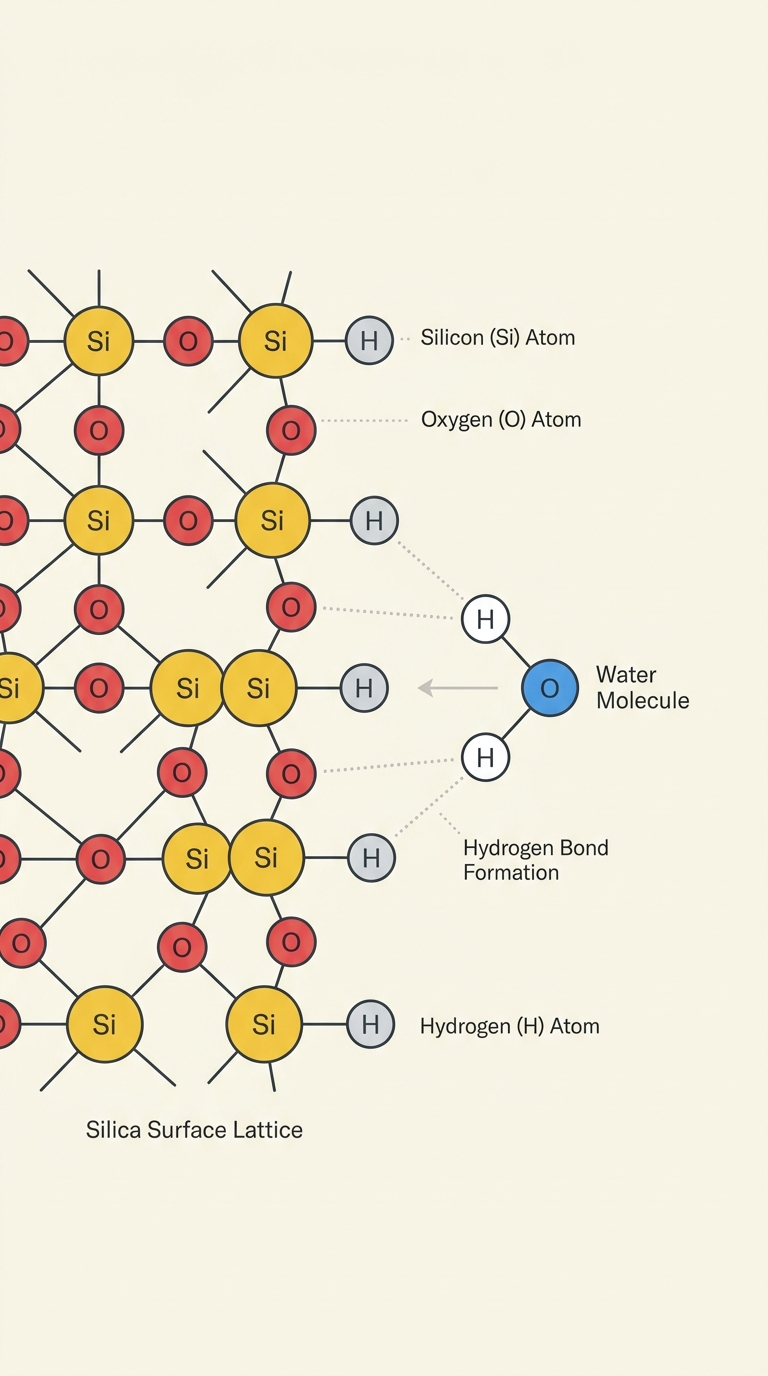
Surface Functional Groups

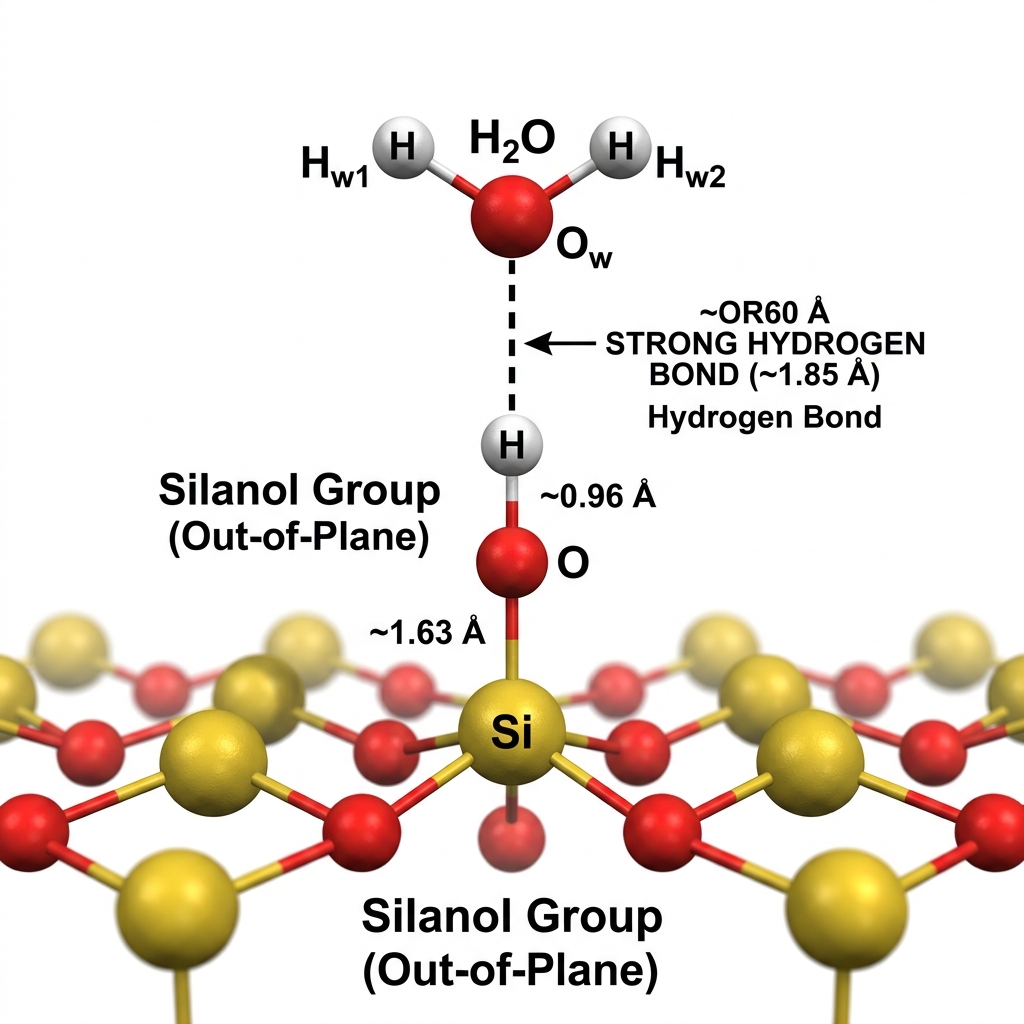
Out-of-plane silanol
Strong H-bond
(ice-like)
In-plane silanol
Weak H-bond
(liquid-like)

Industrial Impact

Semiconductors $226B global market
(2009)
Medical Devices $33B US market
(2009)
Anti-corrosion $10.7B+ US market
(2005)
Background & Importance
Slide 4
Made byBobr AI

Theoretical Framework: DFT & Electronic Structure

From QM to DFT

Schrödinger Equation: Hψ = Eψ
describes full quantum state of the system
Born-Oppenheimer Approximation
nuclei fixed; electrons move in nuclear field (mass ratio electron:proton = 1:1836)
Density Functional Theory (DFT)
energy expressed as a functional of electron density ρ(r), not wavefunctions
HK Theorem 1
Vext uniquely defined by ρ(r)
HK Theorem 2
Variational principle — approximate ρ always gives E ≥ E0

Exchange-Correlation Functionals

Functional
Type
Used For
PBE
GGA
This study (fast, robust)
BLYP
GGA
Hydrogen bond analysis
B3LYP
Hybrid
Higher accuracy
This study uses:
PBE functional
+ DZVP-GTH-BLYP basis set + GTH pseudo-potentials
Theoretical Framework
Slide 5
Made byBobr AI

Computational Methodology: CP2K & Quickstep

CP2K Program
(Fortran 95, GPL, 900,000+ lines)
Quickstep DFT Module
GPW Approach
Gaussian + Plane Waves
MD Trajectory Generation
Run on 64 cores · CRESCO supercomputer
Intel Xeon 5160 @ 3.00 GHz · 10 Teraflops

Basis Sets

  • STOs — accurate but computationally expensive
  • GTOs — linear combination of Gaussian primitives
  • DZVP: Double-Zeta Valence Polarization
  • Split-valence sets balance accuracy vs. cost

Pseudo Potentials (GTH)

  • Replace inner-shell electrons with analytical functions
  • Reduces computational cost significantly
  • Includes relativistic effects
  • Essential for transition metals & large systems
Ab initio MD cost: O(Ne3)
~100x more expensive than classical MD per water molecule
Computational Chemistry Architecture
SLIDE 6
Made byBobr AI

Model Construction & Simulation Setup

Structure A — Sparse Water

  • 96 atoms total | 10 SiO₂ units (5 layers) | 18 H₂O molecules
  • Box: a=b=7.34Å, c=20.0Å
  • Min O-Si distance: 4.0 Å
SiO₂ LATTICE SiO₂ LATTICE

Structure B — Dense Water

  • 117 atoms total | 10 SiO₂ units (5 layers) | 25 H₂O molecules
  • Same box dimensions
  • Min O-Si distance: 3.5 Å
SiO₂ LATTICE SiO₂ LATTICE
1
Geometry Optimization
BFGS, 2000 iterations, 24 cores, ~1 hour
2
Equilibration
NVT ensemble, 300K, 5×5ps = 25ps total, 0.5 fs timestep
3
Trajectory Analysis
Density profile + RDF
Periodic Boundary Conditions (PBC) applied — simulates infinite bulk system
The Silica-Water Interface
7
Made byBobr AI

Results: Atom Density Profiles

Water Layering Near Silica Surface

Structure A Oxygen (Ow) Hydrogen (Hw) 2 5 7 10 20 Sparse water — small surface peak — main density in center Structure B 2 5 7 10 20 Strong surface adsorption — symmetric peaks — similar heights Distance from silica surface (Å) Atom density
Key Findings
Water organizes in well-structured distinct layers
Structure A: water NOT strongly adsorbed at surface
Structure B: strong adsorption at 2Å — denser water fills silanol spaces
Both show symmetric distribution — confirmed equilibration
SILICA SLAB SILICA SLAB Distance between surfaces 1st adsorption layer (~2Å) Bulk-like water layers 1st adsorption layer (~2Å)
Slide 8
Made byBobr AI

Results: Radial Distribution Function (RDF) & H-Bonding

What does g(r) tell us?

g(r) measures probability of finding a water atom at distance r from a silanol atom, relative to homogeneous density.
g(0) = 0  (no overlap) g(∞) = 1  (no correlation)
HSi···Ow Blue Line
Out-of-plane silanol H donating to water O — STRONG short H-bond
OSi···Hw Red Line
In-plane silanol O accepting from water H — WEAK H-bond
  • First peak at 1.5–2.0 Å: strong/short H-bond → out-of-plane silanol
  • First peak at ~1.7 Å (black line): in-plane O···H bond
  • Second broad peak at ~3.5 Å: second water shell
  • Structures A & B show similar RDF profiles — water density has limited impact on H-bond structure
Homogeneous density reference 2nd coordination shell 0 1 2 3 4 5 6 r (Å) 0 1 2 3 g(r) HSi···Ow OSi···Hw
Slide 9
Made byBobr AI

Summary & Future Directions

Summary of Findings

Simulation Protocol ✓
Built & optimized two silica-water structures (A: sparse, B: dense) using CP2K ab initio MD at 300K for 25 ps
Density Profiles ✓
Water forms well-structured layers; Structure B shows stronger surface adsorption at ~2Å with molecules intercalating silanol groups
RDF Analysis ✓
Strong H-bond network confirmed; peaks at 1.5–2.0Å for out-of-plane silanols; water density does not dramatically alter H-bond structure

Future Directions

Other SiO₂ polymorphs: α-quartz, α-cristobalite
Gold nanoparticle–water interfaces
Graphene–water interfaces
Metal oxides for photocatalytic water splitting
Supervised by Prof. Luigi Cavallo · Committee: Prof. David Keyes & Prof. Mikhail Moshkov · KAUST CEMSE & KCC · 2013
Thank You
Slide 10
Made byBobr AI
Bobr AI

DESIGNER-MADE
PRESENTATION,
GENERATED FROM
YOUR PROMPT

Create your own professional slide deck with real images, data charts, and unique design in under a minute.

Generate For Free

Molecular Dynamics of the Silica-Water Interface

Explore ab initio MD simulations of the silica-water interface. Learn about Density Functional Theory (DFT), atom density profiles, and H-bond analysis.

The Silica-Water Interface

from the Analysis of Molecular Dynamic Simulations

Sheikha Faisal Lardhi

Master of Science Thesis

King Abdullah University of Science and Technology (KAUST)

Thuwal, Kingdom of Saudi Arabia · May 2013

Research Overview & Objectives

Core Question:

How does liquid water interact with a silica surface at the molecular level?

Investigate the silica-water interface microscopically using ab initio MD simulations

Calculate atomic density profiles of water layers near the β-cristobalite surface

Analyze radial distribution functions (RDF) of hydrogen bonds at surface silanols

System: bulk liquid water confined between two β-cristobalite silica surfaces · CP2K ab initio MD · 25 picoseconds

Sheikha Faisal Lardhi · KAUST 2013

2

Molecular Dynamics: Principles & Applications

Computational Chemistry Group

3

First applied by Alder & Wainwright, 1950s

1 million atom simulation of Satellite Tobacco Mosaic Virus (STMV), 2006 — 50 ns using NAMD

Initial Positions & Velocities

Calculate Forces (Newton's Laws)

Integrate Equations of Motion

New Positions & Trajectory

Structural Biology

(protein folding)

(thin films, nanotech)

(silica-water)

(bond breaking)

Biophysics

(NMR refinement)

The Silica-Water Interface: Background & Importance

Theoretical Framework: DFT & Electronic Structure

From QM to DFT

Schrödinger Equation: Hψ = Eψ

describes full quantum state of the system

Born-Oppenheimer Approximation

nuclei fixed; electrons move in nuclear field (mass ratio electron:proton = 1:1836)

Density Functional Theory (DFT)

energy expressed as a functional of electron density ρ(r), not wavefunctions

HK Theorem 1

V<sub>ext</sub> uniquely defined by ρ(r)

HK Theorem 2

Variational principle — approximate ρ always gives E ≥ E<sub>0</sub>

Exchange-Correlation Functionals

Functional

Type

Used For

PBE

GGA

This study (fast, robust)

BLYP

GGA

Hydrogen bond analysis

B3LYP

Hybrid

Higher accuracy

This study uses:

PBE functional

+ DZVP-GTH-BLYP basis set + GTH pseudo-potentials

Slide 5

Computational Methodology: CP2K & Quickstep

CP2K Program

(Fortran 95, GPL, 900,000+ lines)

Quickstep DFT Module

GPW Approach

Gaussian + Plane Waves

MD Trajectory Generation

Run on 64 cores

CRESCO supercomputer

Intel Xeon 5160 @ 3.00 GHz

10 Teraflops

Basis Sets

STOs — accurate but computationally expensive

GTOs — linear combination of Gaussian primitives

DZVP: Double-Zeta Valence Polarization

Split-valence sets balance accuracy vs. cost

Pseudo Potentials (GTH)

Replace inner-shell electrons with analytical functions

Reduces computational cost significantly

Includes relativistic effects

Essential for transition metals & large systems

Ab initio MD cost:

~100x more expensive than classical MD per water molecule

SLIDE 6

Model Construction & Simulation Setup

Structure A — Sparse Water

96 atoms total | 10 SiO₂ units (5 layers) | 18 H₂O molecules

Box: a=b=7.34Å, c=20.0Å

Min O-Si distance: 4.0 Å

Structure B — Dense Water

117 atoms total | 10 SiO₂ units (5 layers) | 25 H₂O molecules

Same box dimensions

Min O-Si distance: 3.5 Å

Geometry Optimization

BFGS, 2000 iterations, 24 cores, ~1 hour

Equilibration

NVT ensemble, 300K, 5×5ps = 25ps total, 0.5 fs timestep

Trajectory Analysis

Density profile + RDF

Periodic Boundary Conditions (PBC) applied — simulates infinite bulk system

7

Results: Atom Density Profiles

Water Layering Near Silica Surface

Water organizes in well-structured distinct layers

Structure A:

water NOT strongly adsorbed at surface

Structure B:

strong adsorption at 2Å — denser water fills silanol spaces

Both show symmetric distribution — confirmed equilibration

Slide 8

Results: Radial Distribution Function (RDF) & H-Bonding

What does g(r) tell us?

Slide 9

Summary & Future Directions

Summary of Findings

Simulation Protocol ✓

Built & optimized two silica-water structures (A: sparse, B: dense) using CP2K ab initio MD at 300K for 25 ps

Density Profiles ✓

Water forms well-structured layers; Structure B shows stronger surface adsorption at ~2Å with molecules intercalating silanol groups

RDF Analysis ✓

Strong H-bond network confirmed; peaks at 1.5–2.0Å for out-of-plane silanols; water density does not dramatically alter H-bond structure

Future Directions

Other SiO₂ polymorphs: α-quartz, α-cristobalite

Gold nanoparticle–water interfaces

Graphene–water interfaces

Metal oxides for photocatalytic water splitting

Supervised by Prof. Luigi Cavallo · Committee: Prof. David Keyes & Prof. Mikhail Moshkov · KAUST CEMSE & KCC · 2013

Thank You

Slide 10