








Made byBobr AI

AI and Machine Learning in Modern Plant Breeding

Explore how AI and ML are transforming agriculture through genomic selection, yield prediction, and climate-smart breeding strategies to ensure food security.

#artificial-intelligence#machine-learning#plant-breeding#genomics#agtech#precision-agriculture#crop-improvement#data-science
Watch
Pitch
MSc Seminar Presentation

Artificial Intelligence and Machine Learning
in Modern Plant Breeding

[Your Name]
MSc Genetics & Plant Breeding
[Institution Name]
March 2026
Made byBobr AI
Section 1: Foundation

Introduction

Global Challenges

Food security threatened by growing population (10 billion by 2050), climate change, and shrinking arable land

Need for Speed

Conventional breeding takes 10–15 years per variety; urgent need for faster, smarter crop improvement

Limitations of Conventional Breeding

Low throughput, labor-intensive, dependent on breeder expertise, limited predictive ability

"We need to produce 70% more food by 2050 with fewer resources"
Made byBobr AI
Section 1: Foundation

Evolution of Plant Breeding

Conventional Breeding

Pre-1900s–1960s

Selection, hybridization, phenotype-based

Molecular Breeding

1980s–2000s

Marker-assisted selection, QTL mapping

Genomic Breeding

2000s–2015

Whole-genome sequencing, SNP arrays, GWAS

Current Era

Digital/AI Breeding

2015–Present

Big data, ML models, predictive analytics

The shift from observing plants to predicting performance using data

Made byBobr AI
Section 1: Foundation

What is Artificial Intelligence (AI)?

AI is the simulation of human intelligence by computer systems — enabling machines to learn, reason, and make decisions.

ARTIFICIAL INTELLIGENCE MACHINE LEARNING DEEP LEARNING

Machine Learning (ML)

Systems that learn from data to improve performance without being explicitly programmed.

Deep Learning (DL)

Multi-layered neural networks that mimic the human brain for complex pattern recognition.

Natural Language Processing (NLP)

AI that understands and generates human language — used in literature mining, chatbots.

Made byBobr AI
SECTION 1: FOUNDATION

What is Machine Learning (ML)?

ML enables computers to learn patterns from data and make decisions — without being explicitly programmed for each scenario.

SUPERVISED LEARNING

Learns from labeled data (input → known output).

Examples
Yield prediction, disease classification

UNSUPERVISED LEARNING

Finds hidden patterns in unlabeled data.

Examples
Clustering genotypes, trait grouping

REINFORCEMENT LEARNING

Learns by trial and reward.

Examples
Autonomous planting robots, irrigation optimization
"Like a student (ML model) learning from past exam papers (data) to predict future exam answers (new decisions)"
Made byBobr AI
Section 1: Foundation

Why AI/ML in Plant Breeding?

Handles Big Data

Processes millions of SNPs, phenotypic records, and environmental data simultaneously

Improved Accuracy

ML models outperform traditional statistical methods in trait prediction

Speed

Reduces selection cycles from years to months

Cost Reduction

Fewer field trials needed through in silico prediction

Scalability

Works across environments, crops, and breeding programs

Predictive Power

Predicts performance before planting — saving resources

AI/ML bridges the gap between genomics and field performance

Made byBobr AI
Section 2: Data in Modern Breeding

Types of Data Used in Modern Breeding

GENOTYPIC DATA

Single Nucleotide Polymorphisms (SNPs), SSR markers, whole-genome sequences, haplotype maps.

Source: DNA sequencing platforms (Illumina, Oxford Nanopore)

PHENOTYPIC DATA

Yield, plant height, days to flowering, disease resistance, grain quality.

Source: Field trials, greenhouse experiments, sensor data
GENOTYPIC
DATA
PHENOTYPIC
DATA
ENV.
DATA
Multi-omics Integration

ENVIRONMENTAL DATA

Temperature, rainfall, soil pH, humidity, solar radiation.

Source: Weather stations, IoT sensors, remote sensing satellites
The real power of AI/ML lies in integrating all three data types
Made byBobr AI
Data Collection

High-Throughput
Phenotyping (HTP)

UAVs & Drones

Rapid aerial scanning of
entire crop fields.

RGB Imaging

High-resolution capture for
detailed canopy analysis.

Hyperspectral

Measuring diverse spectral
bands and crop health.

Ground Sensors

Real-time soil moisture and
micro-climate data.

"HTP generates terabytes of data —
only AI can make sense of it."

Made byBobr AI
Section 2

Big Data Challenges

1

VOLUME

Millions of SNP markers, thousands of field plots, petabytes of sensor imagery

2

VARIETY

Heterogeneous data types — genomic, phenotypic, environmental, image-based

3

VELOCITY

Real-time streaming from sensors, drones, satellite feeds

Data Integration: Combining data from different platforms, formats, and scales remains a key bottleneck

Solving these challenges requires AI-powered pipelines and cloud computing

Made byBobr AI
Section 3: ML Workflow

ML Workflow in Plant Breeding

1
DATA
COLLECTION
2
DATA
CLEANING
3
FEATURE
SELECTION
4
MODEL
SELECTION
5
MODEL
TRAINING
6
MODEL
VALIDATION
7
PREDICTION &
DECISION
Each step will be explored in detail in the following slides
Made byBobr AI
ML Workflow — Step 1 of 7

Step 1: Data Collection

Field Trials

  • Multi-Location Trials
  • Yield Records
  • Agromorphological Traits

Genomic Sequencing

  • Genotyping-by-Sequencing (GBS)
  • SNP Chips & Microarrays
  • Whole Genome Resequencing (WGRS)
GIGO Principle — Garbage In, Garbage Out
Made byBobr AI
ML Workflow — Step 2 of 7

Step 2: Data Cleaning & Preprocessing

1. Handling Missing Values

Imputation (mean/median/KNN), deletion of poor-quality markers, BEAGLE/IMPUTE2 for genomic imputation

2. Normalization & Scaling

Min-max normalization, Z-score standardization — ensures equal weight across traits

3. Outlier Detection

Identify and remove erroneous field data points using statistical methods (IQR, boxplots)

4. Data Encoding

Converting categorical traits (resistant/susceptible) to numerical form for ML algorithms

Data Transformation Process

Raw Noisy Data

ID YIELD RESIST
P01 45.2 High
P02 NaN Low
P03 999.0 N/A
P04 40.1 Susc.

Clean Structured Data

ID Y_SCALED RES_ENC
P01 0.85 1.0
P02 0.65 0.0
P03 0.50 0.5
P04 0.60 0.0

Clean data = better model performance.

Preprocessing can account for 60–70% of ML project time.

Made byBobr AI
ML Workflow — Step 3 of 7

Step 3: Feature Selection

Identifying the most informative variables (markers/traits) that contribute to the prediction outcome, while discarding noise.
In Plant Breeding: Selecting key SNP markers from thousands, choosing relevant environmental covariates.

FILTER METHODS

Statistical tests — correlation, chi-square, ANOVA. Fast but ignores model interaction.

WRAPPER METHODS

Recursive Feature Elimination (RFE) — tries subsets of features with the model.

EMBEDDED METHODS

LASSO, Ridge Regression, Random Forest importance scores — built into the model.

Feature selection reduces overfitting, speeds up training, and improves interpretability.
Made byBobr AI
ML Workflow — Step 4 of 7

Step 4: Model Selection

No single model fits all problems — model choice depends on data type and objective

REGRESSION MODELS

Linear/Ridge/LASSO — simple, interpretable. Used for: yield prediction, continuous trait modeling

RANDOM FOREST (RF)

Ensemble of decision trees. Robust, handles non-linearity. Used for: disease classification, marker selection

SUPPORT VECTOR MACHINE (SVM)

Finds optimal hyperplane to classify data. Used for: disease detection, trait classification

NEURAL NETWORKS / DEEP LEARNING

Multi-layered networks for complex patterns. CNN for image analysis, RNN for time-series

Model
Data Size
Interpretability
Primary Use Case
Regression Models
Small / Medium
Very High
Yield prediction, Continuous trait modeling
Random Forest
Medium / Large
High
Disease classification, Marker selection
Support Vector Machine
Medium / Large
Medium
Disease detection, Trait classification
Neural Networks / DL
Very Large
Low
Complex phenotypes, Image & Time-series analysis
Made byBobr AI
ML Workflow — Step 5 of 7

Step 5: Model Training

1. Data Split
Data is split: 70–80% Training Set | 20–30% Test Set
2. Iterative Learning
Model iteratively learns patterns from training data
3. Optimization
Parameters are updated through optimization (e.g., gradient descent)
Central Training Diagram

Training Dataset

Labeled genomic + phenotypic data used to teach the model

Learning Patterns

Model finds associations between markers/traits and target variable

Hyperparameter Tuning

Adjusting model settings (learning rate, depth) for optimal performance

Overfitting vs Underfitting

Balance between learning enough and not memorizing noise

Training is iterative — the model improves with each pass through the data (epoch)
Made byBobr AI
ML Workflow — Step 6 of 7

Step 6:
Model Validation

K-FOLD CV VISUALIZATION

A model that performs well only on training data is useless — validation tells the true story.

Cross-Validation

Data is partitioned into k subsets. The model is recursively tested on each fold to provide a robust, unbiased accuracy estimate (e.g., 5-fold, 10-fold CV).

Accuracy Metrics

Performance is quantified using robust statistical metrics such as R², RMSE for continuous traits, and AUC-ROC curves for classification tasks.

Prediction Ability

Measured as the fundamental statistical correlation between predicted and observed values — a critically important metric in genomic selection.

Independent Test Set

A pristine, completely unseen dataset serves as the ultimate test validation to unequivocally confirm the final model's true field generalizability.

Made byBobr AI

Step 7:
Prediction & Decision Making

ML Workflow — Step 7 of 7 (Final)

TRAIT PREDICTION

The trained model predicts trait values (yield, disease resistance) for new, untested genotypes — using only their genomic data.

SUPERIOR GENOTYPES

Rank genotypes by predicted breeding value ➔ select top performers for advancement ➔ save 3–5 years of field testing.

End-to-End Decision Flow
Trained
Model
New Genotype
Data
Predicted
GEBV
Selection
Decision
Next Breeding
Cycle

Real-World Impact Example

"In wheat genomic selection, 50,000+ lines can be screened in silico in days instead of years in the field."

AI Closes The Loop —

From data to decision, faster and smarter than ever before.

Made byBobr AI
Section 4: Applications in Plant Breeding

Application 1: Genomic Selection (GS)

Genomic Selection uses genome-wide marker data to predict Genomic Estimated Breeding Values (GEBVs) for all individuals — even those without phenotypic records.

App
01

Historical Standard

Introduced by Meuwissen et al. (2001) — now standard in animal and plant breeding.

Statistical & ML Models

Uses RRBLUP, GBLUP, Bayesian methods, Random Forest, Neural Networks.

Accuracy Dependencies

Accuracy depends strictly on: training population size, marker density, and trait heritability.

GS can reduce the breeding cycle by 30–50% by eliminating phenotyping bottlenecks.

Genomic Selection Pipeline
Training Population
Genotypes (Markers) + Phenotypes
ML / GS Model
Selection Candidates
Genotyped (Unphenotyped)
Predicted GEBV
(Genomic Estimated Breeding Value)
Superior Elite Selection
Successfully Applied In:
🌽 Maize
🌾 Wheat
🍚 Rice
🌱 Soybean
🎋 Sugarcane
Made byBobr AI

Application 2:
Marker-Trait Association & GWAS

Section 4: Applications

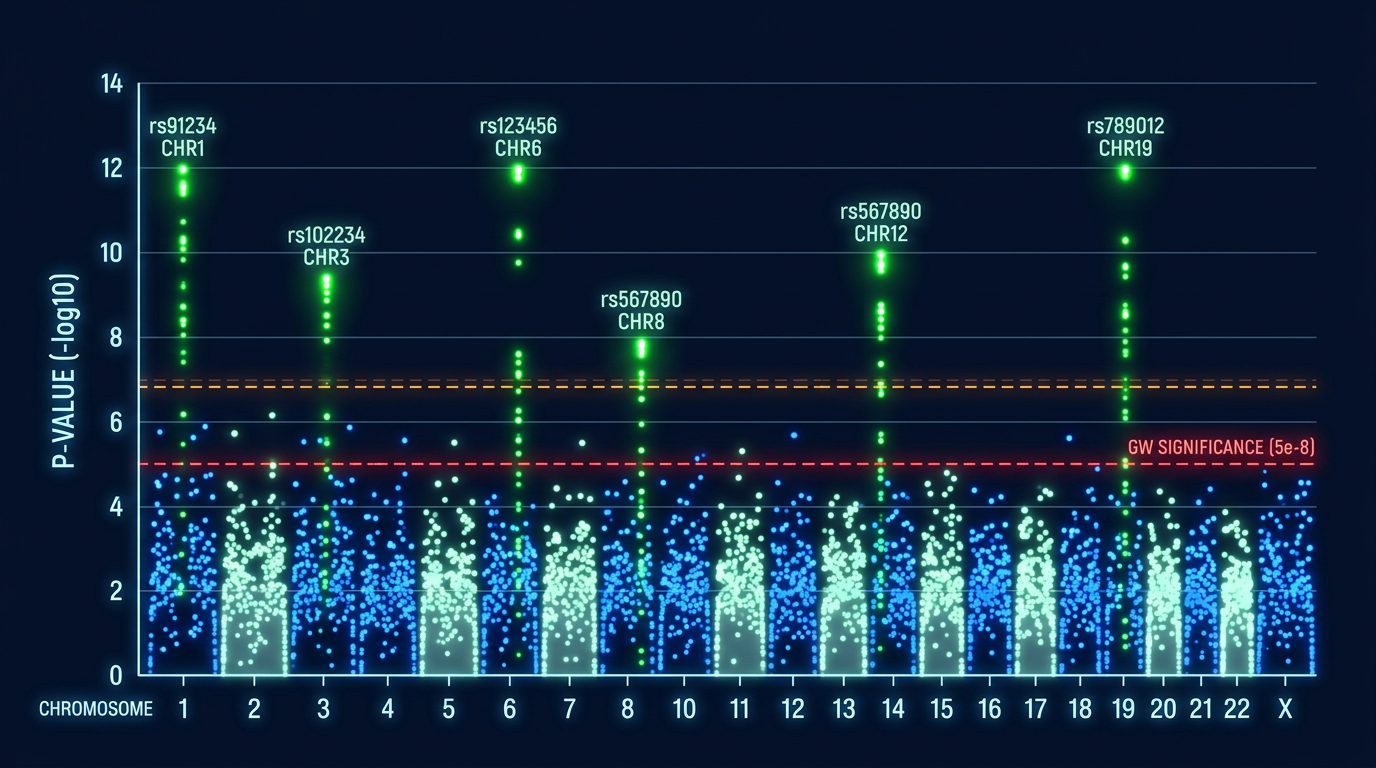
Genome-Wide Association Studies (GWAS) identify genomic regions (QTLs) significantly associated with traits of interest.

Manhattan Plot
ML-Enhanced QTL Discovery

Crop Example

ML-GWAS in rice identified novel QTLs for drought tolerance and grain quality.

ML Models Used

Random Forest GWAS, Deep Learning GWAS, Gradient Boosting

How ML Improves GWAS

Higher Accuracy

ML handles population structure and epistasis better than conventional linear models.

Multi-trait Analysis

Simultaneously models multiple correlated traits.

Reduced False Positives

ML-based methods reduce spurious associations.

Non-linear Interactions

Captures epistatic effects missed by traditional ANOVA-based GWAS.

Made byBobr AI
Phenotyping Pipeline
Field Image
AI Processing
(CNN)
Trait Values
Output
Breeding
Decision
IRRI Case Study
Automated phenotyping of 10,000 rice lines using drone imagery + deep learning.
Time Acceleration
What takes 10 researchers 2 weeks to measure can be done in hours with AI.
Application 3

Phenotyping
Automation

Image-Based Trait Analysis Using AI

PLANT COUNTING

CNNs count individual plants in field images — replaces manual counting. Accuracy >95%

CANOPY ANALYSIS

Measures leaf area index, ground cover, biomass from aerial images

TRAIT EXTRACTION

Automatically measures plant height, stem diameter, tiller number, panicle length from photos

Software Ecosystem Hub
PlantCV FieldAnalyzer TERRA-REF
Made byBobr AI
AI Diagnosis Output
Pathogen Detected
Wheat Rust
Puccinia triticina
Confidence Level 98.7%
Severity
High
Stage
Advanced
Action Required
Apply designated fungicide immediately to mitigate further spread.
Application 4

AI-Based
Disease Detection

Early, accurate, scalable detection using computer vision

1

Image Capture

Smartphone photos, drone imagery, field cameras capture leaf/plant images

2

Deep Learning (CNN)

Convolutional Neural Networks trained on thousands of disease images

3

Classification

Model identifies disease type, severity, spread stage

4

Alert & Recommendation

Farmer/breeder receives real-time alert with treatment advice

>90% Accuracy for Wheat rust, rice blast, maize blight, powdery mildew

Powered By: PlantVillage Plant.id Google DeepMind

AI can detect disease 2–3 weeks before visible symptoms appear — saving entire crops

Made byBobr AI
Application 5

Yield Prediction

Predicting crop performance before harvest using multi-environment data

Input Variables

Genotype (markers), environment (weather, soil), management practices, growth stage data

ML Models Used

Random Forest, Gradient Boosting (XGBoost), LSTM neural networks for time-series data

Model Output

Predicted yield per genotype per environment — enables best-fit variety recommendation

Performance

ML models achieve R² > 0.85 for yield prediction in maize and wheat

Real-World Application

IBM Watson Decision Platform for Agriculture predicts yield 3–4 weeks before harvest with 90% accuracy

Yield prediction enables precision placement of varieties — right genotype, right environment
Made byBobr AI
Application 6: Climate-Smart Breeding

Predicting Genotype × Environment Interaction (GEI) using AI

G×E Interaction

Same genotype performs differently in different environments — major challenge for breeders

ML Solution

Factored Regression, AMMI, Environmental Covariates with ML — models G×E accurately

Adaptability Prediction

Identify broadly adapted vs specifically adapted varieties

Climate Modeling

Project future climate scenarios → predict which genotypes will thrive in 2050

Real-World Impact

CIMMYT uses ML to identify drought and heat-tolerant wheat lines for future climate scenarios.

Sesame, maize, sorghum — C4 crops modeled under CMIP6 climate projections.
Climate-smart breeding = selecting today for tomorrow's climate
Made byBobr AI
Bobr AI

DESIGNER-MADE
PRESENTATION,
GENERATED FROM
YOUR PROMPT

Create your own professional slide deck with real images, data charts, and unique design in under a minute.

Generate For Free

AI and Machine Learning in Modern Plant Breeding

Explore how AI and ML are transforming agriculture through genomic selection, yield prediction, and climate-smart breeding strategies to ensure food security.

Artificial Intelligence and Machine Learning

in Modern Plant Breeding

[Your Name]

MSc Genetics & Plant Breeding

[Institution Name]

March 2026

MSc Seminar Presentation

Section 1: Foundation

Introduction

Global Challenges

Food security threatened by growing population (10 billion by 2050), climate change, and shrinking arable land

Need for Speed

Conventional breeding takes 10–15 years per variety; urgent need for faster, smarter crop improvement

Limitations of Conventional Breeding

Low throughput, labor-intensive, dependent on breeder expertise, limited predictive ability

"We need to produce 70% more food by 2050 with fewer resources"

Section 1: Foundation

Evolution

of Plant Breeding

Conventional Breeding

Pre-1900s–1960s

Selection, hybridization, phenotype-based

Molecular Breeding

1980s–2000s

Marker-assisted selection, QTL mapping

Genomic Breeding

2000s–2015

Whole-genome sequencing, SNP arrays, GWAS

Digital/AI Breeding

2015–Present

Big data, ML models, predictive analytics

Current Era

The shift from observing plants to

predicting performance using data

Section 1: Foundation

What is Artificial Intelligence (AI)?

AI

is the simulation of human intelligence by computer systems — enabling machines to learn, reason, and make decisions.

Machine Learning (ML)

Systems that learn from data to improve performance without being explicitly programmed.

Deep Learning (DL)

Multi-layered neural networks that mimic the human brain for complex pattern recognition.

Natural Language Processing (NLP)

AI that understands and generates human language — used in literature mining, chatbots.

SECTION 1: FOUNDATION

What is

Machine Learning (ML)?

ML enables computers to learn patterns from data and make decisions — without being explicitly programmed for each scenario.

SUPERVISED LEARNING

Learns from labeled data (input → known output).

Yield prediction, disease classification

UNSUPERVISED LEARNING

Finds hidden patterns in unlabeled data.

Clustering genotypes, trait grouping

REINFORCEMENT LEARNING

Learns by trial and reward.

Autonomous planting robots, irrigation optimization

Like a student (ML model) learning from past exam papers (data) to predict future exam answers (new decisions)

Section 1: Foundation

Why AI/ML in Plant Breeding?

Handles Big Data

Processes millions of SNPs, phenotypic records, and environmental data simultaneously

Improved Accuracy

ML models outperform traditional statistical methods in trait prediction

Speed

Reduces selection cycles from years to months

Cost Reduction

Fewer field trials needed through in silico prediction

Scalability

Works across environments, crops, and breeding programs

Predictive Power

Predicts performance before planting — saving resources

AI/ML bridges the gap between genomics and field performance

Section 2: Data in Modern Breeding

Types of Data Used in

Modern Breeding

Single Nucleotide Polymorphisms (SNPs), SSR markers, whole-genome sequences, haplotype maps.

DNA sequencing platforms (Illumina, Oxford Nanopore)

Yield, plant height, days to flowering, disease resistance, grain quality.

Field trials, greenhouse experiments, sensor data

Temperature, rainfall, soil pH, humidity, solar radiation.

Weather stations, IoT sensors, remote sensing satellites

The real power of AI/ML lies in integrating all three data types

Section 2

Big Data

Challenges

VOLUME

Millions of SNP markers, thousands of field plots, petabytes of sensor imagery

VARIETY

Heterogeneous data types — genomic, phenotypic, environmental, image-based

VELOCITY

Real-time streaming from sensors, drones, satellite feeds

Data Integration:

Combining data from different platforms, formats, and scales remains a key bottleneck

Solving these challenges requires AI-powered pipelines and cloud computing

Section 3: ML Workflow

ML Workflow in Plant Breeding

Each step will be explored in detail in the following slides

Step 1: Data Collection

ML Workflow — Step 1 of 7

Field Trials

Multi-Location Trials

Yield Records

Agromorphological Traits

Genomic Sequencing

Genotyping-by-Sequencing (GBS)

SNP Chips & Microarrays

Whole Genome Resequencing (WGRS)

Garbage In, Garbage Out

Step 2: Data Cleaning & Preprocessing

ML Workflow — Step 2 of 7

1. Handling Missing Values

Imputation (mean/median/KNN), deletion of poor-quality markers, BEAGLE/IMPUTE2 for genomic imputation

2. Normalization & Scaling

Min-max normalization, Z-score standardization — ensures equal weight across traits

3. Outlier Detection

Identify and remove erroneous field data points using statistical methods (IQR, boxplots)

4. Data Encoding

Converting categorical traits (resistant/susceptible) to numerical form for ML algorithms

Clean data = better model performance.

Preprocessing can account for 60–70% of ML project time.

ML Workflow — Step 3 of 7

Step 3: Feature Selection

Identifying the most informative variables (markers/traits) that contribute to the prediction outcome, while discarding noise.

FILTER METHODS

Statistical tests — correlation, chi-square, ANOVA. Fast but ignores model interaction.

WRAPPER METHODS

Recursive Feature Elimination (RFE) — tries subsets of features with the model.

EMBEDDED METHODS

LASSO, Ridge Regression, Random Forest importance scores — built into the model.

Selecting key SNP markers from thousands, choosing relevant environmental covariates.

Feature selection reduces overfitting, speeds up training, and improves interpretability.

ML Workflow — Step 4 of 7

Step 4: Model Selection

No single model fits all problems — model choice depends on data type and objective

REGRESSION MODELS

Linear/Ridge/LASSO — simple, interpretable. Used for: yield prediction, continuous trait modeling

RANDOM FOREST (RF)

Ensemble of decision trees. Robust, handles non-linearity. Used for: disease classification, marker selection

SUPPORT VECTOR MACHINE (SVM)

Finds optimal hyperplane to classify data. Used for: disease detection, trait classification

NEURAL NETWORKS / DEEP LEARNING

Multi-layered networks for complex patterns. CNN for image analysis, RNN for time-series

ML Workflow — Step 5 of 7

Step 5: Model Training

Data is split: 70–80% Training Set | 20–30% Test Set

Model iteratively learns patterns from training data

Parameters are updated through optimization (e.g., gradient descent)

Training Dataset

Labeled genomic + phenotypic data used to teach the model

Learning Patterns

Model finds associations between markers/traits and target variable

Hyperparameter Tuning

Adjusting model settings (learning rate, depth) for optimal performance

Overfitting vs Underfitting

Balance between learning enough and not memorizing noise

Training is iterative — the model improves with each pass through the data (epoch)

ML Workflow — Step 6 of 7

A model that performs well only on training data is useless — validation tells the true story.

Cross-Validation

Data is partitioned into k subsets. The model is recursively tested on each fold to provide a robust, unbiased accuracy estimate (e.g., 5-fold, 10-fold CV).

Accuracy Metrics

Performance is quantified using robust statistical metrics such as R², RMSE for continuous traits, and AUC-ROC curves for classification tasks.

Prediction Ability

Measured as the fundamental statistical correlation between predicted and observed values — a critically important metric in genomic selection.

Independent Test Set

A pristine, completely unseen dataset serves as the ultimate test validation to unequivocally confirm the final model's true field generalizability.

Section 4: Applications in Plant Breeding

Application 1:

Genomic Selection (GS)

Genomic Selection uses genome-wide marker data to predict Genomic Estimated Breeding Values (GEBVs) for all individuals — even those without phenotypic records.

Historical Standard

Introduced by Meuwissen et al. (2001) — now standard in animal and plant breeding.

Statistical & ML Models

Uses RRBLUP, GBLUP, Bayesian methods, Random Forest, Neural Networks.

Accuracy Dependencies

Accuracy depends strictly on: training population size, marker density, and trait heritability.

<strong style="color: #a8e063;">GS can reduce the breeding cycle by 30–50%</strong> by eliminating phenotyping bottlenecks.

Genome-Wide Association Studies (GWAS) identify genomic regions (QTLs) significantly associated with traits of interest.

ML-GWAS in rice identified novel QTLs for drought tolerance and grain quality.

Random Forest GWAS, Deep Learning GWAS, Gradient Boosting

Higher Accuracy

ML handles population structure and epistasis better than conventional linear models.

Multi-trait Analysis

Simultaneously models multiple correlated traits.

Reduced False Positives

ML-based methods reduce spurious associations.

Non-linear Interactions

Captures epistatic effects missed by traditional ANOVA-based GWAS.

Application 3

Phenotyping

Automation

Image-Based Trait Analysis Using AI

Application 4

AI-Based

Disease Detection

Early, accurate, scalable detection using computer vision

Image Capture

Smartphone photos, drone imagery, field cameras capture leaf/plant images

Deep Learning (CNN)

Convolutional Neural Networks trained on thousands of disease images

Classification

Model identifies disease type, severity, spread stage

Alert & Recommendation

Farmer/breeder receives real-time alert with treatment advice

Wheat rust, rice blast, maize blight, powdery mildew

AI can detect disease 2–3 weeks before visible symptoms appear — saving entire crops

Application 5

Yield Prediction

Predicting crop performance before harvest using multi-environment data

Input Variables

Genotype (markers), environment (weather, soil), management practices, growth stage data

ML Models Used

Random Forest, Gradient Boosting (XGBoost), LSTM neural networks for time-series data

Model Output

Predicted yield per genotype per environment — enables best-fit variety recommendation

Performance

R² > 0.85

for yield prediction in maize and wheat

Real-World Application

IBM Watson Decision Platform for Agriculture predicts yield

3–4 weeks

before harvest with

90% accuracy

Yield prediction enables precision placement of varieties — right genotype, right environment

Application 6: Climate-Smart Breeding

Predicting Genotype × Environment Interaction (GEI) using AI

G×E Interaction

Same genotype performs differently in different environments — major challenge for breeders

ML Solution

Factored Regression, AMMI, Environmental Covariates with ML — models G×E accurately

Adaptability Prediction

Identify broadly adapted vs specifically adapted varieties

Climate Modeling

Project future climate scenarios → predict which genotypes will thrive in 2050

CIMMYT uses ML to identify drought and heat-tolerant wheat lines for future climate scenarios.

Sesame, maize, sorghum — C4 crops modeled under CMIP6 climate projections.

Climate-smart breeding = selecting today for tomorrow's climate

  • artificial-intelligence
  • machine-learning
  • plant-breeding
  • genomics
  • agtech
  • precision-agriculture
  • crop-improvement
  • data-science