

Made byBobr AI

Data Quality & Project Performance Dashboard Report 2026

Explore key insights on workload analysis, defect rate monitoring, and risk identification across 10 major projects using BI analytics.

#data-quality#project-management#bi-analytics#defect-rate#workload-analysis#kpi-dashboard#business-intelligence
Watch
Pitch

DATA QUALITY & PROJECT PERFORMANCE DASHBOARD

Workload Analysis · Defect Rate Monitoring · Risk & Opportunity Identification

April 2026 | BI Analytics Report
Made byBobr AI
DATA SOURCE

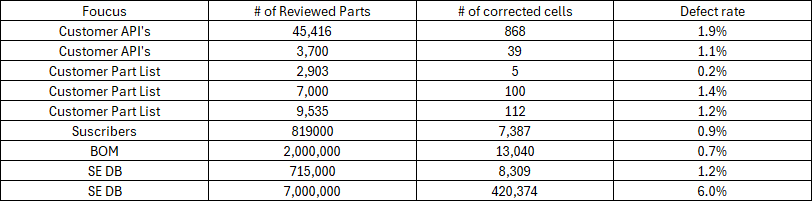
Raw Dataset Overview

Source data covering 10 projects with 6 key metrics used to drive all visualizations in this dashboard.

10 Projects / Customers
4 Frequency Types (Daily → Quarterly)
5 Focus Areas (API, Parts, BOM, Subscribers, SE DB)
Defect Range: 0.2% (Agilent) → 100% (Internal Test)
dataset_raw.xlsx — Project Quality Metrics
Columns: Project Name · Focus · Frequency · # Reviewed Parts · # Corrected Cells · Defect Rate April 2026 | BI Analytics Report
Made byBobr AI

FOCUS AREA SUMMARY

Aggregated metrics grouped by Focus Area

5 Distinct Focus Areas
SE DB: Highest Volume (7.7M+ reviewed)
BOM: Best Efficiency at scale (0.7% defect)
Customer Part List: Most Consistent Quality
focus_area_summary.rpt
Focus Area Breakdown | Project Quality Dashboard | April 2026
Made byBobr AI

KEY PERFORMANCE INDICATORS

10,603,380
Total Reviewed Parts
451,060
Total Corrected Cells
11.4%
Average Defect Rate
Excl. Internal Test: 2.1%
Highest Defect Rate
100%
⚠ Internal Test
Lowest Defect Rate
0.2%
✓ Agilent
Dataset: 10 projects | Frequencies: Daily · Weekly · Monthly · Quarterly
Made byBobr AI

DEFECT RATE BY PROJECT (%)

Identifying quality outliers across all projects

0%
20%
40%
60%
80%
100%
Internal Test
100.0%
Top Issued Product Lines
6.0%
GPV
1.9%
Veiston
1.4%
HIMA
1.2%
Honeywell
1.1%
QA Audit
1.2%
Subscriber Corrective Actions
0.9%
Proactive Plans
0.7%
Agilent
0.2%
Risk Thresholds
High Risk (>4%)
Moderate (1-4%)
Low Risk (<1%)
Internal Test excluded from overall avg. (100% = test environment anomaly)
Made byBobr AI

WORKLOAD DISTRIBUTION — REVIEWED PARTS BY PROJECT

Volume processed per project

Top Issued Product Lines
7,000,000
Highest + 6% defect
Proactive Plans
2,000,000
Low defect 0.7%
Subscriber Corrective Actions
819,000
QA Audit
715,000
GPV
45,416
HIMA
9,535
Veiston
7,000
Honeywell
3,700
Agilent
2,903
Internal Test
1,826
100% defect
Total Reviewed: 10,603,380 parts
Made byBobr AI

VOLUME vs. DEFECT RATE — CORRELATION ANALYSIS

Does higher workload lead to more defects?

High Risk
Moderate
Low Risk

Insight

No strong positive correlation — high volume does not mean poor quality.

100% 80% 60% 40% 20% 0% Defect Rate (%)
1K
10K
100K
1M
10M
Reviewed Parts (Log Scale)
Internal Test ⚠ 100%
Agilent ✓ 0.2%
GPV 1.9%
Proactive Plans ✓ 0.7%
Top Issued Lines 6%
Corporate Quality & Correlation Analytics Confidential & Proprietary Dashboard
Made byBobr AI

REVIEWED vs. CORRECTED CELLS BY FOCUS AREA

8.5M 6.8M 5.1M 3.4M 1.7M 0
907
49,116
317
19,438
7,387
819,000
13,040
2,000,000
430,509
7,716,826
Customer API's
Customer Part List
Subscribers
BOM
SE DB
Reviewed Parts
Corrected Cells

DISTRIBUTION BY REVIEW FREQUENCY

10
Projects
Daily (30%)
3 Projects
Weekly (40%)
4 Projects
Monthly (30%)
3 Projects
Quarterly (10%)
1 Project
Made byBobr AI

KEY INSIGHTS & BUSINESS RECOMMENDATIONS

⚠️

CRITICAL — Internal Test

100% defect rate detected. All 1,826 reviewed parts flagged as defective. Immediate investigation required — possible test environment misconfiguration.

🔴

HIGH RISK — Top Issued Product Lines

Highest workload (7M parts) combined with 6% defect rate. 420,374 corrected cells. Most critical area — requires priority resource allocation.

STRONG PERFORMANCE — Proactive Plans

2M parts reviewed with only 0.7% defect rate (13,040 corrections). High volume handled efficiently — a model for scalable quality control.

CONTROLLED — Subscriber Corrective Actions

819K parts with sub-1% defect rate (0.9%). Large workload managed with strong quality discipline.

💎

HIGH QUALITY — Low-Volume Projects

Agilent (0.2%), Honeywell (1.1%), and Veiston (1.4%) maintain excellent quality at lower volumes. Best-in-class accuracy.

📊

KEY FINDING — No Volume-Defect Correlation

High review volume does NOT guarantee high defect rates. Quality is driven by process discipline, not volume alone.

Dashboard generated: April 2026 | Source: Project Quality Dataset
Made byBobr AI
Bobr AI

DESIGNER-MADE
PRESENTATION,
GENERATED FROM
YOUR PROMPT

Create your own professional slide deck with real images, data charts, and unique design in under a minute.

Generate For Free

Data Quality & Project Performance Dashboard Report 2026

Explore key insights on workload analysis, defect rate monitoring, and risk identification across 10 major projects using BI analytics.

DATA QUALITY & PROJECT PERFORMANCE DASHBOARD

Workload Analysis · Defect Rate Monitoring · Risk & Opportunity Identification

April 2026 | BI Analytics Report

Raw Dataset Overview

Source data covering 10 projects with 6 key metrics used to drive all visualizations in this dashboard.

10 Projects / Customers

4 Frequency Types (Daily → Quarterly)

5 Focus Areas (API, Parts, BOM, Subscribers, SE DB)

Defect Range: 0.2% (Agilent) → 100% (Internal Test)

Columns: Project Name · Focus · Frequency · # Reviewed Parts · # Corrected Cells · Defect Rate

FOCUS AREA SUMMARY

Aggregated metrics grouped by Focus Area

5 Distinct Focus Areas

SE DB: Highest Volume (7.7M+ reviewed)

BOM: Best Efficiency at scale (0.7% defect)

Customer Part List: Most Consistent Quality

Focus Area Breakdown | Project Quality Dashboard | April 2026

KEY PERFORMANCE INDICATORS

10,603,380

Total Reviewed Parts

451,060

Total Corrected Cells

11.4%

Average Defect Rate

Excl. Internal Test: 2.1%

100%

Highest Defect Rate

⚠ Internal Test

0.2%

Lowest Defect Rate

✓ Agilent

Dataset: 10 projects | Frequencies: Daily · Weekly · Monthly · Quarterly

DEFECT RATE BY PROJECT (%)

Identifying quality outliers across all projects

Internal Test excluded from overall avg. (100% = test environment anomaly)

WORKLOAD DISTRIBUTION — REVIEWED PARTS BY PROJECT

Volume processed per project

Total Reviewed: 10,603,380 parts

VOLUME vs. DEFECT RATE — CORRELATION ANALYSIS

Does higher workload lead to more defects?

REVIEWED vs. CORRECTED CELLS BY FOCUS AREA

DISTRIBUTION BY REVIEW FREQUENCY

907

49,116

317

19,438

7,387

819,000

13,040

2,000,000

430,509

7,716,826

10

Projects

(30%)

3 Projects

(40%)

4 Projects

(30%)

3 Projects

(10%)

1 Project

KEY INSIGHTS & BUSINESS RECOMMENDATIONS

⚠️

CRITICAL — Internal Test

100% defect rate detected. All 1,826 reviewed parts flagged as defective. Immediate investigation required — possible test environment misconfiguration.

🔴

HIGH RISK — Top Issued Product Lines

Highest workload (7M parts) combined with 6% defect rate. 420,374 corrected cells. Most critical area — requires priority resource allocation.

STRONG PERFORMANCE — Proactive Plans

2M parts reviewed with only 0.7% defect rate (13,040 corrections). High volume handled efficiently — a model for scalable quality control.

CONTROLLED — Subscriber Corrective Actions

819K parts with sub-1% defect rate (0.9%). Large workload managed with strong quality discipline.

💎

HIGH QUALITY — Low-Volume Projects

Agilent (0.2%), Honeywell (1.1%), and Veiston (1.4%) maintain excellent quality at lower volumes. Best-in-class accuracy.

📊

KEY FINDING — No Volume-Defect Correlation

High review volume does NOT guarantee high defect rates. Quality is driven by process discipline, not volume alone.

Dashboard generated: April 2026 | Source: Project Quality Dataset

  • data-quality
  • project-management
  • bi-analytics
  • defect-rate
  • workload-analysis
  • kpi-dashboard
  • business-intelligence