





















Made byBobr AI

Kinetic Analysis of Hydrogen Peroxide-Iodide Reactions

Learn how to determine rate laws and activation energy for the Hydrogen Peroxide-Iodide reaction using graphical analysis and the Arrhenius equation.

#chemistry-lab#chemical-kinetics#rate-law#activation-energy#arrhenius-equation#iodine-clock#experimental-chemistry

Experiment #24: Determination of a Rate Law

Lab #5: Kinetic Analysis of the Hydrogen Peroxide-Iodide Reaction

Presented by: [Name]
Date: [Date]
GENERAL CHEMISTRY I
LABORATORY
Made byBobr AI
Experiment #24

Objectives & Background

Primary Goals

1

Rate Law Determination

Systematically determine the specific rate law governing the reaction between hydrogen peroxide and iodide ions.

2

Graphical Analysis

utilize graphical analysis techniques to calculate reactant orders and compute the activation energy (Ea) for the reaction.

Chemistry Icon

Background Context

Chemical kinetics is the study of reaction rates. The rate of this reaction is primarily determined by two key factors: the concentration of reactants and the temperature of the environment. Any variation in these parameters will directly alter the speed at which the reaction proceeds.

  • Reaction rate vs. Concentration
  • Temperature effects on Kinetics
KINETICS STUDY
Made byBobr AI

The Chemical Reaction

Overall Reaction

3 I-(aq) + H2O2(aq) + 2H3O+(aq) → I3-(aq) + 4H2O(l)
We use an acetic acid-sodium acetate buffer to maintain a stable environment, keeping [H3O+] constant at pH ~5.
Simplified Rate Law
Rate = k'[I-]p[H2O2]q
GENERAL CHEMISTRY I
KINETICS MODULE
Made byBobr AI

Experimental Design: The 'Clock' Reaction

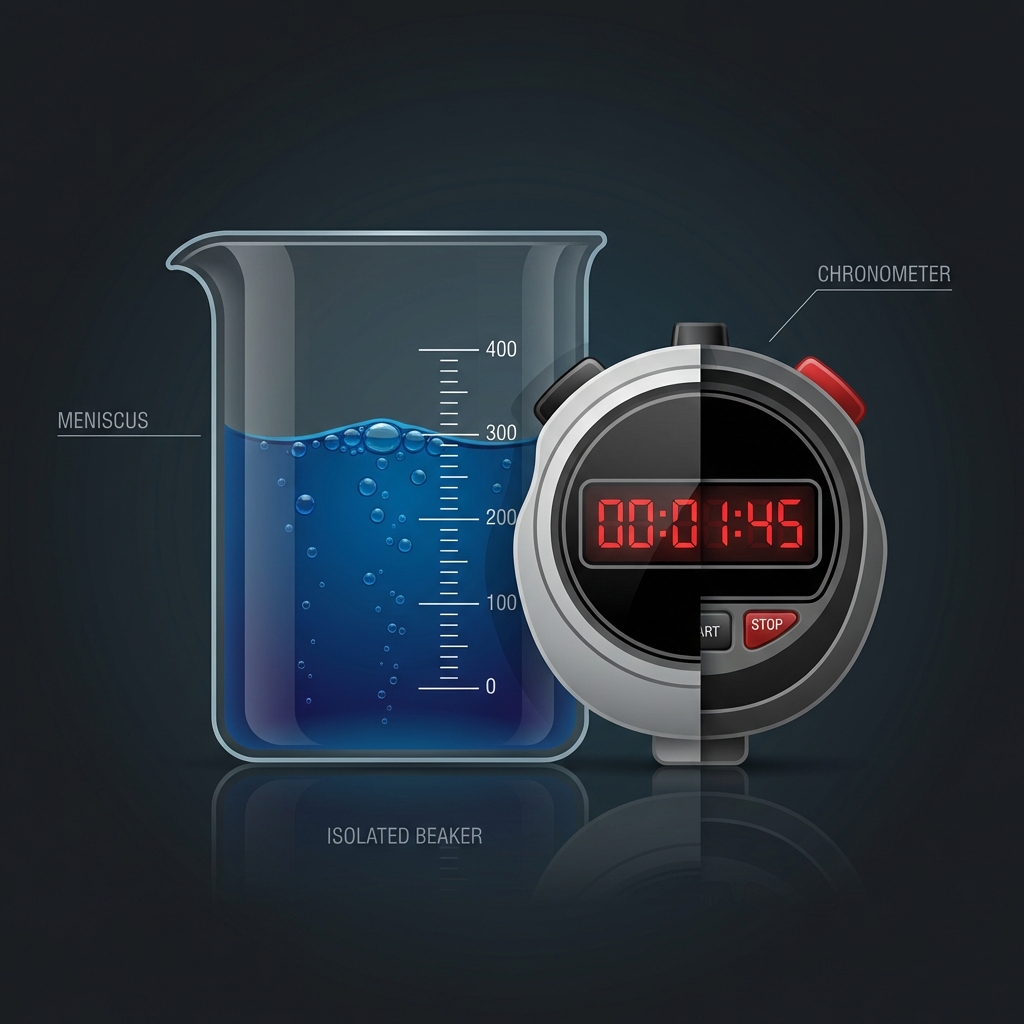
We measure reaction rate indirectly by timing how long it takes for a fixed amount of thiosulfate (S₂O₃²⁻) to be consumed. Changes are invisible until the thiosulfate is gone.

Step 1: Scavenging Reaction
2 S2O32-(aq) + I3-(aq) → 3 I-(aq) + S4O62-(aq)
Step 2: Indicator Reaction
I3-(aq) + starch(aq)Blue Complex
⏱️
Vital Hint
The appearance of the blue color is sudden. Keep your eyes on the solution and be prepared to stop the timer immediately!
Reaction Endpoint
Sudden transition to deep blue
GENERAL CHEMISTRY I
KINETICS LAB
Made byBobr AI

Graphical Analysis for p and q

The Semi-Logarithmic Approach

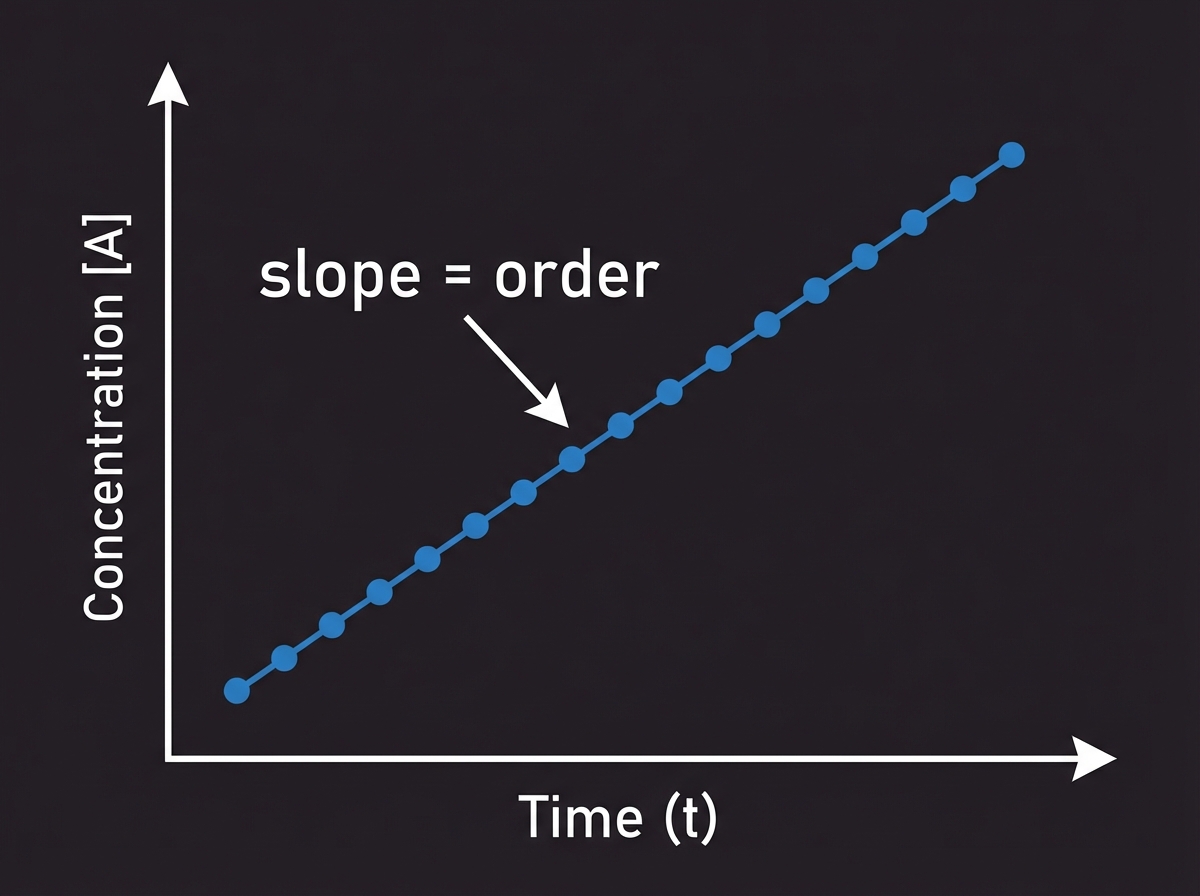
By graphing the logarithm of the rate law equation, we can isolate the orders:

log(rate) = p · log[I⁻] + log C (Find p)
log(rate) = q · log[H₂O₂] + log C' (Find q)
The slope of these linear plots equals the reaction order (p or q).

Pro Tip

Keep the total volume constant (10.0 mL) so you can use volumes or moles directly for rate calculations.

Plot of log(rate) vs log[concentration] yields a straight line where slope = order.
GENERAL CHEMISTRY I
LABORATORY
Made byBobr AI

Arrhenius Equation & Activation Energy

ln k' = ln A - EaR (
1T
)

Defined Constants

  • R = 8.314 J/mol·K
  • T = Temperature in Kelvins
  • Ea = Activation Energy (J/mol)

Graphical Analysis

Linearizing the Arrhenius equation by plotting ln k' versus 1/T yields a straight line related to activation energy.

Slope (m) = -Ea / R

Helpful Hint

Always convert temperature to Kelvin before plotting! (K = °C + 273.15)

GENERAL CHEMISTRY I
LABORATORY
Made byBobr AI

Step-by-Step Procedure & Lab Tips

Outline for Part A and Part E

Procedure Sequence

STEP 1
Prepare Solution A containing KI (Potassium Iodide), Starch, Thiosulfate, and Buffer.
STEP 2
Prepare Solution B containing H₂O₂ (Hydrogen Peroxide).
STEP 3
Mix Solutions A and B swiftly and start timing immediately upon contact.

Pro Tips & Tricks

Monitor Color Change
Place a white sheet of paper under the beaker. It makes the sudden blue-black color shift much easier to detect.
Mixing Technique
Do not swirl continuously during the reaction. Swirl once vigorously to mix, then let it sit undisturbed.
Thermal Equilibrium (Part E)
Temperature is critical. Allow solutions to sit in the water bath for at least 5 minutes before mixing.
Part A & E Protocol
Made byBobr AI

Part A: Determination of Reaction Orders

Detailed Procedure for Reagent Preparation, Mixing, and Data Collection

Phase I: Preparation & Mixing

1. Reagent Preparation
Prepare stock solutions with precise concentrations: 0.040 M KI (Potassium Iodide) and 0.040 M H₂O₂ (Hydrogen Peroxide). Ensure glassware is clean.
2. Mixing Protocol
Initiate the reaction: Pour Solution A (KI, Starch, Na₂S₂O₃, Buffer) swiftly into Solution B (H₂O₂). The 'Clock' starts upon contact.

Phase II: Measurement & Analysis

3. Data Collection
Start timing immediately. Measuring to the nearest second, record the time elapsed until the solution suddenly turns blue-black.
4. Variable Isolation
Repeat with varying volumes of KI/H₂O₂. Use Deionized (DI) water to keep total reaction volume constant, allowing isolation of variables p and q.
!
Experimental Tip: Ensure constant temperature/stirring rate to minimize errors in rate constant determination.
Made byBobr AI

Part E: Temperature Dependence

Activation Energy Determination Protocol

Experimental Sequence

Water Bath Setup
Prepare two distinct environments: an ice bath (~4°C) and a hot water bath (~40°C) to create a wide temperature range.
Thermal Equilibrium
IMPORTANT: Place separate test tubes of Solution A and B into the bath for >5 mins BEFORE mixing.
Record Temperature
Measure the temperature of the mixture immediately after the color change. This is your T value for the Arrhenius plot.

Critical Concepts

Precision is Paramount
Temperature is the primary variable here. Small deviations have a massive impact on the rate constant (k).
Create Data Spread
You need clear 'cold' and 'hot' data points to generate a valid slope for calculating Activation Energy (Ea).
Reaction Rate Changes
Be ready: Cold reactions may take much longer, while hot reactions will occur very rapidly.
ACTIVATION ENERGY LAB
Made byBobr AI

Troubleshooting the Iodine Clock

Common Pitfalls & Solutions

No Color Change
Check if Starch or Na₂S₂O₃ was omitted from the mixture. Without starch, the iodine complex cannot form visible color.
Instant Color Change
Check if Na₂S₂O₃ was forgotten (iodine forms immediately) or if H₂O₂ reactant was contaminated.
Inconsistent Times
Ensure beakers are perfectly clean. Contaminants affect rate. Rinse thoroughly with DI water between every trial.
Calculation Errors
Use Molarity of the FINAL mixture, not the stock solution. Dilution equation M₁V₁ = M₂V₂ is critical here.
Lab Safety & Accuracy
Made byBobr AI
Bobr AI

DESIGNER-MADE
PRESENTATION,
GENERATED FROM
YOUR PROMPT

Create your own professional slide deck with real images, data charts, and unique design in under a minute.

Generate For Free

Kinetic Analysis of Hydrogen Peroxide-Iodide Reactions

Learn how to determine rate laws and activation energy for the Hydrogen Peroxide-Iodide reaction using graphical analysis and the Arrhenius equation.

Experiment #24: Determination of a Rate Law

Lab #5: Kinetic Analysis of the Hydrogen Peroxide-Iodide Reaction

[Name]

[Date]

Objectives & Background

Systematically determine the specific rate law governing the reaction between hydrogen peroxide and iodide ions.

utilize graphical analysis techniques to calculate reactant orders and compute the activation energy (Ea) for the reaction.

Chemical kinetics is the study of reaction rates. The rate of this reaction is primarily determined by two key factors: the concentration of reactants and the temperature of the environment. Any variation in these parameters will directly alter the speed at which the reaction proceeds.

The Chemical Reaction

3 I<sup>-</sup>(aq) + H<sub>2</sub>O<sub>2</sub>(aq) + 2H<sub>3</sub>O<sup>+</sup>(aq) &rarr; I<sub>3</sub><sup>-</sup>(aq) + 4H<sub>2</sub>O(l)

We use an <strong style="color:white; font-weight:600;">acetic acid-sodium acetate buffer</strong> to maintain a stable environment, keeping [H<sub>3</sub>O<sup>+</sup>] constant at <strong style="color:white; font-weight:600;">pH ~5</strong>.

Simplified Rate Law

Rate = k'[I<sup>-</sup>]<sup>p</sup>[H<sub>2</sub>O<sub>2</sub>]<sup>q</sup>

Experimental Design: The 'Clock' Reaction

We measure reaction rate indirectly by timing how long it takes for a fixed amount of thiosulfate (S₂O₃²⁻) to be consumed. Changes are invisible until the thiosulfate is gone.

The appearance of the blue color is sudden. Keep your eyes on the solution and be prepared to stop the timer immediately!

Graphical Analysis for p and q

The Semi-Logarithmic Approach

log(rate) = p · log[I⁻] + log C

log(rate) = q · log[H₂O₂] + log C'

The slope of these linear plots equals the reaction order (p or q).

Keep the total volume constant (10.0 mL) so you can use volumes or moles directly for rate calculations.

Arrhenius Equation & Activation Energy

8.314 J/mol·K

Temperature in Kelvins

Linearizing the Arrhenius equation by plotting ln k' versus 1/T yields a straight line related to activation energy.

Always convert temperature to Kelvin before plotting! (K = °C + 273.15)

GENERAL CHEMISTRY I

LABORATORY

Step-by-Step Procedure & Lab Tips

Outline for Part A and Part E

Prepare Solution A containing KI (Potassium Iodide), Starch, Thiosulfate, and Buffer.

Prepare Solution B containing H₂O₂ (Hydrogen Peroxide).

Mix Solutions A and B swiftly and start timing immediately upon contact.

Monitor Color Change

Place a white sheet of paper under the beaker. It makes the sudden blue-black color shift much easier to detect.

Mixing Technique

Do not swirl continuously during the reaction. Swirl once vigorously to mix, then let it sit undisturbed.

Thermal Equilibrium (Part E)

Temperature is critical. Allow solutions to sit in the water bath for at least 5 minutes before mixing.

Part A: Determination of Reaction Orders

Detailed Procedure for Reagent Preparation, Mixing, and Data Collection

Prepare stock solutions with precise concentrations: 0.040 M KI (Potassium Iodide) and 0.040 M H₂O₂ (Hydrogen Peroxide). Ensure glassware is clean.

Initiate the reaction: Pour Solution A (KI, Starch, Na₂S₂O₃, Buffer) swiftly into Solution B (H₂O₂). The 'Clock' starts upon contact.

Start timing immediately. Measuring to the nearest second, record the time elapsed until the solution suddenly turns blue-black.

Repeat with varying volumes of KI/H₂O₂. Use Deionized (DI) water to keep total reaction volume constant, allowing isolation of variables p and q.

Part E: Temperature Dependence

Activation Energy Determination Protocol

Water Bath Setup

Prepare two distinct environments: an ice bath (~4°C) and a hot water bath (~40°C) to create a wide temperature range.

Thermal Equilibrium

IMPORTANT: Place separate test tubes of Solution A and B into the bath for >5 mins BEFORE mixing.

Record Temperature

Measure the temperature of the mixture immediately after the color change. This is your T value for the Arrhenius plot.

Precision is Paramount

Temperature is the primary variable here. Small deviations have a massive impact on the rate constant (k).

Create Data Spread

You need clear 'cold' and 'hot' data points to generate a valid slope for calculating Activation Energy (Ea).

Reaction Rate Changes

Be ready: Cold reactions may take much longer, while hot reactions will occur very rapidly.

Troubleshooting the Iodine Clock

Common Pitfalls & Solutions

No Color Change

Check if Starch or Na₂S₂O₃ was omitted from the mixture. Without starch, the iodine complex cannot form visible color.

Instant Color Change

Check if Na₂S₂O₃ was forgotten (iodine forms immediately) or if H₂O₂ reactant was contaminated.

Inconsistent Times

Ensure beakers are perfectly clean. Contaminants affect rate. Rinse thoroughly with DI water between every trial.

Calculation Errors

Use Molarity of the FINAL mixture, not the stock solution. Dilution equation M₁V₁ = M₂V₂ is critical here.

  • chemistry-lab
  • chemical-kinetics
  • rate-law
  • activation-energy
  • arrhenius-equation
  • iodine-clock
  • experimental-chemistry