

ML-Based Macro-Modeling for SAR ADC Analog IC Design
Learn how Machine Learning-Based Macro-Modeling (MMM) achieves 3600x speedup over SPICE in SAR ADC performance estimation with less than 1% error.
MMM: Machine Learning-Based Macro-Modeling
Accelerating Performance Estimation for Linear Analog ICs and ADC/DACs
Yishuang Lin, Yaguang Li, Meghna Madhusudan, et al.
METHODLY
#ffffff
The Bottleneck: Analog Design Automation
SPICE simulations are computationally expensive, slowing down optimization loops (days to weeks).
Existing ML Models (Flat P2M): Require massive training data (thousands of simulations) and lack reusability.
Symbolic Analysis & MOR: Limited to small or linear circuits; struggle with ADCs/DACs.
METHODLY
#1a237e
The MMM Solution: Hierarchical Macro-Modeling
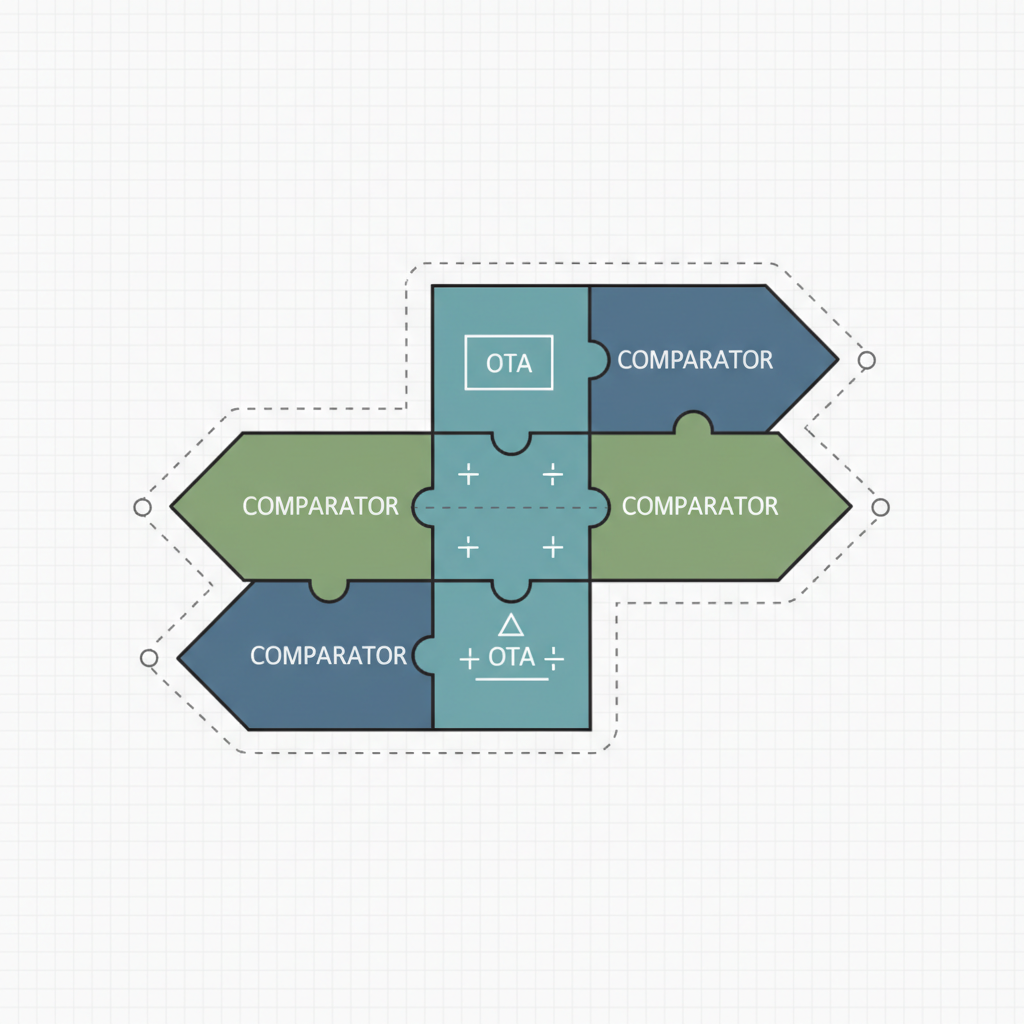
Decompose large circuits into standard reusable sub-circuits (e.g., OTA, Comparator).
Train Once, Reuse Everywhere: Models for sub-circuits are trained independently and assembled for system estimation.
Handling Complexity: Separate handling for Loading Effects, Feedback Loops, and Variable Inputs.
METHODLY
#1a237e
Methodology: Linear Analog ICs
DC Voltage Modeling: ML models estimate DC operating points (considering loading effects).
Parametric Transfer Function: H(s) coefficients are predicted by ML models based on DC points and device sizes.
Pole/Zero Analysis
METHODLY
#1a237e
Methodology: Time-Domain for ADCs
Unlike linear ICs, ADCs require discrete time-step evaluation to capture dynamic behavior.
Sequential Propagation: Output V(t) depends on Input V(t), Input V(t-1), and Output V(t-1).
Key Sub-circuits: Comparators and Encoders are modeled individually and linked.
Performance Output: FFT performed on time-domain waveform to extract SFDR and SNDR.
METHODLY
#ffffff
Applying MMM to SAR ADCs
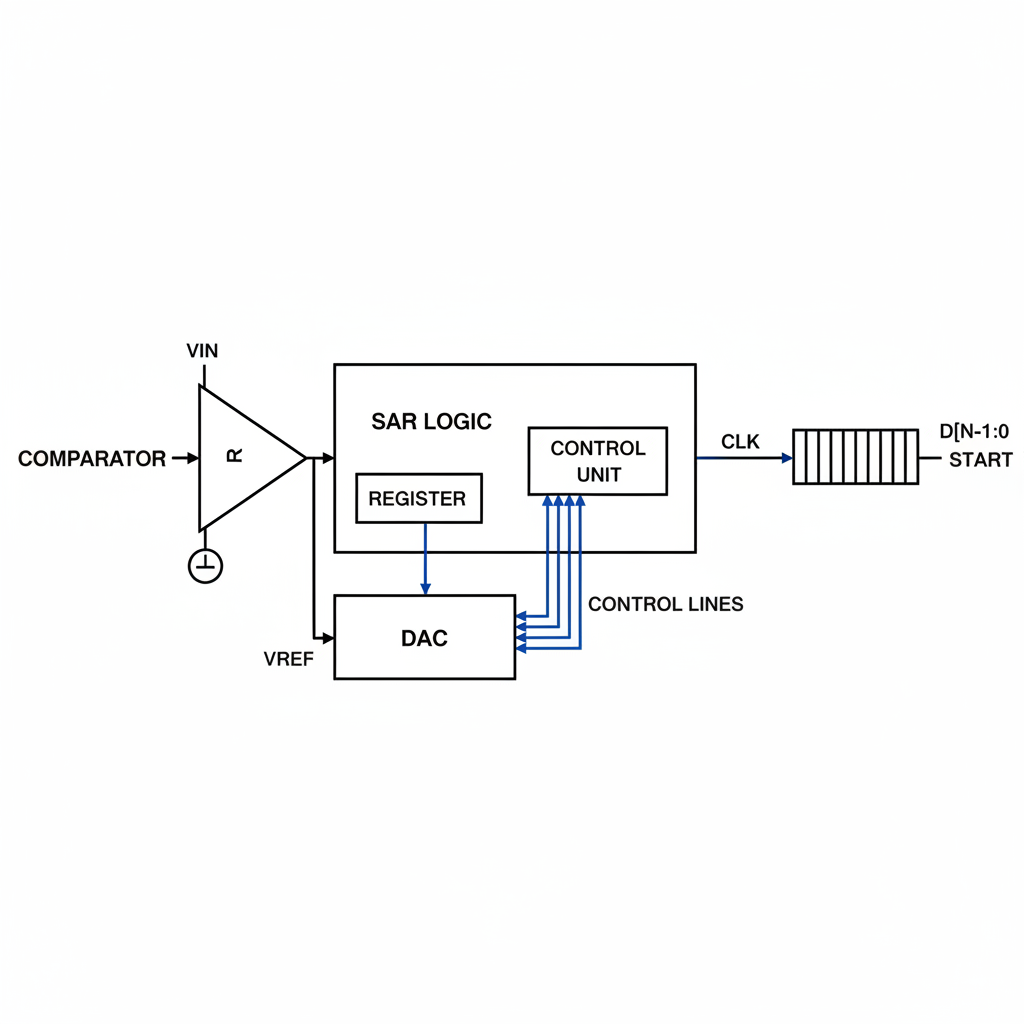
While initial results cover Flash/Pipeline ADCs, the MMM framework is naturally suited for Successive Approximation Register (SAR) architectures.
Comparator: Modeled via MMM Time-Domain interface (proven accurate in Flash results).
Capacitive DAC: Modeled similarly to Weighted Resistor DACs (linear passive network).
SAR Logic Loop: Digital feedback handled by system-level netlist assembly.
METHODLY
#1a237e
Result: Modeling Accuracy
MMM achieves significantly lower error rates (<1%) compared to flat ANN and GNN approaches.
METHODLY
#1a237e
Huge Reduction in Data Preparation Cost
For an 8-bit Flash ADC, MMM reduced simulation needs from 40 days to just 9.6 hours (due to sub-circuit reuse).
METHODLY
#1a237e
Inference Speed: Replacing SPICE
MMM is orders of magnitude faster than SPICE for full-system verification.
8-bit ADC Evaluation Time: SPICE ~ 30 minutes vs MMM < 0.1 second.
METHODLY
#1a237e
Conclusion & Future Work
MMM enables scalable, fast, and reusable performance modeling for Analog/Mixed-Signal ICs.
Achieved >1700x speedup in data prep and >3600x in inference speed over SPICE with <1% error.
Future Focus: Expanding the library for SAR ADCs and complex feedback loops in high-speed data converters.
METHODLY
#ffffff
- analog-ic-design
- machine-learning
- sar-adc
- spice-simulation
- circuit-modeling
- eda-automation