






Introduction to Satellite & Space Communication Systems
Learn about satellite technology, including LEO/GEO orbits, transponders, frequency bands, and real-world applications like Starlink and GPS.
Satellite & Space<br>Communication Systems
Introduction to Satellite Technology
1st Year Engineering | Department of Electronics & Communication
02
Why Satellite<br>Communication?
🌐
Global Connectivity
Covers areas unreachable by cables or towers
🏔️
Remote & Rural Areas
Mountains, oceans, deserts — no blind spots
🆘
Disaster Resilience
Works when terrestrial networks fail
03
What is a Satellite?
An artificial object launched into space that orbits Earth to relay signals, collect data, or observe the planet.
Orbits Earth due to gravitational balance
Acts as a relay station in space
Carries transponders for signal transmission
Types of Satellites
Communication Satellites
TV, internet, phone relay
📡
Weather Satellites
Cloud imaging, forecasting, storm tracking
🌤
Navigation Satellites
GPS, positional data (e.g., NAVIC, Galileo)
🗺
Scientific Satellites
Space research, Hubble-type observation
🔭
Reconnaissance Satellites
Military surveillance, imaging
🕵
Remote Sensing
Land use, agriculture, disaster mapping
🌍
Orbit Types
LEO, MEO, GEO Comparison
06
Working Principle
GROUND STATION
Signal sent from Earth
Uplink: 14–17 GHz
UPLINK
SATELLITE
Transponder amplifies & retransmits
550 km above Earth
DOWNLINK
USER TERMINAL
Received by user
Downlink: 11–12 GHz
Signal Frequency Shifted
Amplified 1000x
Latency: 270ms (GEO)
System Architecture
Network Layout and Space Integration
08
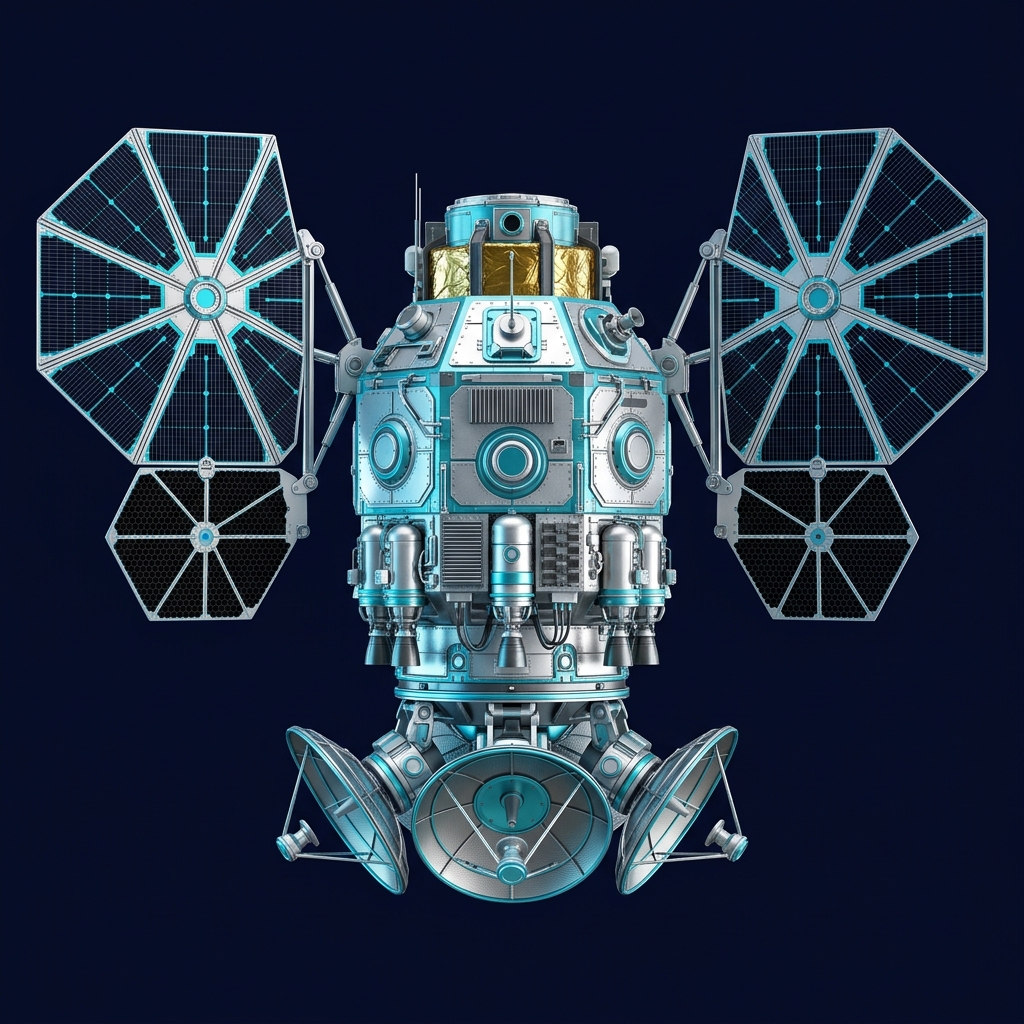
Satellite Components
Solar Panels
power generation
Transponder Module
communication payload
Antenna Arrays
signal transmission
Attitude Control System
orientation
Thermal Control Panels
heat management
Battery / Power Subsystem
power & routing
PAYLOAD
Communication transponders
Antennas & signal processors
Mission-specific instruments
BUS (Spacecraft Bus)
Power, thermal, propulsion
Attitude & orbit control
Command & data handling
09
Transponder Function
Receive → Amplify → Frequency Shift → Retransmit
Frequency shifted to avoid interference
6 GHz (C-band)
4 GHz (C-band)
RECEIVE
Antenna
FILTER
Bandpass
LNA
Low Noise Amplifier
CONVERTER
Frequency Shift
HPA
Power Amplifier
TRANSMIT
Antenna
10
Frequency Bands
11
Multiple Access Techniques
FDMA
Frequency Division
Each user gets a different frequency
Continuous transmission
Used in early satellite systems
TDMA
Time Division
Users share frequency in time slots
Burst transmission
More efficient than FDMA
CDMA
Code Division
Users share full bandwidth using codes
Highly interference-resistant
Used in GPS, 3G networks
📺
Direct-to-Home TV
DTH broadcasting, 500+ channels (TATA Sky, Dish TV)
🛰️
GPS & Navigation
Precise location tracking, aviation, maritime
🌐
Broadband Internet
High-speed internet in remote areas (Starlink, HughesNet)
🌦️
Weather Forecasting
Real-time cloud imagery, cyclone tracking, INSAT
🆘
Disaster Management
Emergency comms, search & rescue coordination
🪖
Military & Defense
Secure encrypted communications, reconnaissance
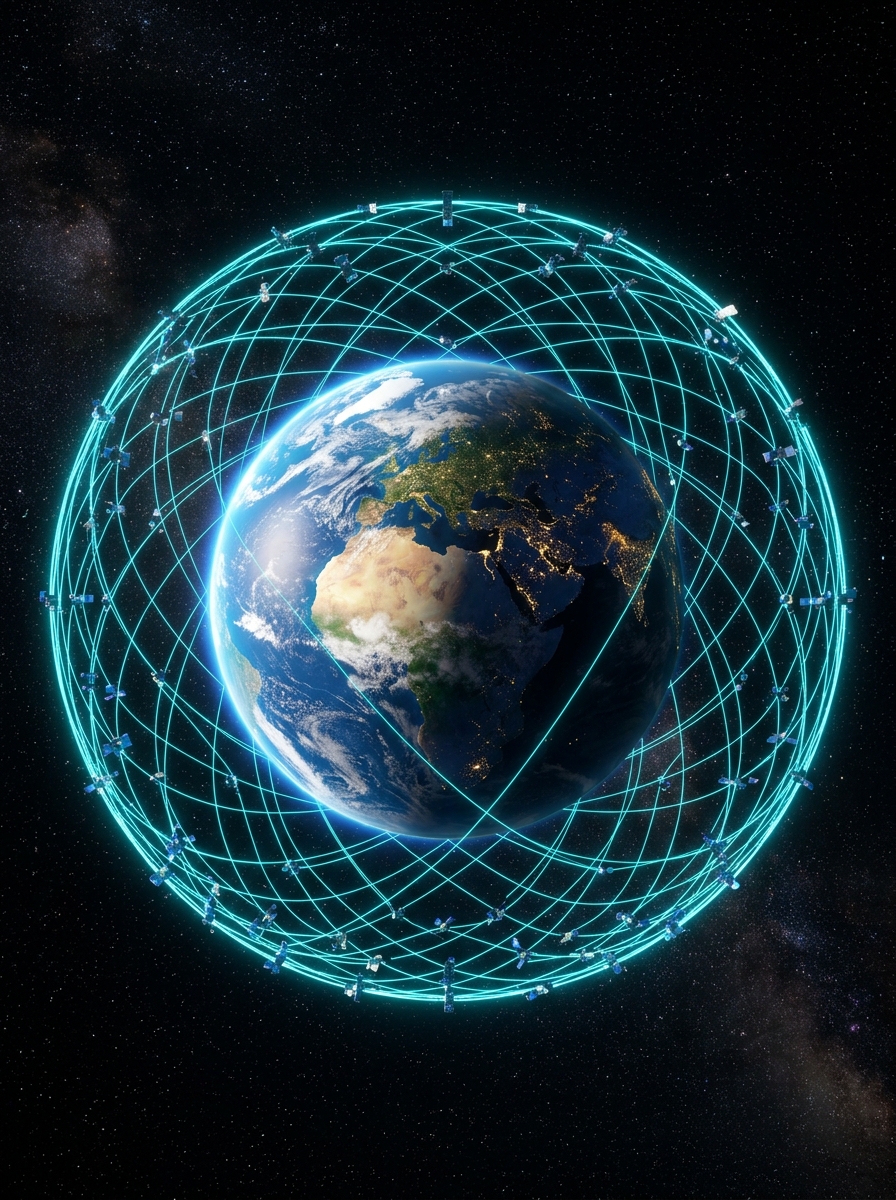
Case Study: Starlink
SpaceX LEO Satellite Internet Network
<strong style="color: #FFFFFF; font-weight: 700;">5,000+ Satellites</strong> in orbit (2024)
<strong style="color: #FFFFFF; font-weight: 700;">Altitude:</strong> 550 km — Low Earth Orbit
<strong style="color: #FFFFFF; font-weight: 700;">Latency:</strong> 20–40 ms (vs 600ms GEO)
<strong style="color: #FFFFFF; font-weight: 700;">Coverage:</strong> 60+ Countries worldwide
<strong style="color: #FFFFFF; font-weight: 700;">Speed:</strong> Up to 200 Mbps download
<strong style="color: #FFFFFF; font-weight: 700;">Goal:</strong> Global broadband internet access
First major LEO mega-constellation — <span style="color: #00CFFF; font-weight: 600;">disrupting traditional satellite internet</span>
14
Advantages & Limitations
✅ Advantages
⚠ Limitations
Wide geographic coverage
— global reach
Serves remote/rural areas
— no infrastructure needed
Reliable during disasters
— independent of ground networks
Supports multiple services
— TV, internet, GPS simultaneously
Scalable
— easy to expand coverage
High propagation delay
— 270ms+ for GEO
Expensive to launch
— $100M+ per mission
Signal attenuation
— rain fade, atmospheric loss
Limited bandwidth
— spectrum congestion issues
Space debris
— collision risk in crowded orbits
NOW — 2024
LEO Mega-Constellations
Starlink, OneWeb, Amazon Kuiper
10,000+ satellites planned
2025–2026
5G & Satellite Integration
Non-Terrestrial Networks (NTN)
Seamless mobile-satellite handoff
2027–2028
High-Throughput Satellites
1 Tbps+ capacity satellites
Ultra-fast broadband globally
2029–2030
Quantum Satellite Comm.
Quantum key distribution
Unbreakable encryption
2030+
Lunar & Deep Space Networks
Moon/Mars communication
Inter-planetary internet
- satellite-communication
- telecommunications
- aerospace-engineering
- starlink
- leo-orbit
- wireless-technology
- electronics