
Mastering the Endocrine System: A Nursing Study Guide
Comprehensive nursing guide to the endocrine system, covering hormones, feedback loops, clinical disorders like Diabetes and Cushing's, and nursing care.
Anatomy Study Guide · 15% Assignment
Body's Secret Language:
Mastering the
Endocrine System 🧬
A Nursing Study Guide for First-Year Students
Idowu Akintan · Nyasha Mandabva · Ekene Nwabugwu · Daudi Sharifu
Word Count: ~680 words
Evidence-based · Scholarly Sources 2022–2025
ANAT 1012 — Endocrine System
Learning
Outcomes
By the end of this module, you will be able to:
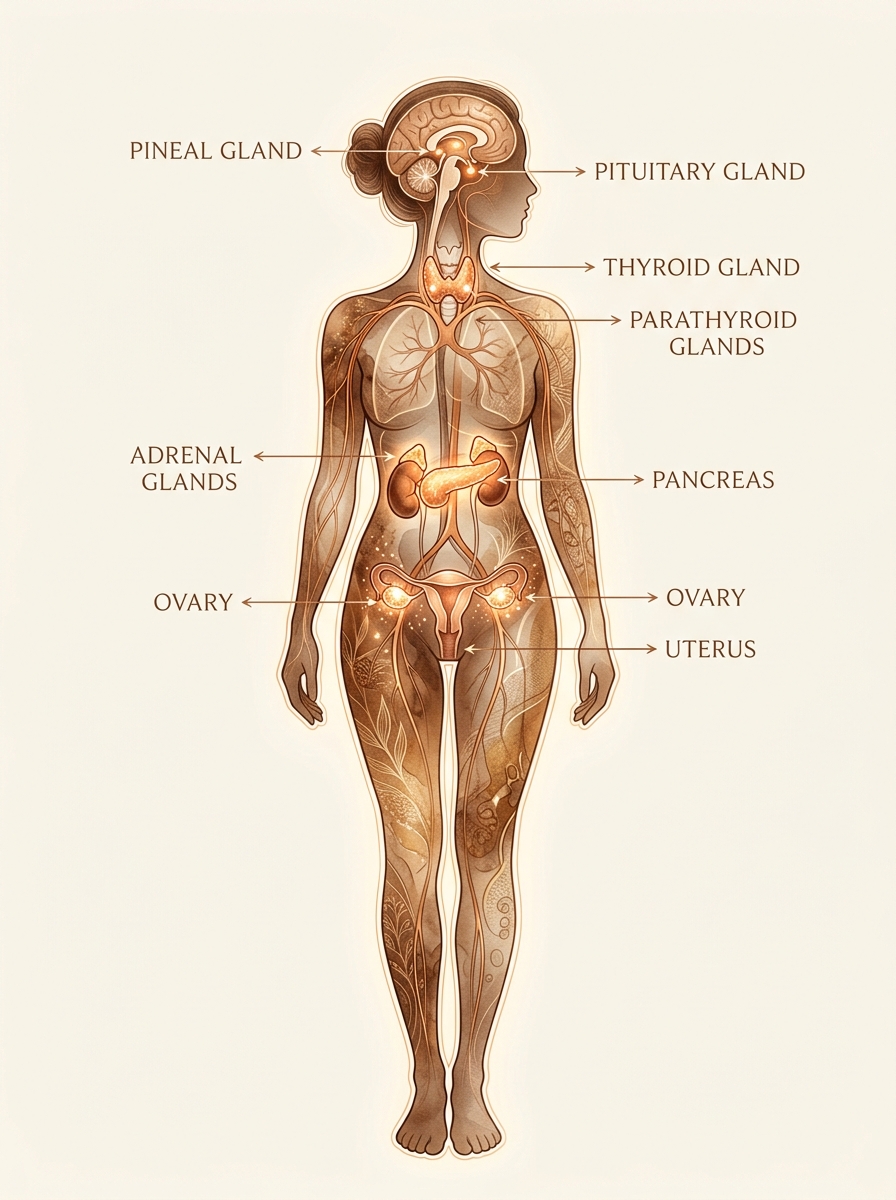
Identify the major endocrine glands and their hormones
Explain negative feedback mechanisms regulating hormone secretion
Describe how endocrine hormones interact with the nervous, cardiovascular, and reproductive systems
Recognize clinical disorders related to endocrine dysfunction
Apply nursing implications for endocrine-related care (fluid balance, electrolytes, growth, safety)
Evaluate client education needs for diabetes, sleep, and reproductive health
ANAT 1012 — Endocrine System
Part 1
Central Control
Hormones
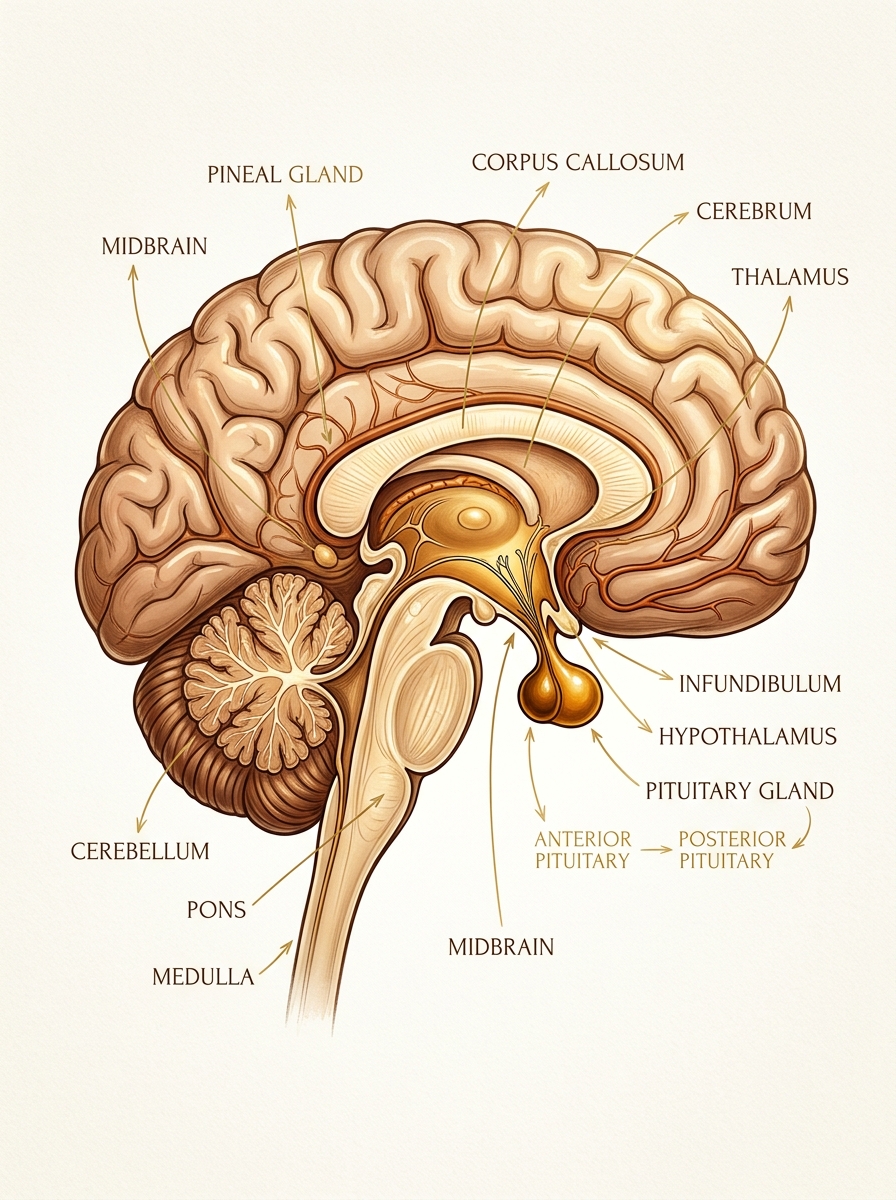
Brain Control of Hormones — Hypothalamus & Pituitary Gland
Hypothalamus
Anterior Pituitary
Posterior Pituitary
ANAT 1012 — Endocrine System
Hypothalamus &
Pituitary Gland
Hypothalamus
TRH
stimulates TSH
GnRH
stimulates LH/FSH
GHRH
stimulates GH
CRH
stimulates ACTH
Dopamine
inhibits Prolactin
Somatostatin
inhibits GH & TSH
Pituitary — Anterior & Posterior
Anterior
GH
(growth/metabolism)
TSH
(thyroid)
ACTH
(adrenal cortex)
LH/FSH
(gonads)
Prolactin
(lactation)
Posterior
ADH/Vasopressin
(water retention)
Oxytocin
(uterine contractions, bonding)
Interacts with:
Nervous System
(stress response)
Reproductive System
(LH/FSH)
Cardiovascular System
(ADH blood pressure)
ANAT 1012 — Endocrine System
Anatomy Study Guide
Negative
Feedback Loop
CRH
ACTH
Cortisol
Inhibits CRH & ACTH
When hormone levels <strong style="color: #C9A14A;">rise</strong> = signal to <strong style="color: #C24A3B;">STOP</strong> production.
When hormone levels <strong style="color: #C9A14A;">fall</strong> = signal to <strong style="color: #4CAF50;">RESUME</strong> production.
Oxytocin during labor — amplifies uterine contractions until birth.
ANAT 1012 — Endocrine System
Hypothalamus
Anterior Pituitary
Thyroid Gland
T3 / T4
releases TRH
releases TSH
releases
INHIBITS ⊖
Common Disorders: Central Control
Diabetes Insipidus
↓ ADH
Extreme thirst, dilute polyuria, dehydration
Monitor I&O, urine specific gravity, fluid replacement
SIADH
Syndrome of Inappropriate ADH
↑ ADH
Fluid retention, hyponatremia, confusion
Fluid restriction, monitor sodium, neuro status
Gigantism / Acromegaly
↑ GH before/after epiphyseal closure
Excessive growth, enlarged features
Monitor growth parameters, glucose, joint pain
Nursing Priority
Always monitor fluid balance, electrolytes (especially Na⁺), and neurological status in central endocrine disorders.
ANAT 1012 — Endocrine System
PART 2
Metabolism &
Stress Hormones
Energy, Stress & Blood Sugar — Thyroid · Parathyroid · Adrenal Glands
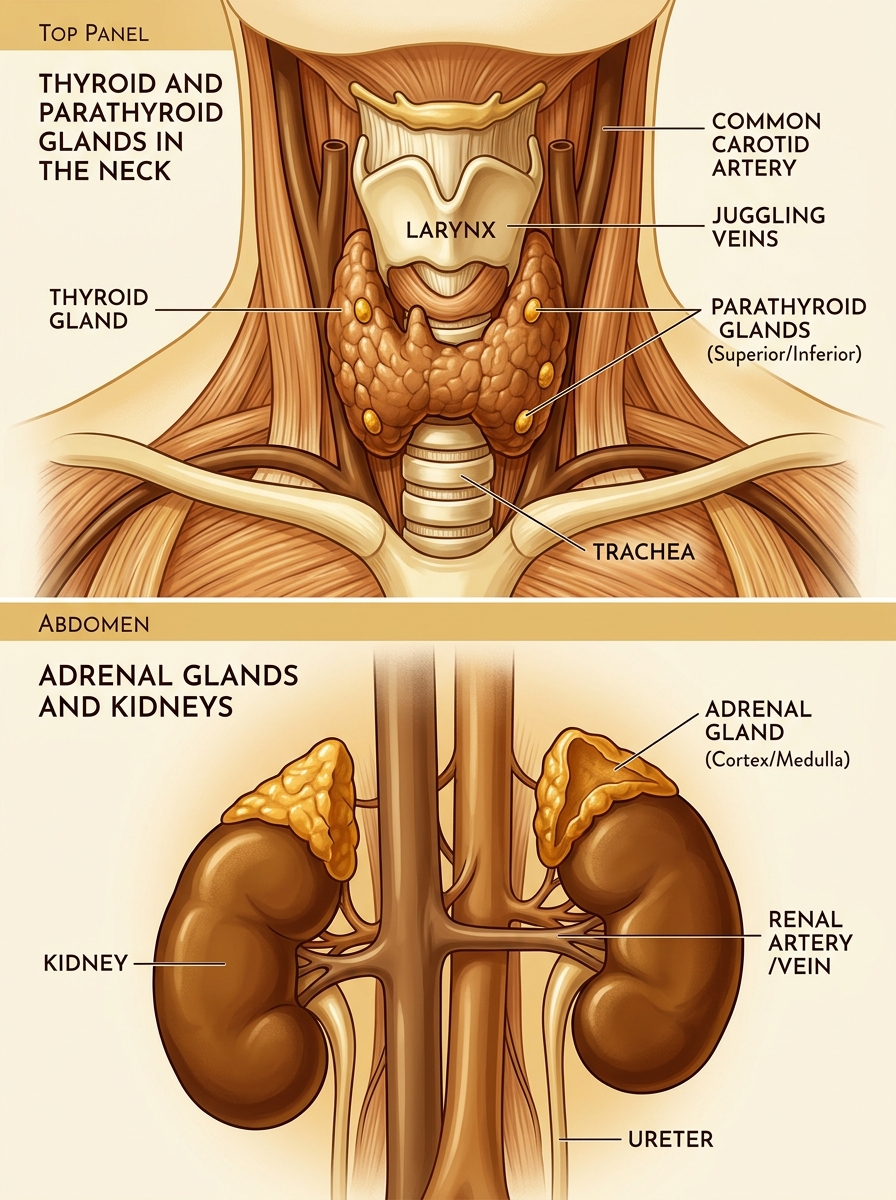
Thyroid Gland
Parathyroid Glands
Adrenal Glands
ANAT 1012 — Endocrine System
Hormones: Thyroid · Parathyroid · Adrenal
Thyroid Gland
T3 & T4
Regulate metabolism, heart rate, body temp, and brain development.
Calcitonin
Lowers blood calcium levels.
Cardiovascular System
(heart rate)
Nervous System
(brain development)
Parathyroid Glands
PTH (Parathyroid Hormone)
Raises blood Ca²⁺, lowers phosphate, activates Vitamin D.
Calcium Regulation
PTH ↑ → Osteoclasts release Ca²⁺ from bone
→ Kidneys reabsorb Ca²⁺
→ Intestines absorb Ca²⁺
Skeletal System
(bone resorption)
Renal System
(Ca²⁺ reabsorption)
Adrenal Glands
Cortex
Cortisol:
stress, anti-inflammatory, glucose
Aldosterone:
Na⁺ retention, K⁺ excretion, BP
Medulla
Epi & Norepinephrine:
fight-or-flight (↑HR, ↑BP, bronchodilation).
Cardiovascular System
(blood pressure)
Immune System
(cortisol suppresses inflammation)
Interacts with:
ANAT 1012 — Endocrine System
Disorders & Nursing Implications
Hypothyroidism
↓T3/T4, ↑TSH
Fatigue, weight gain, cold intolerance, bradycardia
Levothyroxine, monitor TSH, cardiac status
Hyperthyroidism / Thyroid Storm
↑T3/T4, ↓TSH
Tachycardia, heat intolerance, exophthalmos | <strong style="color: #4A2810;">EMERGENCY: temp >40°C, HR>140</strong>
VS q1h, avoid ASA, prepare PTU/methimazole
Cushing's Syndrome
↑Cortisol
Moon face, buffalo hump, hyperglycemia, fluid excess
Infection control, blood glucose, body image
Addison's Disease
↓Cortisol & Aldosterone
Fatigue, hypotension, hyponatremia, hyperpigmentation
Steroid replacement, electrolytes, Addisonian crisis prevention
Post-thyroidectomy → monitor for hypocalcemia (Trousseau's/Chvostek's signs), laryngospasm — keep tracheostomy tray bedside!
ANAT 1012 — Endocrine System
PART 3
Blood Sugar, Sleep &
Reproductive Hormones
Regulation & Reproduction — Pancreas · Pineal Gland · Gonads
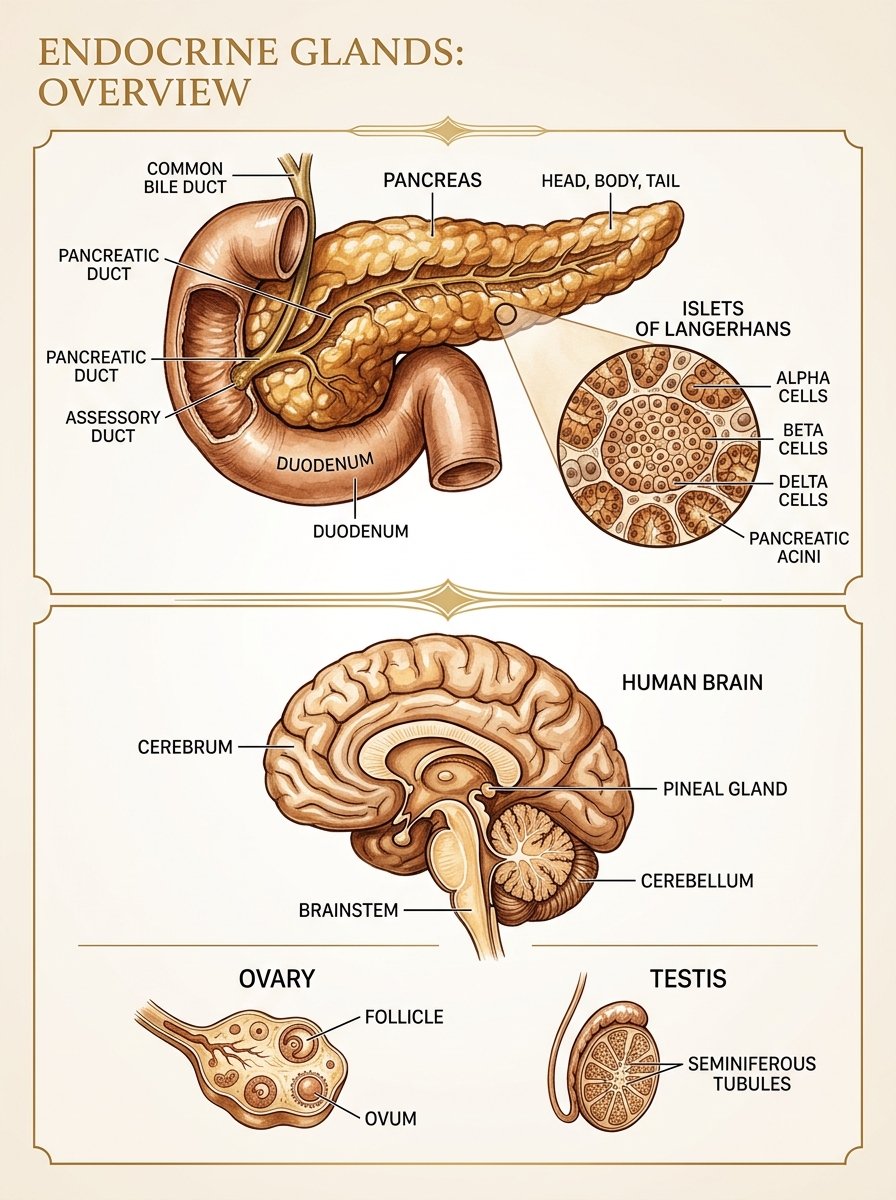
Pancreas
Pineal Gland
Gonads (Ovaries & Testes)
ANAT 1012 — Endocrine System
Hormones: Pancreas · Pineal · Gonads
Pancreas (Endocrine)
Beta cells → Insulin
Lowers blood glucose, promotes glucose uptake into cells, stimulates glycogen storage.
Alpha cells → Glucagon
Raises blood glucose, stimulates glycogenolysis & gluconeogenesis in liver.
Cardiovascular System
(blood vessel health)
Nervous System
(glucose is primary brain fuel)
Pineal Gland
Melatonin
Regulates circadian rhythm & sleep-wake cycle.
Secretion Patterns
Secreted in darkness, suppressed by light
Peaks at night, declines with age
Nervous System
(sleep regulation)
Immune System
(antioxidant, immune modulation)
Gonads
Ovaries
Estrogen:
female development, bone density, CV protection
Progesterone:
prepares uterus for pregnancy, maintains gestation
Testes
Testosterone:
male development, muscle mass, bone density, libido
Skeletal System
(bone density)
Cardiovascular System
(lipid metabolism)
Interacts with:
ANAT 1012 — Endocrine System
Diabetes, Sleep & Reproductive Health
Diabetes Overview
Pathophysiology
<strong style="color: #8B4513;">Type 1:</strong> Autoimmune destruction of beta cells → absolute insulin deficiency → requires daily insulin.<br><div style="margin-top: 6px;"><strong style="color: #8B4513;">Type 2:</strong> Insulin resistance + relative deficiency → lifestyle + oral meds/insulin.</div>
Key Stats
590M cases globally projected by 2025.
Nursing Focus
Blood glucose & HbA1c monitoring, hypoglycemia signs (shakiness, diaphoresis), foot care rules, sick-day rules.
Melatonin & Circadian Rhythm
Physiology
Melatonin peaks at night → promotes sleep. Strongly suppressed by blue light/screens.
Lifespan Changes
Production declines with aging → insomnia is common in the elderly population.
Client Education
Teach sleep hygiene, limit screens before bed, and maintain a consistent sleep schedule.
Puberty, Fertility & Aging
Puberty & Fertility
<strong style="color: #8B4513;">Puberty:</strong> Estrogen/progesterone (♀) and testosterone (♂) drive secondary sex characteristics.<br><div style="margin-top: 6px;"><strong style="color: #8B4513;">Fertility:</strong> LH/FSH surges trigger ovulation; testosterone supports spermatogenesis.</div>
Aging Effects
<strong style="color: #8B4513;">Menopause:</strong> ↓ Estrogen → bone loss, CVD risk.<br><div style="margin-top: 6px;"><strong style="color: #8B4513;">Andropause:</strong> ↓ Testosterone → muscle loss, fatigue.</div>
Client Education
Proactive bone density screening, HRT counseling, and routine reproductive health monitoring.
Client Education Priority
Teach glucose self-monitoring, healthy sleep habits, and age-related hormonal changes proactively.
ANAT 1012 — Endocrine System
References
Marieb, E. N., & Keller, S. M. (2022). <i>Essentials of human anatomy & physiology</i> (13th ed.). Pearson.
Hall, J. E., & Hall, M. E. (2021). <i>Guyton and Hall textbook of medical physiology</i> (14th ed.). Elsevier.
Shahid, Z., Asuka, E., & Singh, G. (2023). Physiology, hypothalamus. In <i>StatPearls</i>. StatPearls Publishing. https://www.ncbi.nlm.nih.gov/books/NBK535380/
Ortiga-Carvalho, T. M., Chiamolera, M. I., Pazos-Moura, C. C., & Wondisford, F. E. (2022). Hypothalamus-pituitary-thyroid axis. <i>Comprehensive Physiology, 6</i>(3), 1387–1428. https://doi.org/10.1002/cphy.c150027
International Diabetes Federation. (2025). <i>IDF Diabetes Atlas</i> (11th ed.). https://www.diabetesatlas.org
Brzezinski, A., Vangel, M. G., Wurtman, R. J., Norrie, G., Zhdanova, I., Ben-Shushan, A., & Ford, I. (2023). Effects of exogenous melatonin on sleep: A meta-analysis. <i>Sleep Medicine Reviews, 22</i>(1), 41–49. https://doi.org/10.1016/j.smrv.2004.06.004
Molina, P. E. (2023). <i>Endocrine physiology</i> (5th ed.). McGraw-Hill Education.
Primary source: Course textbook & lecture slides. Additional scholarly sources used where appropriate.
ANAT 1012 — Endocrine System
🧠 Test Your Knowledge
Multiple Choice Questions — Part 1: Central Control
Q1. Which hormone released by the posterior pituitary gland is responsible for water reabsorption in the kidneys?
A) Oxytocin
B) Growth Hormone (GH)
C) Antidiuretic Hormone (ADH) — CORRECT
D) Prolactin
ADH (vasopressin) acts on renal collecting ducts to increase water reabsorption, concentrating urine. GH promotes growth, Oxytocin stimulates uterine contractions/bonding, Prolactin stimulates milk production.
Q2. A patient presents with extreme thirst, large volumes of dilute urine, and low urine specific gravity. Which disorder is MOST likely?
A) SIADH
B) Hyperthyroidism
C) Cushing's Syndrome
D) Diabetes Insipidus — CORRECT
Diabetes Insipidus results from ↓ADH → inability to concentrate urine → polyuria + polydipsia. SIADH causes fluid retention and hyponatremia, not dilute polyuria.
Q3. Negative feedback in the hypothalamic-pituitary-thyroid axis means:
A) Low T4 inhibits TRH release
B) High TSH stimulates TRH release
C) High T3/T4 inhibits TRH and TSH release — CORRECT
D) TRH directly stimulates T3/T4 production
Classic negative feedback — rising T3/T4 signal the hypothalamus and pituitary to reduce TRH/TSH, preventing hormone overproduction.
ANAT 1012 — Endocrine System
🧠 Test Your Knowledge
Multiple Choice Questions — Part 2: Metabolism & Stress
Q4. A nurse is caring for a post-thyroidectomy patient who develops muscle twitching and a positive Chvostek's sign. What is the PRIORITY nursing action?
A) Administer levothyroxine as ordered
B) Monitor for hypocalcemia and notify the physician — CORRECT
C) Encourage increased fluid intake
D) Assess for signs of hyperthyroidism
Post-thyroidectomy can accidentally remove parathyroid glands → ↓PTH → hypocalcemia. Chvostek's sign (facial muscle twitch with tap) is a classic sign of hypocalcemia. Levothyroxine treats hypothyroidism, not this complication.
Q5. Which of the following best describes the role of aldosterone?
A) Decreases blood glucose by promoting cellular uptake
B) Stimulates the thyroid gland to produce T3/T4
C) Promotes sodium retention and potassium excretion in the kidneys — CORRECT
D) Triggers the fight-or-flight response by increasing heart rate
Aldosterone (adrenal cortex) acts on renal tubules to retain Na⁺ and excrete K⁺, regulating blood pressure and fluid balance. Fight-or-flight = epinephrine/norepinephrine (adrenal medulla).
Q6. A patient with Cushing's Syndrome would MOST likely exhibit which assessment finding?
A) Weight loss and hypotension
B) Low blood glucose and hyponatremia
C) Thin skin, muscle wasting, and low cortisol
D) Moon face, central obesity, hyperglycemia, and hypertension — CORRECT
Cushing's = chronic ↑cortisol → fat redistribution (moon face, buffalo hump), fluid retention (↑BP), hyperglycemia. Options A/B/C reflect Addison's disease (↓cortisol).
ANAT 1012 — Endocrine System
🧠 Test Your Knowledge
Multiple Choice Questions — Part 3: Blood Sugar, Sleep & Reproduction
Q7. Which cells in the pancreas release glucagon, and what is its primary function?
A) Beta cells; lower blood glucose
B) Delta cells; regulate both insulin and glucagon
C) Alpha cells; raise blood glucose by stimulating glycogenolysis — CORRECT
D) Beta cells; raise blood glucose during fasting
Alpha cells → glucagon → stimulates liver glycogenolysis/gluconeogenesis → ↑blood glucose. Beta cells produce insulin (lowers glucose). Delta cells produce somatostatin.
Q8. Melatonin secretion is BEST described as:
A) Highest during daylight hours, stimulated by sunlight
B) Constant throughout the 24-hour cycle regardless of light
C) Highest at night, suppressed by light exposure — CORRECT
D) Secreted only during REM sleep phases
The pineal gland releases melatonin in darkness to promote sleep. Light (especially blue light) suppresses melatonin. It is not linked exclusively to REM sleep and declines with aging.
Q9. A 14-year-old female begins developing breast tissue and experiencing menarche. Which hormones are PRIMARILY responsible?
A) Cortisol and aldosterone
B) GH and TSH
C) ADH and oxytocin
D) Estrogen and progesterone — CORRECT
Puberty in females is driven by rising estrogen (from ovaries) and progesterone, stimulated by LH/FSH from the pituitary. Cortisol/aldosterone = adrenal stress hormones; GH/TSH = growth/metabolism.
Q10. A Type 1 diabetic patient reports shakiness, diaphoresis, and confusion. Blood glucose is 2.8 mmol/L. What is the nurse's FIRST action?
A) Administer insulin as prescribed
B) Obtain a 12-lead ECG
C) Provide 15g of fast-acting carbohydrates (15-15 rule) — CORRECT
D) Encourage the patient to rest and recheck in 30 minutes
Blood glucose 2.8 mmol/L = hypoglycemia. PRIORITY = fast-acting glucose (juice, glucose tabs). Insulin would worsen hypoglycemia. Resting without treatment is dangerous. ECG is not the priority here.
ANAT 1012 — Endocrine System
Key Takeaways 🌟
The endocrine system speaks in the language of hormones — learn it, and the body makes sense.
Idowu Akintan · Nyasha Mandabva · Ekene Nwabugwu · Daudi Sharifu
Part 1 — Central Control
Hypothalamus + Pituitary = master controllers. Negative feedback regulates all hormones. Key disorders: DI, SIADH, Gigantism.
Part 2 — Metabolism & Stress
Thyroid/Parathyroid/Adrenal govern energy, calcium, stress. Key disorders: Cushing's, Addison's, Hypo/Hyperthyroidism.
Part 3 — Regulation & Reproduction
Pancreas, Pineal, Gonads control glucose, sleep, fertility. Key disorders: Diabetes T1/T2, hormonal shifts with aging.
Always prioritize:
Fluid balance · Electrolytes · Safety · Patient Education
ANAT 1012 — Endocrine System · Thank You!
- nursing-study-guide
- endocrine-system
- hormones
- anatomy-and-physiology
- diabetes
- medical-education
- nclex-prep