




Made byBobr AI

Thermal EMF Measurement and Seebeck Effect Experiment

Learn how to determine thermal EMF and plot temperature vs. EMF diagrams using a potentiometer in this comprehensive physics laboratory guide.

#physics-experiment#seebeck-effect#thermocouple#thermal-emf#potentiometer#thermoelectricity#laboratory-manual
Watch
Pitch

Determination of Thermal EMF

Experiment: Plotting the Temperature vs. EMF Diagram Using a Potentiometer

Department of Physics | Undergraduate Laboratory

Made byBobr AI

Objective of the Experiment

  • To understand the principle of the Seebeck Effect.
  • To calibrate a thermocouple (e.g., Copper-Constantan) using a potentiometer.
  • To plot the calibration curve: Temperature Difference (θ) vs. Thermo-EMF (E).
vector illustration of a physics lab setup, clean minimalist style, scientific equipment icons
Made byBobr AI

Theory: The Seebeck Effect

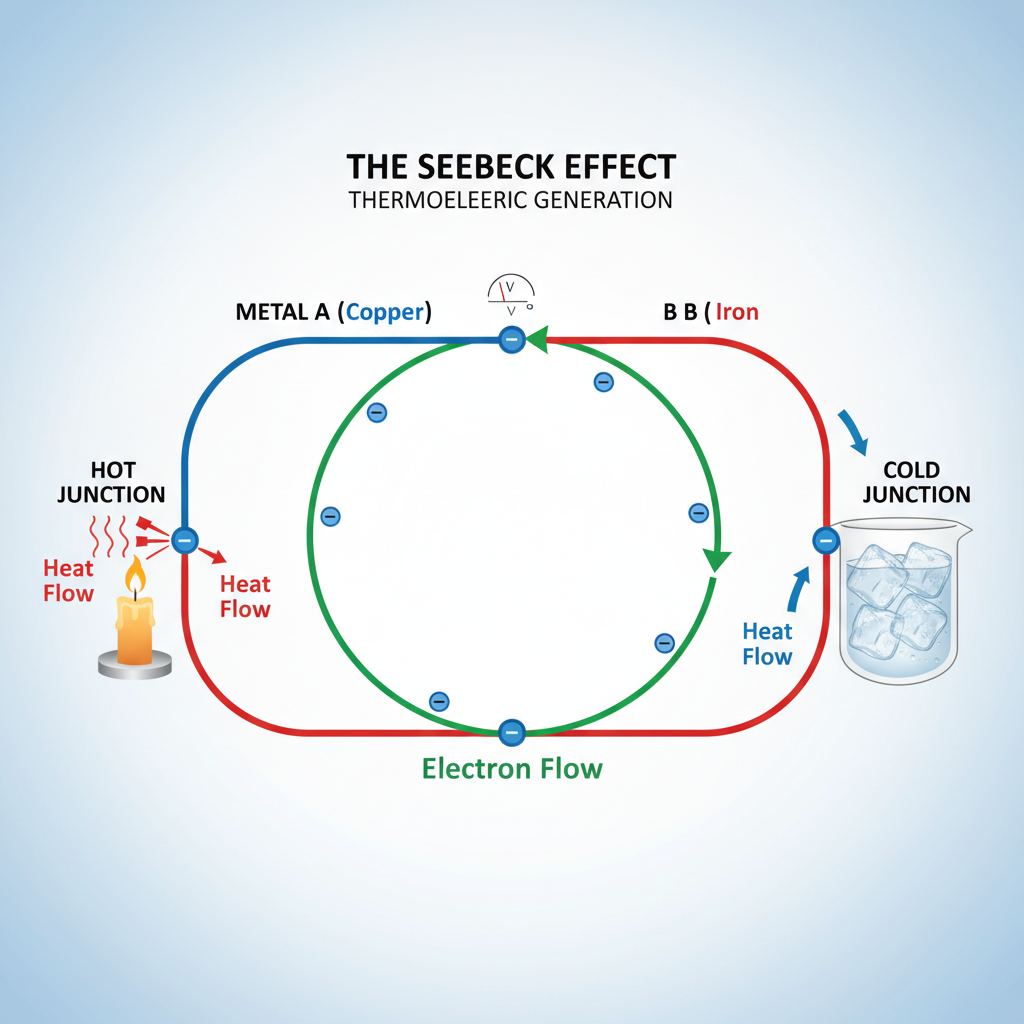
When two dissimilar metals are joined to form a closed loop and the two junctions are maintained at different temperatures, an electromotive force (EMF) is induced. This is known as the thermal EMF.

E = aθ + bθ²

Where 'E' is the thermo-EMF, 'θ' is the temperature difference between hot and cold junctions, and 'a' and 'b' are constants depending on the metals.

Diagram illustrating the Seebeck effect, loop of two different metals, one junction hot candle one junction ice cold, electron flow arrows, scientific educational diagram
Made byBobr AI

Experimental Apparatus

  • Potentiometer (Measurement Device)
  • Thermocouple (Copper-Constantan or Chromel-Alumel)
  • Sensitive Galvanometer & Jockey
  • Stable DC Source (Battery Eliminator/Accumulator)
  • Two Beakers (Ice Bath & Sand/Water Bath) + Thermometers
physics laboratory potentiometer wooden board with sliding jockey and wires, realistic photo

Typical Potentiometer Setup

Made byBobr AI

Circuit Diagram

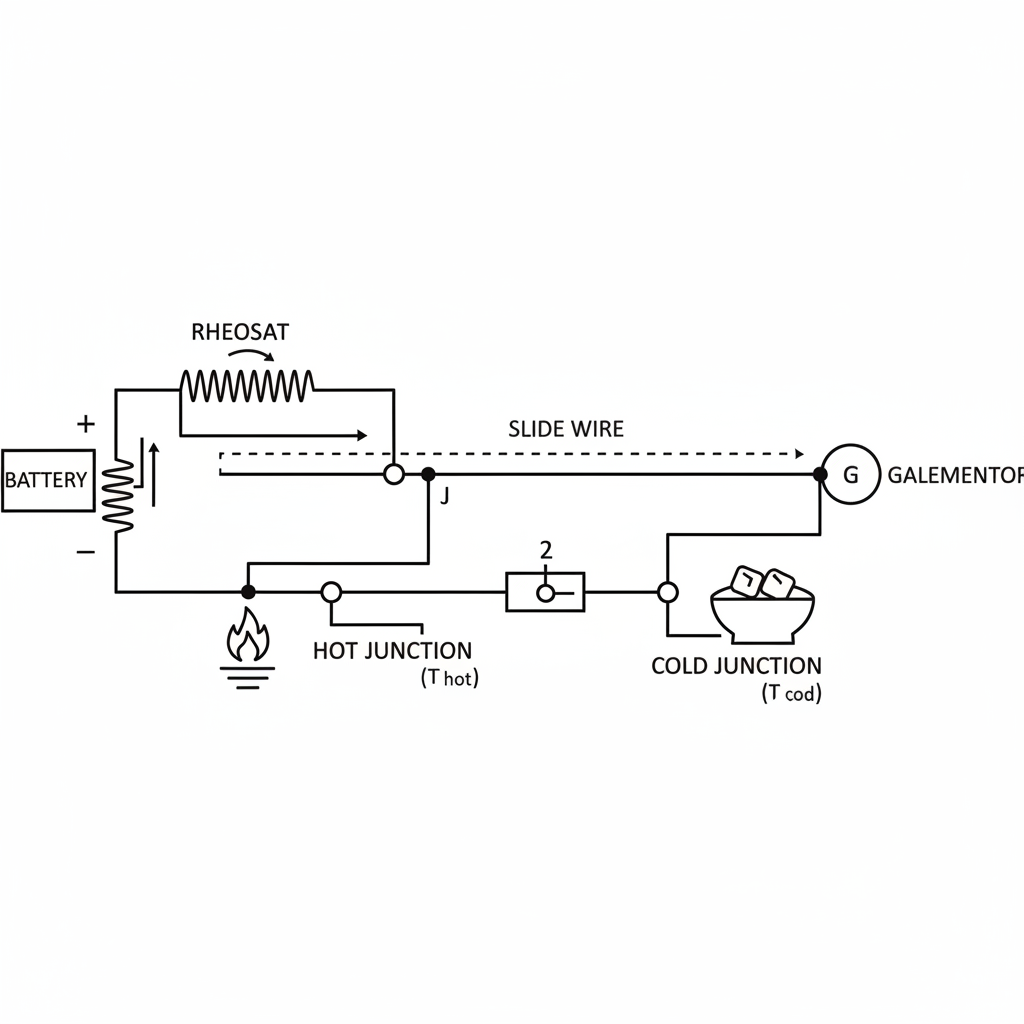
Schematic circuit diagram of a potentiometer connected to a thermocouple, clear lines, white background, physics textbook diagram style. Shows battery, rheostat, slide wire, galvanometer, and thermocouple junctions.

The potentiometer measures the small EMF generated by the thermocouple without drawing current (Null Method). The cold junction is kept at 0°C (Ice), and the hot junction is heated gradually.

Made byBobr AI

Procedure: Initial Setup

1. Cleaning: Clean the ends of the thermocouple wires with sandpaper to ensure good electrical contact.

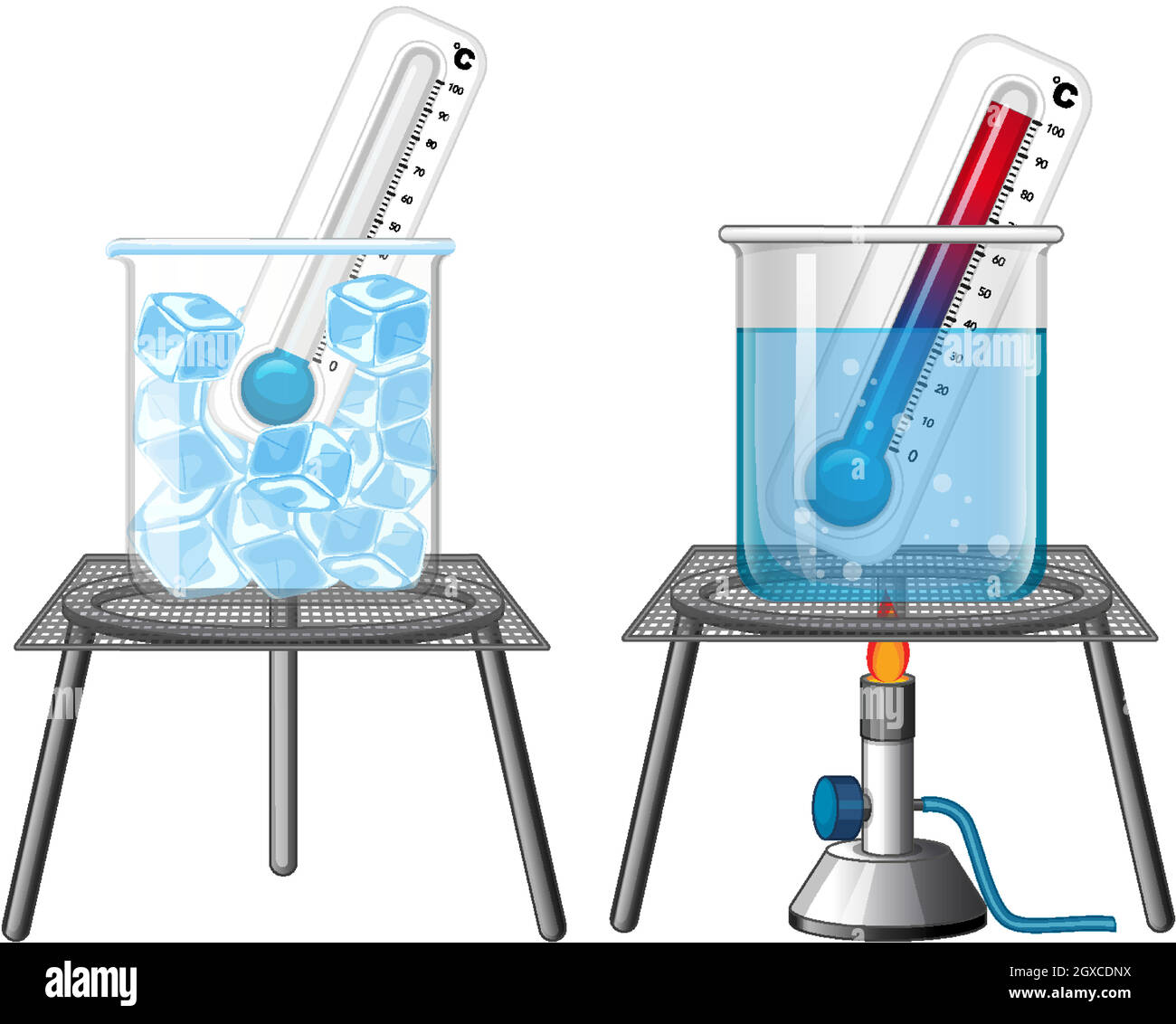
2. Junction Placement: Immerse one junction in a beaker of melting ice (Cold Junction at 0°C) and the other in a beaker of water/oil (Hot Junction).

3. Standardization: Connect the standard cell to the potentiometer and adjust the rheostat to standardize the wire (e.g., potential gradient k).

Photo of two beakers in a lab, one with ice and thermometer, one with water on a heater, connected by wires, physics experiment
Made byBobr AI

Procedure: Measurement

  • Heat the hot junction beaker slowly using a bunsen burner or electric heater.
  • For every 5°C or 10°C rise in temperature, insert the key and balance the potentiometer (find the null point length 'l').
  • Calculate EMF (E) using E = k × l (where k is the potential gradient). Record readings until water boils (~100°C).
icon or simple illustration of a thermometer rising in temperature, flat design
Made byBobr AI

Observation Table Format

Temp of Cold Junction (°C)Temp of Hot Junction (°C)Temp Diff θ (°C)Balancing Length l (cm)Thermal EMF E = kl (mV)
02020......
03030......
04040......
...............
Made byBobr AI

Results: Temperature vs. EMF Diagram

The graph plots Temperature Difference (X-axis) against the measured Thermal EMF (Y-axis). For lower temperature ranges (0-100°C), the relationship is approximately linear.

Chart
Made byBobr AI

Results & Discussion

1. Linearity: Linearity: The graph shows a nearly straight line passing through the origin, indicating that EMF is directly proportional to temperature difference (E ∝ θ) for this range.

2. Slope Analysis: Slope: The slope of the graph (dE/dθ) gives the thermoelectric power (Seebeck Coefficient) of the thermocouple pair.

3. Range Note: Neutral Temp: Within the 0-100°C range, the neutral temperature (where EMF peaks) is not reached for Cu-Constantan, hence no parabolic curve is observed.

abstract visualization of linear data growth, clean business/science graphic style, blue and grey
Made byBobr AI

Precautions and Sources of Error

• Keep the cold junction exactly at 0°C; replenish ice as needed.
• Ensure tight connections to minimize contact resistance.
• Stir the hot water bath continuously for uniform temperature measure.
• Avoid parallax error while reading the potentiometer scale.
3D render of a scientific warning symbol or attention icon, clean blue and white
Made byBobr AI

Conclusion

The thermal EMF was successfully determined for various temperatures. The Temperature vs. EMF diagram was plotted, verifying the Seebeck effect characteristics for the given thermocouple.

Thank you.

Made byBobr AI
Bobr AI

DESIGNER-MADE
PRESENTATION,
GENERATED FROM
YOUR PROMPT

Create your own professional slide deck with real images, data charts, and unique design in under a minute.

Generate For Free

Thermal EMF Measurement and Seebeck Effect Experiment

Learn how to determine thermal EMF and plot temperature vs. EMF diagrams using a potentiometer in this comprehensive physics laboratory guide.

Determination of Thermal EMF

Experiment: Plotting the Temperature vs. EMF Diagram Using a Potentiometer

Department of Physics | Undergraduate Laboratory

Objective of the Experiment

To understand the principle of the Seebeck Effect.

To calibrate a thermocouple (e.g., Copper-Constantan) using a potentiometer.

To plot the calibration curve: Temperature Difference (θ) vs. Thermo-EMF (E).

Theory: The Seebeck Effect

When two dissimilar metals are joined to form a closed loop and the two junctions are maintained at different temperatures, an electromotive force (EMF) is induced. This is known as the thermal EMF.

E = aθ + bθ²

Where 'E' is the thermo-EMF, 'θ' is the temperature difference between hot and cold junctions, and 'a' and 'b' are constants depending on the metals.

Experimental Apparatus

Potentiometer (Measurement Device)

Thermocouple (Copper-Constantan or Chromel-Alumel)

Sensitive Galvanometer & Jockey

Stable DC Source (Battery Eliminator/Accumulator)

Two Beakers (Ice Bath & Sand/Water Bath) + Thermometers

Circuit Diagram

The potentiometer measures the small EMF generated by the thermocouple without drawing current (Null Method). The cold junction is kept at 0°C (Ice), and the hot junction is heated gradually.

Procedure: Initial Setup

1. Cleaning: Clean the ends of the thermocouple wires with sandpaper to ensure good electrical contact.

2. Junction Placement: Immerse one junction in a beaker of melting ice (Cold Junction at 0°C) and the other in a beaker of water/oil (Hot Junction).

3. Standardization: Connect the standard cell to the potentiometer and adjust the rheostat to standardize the wire (e.g., potential gradient k).

Procedure: Measurement

Heat the hot junction beaker slowly using a bunsen burner or electric heater.

For every 5°C or 10°C rise in temperature, insert the key and balance the potentiometer (find the null point length 'l').

Calculate EMF (E) using E = k × l (where k is the potential gradient). Record readings until water boils (~100°C).

Observation Table Format

Temp of Cold Junction (°C)

Temp of Hot Junction (°C)

Temp Diff θ (°C)

Balancing Length l (cm)

Thermal EMF E = kl (mV)

Results: Temperature vs. EMF Diagram

The graph plots Temperature Difference (X-axis) against the measured Thermal EMF (Y-axis). For lower temperature ranges (0-100°C), the relationship is approximately linear.

Results & Discussion

Linearity: The graph shows a nearly straight line passing through the origin, indicating that EMF is directly proportional to temperature difference (E ∝ θ) for this range.

Slope: The slope of the graph (dE/dθ) gives the thermoelectric power (Seebeck Coefficient) of the thermocouple pair.

Neutral Temp: Within the 0-100°C range, the neutral temperature (where EMF peaks) is not reached for Cu-Constantan, hence no parabolic curve is observed.

Precautions and Sources of Error

• Keep the cold junction exactly at 0°C; replenish ice as needed.<br>• Ensure tight connections to minimize contact resistance.<br>• Stir the hot water bath continuously for uniform temperature measure.<br>• Avoid parallax error while reading the potentiometer scale.

Conclusion

The thermal EMF was successfully determined for various temperatures. The Temperature vs. EMF diagram was plotted, verifying the Seebeck effect characteristics for the given thermocouple.

Thank you.

  • physics-experiment
  • seebeck-effect
  • thermocouple
  • thermal-emf
  • potentiometer
  • thermoelectricity
  • laboratory-manual