
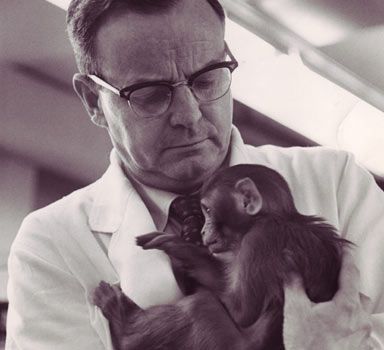
Harry Harlow & Attachment Theory: The Science of Love
Explore Harry Harlow's rhesus monkey experiments, the concept of contact comfort, and how they revolutionized our understanding of baby-caregiver bonding.
Psychology Presentation
HARRY HARLOW
& The Theory of Attachment
What makes us bond? 🐒
Harry Harlow (1905–1981)
Who Was Harry Harlow? 🧠
Born: October 31, 1905 — Fairfield, Iowa, USA
Education: Stanford University, Psychology
Career: University of Wisconsin–Madison
Died: December 6, 1981
Harry Harlow was an American psychologist famous for his rhesus monkey experiments. His work completely changed how scientists understood love, bonding, and attachment.
🐒
It's not just about food — it's about LOVE! ❤️
WHAT WAS HIS THEORY? 🤔
🍼
NOT JUST ABOUT FOOD
Before Harlow, scientists believed babies bonded with their mothers simply because they provided FOOD. This was known as the 'Cupboard Love' theory.
🤗
CONTACT COMFORT
Harlow proved that babies bond because of warmth, softness and physical touch — NOT just feeding. He called this powerful need 'Contact Comfort'.
🔐
SECURE BASE
A caring, warm attachment figure gives babies a 'secure base' to explore the world safely. Without this, emotional and social development suffers greatly.
❤️ Attachment = The emotional bond between a baby and its caregiver
The Famous Monkey Experiment 🐒
🔩 Wire Mother
🧸 Cloth Mother
💡 KEY FINDING: Monkeys chose COMFORT over FOOD — proving attachment is about warmth, not just feeding!
Made of bare wire
Had a milk bottle attached
Cold, hard, uncomfortable
Monkeys only visited to feed
Time spent: less than 1 hour per day
Result: Monkeys showed stress & anxiety
Covered in soft terry cloth
Warm and cuddly
No milk bottle
Monkeys clung to her for comfort
Time spent: 17–18 hours per day!
Result: Monkeys felt safe and secure
What Did Harlow Find Out? 🔍
💛
Comfort Over Food
Monkeys bonded with the soft cloth mother, NOT the wire mother with milk. Attachment is about warmth and comfort, not just feeding.
🏡
Secure Base
The cloth mother acted as a 'secure base'. Monkeys explored freely when she was nearby, but froze and panicked without her.
⏰
Critical Period
There is a critical window of 90 days. If monkeys were isolated longer than this, the psychological damage became permanent and irreversible.
😢
Deprivation = Damage
Monkeys raised in total isolation became aggressive, self-harming, unable to socialise, and were poor parents as adults.
🌍 Harlow's findings changed childcare, psychology and animal welfare laws forever!
Why Does It Matter? 🌟
✅ Strengths
Proved attachment is about love not food
Changed how hospitals & orphanages care for babies
Supported Bowlby's theory with real evidence
Highly controlled — reliable results
❌ Criticisms
Ethically wrong — caused animal suffering
Animal studies may not apply to humans
Only studied rhesus monkeys
Sparked the U.S. Animal Welfare Act (1966)
DID YOU KNOW? 🤯
Harlow's work helped spark the entire Animal Rights movement!
⭐
His research influenced the U.S. Animal Welfare Act (1966)
🌍 His legacy lives on in modern childcare, therapy, and animal welfare!
Summary: Key Takeaways 📝
💛
Attachment is about COMFORT, not food
🤗
Contact Comfort = warmth & soft touch
⏰
There is a CRITICAL PERIOD for attachment
😢
Isolation causes permanent psychological damage
🌍
Changed childcare & animal welfare laws
Love is a wondrous state, deep, tender, and rewarding.
— Harry Harlow
Thank you for listening! 🐒❤️
- psychology
- attachment-theory
- harry-harlow
- child-development
- rhesus-monkey-experiment
- behavioral-science