























Made byBobr AI

Fins & Frameworks: Fish Appendicular Skeleton Anatomy

Explore the structural anatomy and evolution of fish fins and girdles. Learn about the differences between bony and cartilaginous skeletal systems.

#ichthyology#fish-anatomy#zoology#vertebrate-anatomy#evolution#marine-biology
Watch
Pitch
ICHTHYOLOGY · VERTEBRATE ANATOMY
ENDOSKELETON
IN FISHES
Appendicular Skeleton
Structure · Girdles · Fins · Evolution
Zoology | Fish Anatomy
Made byBobr AI
CONTENTS
What We Will Cover
1
Introduction to Fish Endoskeleton
2
Overview of Appendicular Skeleton
3
Pectoral Girdle — Structure & Bones
4
Pectoral Fin Anatomy
5
Pelvic Girdle — Structure & Bones
6
Pelvic Fin Anatomy & Positions
7
Fin Ray Types: Spines vs Soft Rays
8
Evolutionary Adaptations
Made byBobr AI
03
INTRODUCTION TO FISH ENDOSKELETON
What is an Endoskeleton?
An endoskeleton is an internal framework of bones or cartilage that supports and protects the body of an organism. In fishes, it forms the structural foundation for movement, protection, and organ support.
Types of Fish Skeleton
Bony Fishes (Osteichthyes) — ossified endoskeleton
Cartilaginous Fishes (Chondrichthyes) — cartilaginous endoskeleton
Divisions of Fish Endoskeleton
AXIAL SKELETON
APPENDICULAR SKELETON
VISCERAL SKELETON
Ichthyology | Vertebrate Anatomy
Made byBobr AI
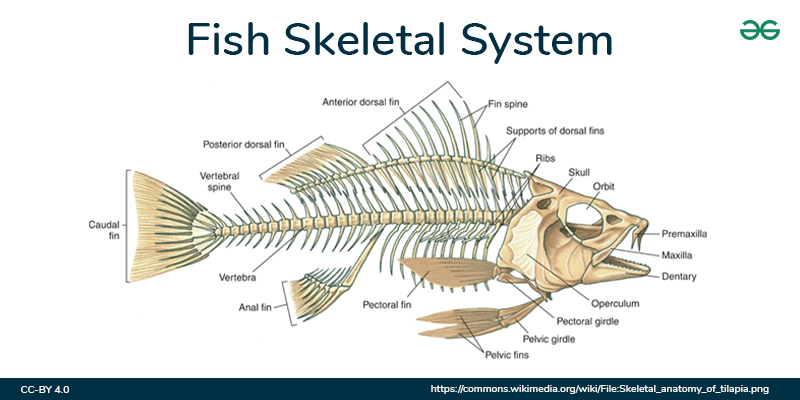
APPENDICULAR SKELETON — OVERVIEW
04
Definition
The appendicular skeleton consists of all paired fins and their supporting girdles. It is the fish equivalent of the limb skeleton in tetrapods.
Key Function: Locomotion, balance, steering and mating displays
Components
1
Pectoral Girdle
2
Pectoral Fins
3
Pelvic Girdle
4
Pelvic Fins
Paired fins = homologous to tetrapod limbs
PAIRED APPENDAGES
Zoology | Fish Anatomy
Made byBobr AI
05
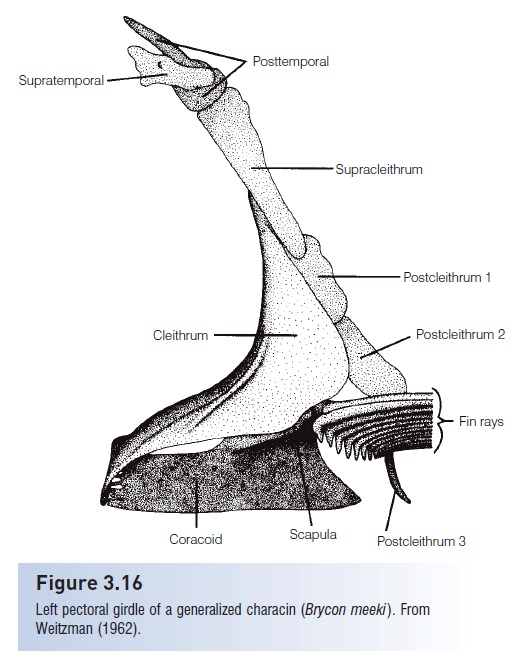
PECTORAL GIRDLE
Structure, Composition & Bone Elements
The pectoral girdle anchors the pectoral fins to the body. In bony fishes, it attaches to the skull rather than the vertebral column.
Endochondral Bones
  • Scapula
  • Anterior Coracoid
  • Mesocoracoid
    (in basal teleosts)
Dermal (Intramembranous) Bones
  • Cleithrum (always present)
  • Supracleithrum
  • Posttemporal
  • Clavicle (absent in some)
In cartilaginous fishes (sharks), the pectoral girdle is a single large SCAPULOCORACOID with scapular process, suprascapula, and coracoid bar.
Fig: Left Pectoral Girdle of a generalized bony fish
ICHTHYOLOGY | VERTEBRATE ANATOMY
Made byBobr AI
06
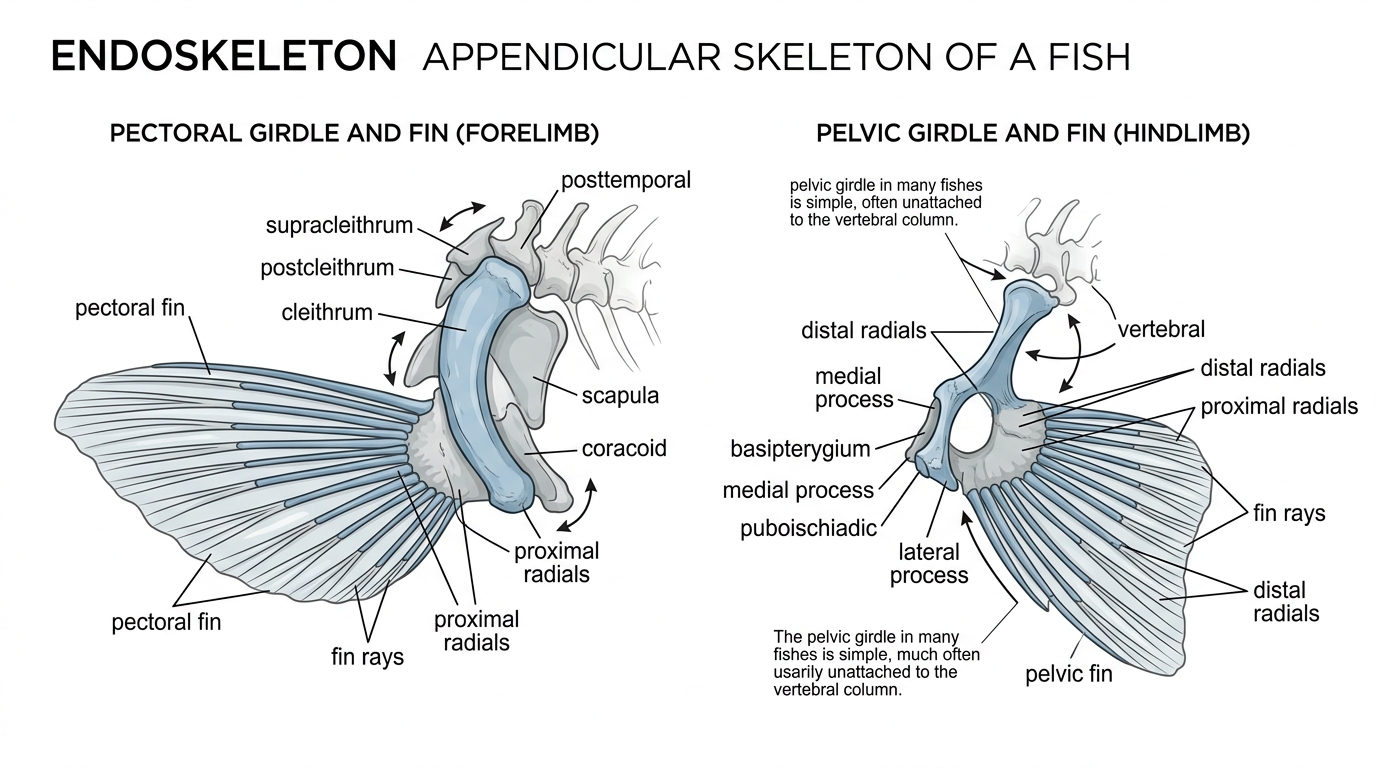
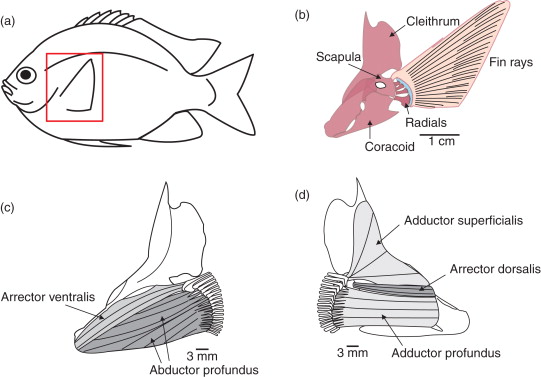
PECTORAL FIN ANATOMY
Skeletal Components & Radial Organization
CLEITHRUM
Crescent-shaped dermal bone
SCAPULA + CORACOID
Endochondral bones
MESOCORACOID
Connects cleithrum (lost in derived teleosts)
PROXIMAL RADIALS (PR)
Elongated bones, typically 4
DISTAL RADIALS (DR)
Granular connecting bones
FIN RAYS (FR)
Rod-shaped dermal terminal bones
🔹
4-Basal Rule: Most teleosts have 4 proximal radials
🔹
Mesocoracoid absent in advanced teleosts
🔹
Fin ray connections: 1-to-many (basal) vs 1-to-1 (derived)
Made byBobr AI
07
PROXIMAL RADIAL MORPHOLOGY
Evolutionary Shape Variations Across Teleosts
BASAL TELEOSTS
RECTANGULAR-TYPE
Adjacent along the long side. Found in basal teleosts.
Osteoglossomorpha, Otomorpha, Protacanthopterygii
DERIVED TELEOSTS
HOURGLASS-TYPE
Adjacent only at distal and proximal tips. Wide space in the middle.
Paracanthopterygii and Acanthopterygii
ADVANCED TELEOSTS
DUMBBELL-TYPE
Tightly adjacent with holes in mid-portion. Hollowed after chondrification.
Syngnatharia, Gobiaria, Eupercaria
Evolutionary Progression →
Pectoral Girdle Comparison
Made byBobr AI
PELVIC GIRDLE
Structure, Attachment & Composition
08
Unlike the pectoral girdle, the pelvic girdle in fishes is NOT attached to the vertebral column — it remains FREE within the body wall.
Bony Fishes
  • Composed only of ENDOCHONDRAL bone
  • Left & right pelvic girdles fused via PUBOISCHIAC BAR
  • Pelvic fins attach to BASIPTERYGIUM
  • Single element in most species
Cartilaginous Fishes (Sharks)
  • Single ACETABULUM where pelvic fin attaches
  • Small ILIAC PROCESS
    (comparable to scapular process)
  • No attachment to axial skeleton
!
The pelvic girdle arose from pterygophores and is fundamentally simpler than the tetrapod pelvis (which has pubis, ilium & ischium attached to vertebral column).
Pelvic Girdle Diagram
Fig: Fish Pectoral & Pelvic Girdles comparison
Made byBobr AI
09

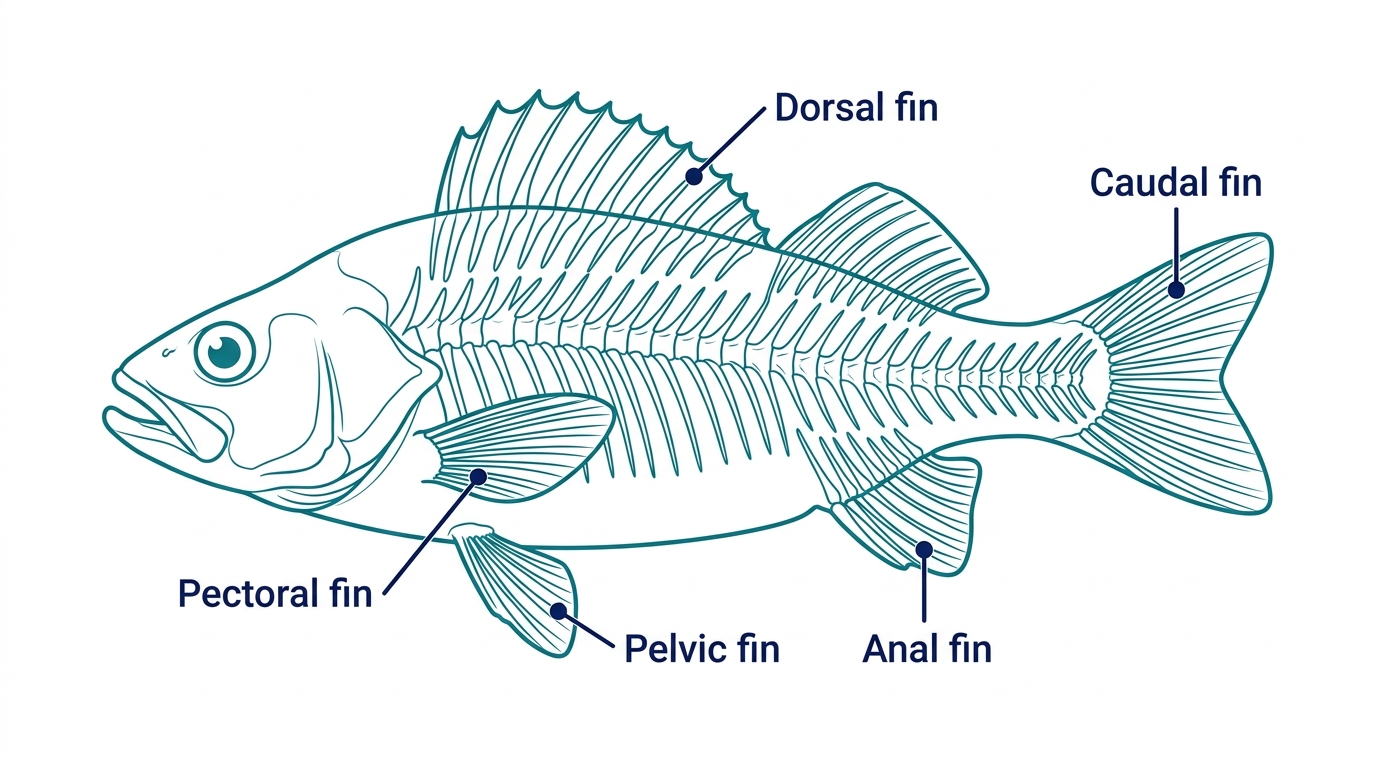
PELVIC FIN ANATOMY

Skeletal Structure & Positional Variations

Skeletal Structure

  • Each pelvic fin supported by fin rays (lepidotrichia) and radials (dermactidia)
  • In Labeo rohita: 9 lepidotrichia + 3 radials
  • First 2 radials → 2 fin rays each; 3rd radial → 3 fin rays
  • Articulate with posterior border of basipterygium
Basipterygium labeled diagram
PRIMITIVE POSITION

ABDOMINAL POSITION

Pelvic fins located ventrally, anterior to anal fin

Found in
Soft-rayed teleosts (e.g., salmon, herring)
ADVANCED POSITION

THORACIC POSITION

Directly below the pectoral fins

Found in
Spiny-rayed fishes (e.g., perch, bass)
SPECIALIZED

JUGULAR POSITION

Anterior to pectoral fins; may attach to pectoral girdle

Found in
Cusk-eels, cods
Pelvic girdle entirely LOST in: eels (Anguilliformes), puffers, and some needlefishes
Made byBobr AI
10
FIN RAY TYPES
Spines & Soft Rays — Structure & Function
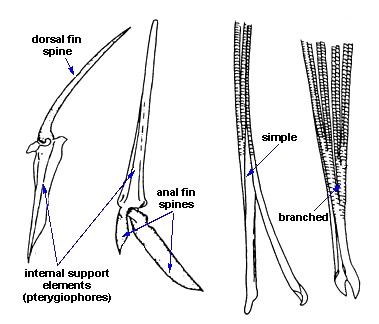
Fig: Comparison of fin spines and soft rays
SPINES
Simple, Unbranched, Unsegmented
  • Hard, stiff, pointed structures
  • Single piece of bone — not paired
  • Found in more evolutionarily ADVANCED fishes
  • Example: First dorsal fin rays in perch
  • Function: Defense and support
SOFT RAYS
Branched, Segmented, Flexible
  • Composed of two mirrored halves (paired)
  • Flexible, branched at tips
  • Found in primitive and derived fishes
  • Example: Pectoral and pelvic fins
  • Function: Fine locomotor control
Lepidotrichia = dermal fin rays      |      Actinotrichia = ceratotrichia in cartilaginous fishes
Made byBobr AI
11
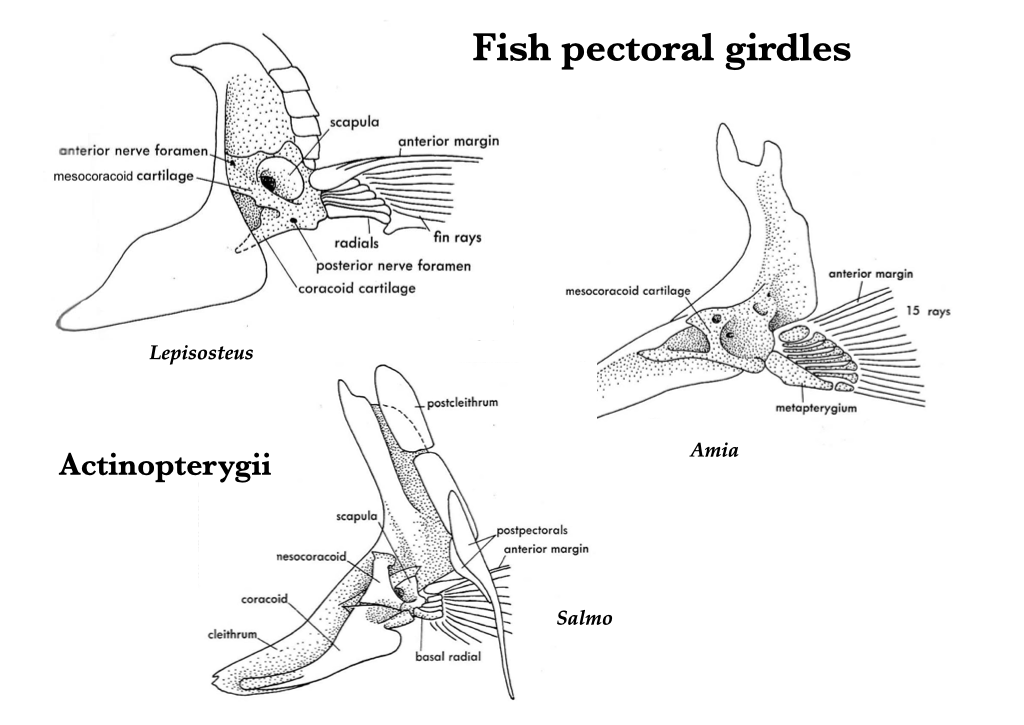
MESOCORACOID — EVOLUTIONARY LOSS
A Key Innovation in Teleost Evolution
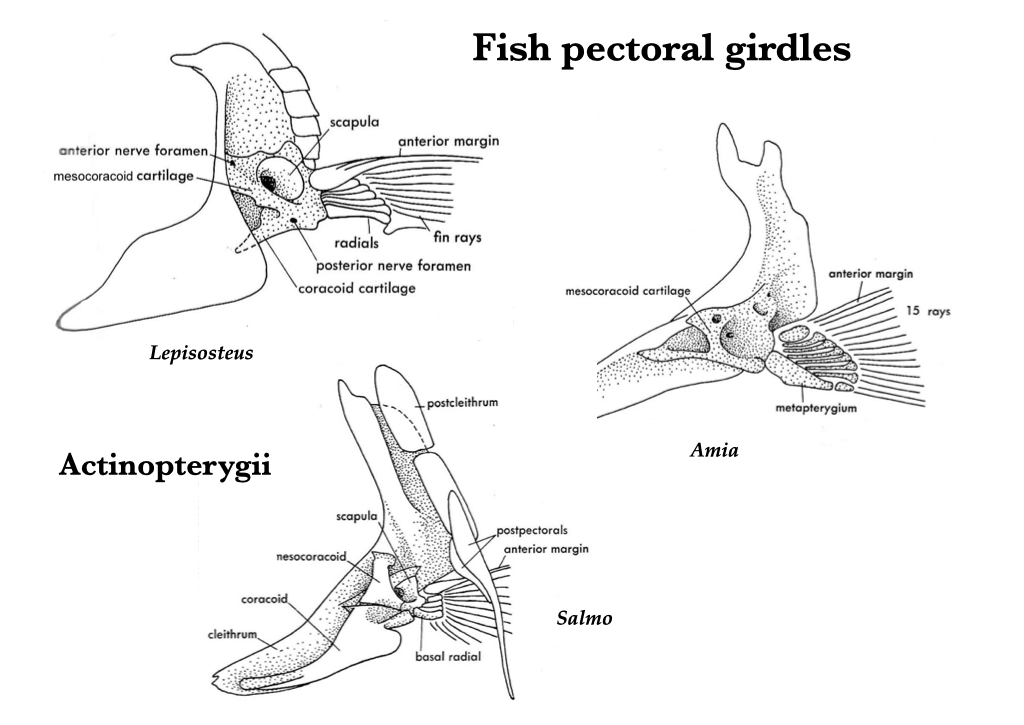
The mesocoracoid is a bone present in all basal actinopterygians (sturgeon, paddlefish, gar, bowfin). Its selective LOSS in derived teleosts is a major evolutionary event.
BASAL ACTINOPTERYGIANS
✓ Mesocoracoid PRESENT
  • Sturgeon, Paddlefish, Gar, Bowfin
  • Pectoral fins positioned VENTRALLY
  • Fins protrude laterally from ventral side
BASAL TELEOSTS
✓ Mesocoracoid PRESENT
  • Osteoglossomorpha, Otomorpha
  • Pectoral fins still ventral
  • Rectangular proximal radials
DERIVED TELEOSTS
✗ Mesocoracoid LOST
  • Paracanthopterygii, Acanthopterygii
  • Pectoral fins repositioned LATERALLY
  • Hourglass/dumbbell radials
  • Better fin control and maneuverability
🔬 In zebrafish larvae (8.2–8.9 mm body length), pectoral fins shift from lateral → ventral positioning, coinciding with mesocoracoid cartilage formation — suggesting developmental linkage.
Fig: Evolution of pectoral girdles across fish groups
Made byBobr AI
12
EVOLUTIONARY ADAPTATIONS
Special Cases & Remarkable Modifications
EELS
Anguilliformes
Variable proximal radials (3–7)
Hourglass-shaped radials
Mesocoracoid ABSENT
Pelvic girdle ENTIRELY LOST in many
ANGLERFISH
Lophiiformes
Only 2 proximal radials
Mesocoracoid ABSENT
Highly modified for deep-sea life
SEAROBINS
Triglidae
3 FREE posterior fin rays
Adapted for WALKING on sea floor
Scapula and coracoid separated
Remarkable locomotor specialization
CODFISH
Gadiformes
Cartilage BAND replaces distal radials
Mesocoracoid ABSENT
Jugular pelvic fin position
PUFFERFISH & NEEDLEFISH
Shape Adaptation
Pelvic girdle ENTIRELY LOST
Complete loss of pelvic appendage
Body shape adaptation
ALASKA BLACKFISH
Dallia
Pectoral fin skeleton = irregularly divided cartilage
Extreme cold-water adaptation
These diverse modifications demonstrate the remarkable plasticity of the appendicular skeleton across 30,000+ fish species
Made byBobr AI
13
BONY FISH vs CARTILAGINOUS FISH
Appendicular Skeleton Comparison
BONY FISHES (Osteichthyes)
🦴 OSSIFIED SKELETON
Pectoral Girdle: Composed of both endochondral AND dermal bones; cleithrum always present
Girdle Attachment: Attaches to SKULL (not vertebral column)
Pelvic Girdle: Endochondral only; puboischiac bar fuses left & right halves
Basipterygium: Present; single element
Fin Rays: Lepidotrichia (bony, segmented, often branched)
Mesocoracoid: Present in basal; LOST in derived teleosts
Example: Salmon, Perch, Cod, Rohu
CARTILAGINOUS FISHES (Chondrichthyes)
💎 CARTILAGINOUS SKELETON
Pectoral Girdle: Single large SCAPULOCORACOID cartilage (scapula + coracoid fused)
Girdle Attachment: Free; NOT attached to skull or vertebral column
Pelvic Girdle: Single acetabular cartilage with iliac process
Basipterygium: Cartilaginous basipterygium
Fin Rays: Ceratotrichia (unsegmented, flexible protein fibers)
Mesocoracoid: ABSENT throughout
Example: Sharks, Rays, Skates
SUMMARY // Bony fishes possess an ossified appendicular skeleton attached to the skull, while cartilaginous fishes have a free connective cartilage structure.
Made byBobr AI
14
KEY TAKEAWAYS
Endoskeleton in Fishes: Appendicular Skeleton
🔹
The appendicular skeleton = paired fins + girdles that support them
🔹
Pectoral girdle attaches to skull (not spine) in bony fishes; contains both endochondral and dermal bones
🔹
Pelvic girdle is FREE from the axial skeleton; composed of endochondral bone only
🔹
Proximal radials follow the 4-basal rule; shaped as rectangular → hourglass → dumbbell through evolution
🔹
Loss of mesocoracoid in derived teleosts enabled lateral repositioning of pectoral fins — key innovation
🔹
Pelvic fin position varies: abdominal (primitive) → thoracic → jugular (advanced/specialized)
The appendicular skeleton reflects 400+ million years of fish evolution and adaptation
Made byBobr AI
Bobr AI

DESIGNER-MADE
PRESENTATION,
GENERATED FROM
YOUR PROMPT

Create your own professional slide deck with real images, data charts, and unique design in under a minute.

Generate For Free

Fins & Frameworks: Fish Appendicular Skeleton Anatomy

Explore the structural anatomy and evolution of fish fins and girdles. Learn about the differences between bony and cartilaginous skeletal systems.

ICHTHYOLOGY · VERTEBRATE ANATOMY

ENDOSKELETON

IN FISHES

Appendicular Skeleton

Structure · Girdles · Fins · Evolution

Zoology | Fish Anatomy

03

INTRODUCTION TO FISH ENDOSKELETON

What is an Endoskeleton?

An endoskeleton is an internal framework of bones or cartilage that supports and protects the body of an organism. In fishes, it forms the structural foundation for movement, protection, and organ support.

Types of Fish Skeleton

Bony Fishes (Osteichthyes) — ossified endoskeleton

Cartilaginous Fishes (Chondrichthyes) — cartilaginous endoskeleton

Divisions of Fish Endoskeleton

AXIAL SKELETON

APPENDICULAR SKELETON

VISCERAL SKELETON

Ichthyology | Vertebrate Anatomy

04

APPENDICULAR SKELETON — OVERVIEW

Definition

The appendicular skeleton consists of all paired fins and their supporting girdles. It is the fish equivalent of the limb skeleton in tetrapods.

Key Function:

Locomotion, balance, steering and mating displays

Components

Pectoral Girdle

Pectoral Fins

Pelvic Girdle

Pelvic Fins

Paired fins = homologous to tetrapod limbs

PAIRED APPENDAGES

Zoology | Fish Anatomy

PECTORAL GIRDLE

Structure, Composition & Bone Elements

The pectoral girdle anchors the pectoral fins to the body. In bony fishes, it attaches to the skull rather than the vertebral column.

Endochondral Bones

Dermal (Intramembranous) Bones

In cartilaginous fishes (sharks), the pectoral girdle is a single large

SCAPULOCORACOID

with scapular process, suprascapula, and coracoid bar.

Fig: Left Pectoral Girdle of a generalized bony fish

ICHTHYOLOGY | VERTEBRATE ANATOMY

06

PECTORAL FIN ANATOMY

Skeletal Components & Radial Organization

CLEITHRUM

Crescent-shaped dermal bone

SCAPULA + CORACOID

Endochondral bones

MESOCORACOID

Connects cleithrum (lost in derived teleosts)

PROXIMAL RADIALS (PR)

Elongated bones, typically 4

DISTAL RADIALS (DR)

Granular connecting bones

FIN RAYS (FR)

Rod-shaped dermal terminal bones

4-Basal Rule: Most teleosts have 4 proximal radials

Mesocoracoid absent in advanced teleosts

Fin ray connections: 1-to-many (basal) vs 1-to-1 (derived)

07

PROXIMAL RADIAL MORPHOLOGY

Evolutionary Shape Variations Across Teleosts

BASAL TELEOSTS

RECTANGULAR-TYPE

Adjacent along the long side. Found in basal teleosts.

Osteoglossomorpha, Otomorpha, Protacanthopterygii

DERIVED TELEOSTS

HOURGLASS-TYPE

Adjacent only at distal and proximal tips. Wide space in the middle.

Paracanthopterygii and Acanthopterygii

ADVANCED TELEOSTS

DUMBBELL-TYPE

Tightly adjacent with holes in mid-portion. Hollowed after chondrification.

Syngnatharia, Gobiaria, Eupercaria

Evolutionary Progression →

Pectoral Girdle Comparison

PELVIC GIRDLE

Structure, Attachment & Composition

Unlike the pectoral girdle, the pelvic girdle in fishes is <strong>NOT</strong> attached to the vertebral column — it remains <strong>FREE</strong> within the body wall.

The pelvic girdle arose from pterygophores and is fundamentally simpler than the tetrapod pelvis (which has pubis, ilium & ischium attached to vertebral column).

Fig: Fish Pectoral & Pelvic Girdles comparison

PELVIC FIN ANATOMY

Skeletal Structure & Positional Variations

Each pelvic fin supported by fin rays (lepidotrichia) and radials (dermactidia)

In <em>Labeo rohita</em>: 9 lepidotrichia + 3 radials

First 2 radials &rarr; 2 fin rays each; 3rd radial &rarr; 3 fin rays

Articulate with posterior border of basipterygium

ABDOMINAL POSITION

Pelvic fins located ventrally, anterior to anal fin

Soft-rayed teleosts (e.g., salmon, herring)

PRIMITIVE POSITION

THORACIC POSITION

Directly below the pectoral fins

Spiny-rayed fishes (e.g., perch, bass)

ADVANCED POSITION

JUGULAR POSITION

Anterior to pectoral fins; may attach to pectoral girdle

Cusk-eels, cods

SPECIALIZED

<strong>Pelvic girdle entirely LOST in:</strong> eels (Anguilliformes), puffers, and some needlefishes

10

FIN RAY TYPES

Spines & Soft Rays — Structure & Function

Fig: Comparison of fin spines and soft rays

SPINES

Simple, Unbranched, Unsegmented

<b>Hard, stiff, pointed</b> structures

Single piece of bone — <b>not paired</b>

Found in more evolutionarily <span style="color:#ff9800; font-weight:700;">ADVANCED</span> fishes

Example: First dorsal fin rays in perch

Function: <b>Defense and support</b>

SOFT RAYS

Branched, Segmented, Flexible

Composed of two mirrored halves <b>(paired)</b>

<b>Flexible, branched</b> at tips

Found in <b>primitive and derived</b> fishes

Example: Pectoral and pelvic fins

Function: <b>Fine locomotor control</b>

<span style="color:#ffffff; font-weight:700;">Lepidotrichia</span> = dermal fin rays &nbsp;&nbsp;&nbsp;&nbsp;&nbsp;|&nbsp;&nbsp;&nbsp;&nbsp;&nbsp; <span style="color:#ffffff; font-weight:700;">Actinotrichia</span> = ceratotrichia in cartilaginous fishes

11

MESOCORACOID — EVOLUTIONARY LOSS

A Key Innovation in Teleost Evolution

The mesocoracoid is a bone present in all basal actinopterygians (sturgeon, paddlefish, gar, bowfin). Its selective LOSS in derived teleosts is a major evolutionary event.

BASAL ACTINOPTERYGIANS

✓ Mesocoracoid PRESENT

Sturgeon, Paddlefish, Gar, Bowfin

Pectoral fins positioned VENTRALLY

Fins protrude laterally from ventral side

BASAL TELEOSTS

✓ Mesocoracoid PRESENT

Osteoglossomorpha, Otomorpha

Pectoral fins still ventral

Rectangular proximal radials

DERIVED TELEOSTS

✗ Mesocoracoid LOST

Paracanthopterygii, Acanthopterygii

Pectoral fins repositioned LATERALLY

Hourglass/dumbbell radials

Better fin control and maneuverability

🔬 In zebrafish larvae (8.2–8.9 mm body length), pectoral fins shift from lateral → ventral positioning, coinciding with mesocoracoid cartilage formation — suggesting developmental linkage.

Fig: Evolution of pectoral girdles across fish groups

EVOLUTIONARY ADAPTATIONS

Special Cases & Remarkable Modifications

These diverse modifications demonstrate the remarkable plasticity of the appendicular skeleton across 30,000+ fish species

13

BONY FISH vs CARTILAGINOUS FISH

Appendicular Skeleton Comparison

BONY FISHES (Osteichthyes)

🦴 OSSIFIED SKELETON

Composed of both endochondral AND dermal bones; cleithrum always present

Attaches to SKULL (not vertebral column)

Endochondral only; puboischiac bar fuses left & right halves

Present; single element

Lepidotrichia (bony, segmented, often branched)

Present in basal; LOST in derived teleosts

Salmon, Perch, Cod, Rohu

CARTILAGINOUS FISHES (Chondrichthyes)

💎 CARTILAGINOUS SKELETON

Single large SCAPULOCORACOID cartilage (scapula + coracoid fused)

Free; NOT attached to skull or vertebral column

Single acetabular cartilage with iliac process

Cartilaginous basipterygium

Ceratotrichia (unsegmented, flexible protein fibers)

ABSENT throughout

Sharks, Rays, Skates

SUMMARY // Bony fishes possess an ossified appendicular skeleton attached to the skull, while cartilaginous fishes have a free connective cartilage structure.

KEY TAKEAWAYS

Endoskeleton in Fishes: Appendicular Skeleton

The <b>appendicular skeleton</b> = paired fins + girdles that support them

<b>Pectoral girdle</b> attaches to skull (not spine) in bony fishes; contains both endochondral and dermal bones

<b>Pelvic girdle</b> is FREE from the axial skeleton; composed of endochondral bone only

<b>Proximal radials</b> follow the 4-basal rule; shaped as rectangular → hourglass → dumbbell through evolution

<b>Loss of mesocoracoid</b> in derived teleosts enabled lateral repositioning of pectoral fins — key innovation

<b>Pelvic fin position varies:</b> abdominal (primitive) → thoracic → jugular (advanced/specialized)

The appendicular skeleton reflects 400+ million years of fish evolution and adaptation

  • ichthyology
  • fish-anatomy
  • zoology
  • vertebrate-anatomy
  • evolution
  • marine-biology