












The Future of Work: Virtual Organisations and Global Business
Explore the rise of virtual organizations, technological drivers like AI, and strategies for managing remote global teams in the modern business landscape.
GLOBAL BUSINESS CONFERENCE
The Future of Work:
Virtual Organisations
Challenges, Developments & Strategies in Global Business
Group Members:
Andre Brown · Monifa Allen-Fearson · Kolilur Rahman · Moynoor Rahman
Tutor: Chukwuemeka Afam Ikejiaku
Table of Contents
01
Title Slide
01
02
Table of Contents
02
03
Introduction
03
04
Understanding Virtual Organizations
04
05
The Rise of Virtual Organization
05
06
Contested Nature
06
07
Key Drivers
07
08
Benefits
08
09
Challenges
09
10
Technological Developments
10
11
Impact on Global Business
11
12
Ethical and Social Issues
12
13
Environmental Impact
13
14
Strategies
14
15
Recommendations
15
16
Conclusion
16
Introduction
This presentation evaluates virtual organisations as a major shift in global business
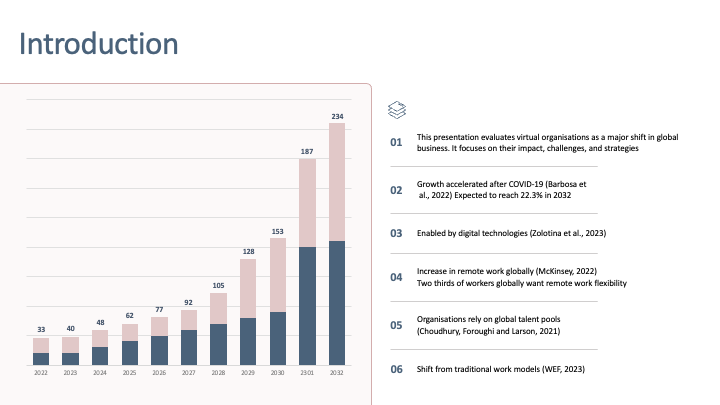
Growth accelerated after COVID-19 (Barbosa et al., 2022) — <span style="font-weight: 700; color: #00D4C8;">Expected to reach 22.3% in 2032</span>
Enabled by digital technologies (Zolotina et al., 2023)
Increase in remote work globally (McKinsey, 2022) — Two thirds of workers want remote flexibility
Organisations rely on global talent pools (Choudhury, Foroughi and Larson, 2021)
Shift from traditional work models (WEF, 2023)
Projected Growth of Virtual Organisations (%)
Understanding Virtual Organisations
Network-based organizational structure<div style='color: #00D4C8; font-size: 15px; font-style: italic; margin-top: 6px;'>(Froese et al., 2025)</div>
Employees work across different countries<div style='color: #00D4C8; font-size: 15px; font-style: italic; margin-top: 6px;'>(Choudhury, Foroughi & Larson, 2021)</div>
Flexible and project-based teams
Use of digital platforms for coordination<div style='color: #00D4C8; font-size: 15px; font-style: italic; margin-top: 6px;'>(Zolotina et al., 2023)</div>
No central physical office
Heavy reliance on communication tools
The Rise of Virtual Organization
Remote work trends
Digital transformation
COVID-19 acceleration
Globalization
New business models
LO2: Contemporary Developments
Contested Nature
Flexible Work Evidence
26
67
59
22
20
60
67
89
85
WFH<br>stress
Satis-<br>faction
Free<br>stress
Time<br>activity
Isolation
Schedules
Remote<br>Work
HR<br>Retention
Produc-<br>tivity
Advantages
Flexibility improves work autonomy (Barbosa et al., 2022)
Reduced social interaction
Disadvantages
Job insecurity increases (ILO, 2021)
Remote work can increase burnout (Kniffin et al., 2021)
Digital divide creates inequality (Barbosa et al., 2022)
Work-life boundaries become blurred
Key Drivers
Digital transformation of businesses (Zolotina et al., 2023)
Growth of AI and cloud computing (WEF, 2023)
Demand for global talent (Froese et al., 2025)
Cost reduction strategies (McKinsey, 2022)
Increased internet access globally
Competitive business environment
Benefits
01
🔷
Digital<br>Transformation
Digital transformation of businesses <span style="display:block;margin-top:8px;font-size:14px;color:#A9B4C2;">(Zolotina et al., 2023)</span>
02
👥
Global Talent
Access to global talent pools <span style="display:block;margin-top:8px;font-size:14px;color:#A9B4C2;">(Choudhury et al., 2021)</span>
03
⚡
Flexible Work
Flexible working conditions <span style="display:block;margin-top:8px;font-size:14px;color:#A9B4C2;">(Deloitte, 2023)</span>
04
🌱
Employee<br>Satisfaction
Increased employee satisfaction
05
📈
Scalability
Faster business scalability <span style="display:block;margin-top:8px;font-size:14px;color:#A9B4C2;">(McKinsey, 2022)</span>
06
✅
Productivity
Improved productivity in some cases
Challenges
Lack of trust and team cohesion (Kniffin et al., 2021)
Communication barriers in remote teams (Waizenegger et al., 2020)
Difficulty monitoring performance
Cybersecurity risks increase (Zolotina et al., 2023)
Technology dependence
Time zone differences
Technological
Developments
Artificial intelligence improves productivity
(Somanathan, 2023)
Virtual reality enhances collaboration
Use of platforms like Zoom and Slack
(Zolotina et al., 2023)
Automation reduces manual tasks
(WEF, 2023)
Cloud computing enables remote access
Data analytics supports decision-making
Where AI is Aiding Productivity
Projected increase in productivity due to AI in selected economies until 2035
Impact on Global Business
Global Operations
Enables global operations (Froese et al., 2025)
Changes organizational structures
Reduced Relocation
Reduces need for relocation (McKinsey, 2022)
Encourages innovation
Global Competition
Increases global competition (Deloitte, 2023)
Expands market reach
Ethical and Social Issues
01
Work-Life Balance
Work-life balance challenges (Barbosa et al., 2022)
02
Mental Health
Mental health issues increase (Kniffin et al., 2021)
03
Job Insecurity
Job insecurity concerns
04
Surveillance
Employee surveillance concerns (ILO, 2021)
05
Tech Access
Unequal access to technology
06
Workplace Interaction
Reduced workplace interaction
Environmental Impact
Reduced commuting emissions (Barbosa et al., 2022)
Lower office energy use
Increased digital energy consumption (McKinsey, 2022)
Reduced business travel
Growth in data center usage
Mixed environmental outcomes (Deloitte, 2023)
Strategies
Invest in digital infrastructure<br><span style='font-size: 18px; color: rgba(255,255,255,0.7); font-weight: 400; margin-top: 6px; display: inline-block;'>(Zolotina et al., 2023)</span>
Improve communication systems<br><span style='font-size: 18px; color: rgba(221,227,233,0.6); font-weight: 400; margin-top: 6px; display: inline-block;'>(Deloitte, 2023)</span>
Support employee wellbeing programs
Strengthen cybersecurity<br><span style='font-size: 18px; color: rgba(221,227,233,0.6); font-weight: 400; margin-top: 6px; display: inline-block;'>(WEF, 2023)</span>
Develop clear remote work policies
Train employees in digital tools
STRATEGIC ROADMAP
Recommendations
Provide digital skills training
(McKinsey, 2022)
Adopt hybrid work models
(Froese et al., 2025)
Promote inclusive global hiring
(Choudhury, Foroughi and Larson, 2021)
Encourage collaboration and engagement
Develop ethical policies
Monitor performance effectively
Conclusion
Virtual organisations are growing rapidly (WEF, 2023)
Provide cost and flexibility benefits (Deloitte, 2023)
Present management challenges (Froese et al., 2025)
Require strategic adaptation
Technology will continue to drive change
Future work will remain hybrid
GLOBAL BUSINESS CONFERENCE
Thank You
The Future of Work: Virtual Organisations
Questions & Discussion Welcome
Andre Brown · Monifa Allen-Fearson · Kolilur Rahman · Moynoor Rahman
- virtual-organization
- remote-work
- future-of-work
- digital-transformation
- global-business
- business-strategy