

















Capital Budgeting & ESG Integration: IRR Analysis Guide
Explore how to integrate ESG factors with Internal Rate of Return (IRR) for sustainable capital budgeting and modern investment decision-making.
Capital Budgeting & ESG Integration in Finance
Current Trends and Cases in Finance
Presented by: Vishal Ravindra Jain
Institute: Indira Institute of Management, Pune
Date: April 14, 2026
CO1 – Application
Introduction
Capital budgeting = Selection of profitable investments
Focus on IRR method + ESG integration
Combines traditional finance + modern trends
Aligns with Unit 4 (Capital Budgeting) & Unit 2 (ESG)
Rubrics: Concept clarity + syllabus linkage
Concept of IRR
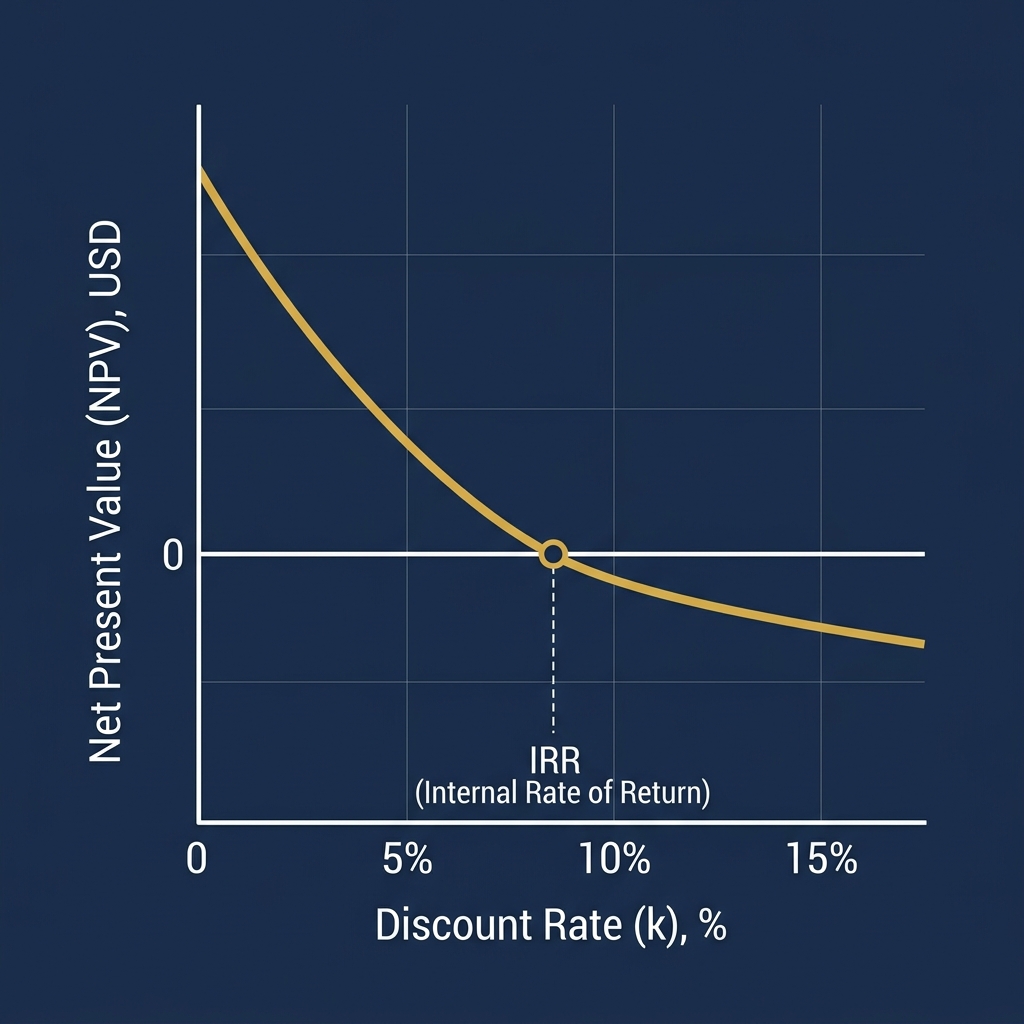
IRR = Rate where NPV = 0
Measures actual profitability of a project
Used for comparing multiple projects
Accept if IRR > Cost of Capital (12%)
Case Study Overview
Application
Machine 1
₹2,35,000
Machine 2
₹2,15,000
Cash inflows projected over 9 years
Objective: Select the best investment project
Rubrics: Practical application
Method Used – IRR Calculation
CO2 – Analysis
Trial & Error Method
Interpolation Technique
Choose 2 discount rates
Identify positive & negative NPV
Apply interpolation formula
IRR = Lower Rate + [NPV at Lower Rate / (NPV at Lower Rate – NPV at Higher Rate)] × (Higher Rate – Lower Rate)
Rubrics: Analytical method
IRR Result – Machine 1
NPV @12%
₹75,860
NPV @18%
₹2,159
IRR
≈ 17.8%
Acceptable
IRR exceeds Cost of Capital (12%)
IRR Result – Machine 2
NPV @12%
₹94,505
NPV @20%
₹3,319
IRR ≈ 19.3%
Comparative Analysis
CO3 – Evaluation
Both machines are acceptable (IRR > 12%)
Machine 2 is superior with higher IRR
Rubrics: Comparison + evaluation
Decision & Justification
✔ Select Machine 2
Highest IRR (19.3%)
Better Capital Efficiency
Profit Maximization
Rubrics: Decision-making ability
IRR vs Payback Method
Basis
IRR
Payback Period
Time Value of Money
Considered ✔
Ignored ✗
Project Coverage
Full project life
Limited period
Focus
Profitability
Liquidity
✔ IRR is a more accurate and comprehensive method
Introduction to ESG
Unit 2 – CO1
E — Environmental
S — Social
G — Governance
ESG = Environmental, Social & Governance
Used in modern financial decision-making
Focus: Sustainability + Ethics + Profitability
As per Syllabus Unit 2
ESG Factors in Project Selection
CO2 – Analysis
Carbon emissions & energy use
Preference for green projects
Employee welfare & customer safety
Community development
Transparency & ethical practices
Strong management
Impact of ESG on Capital Budgeting
CO3 – Evaluation
Expands decision criteria beyond pure financials
Reduces environmental & regulatory risk
Encourages long-term sustainability
Lowers cost of capital
Attracts responsible investors
ESG
Finance
Risk
Sustainability
Investors
Rubrics: Analytical depth
Advantages & Challenges of ESG
Advantages
Better risk management
Improved brand image
Long-term profitability
Challenges
Difficult measurement
High initial cost
Lack of standard metrics
Conclusion & Suggestions
CO4 – Creation
📌 Conclusion
IRR helps in selecting profitable projects
ESG ensures sustainable investment decisions
Combined approach = Modern financial strategy
💡 Suggestions
Integrate ESG with financial tools
Focus on long-term value creation
Use multiple evaluation techniques
A holistic financial framework combining IRR + ESG leads to smarter, sustainable investment decisions.
- capital-budgeting
- irr-analysis
- esg-integration
- finance
- investment-strategy
- sustainable-finance