





Made byBobr AI

Fetal Monitoring & CTG Interpretation: NICE Case Study

Expert review of CTG interpretation, fetal physiology, and NICE guidelines using a clinical case study on maternal tachycardia and metabolic acidosis.

#ctg-interpretation#fetal-monitoring#nice-guidelines#obstetrics#clinical-case-study#maternity-safety#midwifery-education
Watch
Pitch

Clinical Case Review & CTG Interpretation

Data-driven Learning Incident (INC-151338) & NICE Guideline Refresher

Medical education background, clean hospital setting, stethoscope and notebook on desk, soft lighting, professional healthcare style
Made byBobr AI

Case Context: Patient Profile

Demographics

Parity: P0 Gestation: 40+4 weeks BMI: 37 (Booking) Indication for IOL: Large for Gestational Age (LGA - 97th Centile)

Risk Overview

Key Risk Factors: • Induction of Labour (Propess, CRB, Prostin) • Multiple Vaginal Checks (Risk of Infection) • Prolonged Maternal Tachycardia noted antenatally

Abstract medical illustration representing pregnancy health record, soft blue and white tones, patient file concept
Made byBobr AI

Timeline: The Emerging Picture

Antenatal / Early Admission

Maternal tachycardia noted (100-115 bpm). ECG review normal. WCC raised but no CRP checked. Infection risk not fully ruled out.

18:00 (Active Labour)

warning icon symbol orange and yellow simple flat design

CTG Baseline increases from 120 bpm to 140 bpm. Syntocinon in progress. This 20 bpm rise was a subtle sign of fetal stress/infection.

Made byBobr AI

Critical Decision & Outcome

[Space reserved for user to attach 20:30 - 22:13 CTG Trace]

20:30 - Decision for Cat 2 CS

Failure to progress at 2cm. Syntocinon stopped. CTG baseline dropped to 125-130 bpm.

22:13 - Delivery (Forceps)

Difficult delivery (Wrigleys x2). Meconium liquor observed. 9 mins from 'Knife to Skin' to birth.

Made byBobr AI

The Outcome: Cord Gases Analysis

Baby born in good condition (Apgars 8 at 1 min, 9 at 5 mins), but cord gases revealed significant metabolic acidosis likely exacerbated by difficult delivery.

Chart
Made byBobr AI

Key Learning Points

  • 1. Baseline Shift:
    Baseline Shift is Significant: An increase in baseline (e.g., 20bpm rise) even within 'normal' range can be a sign of developing hypoxia or infection.
  • 2. Infection Markers:
    Maternal Tachycardia Context: Persistent maternal tachycardia + multiple VEs should trigger a 'Rule Out Infection' protocol (CRP alongside WCC).
  • 3. Holistic Review:
    Holistic Review: Compare current CTG baseline with the *initial* monitoring baseline, not just the previous hour.
Conceptual illustration of a magnifying glass over a medical heart rate graph, symbolizing detailed review
Made byBobr AI

NICE Guidelines: CTG Feature Definitions

Baseline Rate

Normal: 110–160 bpm.
Stable excluding accels/decels.

Variability

Normal: 5–25 bpm.
Reflects CNS integrity & oxygenation.

Decelerations

Early: Concurrent with contraction (Head compression).
Variable: Rapid drop/recovery (Cord).
Late: Delayed (>50% after peak) (Placental insufficiency).

Accelerations

Rise of >15bpm for >15s.
Presence is reassuring of somatic nervous system function.

Made byBobr AI

NICE Categorisation System

NORMAL

• All features reassuring • Baseline 110-160 • Variability 5-25 • No non-reassuring features

SUSPICIOUS

• 1 non-reassuring feature AND • 2 reassuring features • Action: Correct underlying causes, conservative measures.

PATHOLOGICAL

• 2 or more non-reassuring features OR • 1 abnormal feature • Action: Review by Senior/Consultant. Consider delivery/FBS.

Made byBobr AI

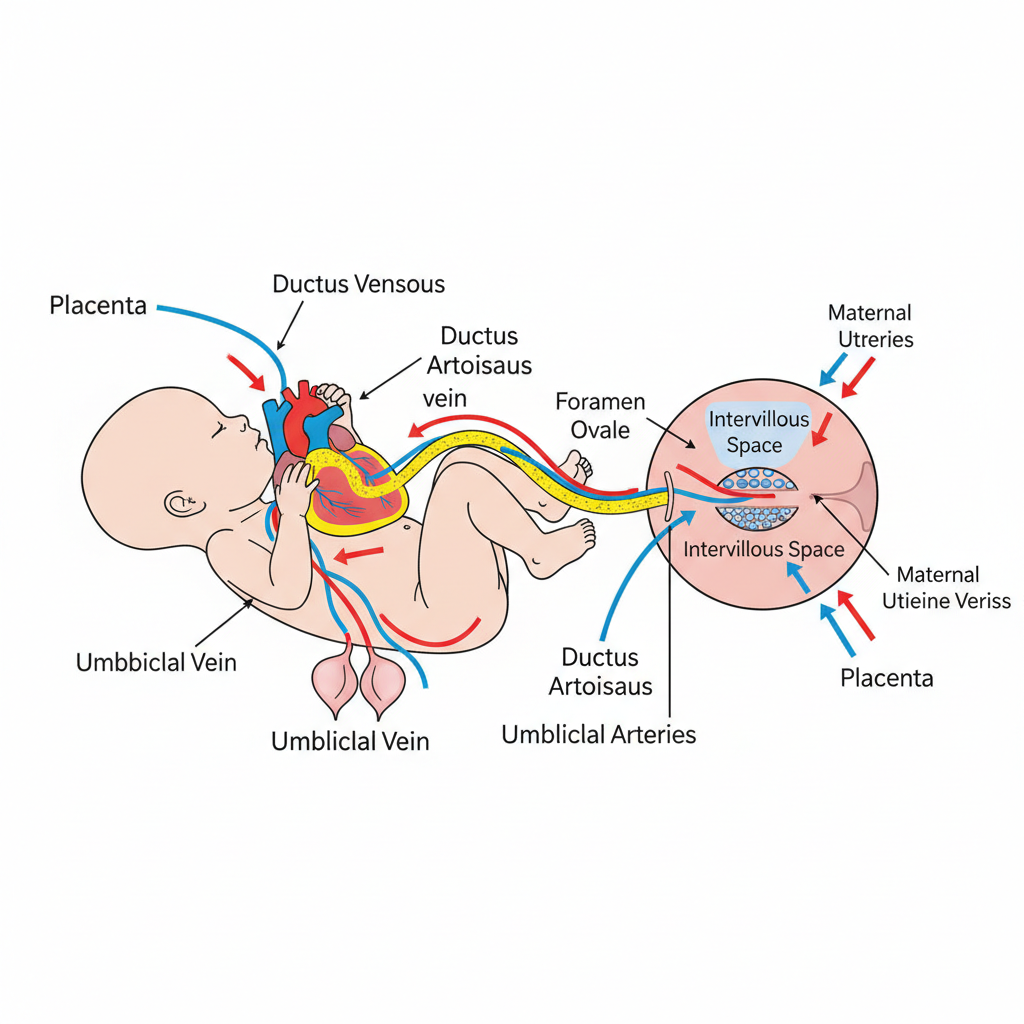
Physiology: Why the Heart Rate Changes

• Chemoreceptors: Detect low O2 / high CO2 -> Stimulation of Vagus nerve -> Cardio-deceleration (Late Decels). • Baroreceptors: Detect high pressure (cord compression) -> Vagal response to lower BP -> Variable Decelerations. • Sympathetic Nervous System: Releases catecholamines to maintain Cardiac Output when stressed (Rising Baseline/Tachycardia).

Diagram of fetal circulation and placental exchange, medical textbook style, clean lines, highlighting umbilical cord and heart
Made byBobr AI

Mapping Physiology to Action

Physiological TriggerCTG FeatureClinical ImplicationPrimary Action
Catecholamine release (Stress response)Rising Baseline / TachycardiaDeveloping hypoxia or Infection (Chorioamnionitis)Check maternal temp, fluids, rule out infection
Umbilical artery occlusion (Baroreceptors)Variable DecelerationsCord CompressionPositional change
Chemoreceptor activation (Hypoxia)Late DecelerationsUteroplacental InsufficiencyStop Syntocinon, Fluid bolus, Scalp stimulation, Prepare delivery
Vagal hyperactivity / Head compressionEarly DecelerationsHead Compression (Descent)VE to check progress (usually benign)
Made byBobr AI

Summary & Discussion

  • This case highlights the importance of recognizing rising baselines and maternal tachycardia as early warnings.
  • NICE guidelines categorize risk, but physiology explains 'why'. Understanding the mechanism drives the correct action.
  • Cord gases confirmed significant acidosis, validating the need for the intervention, though earlier recognition might have reduced the depth of acidosis.
Team of doctors and midwives discussing in a meeting room, professional medical learning environment
Made byBobr AI
Bobr AI

DESIGNER-MADE
PRESENTATION,
GENERATED FROM
YOUR PROMPT

Create your own professional slide deck with real images, data charts, and unique design in under a minute.

Generate For Free

Fetal Monitoring & CTG Interpretation: NICE Case Study

Expert review of CTG interpretation, fetal physiology, and NICE guidelines using a clinical case study on maternal tachycardia and metabolic acidosis.

Clinical Case Review & CTG Interpretation

Data-driven Learning Incident (INC-151338) & NICE Guideline Refresher

Case Context: Patient Profile

Parity: P0 Gestation: 40+4 weeks BMI: 37 (Booking) Indication for IOL: Large for Gestational Age (LGA - 97th Centile)

Key Risk Factors: • Induction of Labour (Propess, CRB, Prostin) • Multiple Vaginal Checks (Risk of Infection) • Prolonged Maternal Tachycardia noted antenatally

Timeline: The Emerging Picture

Antenatal / Early Admission

Maternal tachycardia noted (100-115 bpm). ECG review normal. WCC raised but no CRP checked. Infection risk not fully ruled out.

18:00 (Active Labour)

CTG Baseline increases from 120 bpm to 140 bpm. Syntocinon in progress. This 20 bpm rise was a subtle sign of fetal stress/infection.

Critical Decision & Outcome

20:30 - Decision for Cat 2 CS

Failure to progress at 2cm. Syntocinon stopped. CTG baseline dropped to 125-130 bpm.

22:13 - Delivery (Forceps)

Difficult delivery (Wrigleys x2). Meconium liquor observed. 9 mins from 'Knife to Skin' to birth.

[Space reserved for user to attach 20:30 - 22:13 CTG Trace]

The Outcome: Cord Gases Analysis

Baby born in good condition (Apgars 8 at 1 min, 9 at 5 mins), but cord gases revealed significant metabolic acidosis likely exacerbated by difficult delivery.

Key Learning Points

Baseline Shift is Significant: An increase in baseline (e.g., 20bpm rise) even within 'normal' range can be a sign of developing hypoxia or infection.

Maternal Tachycardia Context: Persistent maternal tachycardia + multiple VEs should trigger a 'Rule Out Infection' protocol (CRP alongside WCC).

Holistic Review: Compare current CTG baseline with the *initial* monitoring baseline, not just the previous hour.

NICE Guidelines: CTG Feature Definitions

Baseline Rate

Normal: 110–160 bpm.<br>Stable excluding accels/decels.

Variability

Normal: 5–25 bpm.<br>Reflects CNS integrity & oxygenation.

Decelerations

Early: Concurrent with contraction (Head compression).<br>Variable: Rapid drop/recovery (Cord).<br>Late: Delayed (>50% after peak) (Placental insufficiency).

Accelerations

Rise of >15bpm for >15s.<br>Presence is reassuring of somatic nervous system function.

NICE Categorisation System

NORMAL

• All features reassuring • Baseline 110-160 • Variability 5-25 • No non-reassuring features

SUSPICIOUS

• 1 non-reassuring feature AND • 2 reassuring features • Action: Correct underlying causes, conservative measures.

PATHOLOGICAL

• 2 or more non-reassuring features OR • 1 abnormal feature • Action: Review by Senior/Consultant. Consider delivery/FBS.

Physiology: Why the Heart Rate Changes

• Chemoreceptors: Detect low O2 / high CO2 -> Stimulation of Vagus nerve -> Cardio-deceleration (Late Decels). • Baroreceptors: Detect high pressure (cord compression) -> Vagal response to lower BP -> Variable Decelerations. • Sympathetic Nervous System: Releases catecholamines to maintain Cardiac Output when stressed (Rising Baseline/Tachycardia).

Mapping Physiology to Action

Summary & Discussion

This case highlights the importance of recognizing rising baselines and maternal tachycardia as early warnings.

NICE guidelines categorize risk, but physiology explains 'why'. Understanding the mechanism drives the correct action.

Cord gases confirmed significant acidosis, validating the need for the intervention, though earlier recognition might have reduced the depth of acidosis.

  • ctg-interpretation
  • fetal-monitoring
  • nice-guidelines
  • obstetrics
  • clinical-case-study
  • maternity-safety
  • midwifery-education