
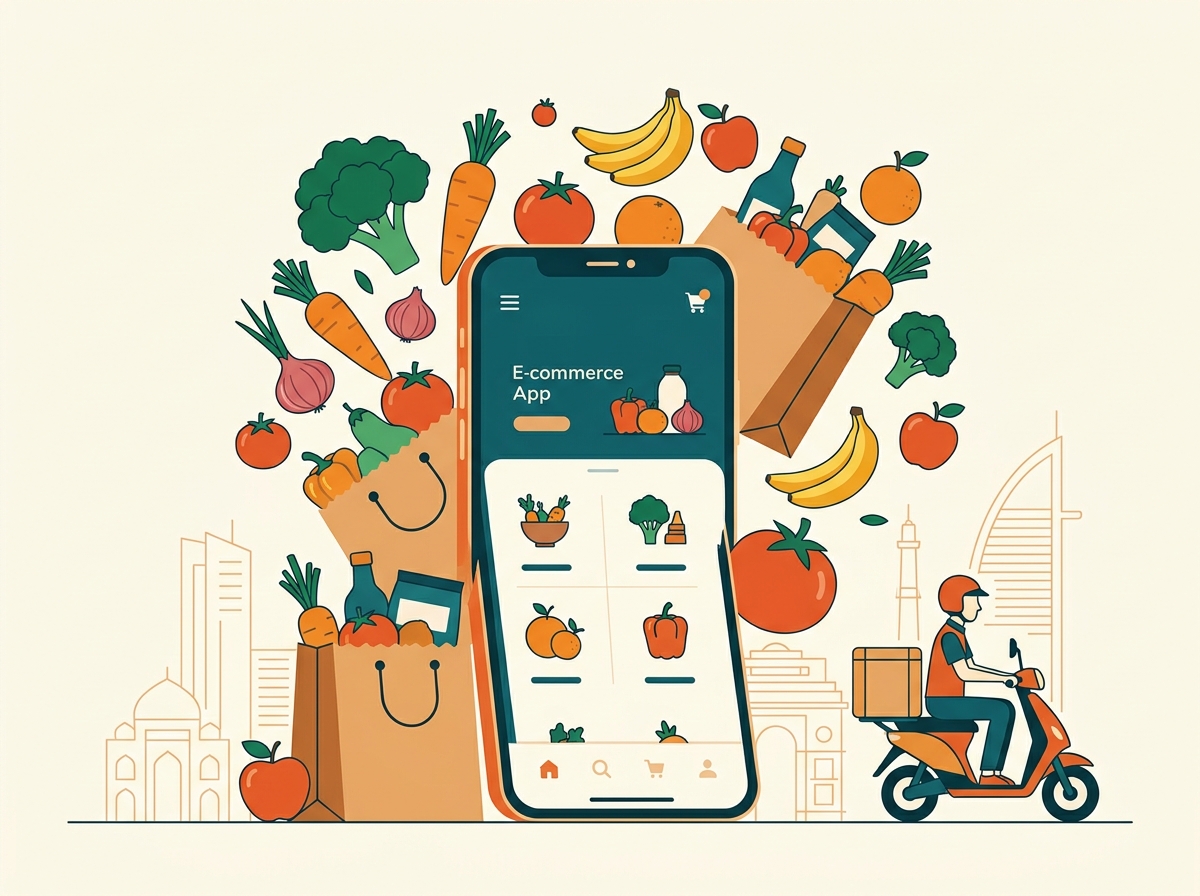
Quick Commerce Trends & Consumer Behaviour in Indore 2026
Academic study on quick commerce apps (Blinkit, Zepto, Swiggy Instamart) and their impact on household buying habits and kirana stores in Indore.
Impact of Quick Commerce Apps on Buying Behaviour of Households in Indore
Blinkit • Zepto • Swiggy Instamart • BB Now
Aishvi Gandhi
MBA E-Commerce, Xth Semester
Under the guidance of Dr. Sona Fating
146
Indore
April 2026
Institute of Management Studies, Devi Ahilya Vishwavidyalaya
Major Research Project — Aishvi Gandhi
Presentation Overview
Introduction & Significance
Research Objectives
Research Methodology
Quick Commerce Landscape in India
Target Audience & Market Profile
Key Findings & Behavioural Analysis
Hypothesis Testing & Outcome Analysis
Challenges, Recommendations & Conclusion
The Quick Commerce Revolution
Quick commerce has evolved beyond emergency delivery — it is now embedded convenience infrastructure in India
Compresses the distance between need recognition and purchase completion
Reduces the behavioural cost of stepping out, planning ahead, or tolerating stock-outs
India's grocery category is especially susceptible: contains both repetitive staples and low-planning top-up items
Once consumers learn that a shortage can be solved in minutes, inventory discipline inside the home weakens
Why Indore is Analytically Important:
Sits at the intersection of tier-2 urban growth and rising digital familiarity
Strong kirana culture + expanding appetite for on-demand services
Consumers are more value-sensitive and relationship-oriented than metro consumers
Not a simple metro clone — makes findings richer and more nuanced
Quick commerce in Indore is convenience-led, basket-expanding, and household-relevant — but still hybrid rather than fully substitutive.
Why This Study Matters
Significance of Research
1. Industry Growth
• Quick commerce is one of the fastest-scaling layers of Indian retail. • Datum Intelligence 2024 survey: sharp rise in 10-min delivery interest across 10 Indian cities.
2. Platform Scale
• Blinkit (Eternal): millions of monthly transacting customers, hundreds of cities. • Swiggy Instamart: aggressive multi-city dark-store expansion.
3. Indore Context
• Tier-2 city with kirana culture, price-consciousness and digital growth. • Forces a disciplined interpretation beyond standard metro assumptions.
4. Academic Value
• Brings together: convenience orientation, low-involvement purchase triggers, impulse buying. • Focuses heavily on price-value trade-offs and channel coexistence.
This study fills a critical gap: understanding quick commerce behaviour in a high-growth, value-conscious, tier-2 Indian city.
Research Objectives
Dominant Usage Drivers
To identify the reasons driving quick-commerce usage among respondents in Indore.
Impulse Buying Extent
To measure the extent to which quick commerce is associated with impulse buying.
Grocery Budget Impact
To evaluate the perceived impact of quick-commerce usage on monthly grocery budgets.
Categories & Stickiness
To identify the most frequently ordered product categories and platform stickiness across apps.
Convenience Economics
To assess delivery-time expectations, fee sensitivity, and the behavioural economics of convenience.
Retail Displacing Patterns
To determine whether quick commerce is displacing kiranas or coexisting in a hybrid retail pattern.
Research Methodology
Research Design
Descriptive research design
Primary data collection
Structured questionnaire-based survey
Data Collection
146 valid respondents
City: Indore
Questionnaire responses coded and organized into category-wise tables
Analytical Methods
Frequency analysis
Percentage analysis
Midpoint-based descriptive estimation for order-value brackets
One-tailed binomial hypothesis testing
Output
Frequency tables
Cross-tabs
Visualizations
Behavioural propositions tested statistically
Why this methodology is appropriate
The goals are to identify adoption drivers, understand behavioural tendencies, and interpret findings for platform strategy — descriptive-analytical approach is perfectly suited.
Quick Commerce Platforms: The Big Four in India
These are not fringe operations — they represent distinct psychological offers to consumers and are reshaping India's Rs. 7 lakh crore grocery market.
Blinkit
Strong top-of-mind awareness
Dense mainstream convenience identity
Backed by Eternal (formerly Zomato)
Millions of monthly transacting customers
Present in hundreds of cities
Swiggy Instamart
Benefits from ecosystem familiarity
Leverages Swiggy's food delivery network
Multi-city dark-store expansion
Strong urban presence
Zepto
Fast, youth-friendly positioning
Assortment-rich catalogue
10-minute delivery promise
Strong appeal to digitally native users
BB Now
Grocery credibility of BigBasket brand
Trusted for quality and variety
Appeals to household and family segment
Valid Analytical Base: 146 Respondents | City: Indore
Respondent Profile: Who Was Surveyed?
Age Group Distribution
18–25 years
88 (60.3%)
60.3%
26–35 years
37 (25.3%)
25.3%
36–50 years
14 (9.6%)
9.6%
50+ years
7 (4.8%)
4.8%
85.6% of respondents are aged 18–35
Occupational Composition
Student
69 (47.3%)
47.3%
Private/Govt Employee
37 (25.3%)
25.3%
Business/Self-Employed
24 (16.4%)
16.4%
Homemaker
16 (11.0%)
11.0%
72.6% are students or salaried employees
This youth-weighted, digitally fluent sample captures the consumer layer most likely to normalize app-first replenishment. Their habits establish new household expectations.
Why Do People Use Quick Commerce? — Primary Adoption Drivers
CONVENIENCE BEATS DISCOUNTS
What This Means Strategically
Convenience-led users are willing to pay a small premium
They optimize for time recovery, not absolute cheapest price
Platform stickiness is driven by ease, not promotions
Basket expansion happens naturally in low-friction environments
App Preference & Ordering Frequency
Blinkit + Instamart = 76.7%
of primary preference — market has concentration but not monopoly.
Ordering Frequency
83.6% order at least once a week
— quick commerce has crossed the novelty threshold into habitual behaviour.
What Are People Ordering?
Product Categories
Vegetables / Fruits
42 (28.8%)
93.3
Packaged Grocery
36 (24.7%)
80.0
Snacks / Beverages
27 (18.5%)
60.0
Milk / Bread / Eggs
19 (13.0%)
42.2
Personal Care
13 (8.9%)
28.9
Paan / Tobacco items
9 (6.2%)
20.0
“The use case has expanded
BEYOND
emergency replenishment. Vegetables & fruits lead — this is mainstream grocery adoption, not just snack top-ups.”
Fresh produce (28.8%) shows deep
household integration
— not just junk food
Packaged grocery + snacks = 43.2% —
habitual and impulse
categories combined
Category depth signals broader household relevance and
growing platform stickiness
Impulse Buying: The Hidden Engine of Quick Commerce
82.9%
of respondents buy unplanned items — often or sometimes
Yes, often
47.9% (70 respondents)
Sometimes
34.9% (51 respondents)
No, never
17.1% (25 respondents)
The app functions as both fulfilment engine AND demand trigger. When the path from thought to purchase is short, the psychological cost of adding one more item becomes trivial.
Short purchase path
removes friction
encourages unplanned additions
Visual prompts & suggested items
converts browsing into buying
Impulse buying + budget pressure
68.5% report increased grocery spending
Impulse buying is not a side effect — it is a
STRUCTURAL FEATURE
of the quick commerce channel design.
Budget Impact & Spending Behaviour
Budget Impact
68.5% report increased grocery spending after using quick commerce apps
Yes, marginally
48.6%
n=71
No, it is about the same
28.1%
n=41
Yes, significantly
19.9%
n=29
No, I save due to discounts
3.4%
n=5
Average Order Value
~Rs. 291.8 per order
Rs. 200–300
61.0% (n=89)
Rs. 300–400
24.0% (n=35)
Rs. 400–500
11.0% (n=16)
Below Rs. 200
4.1% (n=6)
Monthly Spend Distribution
~Rs. 2,671.2
Rs. 1,000–2,500
41.8% (n=61)
Below Rs. 1,000
21.2% (n=31)
Rs. 5,000+
19.9% (n=29)
Rs. 2,500–4,999
17.1% (n=25)
Quick commerce creates real budget effects. The convenience dividend and impulse leakage are occurring simultaneously — users save time but lose budgeting discipline.
Delivery Time Expectations & Fee Sensitivity
91.8% now consider 30 minutes or less as the ONLY acceptable convenience window
Only 20.5% are willing to pay. 79.5% are conditional or resistant.
Respondents want premium-infrastructure service at mass-market economics. They expect 30-min delivery but resist paying the Rs. 15–30 fee that makes it possible.
Once 30-min delivery becomes the norm, even slight delays feel disproportionate — the expectation itself becomes a competitive liability.
Are Kiranas Being Replaced?
Hybrid Retail Reality
Bulk Staples Preference
Mostly local kirana/supermarket
108 (74.0%)
74%
Mix of both
34 (23.3%)
23.3%
Mostly quick commerce
4 (2.7%)
2.7%
97.3% still rely on kiranas, supermarkets, or mixed channels for bulk staples (rice, wheat, oil, pulses)
Change in Kirana Visits
Not changed
78 (53.4%)
53.4%
Reduced somewhat
49 (33.6%)
33.6%
Reduced significantly
15 (10.3%)
10.3%
Increased
4 (2.7%)
2.7%
Over half of respondents show NO reduction in kirana visits
The Hybrid Model
Quick Commerce
Urgent, fragmented baskets
Impulse purchases
Convenience-driven top-ups
Kiranas
Bulk staples
Trust & relationships
Value-conscious stocking
Credit availability
The evidence does not support displacement. It supports BASKET SEGMENTATION.
Each channel serves a different role in the household's grocery ecosystem.
Hypothesis Testing — Statistical Validation
Hypothesis
Test
Result
p-value
Decision
Convenience is cited significantly more often than discounts
One-tailed binomial
78 out of 94 chose convenience
p = 2.89e-11
Supported
A majority report impulse buying often or sometimes
One-tailed binomial
121 out of 146
p = 1.32e-16
Supported
A majority consider 30 minutes or less acceptable
One-tailed binomial
134 out of 146
p = 1.51e-27
Supported
Bulk staples still sourced mainly via kiranas/mixed mode
One-tailed binomial
142 out of 146
p = 2.09e-37
Supported
Convenience vs discounts
Statistically conclusive
— platform value is about friction reduction, not savings
Impulse majority
82.9% confirms
structural channel-induced spontaneous purchasing
Time compression
Near-unanimous expectation reset
— 30 min is the new grocery standard
Kirana coexistence
Overwhelmingly confirmed
— hybrid structure is stable, not transitional
All four hypotheses are strongly supported at extremely low p-values — the findings are not coincidental but reflect a consistent and robust behavioural pattern.
Pain Points & User Satisfaction
Biggest Problems on Quick Commerce Apps
Delivery fee / surge fee
69 (47.3%)
Higher visible prices
44 (30.1%)
Out-of-stock items
23 (15.8%)
Late delivery
8 (5.5%)
Wrong or missing items
2 (1.4%)
Key Insight
Cost-related frustrations
77.4%
(delivery fee + higher prices) account for 77.4% of all pain points — users are not rejecting the convenience proposition, they are objecting to the
VALUE EQUATION
Overall Satisfaction
3.55
/ 5.0
Satisfaction is moderate — useful enough to retain users but not frictionless enough to stop comparisons
A channel with average satisfaction of 3.55/5 creates a strategically unstable equilibrium: habits are strong, but resentment remains available for competitors to exploit.
Fee transparency
biggest retention lever
Price perception
competitive vulnerability
Operational quality
secondary concern but growing
SUMMARY SNAPSHOT
Key Findings at a Glance
YOUTH-LED
85.6%
Aged 18–35. Digitally fluent, emphasizing app-first behaviour.
CONVENIENCE-FIRST
53.4%
Primary driver is convenience, not discounts (11%). Friction-reducing market.
HABITUAL USE
83.6%
Order at least weekly. Quick commerce is now routine, not an exceptional event.
IMPULSE BUYING
82.9%
Acknowledge impulse purchases. Channel design actively triggers unplanned spending.
BUDGET PRESSURE
68.5%
Report increased grocery spending. Avg order: Rs.291.8 | Monthly: Rs.2,671.
SPEED EXPECTATION
91.8%
Accept only 30 minutes or less. Delivery expectations permanently compressed.
HYBRID STRUCTURE
97.3%
Still use kiranas for bulk staples. Represents coexistence, not market displacement.
Quick commerce in Indore is a normalized convenience layer — not a replacement system.
It has altered timing, impulse, and budgeting while leaving room for kiranas and value-based decision-making.
Recommendations & Strategic Implications
Strengthen Convenience Credibility
Focus platform messaging on ease-of-use and time-saving, not just discount promotions
Transparent Fee Design
Hidden/variable delivery charges create strong resentment; clear upfront pricing improves retention
Budget Management Tools
Offer monthly spend trackers and cart value warnings to reduce invisible leakage and build user trust
Defend Fresh Category
Vegetables, fruits, and packaged grocery lead orders — invest in quality, availability, and freshness perception
Kirana Hybrid Strategy
Kirana retailers should adopt WhatsApp ordering and local delivery to compete selectively in convenience
Segmented Targeting
Students, salaried employees, homemakers, and older users respond to different triggers — personalize the value proposition
Future Research
Extend to joint households, multiple cities, festival-season effects, and platform loyalty subscription dynamics
The core strategic insight: platforms that solve for fee transparency and price perception will deepen loyalty more effectively than any advertising campaign.
Quick commerce in Indore is convenience-led, basket-expanding, and household-relevant — but hybrid rather than fully substitutive.
What the study confirms
Behavioural normalization is real. 83.6% weekly usage, 82.9% impulse buying, and 91.8% compressed time expectations confirm that quick commerce has reshaped grocery habits.
What the study cautions
Kiranas are not displaced. 97.3% still rely on traditional channels for bulk staples. The retail structure remains hybrid and segmented by basket type.
What this means
This is not just a tech story. It is a behavioural economics story about convenience, impulse, budget discipline, and the limits of digital substitution in a value-conscious tier-2 city.
Limitations & Future Scope
Youth-heavy sample → future research should include broader age mix
City-specific → multi-city comparative studies needed
Self-reported data → observational/transactional data would strengthen findings
Festival/seasonal effects, hostel vs family households, loyalty subscriptions — all warrant separate investigation
Aishvi Gandhi
Guide: Dr. Sona Fating
IMS, DAVV
MBA E-Commerce Xth Semester
2026
- quick-commerce
- consumer-behaviour
- indore-retail
- e-commerce-study
- blinkit
- zepto
- swiggy-instamart
- market-research