







Impact of Gasoline Taxation in Kazakhstan: Economic Analysis
Economic analysis of AI-92 gasoline taxes in Kazakhstan. Explore market equilibrium modeling, tax incidence, and welfare effects on consumers and producers.
Analysis of the Effects of Gasoline Tax on Market Equilibrium and Welfare in Kazakhstan
Focus on AI-92 Gasoline: Taxation and Welfare Effects
ECONOMIC IMPACT REPORT
Research Department
2023
INTRODUCTION & OBJECTIVES
Research Framework
Gasoline fuels Kazakhstan’s economy—powering transport, delivery networks, and daily household life. It is a critical commodity where price stability directly impacts national economic health.
While government excise taxes generate necessary public revenue, they risk distorting market prices and reducing overall efficiency, creating a delicate policy balance.
How does excise taxation on AI-92 gasoline affect market equilibrium and welfare in Kazakhstan?
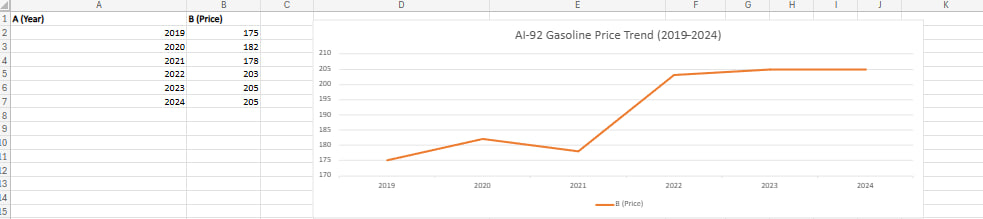
Data Trends (2019-2024)
Analysis of AI-92 Gasoline Price Dynamics in Kazakhstan
Real AI-92 prices in KZT per liter serve as the primary dataset.
Relatively stable prices observe maintained levels at ~175-182 KZT.
Sharp increase followed by stabilization at a higher equilibrium of ~205 KZT.
Higher prices increase the importance and magnitude of tax impact analysis.
Theoretical Framework & Economic Model
METHODOLOGY
Initial Market Analysis
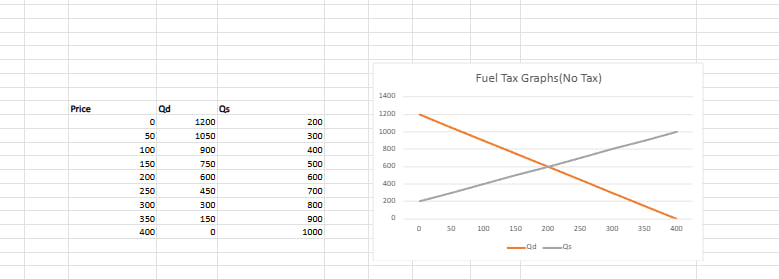
Market Equilibrium Without Tax
1200 - 3P = 200 + 2P
200 KZT/L
600 units
60,000
90,000
150,000
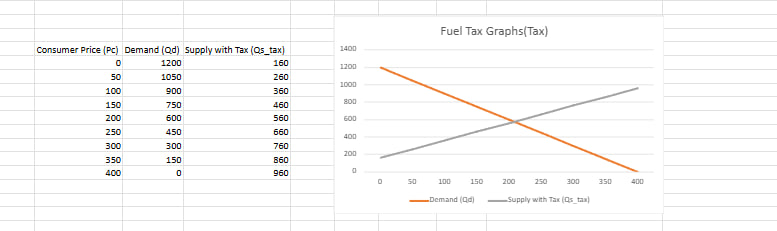
Introducing the Fuel Tax (t = 20 KZT)
Market Equilibrium Analysis
20 KZT
208 KZT
+8
188 KZT
-12
576 units
Consumers pay more (burden sharing), producers receive significantly less, and overall market quantity decreases due to the tax wedge.
Economic Impact Assessment
Welfare Effects Analysis
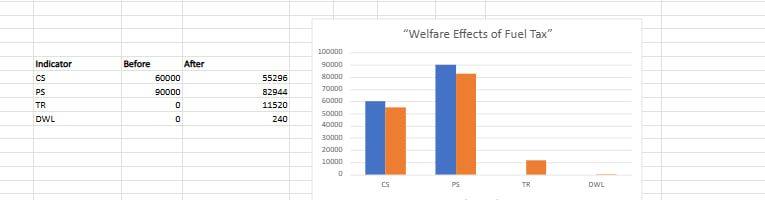
55,296
4,704
82,944
7,056
11,520
240
Producers bear a larger burden <span style="font-weight:700; color:#D4AF37;">(12 KZT)</span> than consumers <span style="font-weight:700; color:#D4AF37;">(8 KZT)</span> in this model.
IMPACT ASSESSMENT
Economic Impacts
Comparative Analysis: Short & Long Term Effects
Short-Term Effects
Inflation, higher transport costs for businesses and households, and immediate welfare reduction.
Long-Term Shifts
Behavioral shifts towards fuel-efficient cars, increased public transport usage, and alternative energy.
Winners
Government (revenue generation) and Society (potential benefits if revenue is reinvested in infrastructure).
Losers
Households (especially low-income), logistics businesses, and producers facing cost burdens.
Research Department
2023
SUMMARY & OUTLOOK
Strategic Recommendations
While excise taxes are vital for the budget, they create unavoidable deadweight loss. Policy must effectively balance revenue generation with minimizing economic distortion to protect market welfare.
- economic-impact
- kazakhstan-economy
- gasoline-taxation
- market-equilibrium
- welfare-economics
- fiscal-policy