






Calculus Derivatives: Intuition, Rules, and Economics
Learn the theory and application of derivatives in economics. Covers basic differentiation rules, marginal cost analysis, and international trade growth.
The Derivative: Theory, Intuition, and Applications
Focus on International Economics and Trade
Intuition: Rate of Change
Before the math, understand the concept. A derivative measures how a function changes as its input changes.<br><br><strong>Everyday Examples:</strong><br>• Speed: How distance changes over time.<br>• Inflation: How prices change over a year.<br>• Cooling: How temperature drops per minute.
Average vs. Instantaneous
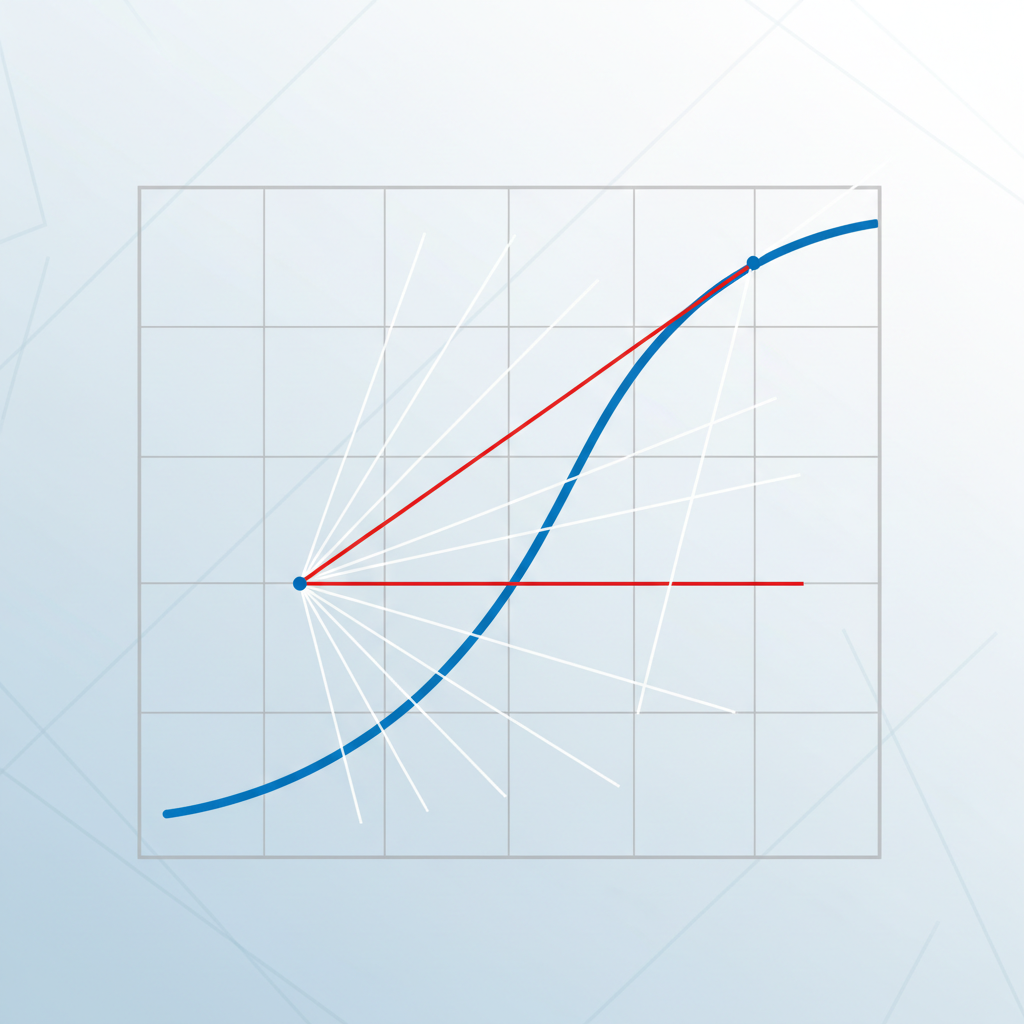
<strong>Average Rate:</strong> The slope between two distinct points (A and B). Like calculating average speed over a 2-hour trip.<br><br><strong>Instantaneous Rate:</strong> What happens when point B moves infinitely close to point A? The distance (Δx) approaches zero using a Limit.
The Formal Definition
f'(x) = lim (h -> 0) [ ( f(x + h) - f(x) ) / h ]
Geometric Interpretation
The derivative is technically the <strong>slope of the tangent line</strong> to the curve at a specific point.<br><br><ul><li><strong>Positive Slope:</strong> The function is increasing (Growth).</li><li><strong>Negative Slope:</strong> The function is decreasing (Decline).</li><li><strong>Zero Slope:</strong> A peak or valley (Maximum or Minimum).</li></ul>
Basic Differentiation Rules
<b>Power Rule:</b> If f(x) = x^n, then f'(x) = n*x^(n-1). Example: x^3 becomes 3x^2.
<b>Constant Rule:</b> The derivative of a constant number is 0. (A horizontal line has no slope).
<b>Sum Rule:</b> The derivative of a sum is the sum of the derivatives. (x^2 + 3x)' = 2x + 3.
Worked Examples
<strong>Example 1:</strong><br>y = x<sup>2</sup><br>Apply Power Rule (n=2):<br>y' = 2x<sup>(2-1)</sup> = <strong>2x</strong><br><br><strong>Example 2 (Polynomial):</strong><br>f(x) = 3x<sup>2</sup> - 5x + 10<br>f'(x) = 3(2x) - 5(1) + 0<br>f'(x) = <strong>6x - 5</strong>
Economics: Marginal Cost
In economics, the derivative of the Total Cost function C(x) is the <strong>Marginal Cost (MC)</strong>.<br><br>It represents the approximate cost of producing the <em>next</em> unit. Notice how MC (Red) intersects Average Cost at its minimum.
International Trade: Export Growth
Derivatives help analyze the <strong>rate of growth</strong> for exports or imports.<br><br>While total trade volume (Blue) might be increasing, the <em>derivative</em> (Orange bars) tells us if that growth is accelerating or slowing down.
Optimization: Max & Min
The most powerful application: <strong>Optimization</strong>.<br><br>To find the maximum profit or minimum cost, we find where the derivative equals zero (f'(x) = 0).<br><br>At the peak of the hill, the tangent line is perfectly horizontal.
Key Takeaways
The Derivative is a measure of instantaneous <b>rate of change</b>.
Geometrically, it represents the <b>slope</b> of the tangent line.
In Economics, derivatives calculate <b>Marginal Cost</b> and <b>Revenue</b>.
Optimization (Setting f'(x)=0) allows businesses to maximize profit and efficiency.
- calculus
- derivatives
- marginal-cost
- economics
- math-tutorial
- optimization
- education