



Classification of Force Systems in Applied Mechanics
Learn various types of force systems in mechanical engineering, including coplanar, concurrent, and non-coplanar systems with real-world examples.
APPLIED MECHANICS
FORCE
SYSTEMS
Classification & Analysis of Force Systems in Mechanics
Mechanical Engineering | Applied Mechanics
WHAT IS A FORCE SYSTEM?
A Force System is a collection of forces acting on a body in one or more planes.
Forces are classified based on the RELATIVE POSITIONS of their lines of action.
Coplanar Concurrent Collinear
Coplanar Concurrent Non-Parallel
Coplanar Non-Concurrent Parallel
Coplanar Non-Concurrent Non-Parallel
Non-Coplanar Concurrent
Non-Coplanar Non-Concurrent
Coplanar Concurrent Collinear
Coplanar Concurrent Non-Parallel
Coplanar Non-Concurrent Parallel
Coplanar Non-Concurrent Non-Parallel
Non-Coplanar Concurrent
Non-Coplanar Non-Concurrent
Applied Mechanics | Force Systems
TYPE 01
Coplanar Concurrent Collinear
Force System
The simplest force system — all force vectors lie along the same straight line.
All forces act along the SAME LINE of action
All forces lie in the SAME PLANE (Coplanar)
All forces pass through a COMMON POINT (Concurrent)
All forces act along the SAME LINE (Collinear)
Simplest of all force systems
Real-World Example
A rope being pulled from both ends — Tug of War
03
Applied Mechanics | Force Systems
TYPE 02
Coplanar Concurrent Non-Parallel
Force System
Forces whose lines of action pass through a COMMON POINT but have different directions in the same plane.
All forces meet at ONE common point
All forces in the SAME PLANE
All lines of action meet at a SINGLE POINT
Forces have DIFFERENT DIRECTIONS (non-parallel)
Resultant found using Parallelogram / Polygon Law
Example: Forces acting on a roof truss joint / Forces at a pin joint in a structure
Resultant R = √(ΣFx² + ΣFy²)
04 | Coplanar Concurrent Non-Parallel
TYPE 03
Coplanar Non-Concurrent Parallel
Force System
Lines of action of all forces lie in the same plane and are PARALLEL to each other but may not have the same direction.
Parallel forces — NO common point of intersection
All forces lie in SAME PLANE
Forces are PARALLEL to each other
Lines of action DO NOT meet at a common point
May act in same or opposite directions
Loading on a simply supported beam
Weight of books on a shelf
Forces on a see-saw / lever
Algebraic sum of all parallel forces
05 | Coplanar Non-Concurrent Parallel
TYPE 04
Coplanar Non-Concurrent Non-Parallel
Force System
All forces lie in the SAME PLANE but do NOT pass through a common point and are NOT parallel to each other.
F₁ = 30N
F₂ = 20N
F₃ = 25N
F₄ = 15N
Lines of action do NOT intersect at one point
All forces in the SAME PLANE (Coplanar)
Forces do NOT meet at a common point (Non-Concurrent)
Forces are NOT parallel (Non-Parallel)
Most GENERAL type of 2D force system
Examples
Forces acting on a spanner/wrench
Wind forces on a building wall
Forces on a ladder against a wall
This system can produce both TRANSLATION and ROTATION of the body
06 | Coplanar Non-Concurrent Non-Parallel
TYPE 05
Non-Coplanar Concurrent
Force System
Lines of action of all forces do NOT lie in the same plane but DO pass through a COMMON POINT.
All forces meet at ONE point in 3D space
Forces do NOT lie in the same plane (Non-Coplanar)
All lines of action pass through ONE common point (Concurrent)
Exists in THREE-DIMENSIONAL space
Requires 3D vector analysis (x, y, z components)
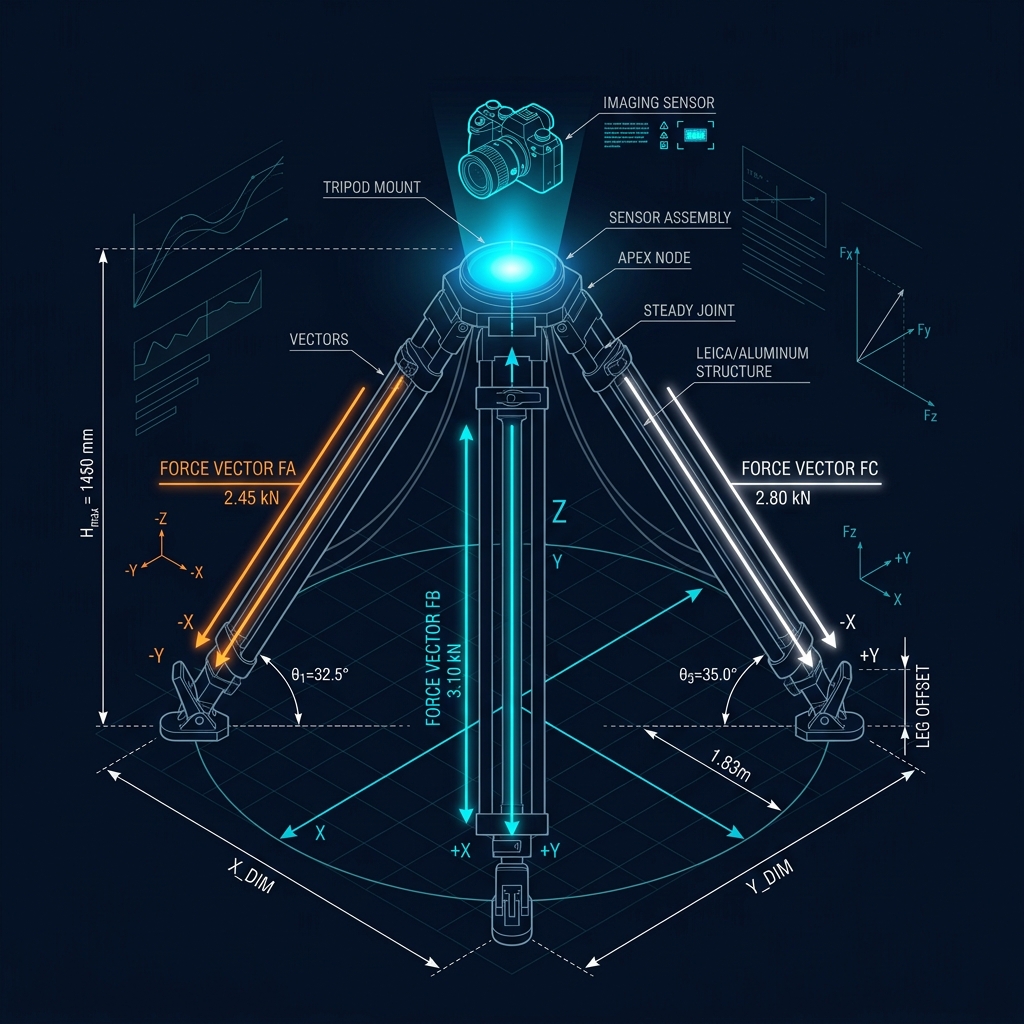
TRIPOD support for a camera
Forces in the legs of a tripod meet at the camera mount
Crane hook forces
Guy wires of a tower meeting at apex
R = √(ΣFx² + ΣFy² + ΣFz²)
07 | Non-Coplanar Concurrent
TYPE 06
Non-Coplanar Non-Concurrent
Force System
Lines of action do NOT lie in the same plane AND do NOT pass through a common point — the most general 3D force system.
Forces in DIFFERENT planes, NO common intersection point
Forces do NOT lie in the same plane (Non-Coplanar)
Forces do NOT pass through a common point (Non-Concurrent)
MOST GENERAL and COMPLEX force system
Produces both Translation AND Rotation in 3D
📌 Examples:
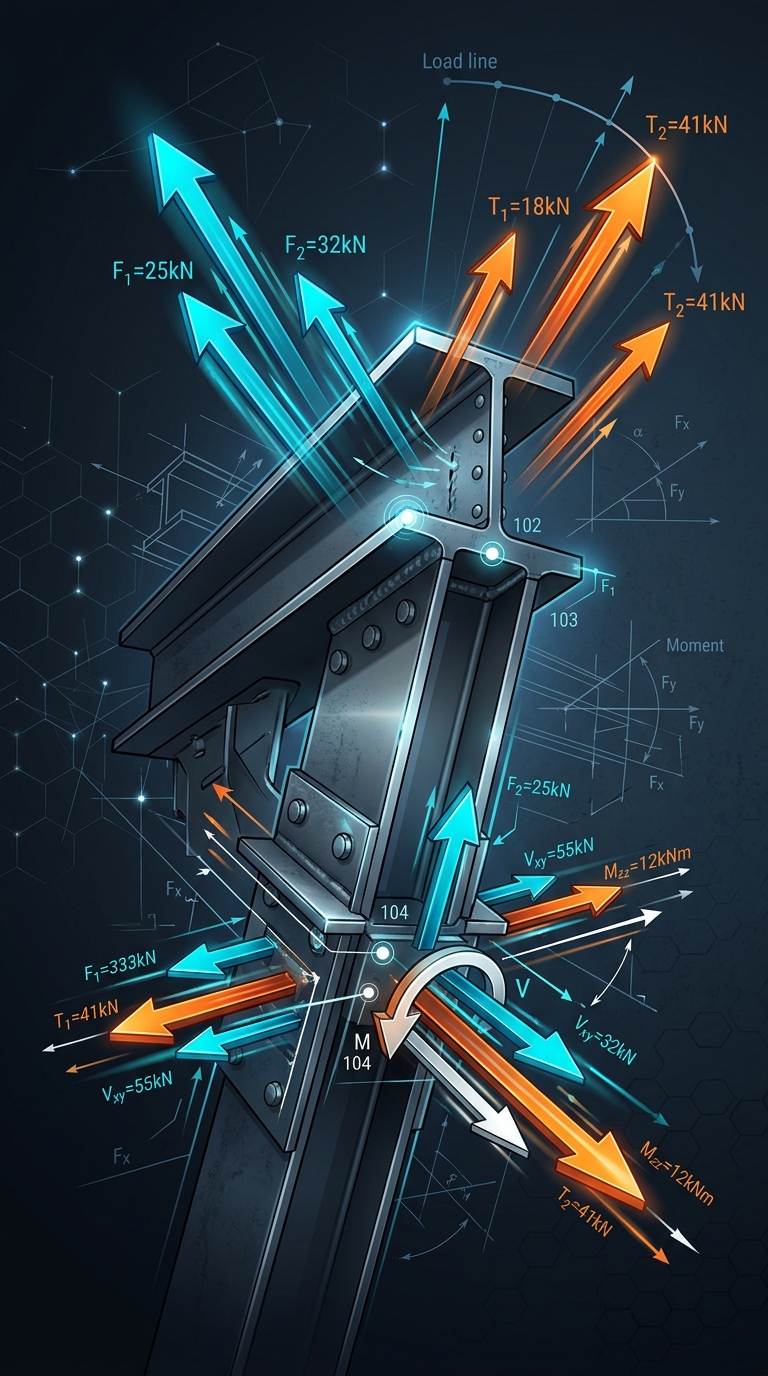
Forces acting on a moving ship or aircraft
Wind loads on a 3D building structure
Forces on a vehicle chassis
General loading on machine components
08 | Non-Coplanar Non-Concurrent
SUMMARY
Classification of Force Systems
— At a Glance —
Collinear
Coplanar Concurrent Non-Parallel
Coplanar Non-Concurrent Parallel
Coplanar Non-Concurrent Non-Parallel
Non-Coplanar Concurrent
Non-Coplanar Non-Concurrent
2D Systems (Types 1–4):
3D Systems (Types 5–6):
All forces in the SAME PLANE
Forces in DIFFERENT PLANES
Applied Mechanics | Force Systems | Complete Classification
- applied-mechanics
- force-systems
- mechanical-engineering
- physics
- coplanar-forces
- concurrent-forces
- engineering-education