











Made byBobr AI

Smart Sensors for Safer Mineral Processing & Dust Control

Discover a smart IoT sensor system designed to eliminate hazardous silica dust, prevent silicosis, and automate quality control in mineral processing units.

#iot#industrial-safety#mineral-processing#design-thinking#smart-sensors#occupational-health#industry-4.0#sustainability
Watch
Pitch
Design Thinking | Amgeen Minerals
We are making mineral processing SAFER, SMARTER, and CLEANER — for workers, for business, for the planet.
Transforming hazardous dust into zero-leakage precision through a Smart Self-Adjusting Sensor System
Group A05 | MBA-FT (2025-27) | Institute of Management, Nirma University
Submitted to Dr. Rohit Swarup & Prof. Romita Swarup | 24 March 2026
Made byBobr AI
02
The Organization
Amgeen Minerals, Ahmedabad
Sector: Manufacturing (Secondary Economic Sector)
Core Process: Micronizing — grinding minerals into ultra-fine powder
Location: Ahmedabad, Gujarat, India
Scale: Mid-sized industrial mineral processing unit
Regulatory Body: GPCB (Gujarat Pollution Control Board)
Made byBobr AI
03
The Discovery
How We Found the Problem
STEP 1 — OBSERVE
Field Observation (AEIOU)
Fine white dust on machinery & vegetation. Workers lifting heavy bags. Visual quality checks by intuition.
STEP 2 — EMPATHIZE
Stakeholder Interviews (5W1H)
3 Key Insights: Poor WiFi for digital logging. Invoice vs dispatch discrepancies. Workers feared silica dust but had no monitoring tools.
STEP 3 — ANALYZE
PESTEL Analysis
Rising GPCB norms. No Industry 4.0 adoption. Silicosis health risk among workforce.
Routine acceptance of harsh conditions = the biggest barrier to excellence.
Made byBobr AI
04
Problem Definition
How Might We...?
How might we redesign the micronizing process to eliminate hazardous dust and human error while ensuring consistent, verifiable mineral quality for B2B clients within the next 4 months?
Insights / Pains
Health & Safety Crisis
  • Workers spend 8-hour shifts in high-noise, high-dust zones
  • Fine Silica Dust causes Silicosis — a life-threatening lung disease
  • No real-time automated dust monitoring tools available
  • Cognitive empathy: operators rely on "years of intuition" not data
Insights / Pains
Operational & Business Errors
  • Manual visual inspection = subjective, inconsistent mineral quality
  • Invoice vs. dispatched quantity discrepancies causing B2B conflicts
  • Poor WiFi prevents digital logging of production data
  • Manual data entry leads to billing and quality errors
Group A05 | MBA-FT (2025-27) | Institute of Management, Nirma University
Submitted to Dr. Rohit Swarup & Prof. Romita Swarup | 24 March 2026
Made byBobr AI
05 The Solution
Smart Self-Adjusting Sensor System
What It Does
A closed-loop Smart Sensor Box integrated into the micronizing process that:
  • Replaces manual visual inspection with precision sensors
  • Auto-adjusts grinding settings via feedback loop
  • Seals dust in a closed collection chamber (zero leakage)
  • Connects machinery to a digital management dashboard via IoT
  • Eliminates manual data entry — reducing billing and quality errors
Substitute
Combine
Adapt
Eliminate
Unique
Sensor-based precision + IoT feedback loop — first in mid-sized mineral units
Scalable
Can be deployed across multiple plant sections and factories
Sustainable
Reduces dust pollution, aligns with GPCB norms & Viksit Bharat 2047
Feasible & Viable
Pilot cost ~₹30,000 | 4-month implementation cycle
Made byBobr AI
06
Prototype I
From Idea to Paper Sketch
Prototype Level I — Paper Concept
Initial hand-drawn sketches of a closed-loop sensor system
Mapped the flow: Raw Material Grinding Dust Collection Feedback Output
Identified key components: Smart Sensor Box, Collection Chamber, IoT Gateway
Validated the concept with the operations team at Amgeen
WHAT'S UNIQUE
First time the factory's process was visualized end-to-end with sensor integration points mapped
Made byBobr AI
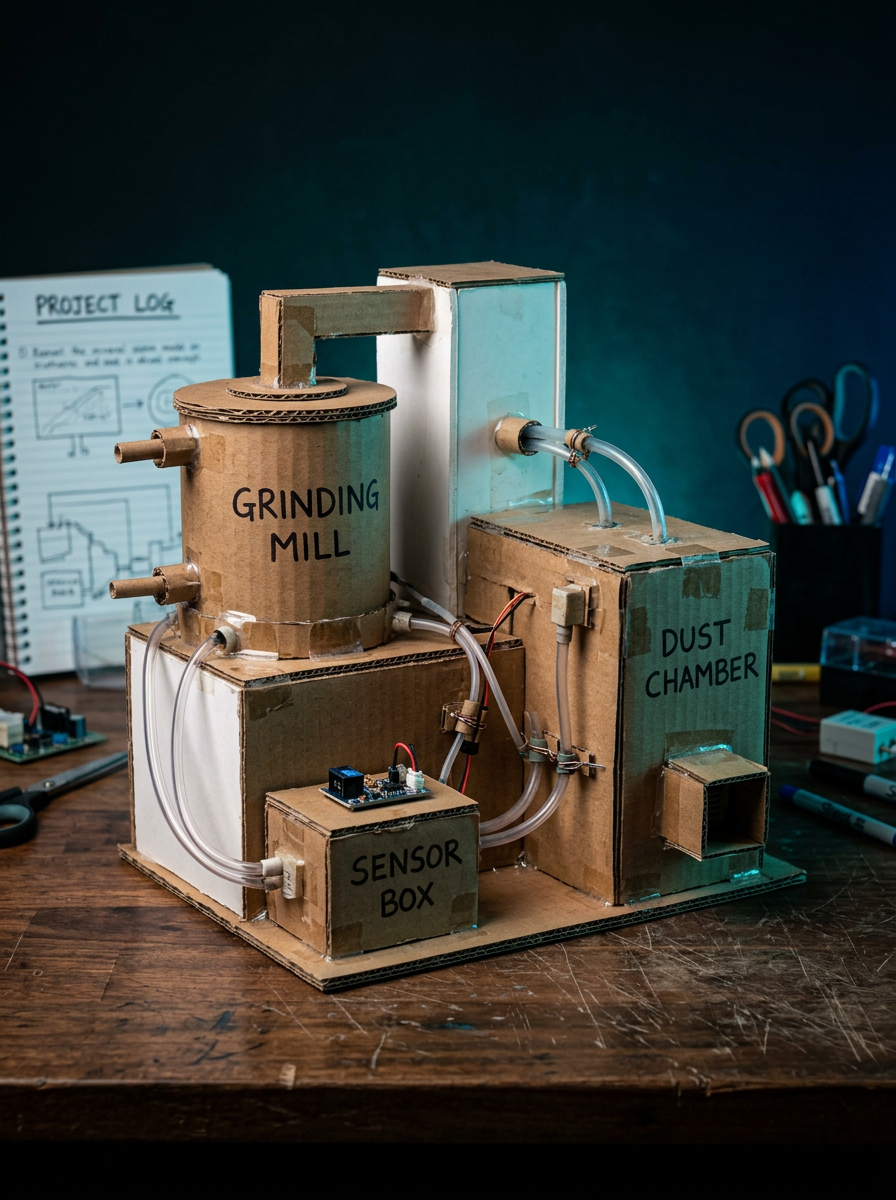
07
Prototype II
From Paper to 3D Physical Model
Prototype Level II — Physical Model
  • Built a 3D physical cardboard/foam model of the full system
  • Visualized the complete flow: Raw Material Input → Micronizing Mill → Smart Sensor Box → Dust Collection Chamber → Packaged Output
  • Demonstrated real-world spatial layout of components
  • Used to communicate the design to factory stakeholders
Dimension
Current (Manual)
Smart System
Operational
Inconsistent
Auto-Adjustment Loop
Environmental
Dust Pollution
Closed Collection
Quality
Subjective
Sensor Precision
Safety
High Silica Exposure
Zero-Leakage
Group A05 | MBA-FT (2025-27) | Institute of Management, Nirma University
Submitted to Dr. Rohit Swarup & Prof. Romita Swarup | 24 March 2026
Made byBobr AI
08
Prototype III
From Model to Business — The Smart Sensor Box
Core Value Proposition
The Smart Sensor Box — an IoT-enabled device that:
Monitors dust emission in real-time
Auto-adjusts micron fineness settings
Logs all production data digitally
Sends alerts to management dashboard
Prototype III — Business Ready Concept
Implementation Timeline
Oct
Documentation &
Team Formation
Nov
Beta Testing &
Sensor Calibration
Dec
App Patenting
Jan
Full System Launch
Budget: ~₹30,000 pilot cost
Triple Bottom Line
PEOPLE
Worker safety, zero silica exposure, reduced fatigue
PLANET
Closed-loop dust system, GPCB compliant, Viksit Bharat 2047
PROFIT
Fewer B2B disputes, accurate invoicing, lower penalties
A ₹30,000 Smart Sensor Box that saves lives, clears the air, and grows the business.
Made byBobr AI
Bobr AI

DESIGNER-MADE
PRESENTATION,
GENERATED FROM
YOUR PROMPT

Create your own professional slide deck with real images, data charts, and unique design in under a minute.

Generate For Free

Smart Sensors for Safer Mineral Processing & Dust Control

Discover a smart IoT sensor system designed to eliminate hazardous silica dust, prevent silicosis, and automate quality control in mineral processing units.

Design Thinking | Amgeen Minerals

We are making mineral processing SAFER, SMARTER, and CLEANER — for workers, for business, for the planet.

Transforming hazardous dust into zero-leakage precision through a Smart Self-Adjusting Sensor System

Group A05 | MBA-FT (2025-27) | Institute of Management, Nirma University

Submitted to Dr. Rohit Swarup & Prof. Romita Swarup | 24 March 2026

02

The Organization

Amgeen Minerals, Ahmedabad

Manufacturing (Secondary Economic Sector)

Micronizing — grinding minerals into ultra-fine powder

Ahmedabad, Gujarat, India

Mid-sized industrial mineral processing unit

GPCB (Gujarat Pollution Control Board)

03

The Discovery

How We Found the Problem

STEP 1 — OBSERVE

Field Observation (AEIOU)

Fine white dust on machinery & vegetation. Workers lifting heavy bags. Visual quality checks by intuition.

STEP 2 — EMPATHIZE

Stakeholder Interviews (5W1H)

3 Key Insights: Poor WiFi for digital logging. Invoice vs dispatch discrepancies. Workers feared silica dust but had no monitoring tools.

STEP 3 — ANALYZE

PESTEL Analysis

Rising GPCB norms. No Industry 4.0 adoption. Silicosis health risk among workforce.

Routine acceptance of harsh conditions = the biggest barrier to excellence.

04

Problem Definition

How Might We...?

How might we redesign the micronizing process to eliminate hazardous dust and human error while ensuring consistent, verifiable mineral quality for B2B clients within the next 4 months?

Insights / Pains

Health & Safety Crisis

Workers spend 8-hour shifts in high-noise, high-dust zones

Fine Silica Dust causes Silicosis — a life-threatening lung disease

No real-time automated dust monitoring tools available

Cognitive empathy: operators rely on "years of intuition" not data

Operational & Business Errors

Manual visual inspection = subjective, inconsistent mineral quality

Invoice vs. dispatched quantity discrepancies causing B2B conflicts

Poor WiFi prevents digital logging of production data

Manual data entry leads to billing and quality errors

Group A05 | MBA-FT (2025-27) | Institute of Management, Nirma University

Submitted to Dr. Rohit Swarup & Prof. Romita Swarup | 24 March 2026

The Solution

Smart Self-Adjusting Sensor System

What It Does

A closed-loop Smart Sensor Box integrated into the micronizing process that:

Replaces manual visual inspection with precision sensors

Auto-adjusts grinding settings via feedback loop

Seals dust in a closed collection chamber (zero leakage)

Connects machinery to a digital management dashboard via IoT

Eliminates manual data entry — reducing billing and quality errors

Sensor-based precision + IoT feedback loop — first in mid-sized mineral units

Can be deployed across multiple plant sections and factories

Reduces dust pollution, aligns with GPCB norms & Viksit Bharat 2047

Pilot cost ~₹30,000 | 4-month implementation cycle

06

Prototype I

From Idea to Paper Sketch

Prototype Level I — Paper Concept

Initial hand-drawn sketches of a closed-loop sensor system

Validated the concept with the operations team at Amgeen

WHAT'S UNIQUE

First time the factory's process was visualized end-to-end with sensor integration points mapped

07

Prototype II

From Paper to 3D Physical Model

Prototype Level II — Physical Model

Group A05 | MBA-FT (2025-27) | Institute of Management, Nirma University

Submitted to Dr. Rohit Swarup & Prof. Romita Swarup | 24 March 2026

  • iot
  • industrial-safety
  • mineral-processing
  • design-thinking
  • smart-sensors
  • occupational-health
  • industry-4.0
  • sustainability