


Made byBobr AI

Graph Neural Networks for Traffic Forecasting | STGNN Guide

Learn how Spatial-Temporal Graph Neural Networks (STGNNs) solve complex traffic forecasting problems using deep learning and message passing architectures.

#graph-neural-networks#deep-learning#traffic-forecasting#spatial-temporal-data#stgnn#machine-learning
Watch
Pitch
abstract 3d visualization of a neural network overlaying a city map, simplified blue and white lines, high tech, academic style, minimal

Graph Neural Networks: From Theory to Traffic Forecasting

A Deep Learning Approach to Spatial-Temporal Data Analysis

Based on research by Wu, Pan, Chen, Long, Zhang, Yu et al.

Made byBobr AI

The Core Problem: Representing Graph Complexity

Loss of Topology: Traditional Machine Learning requires preprocessing that compresses graphs into flat vectors, losing vital structural connections.

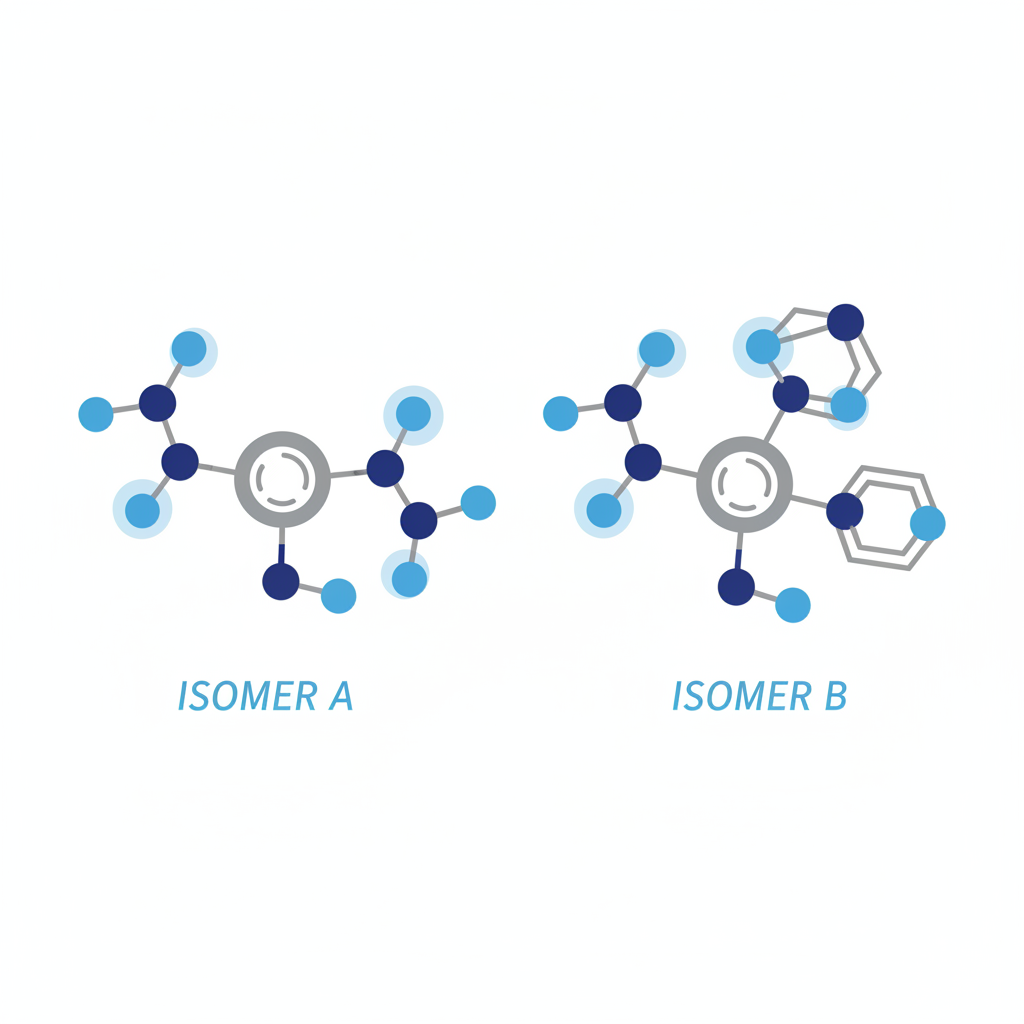
The Isomery Challenge: Different structures with identical components (like chemical isomers) appear identical to standard ML models.

Recursive Limitations: Early attempts (RNNs/Markov Chains) struggled with cyclic graphs and high computational complexity.

vector illustration of two chemical molecules that look similar but have different connections, scientific diagram style, minimal blue and grey
Made byBobr AI

Taxonomy: The Evolution of GNNs

Recurrent GNNs (RecGNNs)

The pioneers. Learn node states via recursive information exchange until equilibrium.

Convolutional GNNs (ConvGNNs)

Generalizes convolution from images (grids) to graphs. Aggregates neighbor features. The modern standard.

Spatial-Temporal GNNs (STGNNs)

Captures both spatial dependencies (topology) and temporal dynamics (time). Critical for traffic forecasting.

Made byBobr AI

How GNNs Work: Message Passing

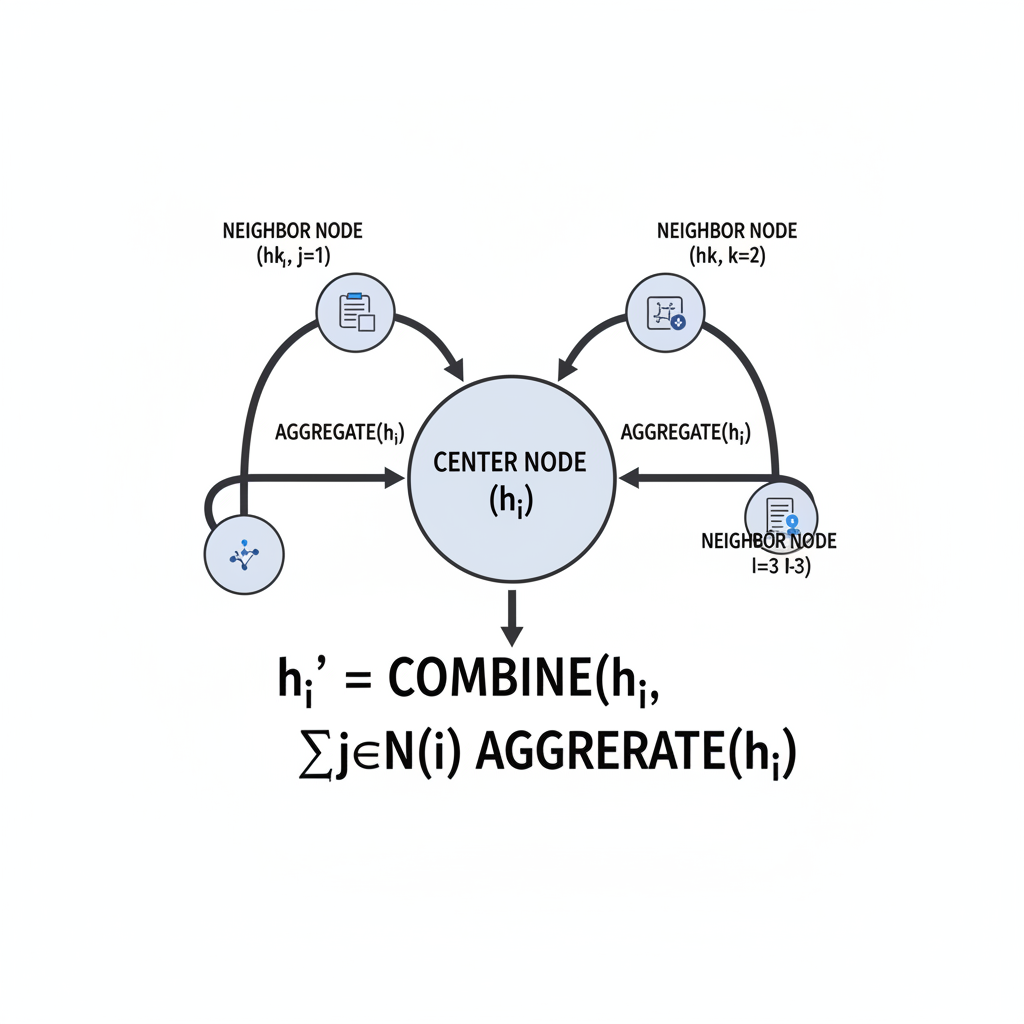
Central to GNNs is the state update function. A node updates its state based on:
1. Its own features.
2. Properties of connected edges.
3. The states of its neighbors.

The local transition function fw aggregates this data, allowing information to diffuse through the network structure.

diagram of a graph neural network node aggregating data from neighbor nodes, arrows pointing to center node, academic style, white background
Made byBobr AI

Proof of Concept: Subgraph Matching

Accuracy comparison on synthetic data showing GNNs significantly outperform Feedforward Neural Networks (FNN), especially as graph complexity increases.

Chart
Made byBobr AI
long exposure photography of city traffic at night showing light trails, red and white lights, modern urban setting

The Traffic Forecasting Challenge

Traffic forecasting is a quintessential Spatial-Temporal problem.

  • Spatial: Roads are not isolated; congestion propagates to connected neighbors (topology).
  • Temporal: Traffic flow is dynamic and history-dependent (time-series).

Previous models (SVM, LSTM) captured one aspect well, but not both simultaneously.
Made byBobr AI

Solution: STGNN Architecture

The "Sandwich" Structure

The Spatio-Temporal Graph Convolutional Network (STGNN) avoids using recurrent networks (RNNs) entirely. Instead, it uses a stacked block architecture:

1. Temporal Gated Conv (Time)
2. Spatial Graph Conv (Space)
3. Temporal Gated Conv (Time)

Benefit: Fully parallelizable training and faster convergence compared to RNNs.

Made byBobr AI

Experimental Setup & Datasets

BJER4 (Beijing)

• Urban traffic network
• 12 Major roads (dense)
• Data collected every 5 mins
• High complexity junctions

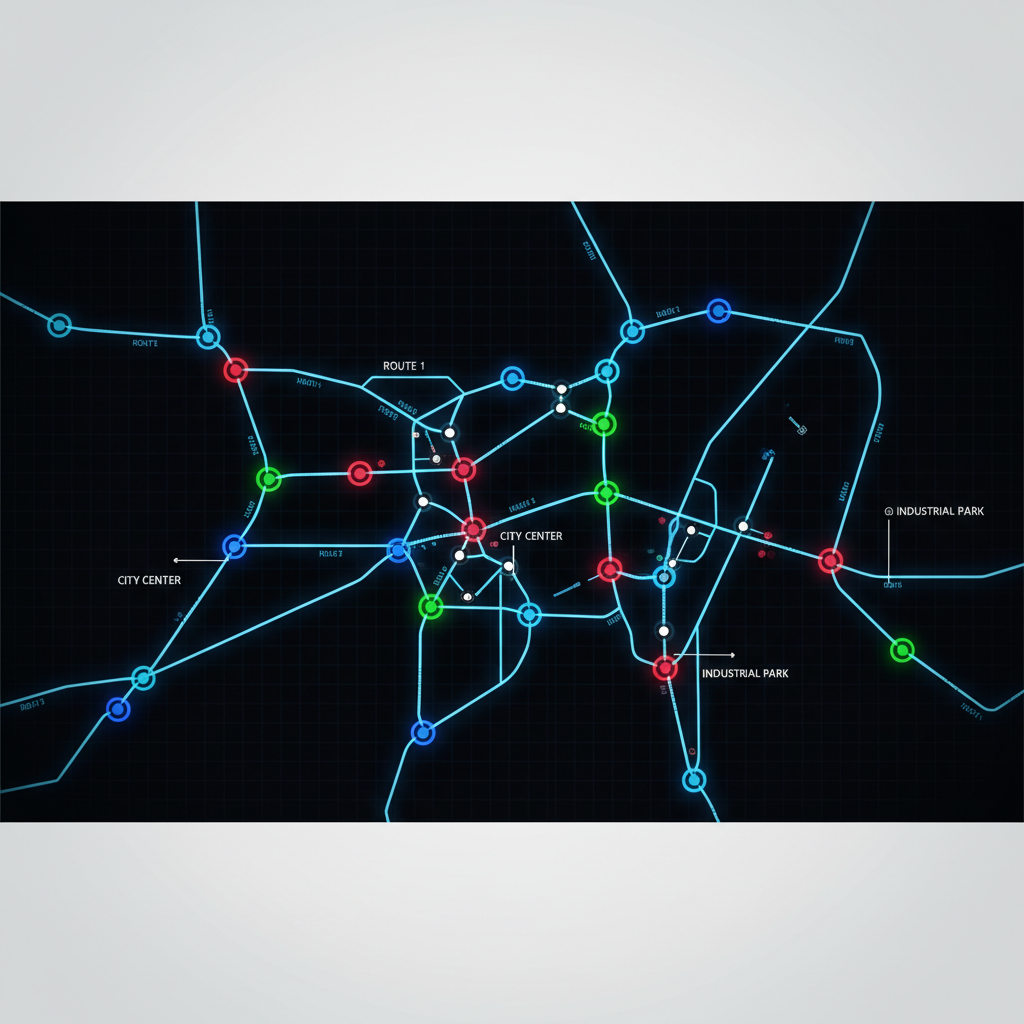
digital map visualization of a road network with nodes and edges highlighted, distinct colors for intersections, dark mode technical style

PeMSD7 (California)

• Highway network
• 228 Sensing stations
• 39,000 sensors (Speed/Flow)
• Tests scalability

Made byBobr AI

Performance: STGNN vs Baselines

Chart

STGNN achieves the lowest error rates (MAE: 2.25), outperforming both statistical baselines (ARIMA) and complex recurrent methods (GCGRU).

Made byBobr AI

Training Efficiency

Chart

Faster Convergence: Because STGNN uses convolutions instead of recurrent loops, it can compute time-steps in parallel. It achieves lower loss in significantly less training time compared to GCGRU.

Made byBobr AI

Conclusion & Future Directions

Summary

  • GNNs effectively capture topological data lost by traditional ML.
  • STGNNs solve the traffic problem by modeling Space and Time simultaneously.
  • The convolutional architecture ensures scalability and speed.

Future Challenges

  • Handling Dynamic Graphs (where the road network itself changes).
  • Improving Scalability for massive city-wide networks.
  • Addressing Heterogeneity (different types of roads/nodes).
Made byBobr AI
Bobr AI

DESIGNER-MADE
PRESENTATION,
GENERATED FROM
YOUR PROMPT

Create your own professional slide deck with real images, data charts, and unique design in under a minute.

Generate For Free

Graph Neural Networks for Traffic Forecasting | STGNN Guide

Learn how Spatial-Temporal Graph Neural Networks (STGNNs) solve complex traffic forecasting problems using deep learning and message passing architectures.

Graph Neural Networks: From Theory to Traffic Forecasting

A Deep Learning Approach to Spatial-Temporal Data Analysis

Based on research by Wu, Pan, Chen, Long, Zhang, Yu et al.

The Core Problem: Representing Graph Complexity

<b>Loss of Topology:</b> Traditional Machine Learning requires preprocessing that compresses graphs into flat vectors, losing vital structural connections.

<b>The Isomery Challenge:</b> Different structures with identical components (like chemical isomers) appear identical to standard ML models.

<b>Recursive Limitations:</b> Early attempts (RNNs/Markov Chains) struggled with cyclic graphs and high computational complexity.

Taxonomy: The Evolution of GNNs

Recurrent GNNs (RecGNNs)

The pioneers. Learn node states via recursive information exchange until equilibrium.

Convolutional GNNs (ConvGNNs)

Generalizes convolution from images (grids) to graphs. Aggregates neighbor features. The modern standard.

Spatial-Temporal GNNs (STGNNs)

Captures both spatial dependencies (topology) and temporal dynamics (time). Critical for traffic forecasting.

How GNNs Work: Message Passing

Central to GNNs is the state update function. A node updates its state based on: <br>1. Its own features.<br>2. Properties of connected edges.<br>3. The states of its neighbors.<br><br>The local transition function <i>f<sub>w</sub></i> aggregates this data, allowing information to diffuse through the network structure.

Proof of Concept: Subgraph Matching

Accuracy comparison on synthetic data showing GNNs significantly outperform Feedforward Neural Networks (FNN), especially as graph complexity increases.

The Traffic Forecasting Challenge

Traffic forecasting is a quintessential <b>Spatial-Temporal</b> problem.<br><br><ul><li><b>Spatial:</b> Roads are not isolated; congestion propagates to connected neighbors (topology).</li><li><b>Temporal:</b> Traffic flow is dynamic and history-dependent (time-series).</li></ul><br>Previous models (SVM, LSTM) captured one aspect well, but not both simultaneously.

Solution: STGNN Architecture

The "Sandwich" Structure

The Spatio-Temporal Graph Convolutional Network (STGNN) avoids using recurrent networks (RNNs) entirely. Instead, it uses a stacked block architecture:

1. Temporal Gated Conv (Time)

2. Spatial Graph Conv (Space)

3. Temporal Gated Conv (Time)

<b>Benefit:</b> Fully parallelizable training and faster convergence compared to RNNs.

Experimental Setup & Datasets

BJER4 (Beijing)

• Urban traffic network<br>• 12 Major roads (dense)<br>• Data collected every 5 mins<br>• High complexity junctions

PeMSD7 (California)

• Highway network<br>• 228 Sensing stations<br>• 39,000 sensors (Speed/Flow)<br>• Tests scalability

Performance: STGNN vs Baselines

STGNN achieves the lowest error rates (MAE: 2.25), outperforming both statistical baselines (ARIMA) and complex recurrent methods (GCGRU).

Training Efficiency

<b>Faster Convergence:</b> Because STGNN uses convolutions instead of recurrent loops, it can compute time-steps in parallel. It achieves lower loss in significantly less training time compared to GCGRU.

Conclusion & Future Directions

Summary

<ul><li>GNNs effectively capture topological data lost by traditional ML.</li><li>STGNNs solve the traffic problem by modeling Space and Time simultaneously.</li><li>The convolutional architecture ensures scalability and speed.</li></ul>

Future Challenges

<ul><li>Handling <b>Dynamic Graphs</b> (where the road network itself changes).</li><li>Improving <b>Scalability</b> for massive city-wide networks.</li><li>Addressing <b>Heterogeneity</b> (different types of roads/nodes).</li></ul>

  • graph-neural-networks
  • deep-learning
  • traffic-forecasting
  • spatial-temporal-data
  • stgnn
  • machine-learning