










Foundations of Physics: Motion, Forces & Newton's Laws
Learn the basics of physics: the scientific method, motion, speed vs. velocity, acceleration formulas, and Newton's three laws of motion for physical science.
Unit 1: The Foundations of Physics
Motion, Forces, and the Nature of Science
Ready Global Academy - Physical Science
Lesson 1: The Nature of Science
Physics
is the study of fundamental laws of nature — how and why things move, interact, and exist.
Science
is a process for understanding the natural world through observation and experimentation.
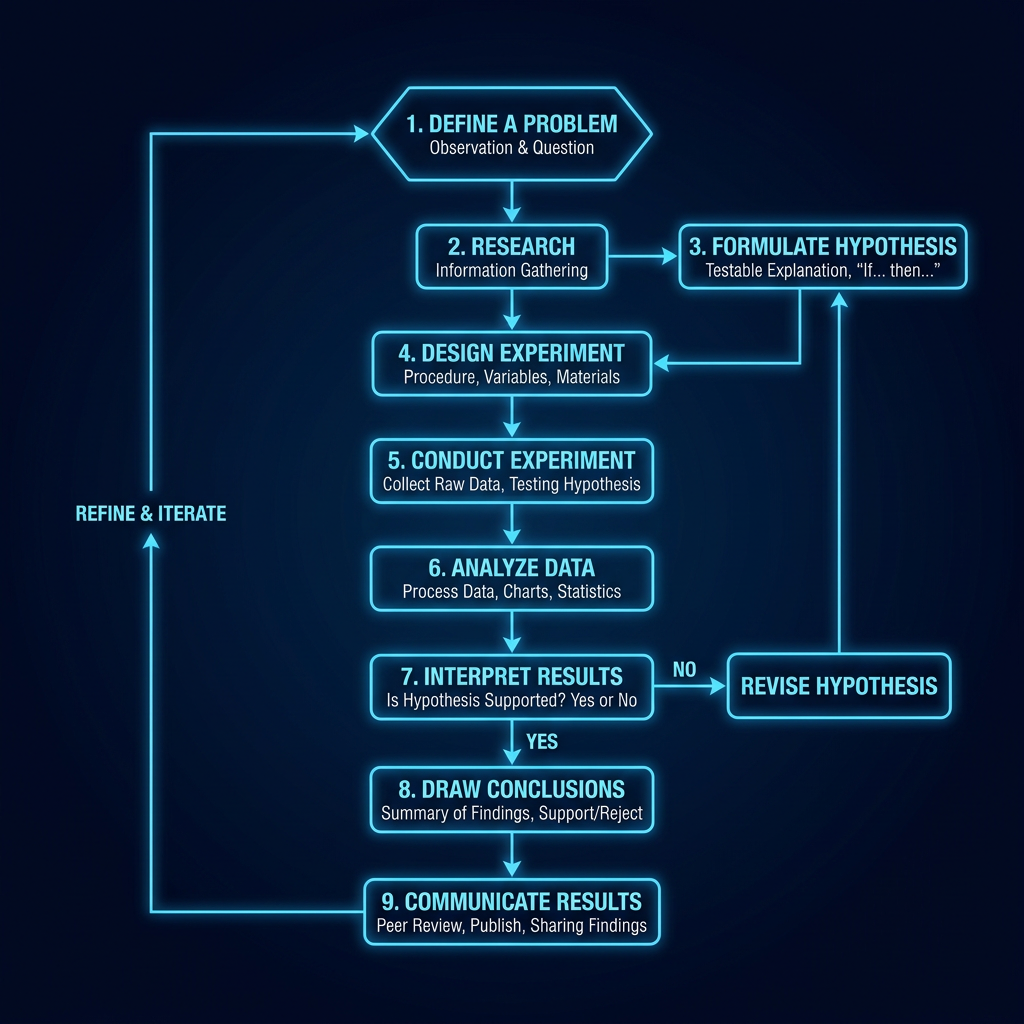
The Scientific Method
a structured approach to inquiry:
Observation
Question
Hypothesis
Experiment
Conclusion
Ready Global Academy - Physical Science
Variables: The 'What' and 'How' of an Experiment
Understanding the key components of a scientific fair test
Independent Variable (IV)
The factor you change on purpose (the cause)
Amount of force applied to a box
Dependent Variable (DV)
The factor that changes because of the IV (the effect)
How fast the box accelerates
Controlled Variables
Factors kept the same for a fair test
Mass of the box, surface it's on
If I increase the height of a ramp
, then a ball will roll down faster
Same ball, same ramp material, same release point.
Video: The Scientific Method
youtube.com/watch?v=yi0hwFDQTSQ
This video explains the scientific method using a simple, fun experiment.
What was the question in the video?
What was the hypothesis?
How did they test it?
What would you have done differently?
Activity: Design an Experiment
You notice that your plants are growing taller in the window than on the shelf.
Write down the Question.
State a Hypothesis using "If...then..." format.
Identify the Independent Variable.
Identify the Dependent Variable.
List two Controlled Variables.
Why do plants grow taller in the window?
If plants get more sunlight, then they will grow taller.
Amount of sunlight
Height of the plant
Same type of plant, same amount of water, same soil
Ready Global Academy - Physical Science
Lesson 2: Motion
Motion
is the change in an object's position over time.
Position:
Where an object is located.
Reference Point:
A stationary object used to detect motion.
Distance:
The total length of the path traveled (a scalar quantity).
Displacement:
The straight-line distance and direction from start to finish (a vector quantity).
Ready Global Academy - Physical Science
The Difference Between Speed and Velocity
Speed
How fast something is moving (magnitude only)
Speed = Distance / Time
m/s, km/h, mph
Velocity
Speed with a given direction (magnitude + direction)
Velocity = Displacement / Time
m/s East, km/h North
Example 1
Instructor Walkthrough
A runner jogs 100 m East in 10 s.
Speed = 10 m/s
Velocity = 10 m/s East
Example 2
Student Practice
A car drives 50 km North, then 30 km South in 2 hours.
Distance = 80 km, Displacement = 20 km North
Average Speed = 40 km/h, Average Velocity = 10 km/h North
Video: Speed, Velocity, and Acceleration
A quick and clear explanation of the difference between speed, velocity, and acceleration.
🏃
Speed
How fast an object is moving, regardless of its direction.
➡️
Velocity
The speed of an object along a specific, given direction.
🚀
Acceleration
The rate at which an object's velocity changes over time.
Ready Global Academy - Physical Science
Lesson 3: Acceleration
Acceleration is the rate of change of velocity.
Ready Global Academy - Physical Science
Calculating Acceleration
a = (v<sub>f</sub> − v<sub>i</sub>) / t
Acceleration = (Final Velocity − Initial Velocity) / Time
Units: meters per second squared (m/s²)
Instructor Walkthrough
A car accelerates from rest (0 m/s) to 20 m/s in 5 seconds.
a = (20 − 0) / 5 = 4 m/s²
Student Practice
A bicycle moving at 10 m/s brakes to a stop in 2 seconds.
a = (0 − 10) / 2 = −5 m/s²<br><span style="font-size: 20px; color: #ffb732; font-family: system-ui, -apple-system, sans-serif; font-weight: 500; font-style: italic; margin-top: 8px; display: inline-block;">(negative = deceleration)</span>
Graphing Motion
Position vs. Time Graph
Velocity
constant velocity
object at rest
Velocity vs. Time Graph
Acceleration
constant velocity (zero acceleration)
acceleration
Ready Global Academy - Physical Science
Activity: What is the Motion?
Describe the motion.
Object is at rest.
Describe the motion.
Fast, constant speed forward.
Describe the motion.
Constant positive velocity.
Describe the motion.
Negative acceleration / deceleration.
Ready Global Academy - Physical Science
Lesson 4: Forces and Newton's Laws of Motion
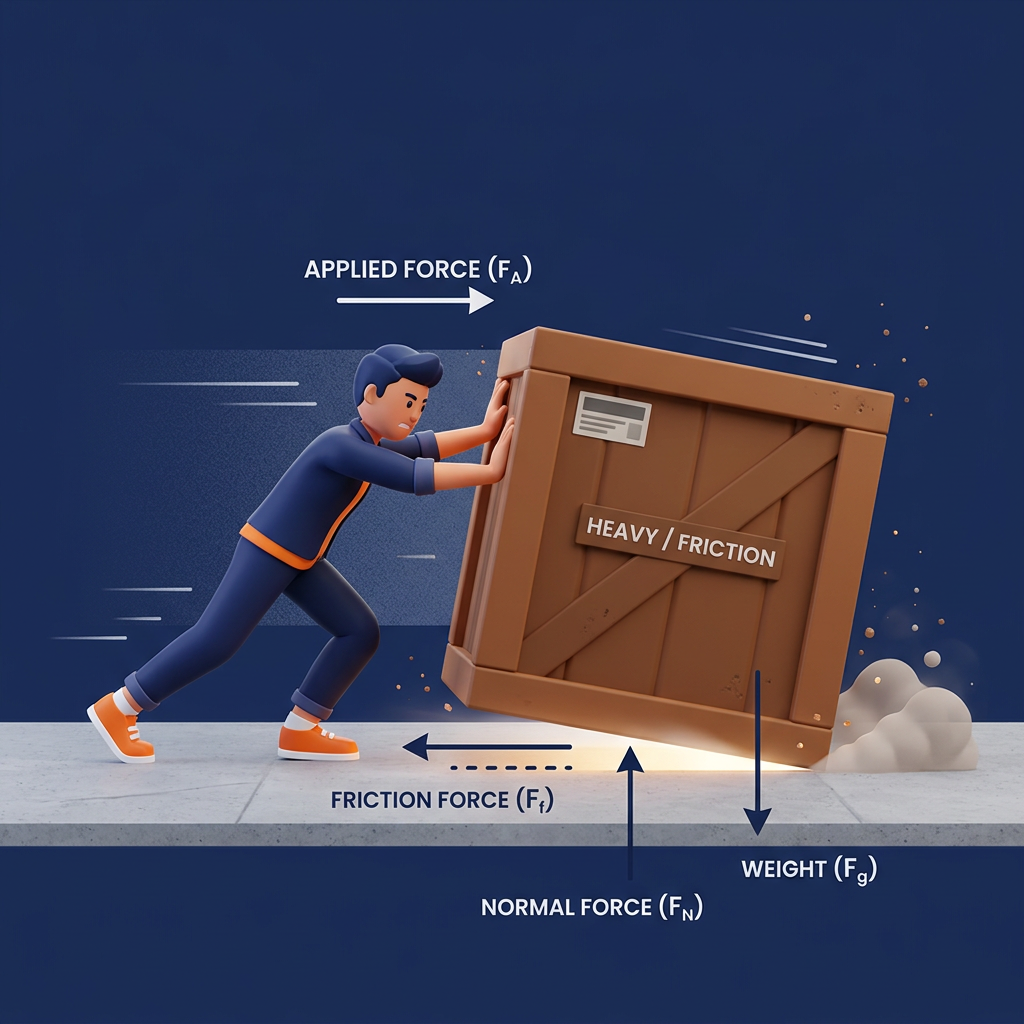
A push or pull on an object, measured in Newtons (N).
Developed three fundamental laws describing how forces affect motion.
"A force is not needed to keep an object moving — only to CHANGE its motion."
Ready Global Academy - Physical Science
Newton's First Law of Motion
1st Law
An object at rest stays at rest, and an object in motion stays in motion with the same speed and in the same direction unless acted upon by an unbalanced force.
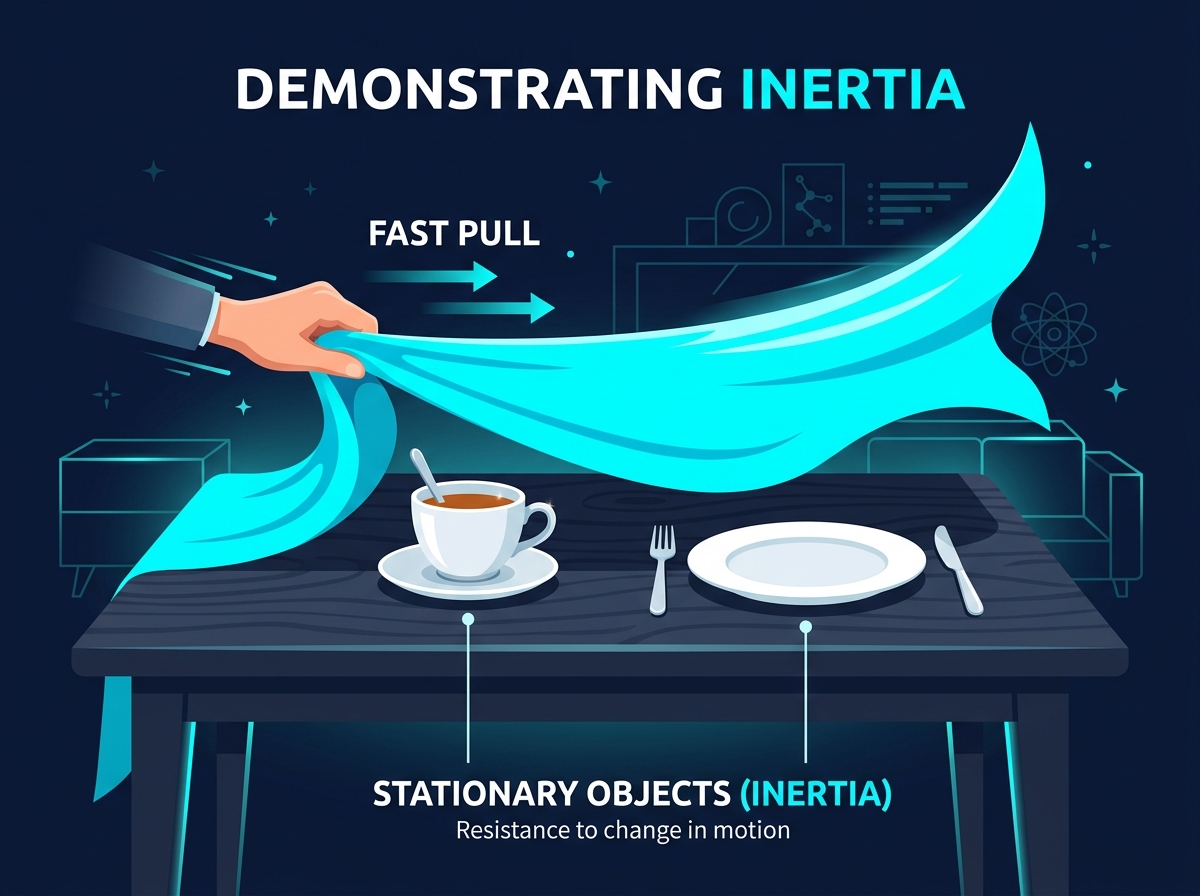
A fun demonstration of Newton's First Law in action.
Why you feel a 'jerk' when a car suddenly stops or starts.
Inertia
The tendency of an object to resist changes in its motion.
More mass = more inertia
Tablecloth pull trick: Demonstrating inertia at rest
Newton's 2nd Law of Motion
2nd Law
The acceleration of an object depends on the mass of the object and the amount of force applied.
F = m × a
Force = mass × acceleration
Key Concepts
Instructor Walkthrough
F = 5 × 2 = 10 N
Student Practice
F = 1000 × 3 = 3000 N
Newton's 3rd Law of Motion
3rd Law
For every action, there is an equal and opposite reaction.
Forces always occur in pairs. When one object exerts a force on a second object, the second exerts an equal and opposite force back.
https://www.youtube.com/embed/4rJ9z6IXnb8
Swimming
You push water backward (action) → water pushes you forward (reaction).
Rocket Launch
Rocket pushes exhaust gases down (action) → gases push rocket up (reaction).
Ready Global Academy - Physical Science
https://bobr.ams3.digitaloceanspaces.com/searched/08ef8c54-99c2-449f-91fe-df90c8ce6f1b.jpg
https://bobr.ams3.digitaloceanspaces.com/searched/f06236fb-29eb-4f79-a90c-1711009a69be.jpg
Activity: Which Law Is It?
A book rests on a table.
1st Law — Inertia: the book stays at rest until a force acts on it.
A soccer ball is kicked and accelerates faster than a bowling ball with the same force.
2nd Law — F=ma: smaller mass → greater acceleration.
A person steps off a small boat onto a dock. The boat moves backward.
3rd Law — Action-Reaction: feet push boat back, boat pushes person forward.
Unit 1 Summary: Key Concepts
Nature of Science
Scientific Method, Variables (IV, DV, Controls)
Motion
Distance vs. Displacement, Speed vs. Velocity
Acceleration
Changing velocity | a = (vf − vi) / t
Graphing
Position vs. Time → slope = velocity | Velocity vs. Time → slope = acceleration
Forces
F = m × a | Measured in Newtons (N)
Newton's 3 Laws
Inertia | F = ma | Action-Reaction
Ready Global Academy - Physical Science
What's Next?
Homework
Complete the Unit 1 Worksheet.
Next Class
Unit 2: Energy — We'll explore work, power, and how energy is transferred.
Questions
Ask me now, or send a message on Classin.
Great work today! Keep exploring the world around you.
Ready Global Academy - Physical Science
- physics-basics
- scientific-method
- newtons-laws
- motion-and-forces
- acceleration-formula
- kinematics
- physical-science
- education