
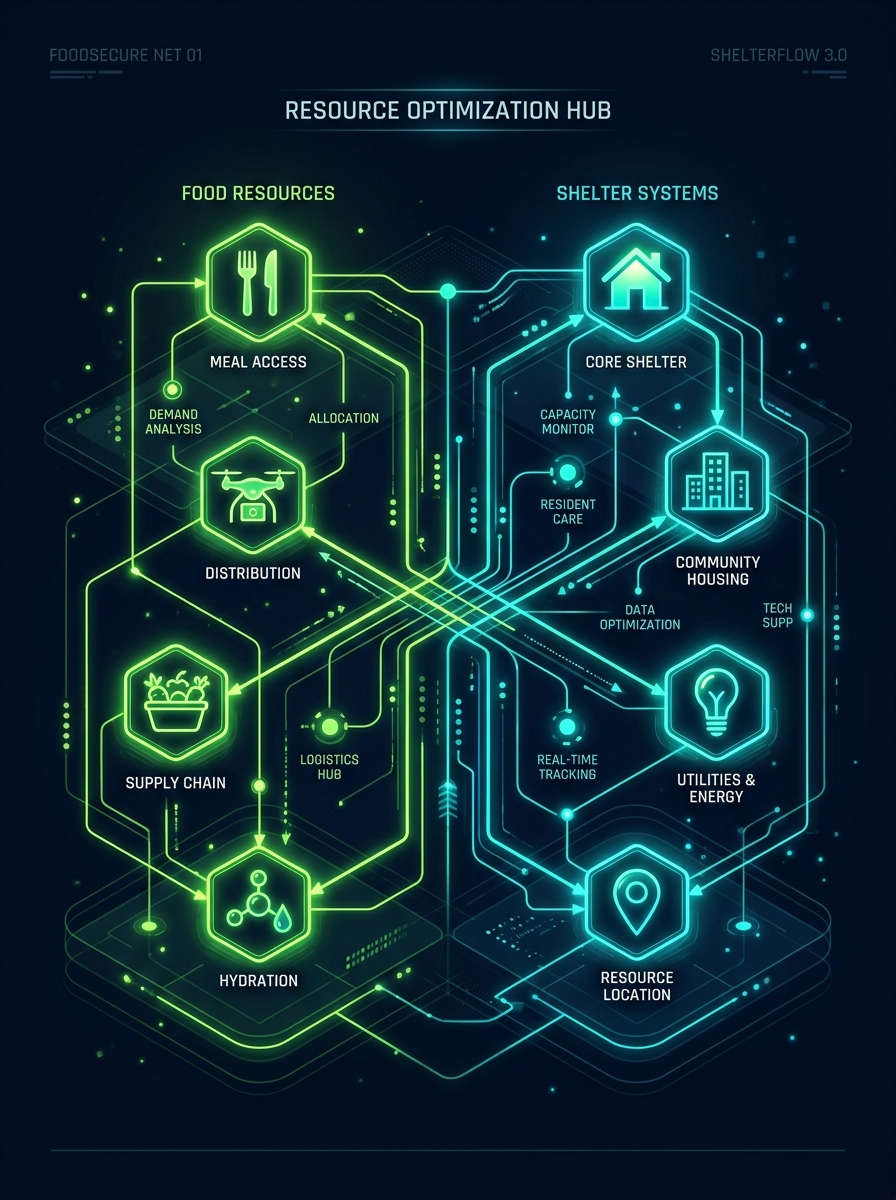




Smart Food Redistribution: AI & IoT Platform Engineering
Explore a technical project report on bridging food surplus and scarcity using a 3-tier architecture with React.js, Node.js, AI forecasting, and IoT monitoring.
TECHNICAL PROJECT REPORT
Smart Food
Redistribution Platform
Leveraging AI, IoT & Digital Technology to Bridge Surplus and Scarcity
Full-Stack Engineering
Social Impact
Industry 4.0
01 / INTRODUCTION
The Crisis at the Intersection of Waste & Hunger
In India, a paradoxical challenge persists — ranking high on global hunger indices while generating immense food waste. Technology is no longer optional; it is a strategic necessity.
1/3
of all global food production is lost or wasted annually — FAO
<span style="color:#22c55e; font-weight:700; font-size: 22px;">Primary Sources:</span><br/><span style="display:inline-block; margin-top:8px;">Hotels, Restaurants, Supermarkets & Large Events</span>
<span style="color:#f97316; font-weight:700; font-size: 22px;">Last-Mile Gap:</span><br/><span style="display:inline-block; margin-top:8px;">Redistribution to orphanages & shelters remains fragmented & manual</span>
Source: Food and Agriculture Organization (FAO) | Indian Food Waste Context
02 / LITERATURE REVIEW
Bridging the Integration Gap
Grounded in the Food Waste Hierarchy (Papargyropoulou et al.) — Redistribution ranks highest in social ROI after Prevention.
Feature
Manual Initiatives
Digital Platform (Proposed)
Data Integrity
Coordination
Ad-hoc manual
Real-time WebSockets/Push
Centralized audit logs
Scalability
Limited by volunteers
Cloud horizontal scaling
Automated NGO vetting
Efficiency
High logistical latency
Geospatial proximity algorithms
GPS & timestamp validation
Data Use
Anecdotal tracking
AI time-series forecasting
Immutable CSR records
Safety
Manual inspection
IoT cold-chain monitoring
Automated breach alerts
Current research identifies AI, IoT, and logistics optimization as key modernization drivers.
03 / PROBLEM STATEMENT
Systemic Information Asymmetry
Core Problem
Commercial sectors generate vast surplus food daily while charitable organizations face acute shortages. Manual systems lack real-time geospatial matching and IoT-based safety monitoring.
Waste Mitigation
Quantifiably reduce food waste via automated redistribution
🎯
Platform Integration
3-tier digital interface: Donors ↔ NGOs ↔ Shelters
🔗
Logistics Optimization
Real-time proximity algorithms minimize time-to-delivery
📍
Safety Compliance
IoT cold-chain monitoring for perishable goods
🌡️
Stakeholder Coordination
Manual workflows → data-driven real-time ecosystem
🤝
04 / ARCHITECTURE
3-Tier Architecture Overview
Modular, secure, and infinitely scalable — built for high-concurrency real-time operations.
Presentation Tier
User Interfaces: React.js
Donor App, NGO Portal, Admin Dashboard, Volunteer Tracker
REST API / WebSocket Layer
Application / Logic Tier
Node.js + Express
Proximity Matching Engine, Notification Service, Role-Based Access Control (RBAC), IoT Data Processor
SQL Queries / PostGIS
Data Tier
PostgreSQL + PostGIS
Donor Records, NGO Profiles, Delivery Logs, Geospatial Data, Audit Trails
RBAC Permissions
Donors
CUR
NGOs & Shelters
Read / Claim
Volunteers
Update
Administrators
Full CRUD
05 / MVP
Minimum Viable Product — Core Pillars
Validate core matching logic before full-scale AI/IoT deployment.
Secure Authentication
Multi-factor authentication + user vetting. Trust-Link established between commercial donors and social recipients.
Standardized Donation Upload
Structured data entry: Food Type, Quantity (kg/servings), Preparation Timestamp, Geospatial Pickup Coordinates.
Geospatial Matching Engine
Proximity-based filtering calculates donor–NGO distance. Real-time alerts pushed to nearest eligible recipients.
Admin Command Center
Real-time Food Flow visibility, user verification status, delivery success rates. Full CSR & regulatory transparency.
06 / TECH STACK
Implementation Stack & Development Lifecycle
Frontend — React.js
High performance, broad accessibility, zero app-store friction for rapid donor onboarding.
Backend — Node.js + Express
Non-blocking I/O architecture ideal for high-volume real-time concurrent connections.
Database — PostgreSQL + PostGIS
Relational integrity for audit trails + PostGIS extension for superior geospatial querying.
Requirement Analysis
Donor-NGO interface specification
Architecture Planning
API endpoints & database schema
Database Design
Normalization of donor, volunteer, distribution tables
Backend Development
Proximity matching + notification engine
Frontend Implementation
Responsive UI for all user roles
Rigorous Testing
Unit, API Integration & UAT
Cloud Deployment
AWS or Azure scalable cloud launch
07 / FUTURE SCOPE
Roadmap to Industry 4.0 Social Infrastructure
Iterative platform evolution from MVP to AI/IoT-enhanced ecosystem.
AI & Predictive Analytics
Time-Series Forecasting transitions from reactive matching to proactive allocation. Predicts demand spikes during festivals/seasons to optimize supply chains.
Phase 2
IoT Cold Chain Monitoring
Hardware sensors monitor temperature & humidity. Automatic delivery cancellation on safety threshold breach. Ensures full Perishable Goods Compliance.
Phase 2
Computer Vision
Mobile integration for AI-based food quality assessment and quantity estimation from donor photographs.
Phase 3
Strategic Expansion
<strong style="color:#ffffff;">Expand to Supermarkets & Event Planners</strong> — increase supply diversity
<strong style="color:#ffffff;">Circular Economy & CSR Investment</strong> — long-term financial sustainability
08 / CONCLUSION
From Surplus to Purpose —
A Zero-Waste Future
The synthesis of full-stack engineering and social welfare offers a transformative solution. This platform reframes food waste as a vital resource — not an environmental liability.
By moving from MVP to AI/IoT ecosystem, this becomes Social Tech infrastructure — driving environmental sustainability, economic stability, and social equity.
Zero Waste Vision
Scalable Digital Backbone
Social Tech Innovation
Smart Food Redistribution Platform | Technical Project Report | 2026
- food-redistribution
- smart-city
- ai-logistics
- iot-monitoring
- full-stack-engineering
- social-impact
- waste-management