

Made byBobr AI

Property Testing Lower Bounds & Communication Complexity

Learn about monotonicity testing on the hypercube, the BLR linearity test, and proving query complexity lower bounds using communication complexity reductions.

#property-testing#theoretical-computer-science#communication-complexity#monotonicity-testing#query-complexity#algorithms

Lower Bounds in Property Testing

Lecture 8: From Linearity to Communication Complexity

Assumed: Mastery of Communication Complexity & Disjointness. Focus: New Property Testing constructions.

Made byBobr AI

The Toolbox (Prerequisites)

  • Comm. Complexity Model (Alice & Bob)
  • Disjointness Lower Bounds
  • Unique-Disjointness (UDISJ)
  • Promise Problems

The New Material (Sections 8.1-8.4)

  • Property Testing Definitions (Query Complexity)
  • Monotonicity on the Hypercube
  • Reduction: UDISJ → Monotonicity
  • The Gadget: Lemma 8.4 (Function hA,B)
Made byBobr AI

8.1: Property Testing Model

Function f: D → R

Black-box access. We query f(x) for specific x.

Property P

A subset of functions (e.g., Linear, Monotone).

Distance

f is ε-far from P if we must change ≥ ε|D| entries to make f ∈ P.

Made byBobr AI

Key Definitions: Distance & Correctness

1. Relative Distance

Hamming Distance: dist(f, g) = Fraction of inputs x where f(x) ≠ g(x).

Distance to Property P:
δ(f, P) = ming∈P dist(f, g)

2. The Definition of "Far"

f is ε-far from P if δ(f, P) ≥ ε.

This means we must change at least an ε-fraction of the domain to satisfy P.

3. The Tester

A randomized algorithm T with oracle access to f.

  • If f ∈ P → Pr[Accept] ≥ 2/3 (Completeness)
  • If f is ε-far → Pr[Reject] ≥ 2/3 (Soundness)
Made byBobr AI
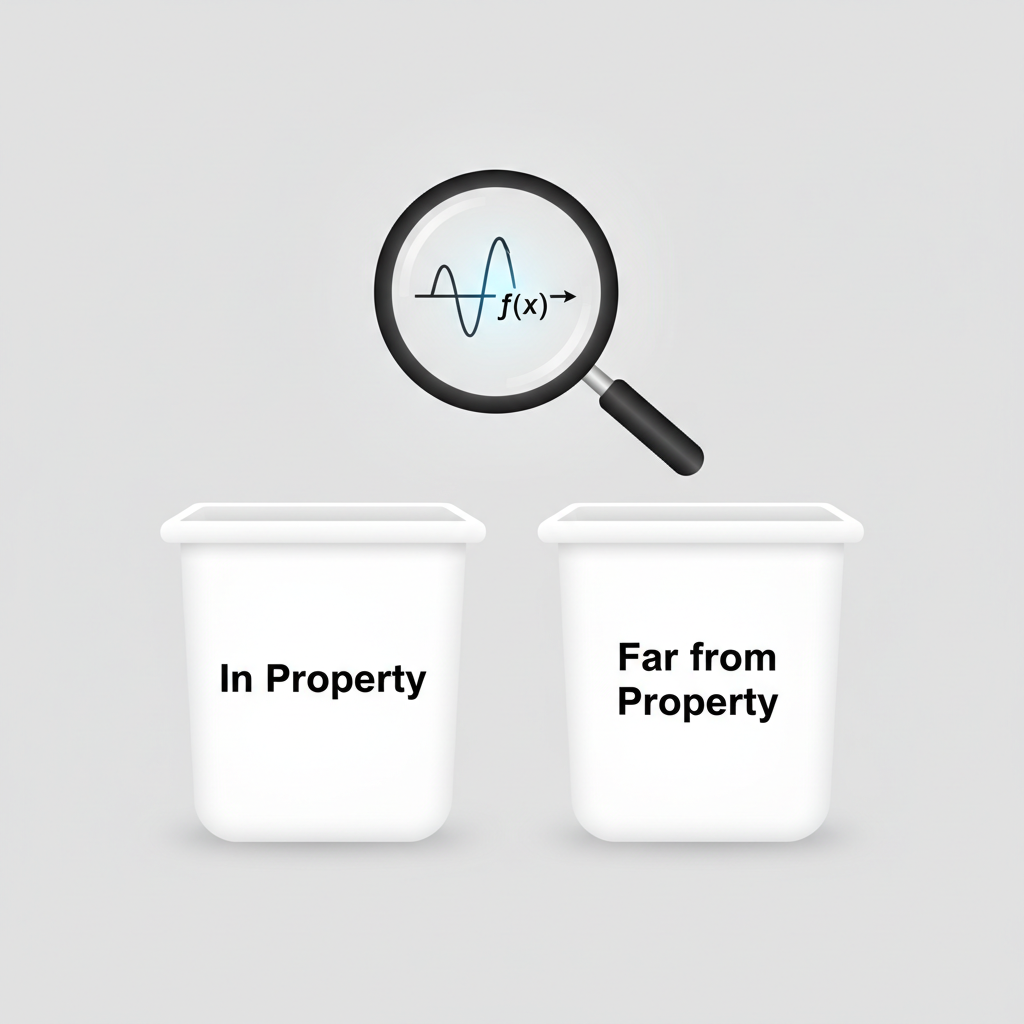
minimalist illustration of two bins, one labeled 'In Property' and one labeled 'Far from Property', with a magnifying glass examining a function

The Tester's Goal

  • Query f(x) a small number of times (much less than |D|).
  • Decide:
    • Is f ∈ P? (Accept w.p. 1, usually)
    • Is f ε-far from P? (Reject w.p. ≥ 2/3)
  • If neither (f is close but not in P), any answer is okay.
Made byBobr AI

8.2: Motivation - The BLR Linearity Test

Theorem 8.1 (Blum et al. 1993)

Testing if f(x+y) = f(x) + f(y).

The key takeaway is the 'Local vs Global' theme:

If f is ε-far (Global property),
then the test fails for many x,y pairs (Local violations).

We skip the proof to focus on Monotonicity, but remember this theme.

Made byBobr AI

8.3: Monotonicity Testing

Domain: {0,1}n (The Hypercube)
Ordering: Partial order x ≤ y (bitwise).

Monotone Function:
Flipping a bit 0 → 1 can increase output (0→1)
but never decrease output (1→0).
The Edge Tester: Pick a random edge (x, y).
If f(x)=1 and f(y)=0, REJECT.
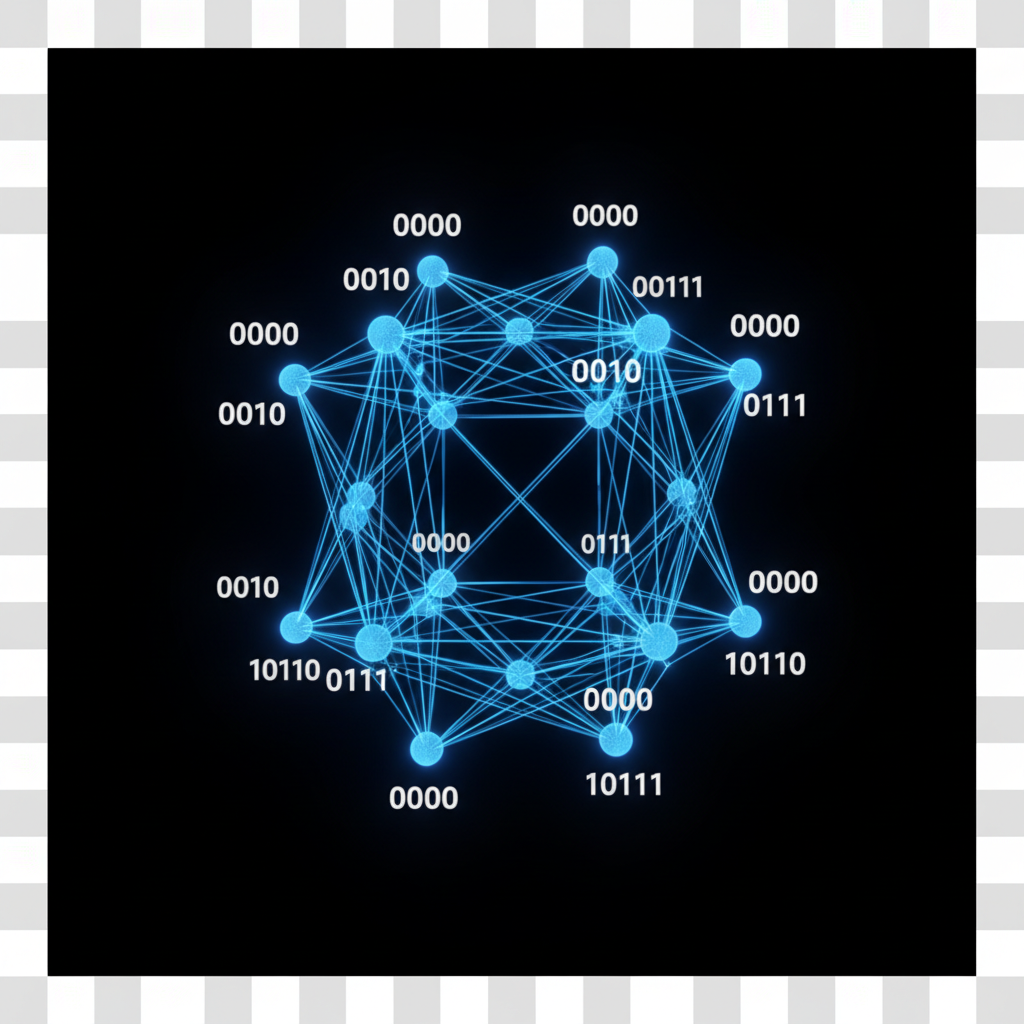
3D wireframe hypercube graph with binary vertex labels 000, 001, 100 etc.
Made byBobr AI

Upper Bounds (Theorem 8.2)

For t = Θ(n/ε), the edge tester rejects every function that is ε-far from monotone with probability ≥ 2/3.
Wait, O(n) queries?
The domain size is 2n.
n is logarithmic in the domain size.
This is very efficient!
Proof Strategy (Sketch):
1. Relate rejection probability to # of violated edges.
2. Prove: If f is far, it has MANY violated edges.
(Repairing f by swapping violations doesn't break fixed edges).
Made byBobr AI

Analysis: Connecting Local to Global

Our algorithm samples edges. Why does this work?

We need a theorem that says:
"If a function is structurally broken (far from monotone), it must be locally broken in MANY places."

This is provided by the Edge Isoperimetric Inequality.
Lemma (Goldreich et al.):

If f is ε-far from monotone,
then the number of violated edges is at least:

ε ċ n ċ 2n-1

Since there are nċ2n-1 total edges, a random edge is violated with probability ≥ ε / n.
Made byBobr AI

8.4: Property Testing Lower Bounds

We know O(n) is possible for Boolean range.
Is O(n) necessary? Can we do better?

Theorem 8.3 (Blais et al. 2012)
For large enough ranges R, every monotonicity tester uses Ω(n) queries.

STRATEGY: Reduction from Communication Complexity

Made byBobr AI

The Setup: Unique Disjointness

Two cartoon figures, Alice and Bob, standing far apart. Alice holds a set A, Bob holds a set B. A wire connects them representing communication.
Unique-Disjointness (Promise Problem):
Alice has A ⊆ {1..n}, Bob has B ⊆ {1..n}.
Promise: Either A ∩ B = ∅ OR |A ∩ B| = 1.

Known Hardness:
Any protocol requires Ω(n) bits of communication.
Made byBobr AI

The Reduction Logic Example

Property Testing

Can we test Monotonicity with o(n) queries?

← ??? →

Comm. Complexity

Solving UDISJ requires Ω(n) bits.

The Reduction Logic (Contrapositive)

  1. Suppose there IS a fast tester T (queries q ≪ n).
  2. Alice & Bob can use T to solve UDISJ efficiently.
  3. But we KNOW UDISJ cannot be solved efficiently.
  4. Contradiction! Therefore, T cannot exist.
Made byBobr AI

The Critical Gadget: Lemma 8.4

We need to map sets A, B to a function hA,B such that properties of the intersection map to properties of monotonicity.

hA,B(S) = 2|S| + (-1)|S ∩ A| + (-1)|S ∩ B|
Why this function?
2|S| forces strong growth (trend toward monotone).
The (-1) terms add small 'wiggles' based on parity of intersection with A and B.
Made byBobr AI

Analyzing hA,B: Case 1

If A ∩ B = ∅ → Then hA,B is MONOTONE.

Consider adding element i to S (S' = S ∪ {i}).

The term 2|S| increases by 2.

Since A ∩ B is empty, i cannot be in both A and B.
So only one of the (-1) terms might change sign.

Max drop from parity terms: -2.
Total change ≥ 2 - 2 = 0.
Non-decreasing!
Made byBobr AI

Analyzing hA,B: Case 2

If |A ∩ B| = 1 → Then hA,B is (1/8)-FAR from Monotone.

Let A ∩ B = {i}. Adding i to S changes BOTH parity terms.
Parity flip (-1 → 1 vs 1 → -1) creates a drop of -2 in both.
Total change: +2 (from 2|S|) - 2 - 2 = -2. (Violation!)
This happens for 1/4 of all edges.
Implies function is 1/8-far.
Made byBobr AI

The Reduction Protocol

Alice & Bob simulate a Tester Q to decide UDISJ.
Tester Q generates a query S ⊆ {1..n}.
To compute hA,B(S) = 2|S| + (-1)|S∩A| + (-1)|S∩B|
Alice computes (-1)|S∩A|
Sends 1 bit to Bob.
Bob computes (-1)|S∩B|
Sends 1 bit to Alice.
Both know hA,B(S). Loop continues.
Total Comm = 2 × (Query Complexity of Q).
Made byBobr AI

Protocol Correctness Verification

Case 1: Disjoint (YES)

If A ∩ B = ∅...

  • hA,B is Monotone (proven).
  • Tester Q must ACCEPT with Pr ≥ 2/3.
  • Alice & Bob output "YES".
CORRECT

Case 2: Unique (NO)

If |A ∩ B| = 1...

  • hA,B is ε-Far (proven).
  • Tester Q must REJECT with Pr ≥ 2/3.
  • Alice & Bob output "NO".
CORRECT
Since the protocol faithfully simulates the tester, the failure probability is exactly the tester's error probability (which is small).
Made byBobr AI

Proof of Theorem 8.3

1. Assume Tester Q exists with query complexity q(n).
2. Use Q to solve Unique-Disjointness.
3. Comm. Complexity of Protocol = 2 · q(n).
4. We know Comm. Complexity(UDISJ) = Ω(n).

∴ q(n) = Ω(n)
We successfully transformed a property testing lower bound problem into a communication complexity lower bound problem!
Made byBobr AI

A Subtle Detail: The Range Size

Notice that hA,B(S) outputs values around 2|S|.
The range of the function is ~ {0...2n}.
Why it matters:
Our lower bound of Ω(n) applies to functions mapping to a range of size Ω(n).
Boolean Range?
For range {0,1}, the Upper Bound O(n/ε) says this is impossible! Hardness requires large range.
Made byBobr AI

8.5: The General Template (Takeaway)

  1. Start with a hard Comm. Complexity problem Π (cost c).
  2. Map inputs (x,y) → function hx,y.
  3. Preserve Structure:
    - 1-inputs → f ∈ P
    - 0-inputs → f is ε-far from P
  4. Simulate: Show hx,y(q) can be computed with d bits.
  5. Result: Query Lower Bound = Ω(c / d).
Made byBobr AI
Bobr AI

DESIGNER-MADE
PRESENTATION,
GENERATED FROM
YOUR PROMPT

Create your own professional slide deck with real images, data charts, and unique design in under a minute.

Generate For Free

Property Testing Lower Bounds & Communication Complexity

Learn about monotonicity testing on the hypercube, the BLR linearity test, and proving query complexity lower bounds using communication complexity reductions.

Lower Bounds in Property Testing

Lecture 8: From Linearity to Communication Complexity

Assumed: Mastery of Communication Complexity & Disjointness. Focus: New Property Testing constructions.

The Toolbox (Prerequisites)

<ul><li>Comm. Complexity Model (Alice & Bob)</li><li>Disjointness Lower Bounds</li><li>Unique-Disjointness (UDISJ)</li><li>Promise Problems</li></ul>

The New Material (Sections 8.1-8.4)

<ul><li>Property Testing Definitions (Query Complexity)</li><li>Monotonicity on the Hypercube</li><li><b>Reduction:</b> UDISJ → Monotonicity</li><li><b>The Gadget:</b> Lemma 8.4 (Function h<sub>A,B</sub>)</li></ul>

8.1: Property Testing Model

Function f: D → R

Black-box access. We query f(x) for specific x.

Property P

A subset of functions (e.g., Linear, Monotone).

Distance

f is <b>&epsilon;-far</b> from P if we must change &ge; &epsilon;|D| entries to make f &in; P.

Key Definitions: Distance & Correctness

The Tester's Goal

<ul><li>Query f(x) a <b>small</b> number of times (much less than |D|).</li><li><b>Decide:</b><ul style='color:#2980b9'><li>Is f &in; P? (Accept w.p. 1, usually)</li></ul><ul style='color:#c0392b'><li>Is f &epsilon;-far from P? (Reject w.p. &ge; 2/3)</li></ul></li><li>If neither (f is close but not in P), any answer is okay.</li></ul>

8.2: Motivation - The BLR Linearity Test

Theorem 8.1 (Blum et al. 1993)

Testing if f(x+y) = f(x) + f(y).<br><br>The key takeaway is the <b>'Local vs Global'</b> theme:<br><br>If f is <span style='color:#c0392b'>&epsilon;-far</span> (Global property),<br>then the test fails for <span style='color:#c0392b'>many x,y pairs</span> (Local violations).

We skip the proof to focus on Monotonicity, but remember this theme.

8.3: Monotonicity Testing

<b>Domain:</b> {0,1}<sup>n</sup> (The Hypercube)<br><b>Ordering:</b> Partial order x &le; y (bitwise).<br><br><b>Monotone Function:</b><br>Flipping a bit 0 &rarr; 1 can <span style='color:#27ae60'>increase</span> output (0&rarr;1)<br>but <span style='color:#c0392b'>never decrease</span> output (1&rarr;0).

<b>The Edge Tester:</b> Pick a random edge (x, y).<br>If f(x)=1 and f(y)=0, REJECT.

Upper Bounds (Theorem 8.2)

For t = &Theta;(n/&epsilon;), the edge tester rejects every function that is &epsilon;-far from monotone with probability &ge; 2/3.

Wait, O(n) queries?<br>The domain size is 2<sup>n</sup>.<br>n is <i>logarithmic</i> in the domain size.<br>This is very efficient!

<b>Proof Strategy (Sketch):</b><br>1. Relate rejection probability to # of violated edges.<br>2. Prove: If f is far, it has MANY violated edges.<br>(Repairing f by swapping violations doesn't break fixed edges).

Analysis: Connecting Local to Global

Our algorithm samples edges. Why does this work?<br><br>We need a theorem that says:<br><b>"If a function is structurally broken (far from monotone), it must be locally broken in MANY places."</b><br><br>This is provided by the Edge Isoperimetric Inequality.

<b>Lemma (Goldreich et al.):</b><br><br>If f is &epsilon;-far from monotone,<br>then the number of violated edges is at least:<br><br><center><span style='font-size:50px; color:#2e7d32; font-weight:bold;'>&epsilon; &cdot; n &cdot; 2<sup>n-1</sup></span></center><br>Since there are n&cdot;2<sup>n-1</sup> total edges, a random edge is violated with probability &ge; &epsilon; / n.

8.4: Property Testing Lower Bounds

We know O(n) is possible for Boolean range.<br>Is O(n) necessary? Can we do better?

Theorem 8.3 (Blais et al. 2012)<br>For large enough ranges R, every monotonicity tester uses &Omega;(n) queries.

STRATEGY: Reduction from Communication Complexity

The Setup: Unique Disjointness

<b>Unique-Disjointness (Promise Problem):</b><br>Alice has A &subseteq; {1..n}, Bob has B &subseteq; {1..n}.<br>Promise: Either A &cap; B = &empty; OR |A &cap; B| = 1.<br><br><b>Known Hardness:</b><br>Any protocol requires <b>&Omega;(n)</b> bits of communication.

The Reduction Logic Example

The Critical Gadget: Lemma 8.4

We need to map sets A, B to a function h<sub>A,B</sub> such that properties of the intersection map to properties of monotonicity.

h<sub>A,B</sub>(S) = 2|S| + (-1)<sup>|S &cap; A|</sup> + (-1)<sup>|S &cap; B|</sup>

Why this function?<br>2|S| forces strong growth (trend toward monotone).<br>The (-1) terms add small 'wiggles' based on parity of intersection with A and B.

Analyzing h<sub>A,B</sub>: Case 1

If A &cap; B = &empty;

Then h<sub>A,B</sub> is <b>MONOTONE</b>.

Consider adding element i to S (S' = S &cup; {i}).<br><br>The term 2|S| increases by <b>2</b>.<br><br>Since A &cap; B is empty, i cannot be in <b>both</b> A and B.<br>So only one of the (-1) terms might change sign.<br><br>Max drop from parity terms: -2.<br>Total change &ge; 2 - 2 = 0.<br>Non-decreasing!

Analyzing h<sub>A,B</sub>: Case 2

If |A &cap; B| = 1

Then h<sub>A,B</sub> is <b>(1/8)-FAR from Monotone</b>.

Let A &cap; B = {i}. Adding i to S changes BOTH parity terms.

Parity flip (-1 &rarr; 1 vs 1 &rarr; -1) creates a drop of -2 in both.

Total change: +2 (from 2|S|) - 2 - 2 = <b>-2</b>. (Violation!)

This happens for 1/4 of all edges.<br>Implies function is 1/8-far.

The Reduction Protocol

Alice & Bob simulate a Tester Q to decide UDISJ.

Tester Q generates a query S &subseteq; {1..n}.

To compute h<sub>A,B</sub>(S) = 2|S| + (-1)<sup>|S&cap;A|</sup> + (-1)<sup>|S&cap;B|</sup>

Alice computes (-1)<sup>|S&cap;A|</sup><br>Sends <b>1 bit</b> to Bob.

Bob computes (-1)<sup>|S&cap;B|</sup><br>Sends <b>1 bit</b> to Alice.

Both know h<sub>A,B</sub>(S). Loop continues.<br>Total Comm = 2 &times; (Query Complexity of Q).

Protocol Correctness Verification

Proof of Theorem 8.3

1. Assume Tester Q exists with query complexity q(n).<br>2. Use Q to solve Unique-Disjointness.<br>3. Comm. Complexity of Protocol = 2 &middot; q(n).<br>4. We know Comm. Complexity(UDISJ) = &Omega;(n).<br><br><span style='font-size:60px; color:#c0392b;'>&therefore; q(n) = &Omega;(n)</span>

We successfully transformed a property testing lower bound problem into a communication complexity lower bound problem!

A Subtle Detail: The Range Size

Notice that h<sub>A,B</sub>(S) outputs values around 2|S|.<br>The range of the function is ~ {0...2n}.

<b>Why it matters:</b><br>Our lower bound of &Omega;(n) applies to functions mapping to a range of size &Omega;(n).

<b>Boolean Range?</b><br>For range {0,1}, the Upper Bound O(n/&epsilon;) says this is impossible! Hardness requires large range.

8.5: The General Template (Takeaway)

<ol><li>Start with a hard Comm. Complexity problem &Pi; (cost <i>c</i>).</li><li>Map inputs (x,y) &rarr; function h<sub>x,y</sub>.</li><li><b>Preserve Structure:</b><br>- 1-inputs &rarr; f &in; P<br>- 0-inputs &rarr; f is &epsilon;-far from P</li><li><b>Simulate:</b> Show h<sub>x,y</sub>(q) can be computed with <i>d</i> bits.</li><li><b>Result:</b> Query Lower Bound = &Omega;(c / d).</li></ol>

  • property-testing
  • theoretical-computer-science
  • communication-complexity
  • monotonicity-testing
  • query-complexity
  • algorithms