
Made byBobr AI

Predicting Post-Translational Modifications in Network Biology

Explore a systematic guide to PTM prediction: from data gathering and feature extraction to machine learning workflows and bioinformatics databases.

#bioinformatics#post-translational-modifications#computational-biology#machine-learning#proteomics#ptm-prediction#network-biology

Systematic Post-Translational Modifications of Proteins

From Prediction to Network Biology

Bioinformatics & Computational Biology

Made byBobr AI

What Are Post-Translational Modifications?

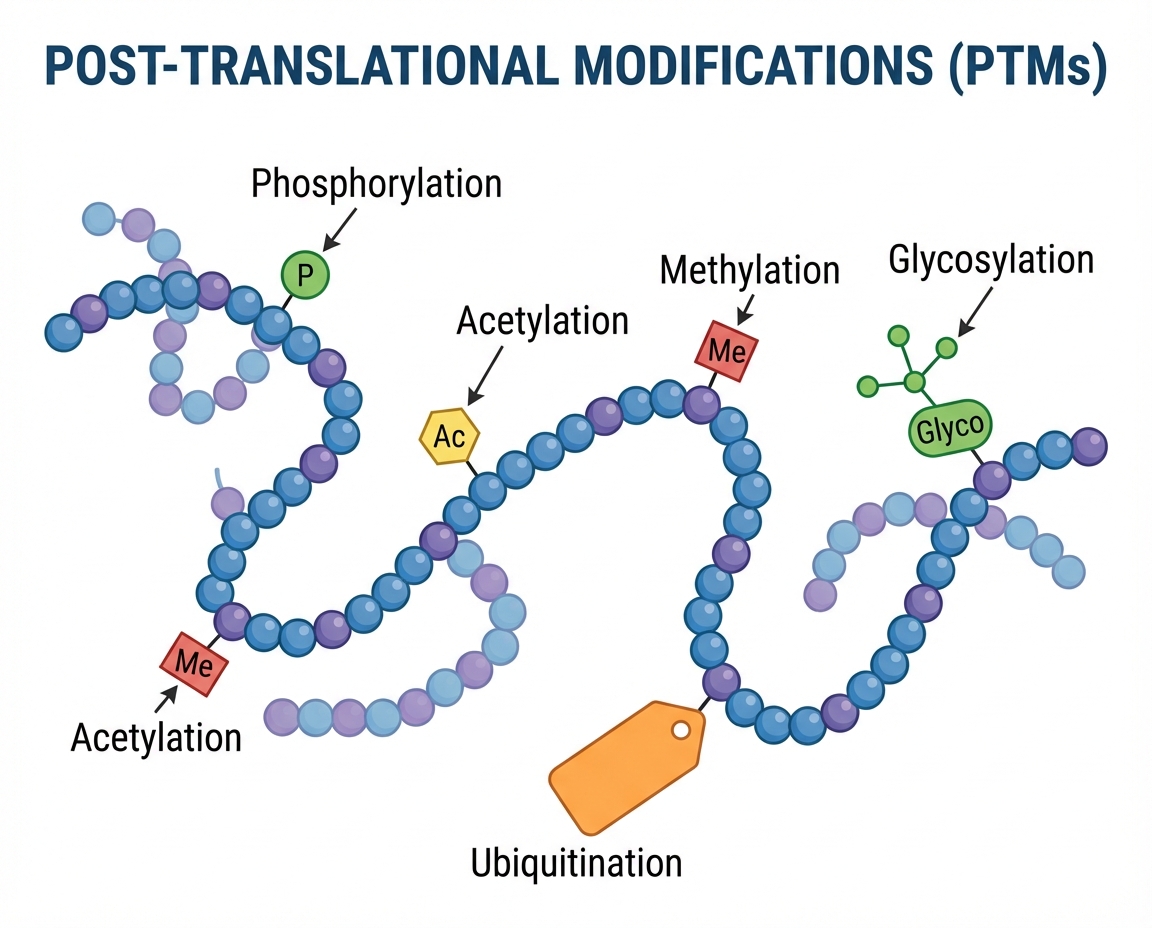
Covalent processing events that change protein properties by proteolytic cleavage or adding modifying groups (acetyl, phosphoryl, glycosyl, methyl) to amino acids

Over 400 different types of PTMs identified

Can be reversible or irreversible modifications

Occur in nucleus, cytoplasm, ER, and Golgi apparatus

Affect protein structure, function, localization, and interactions

Made byBobr AI

The 10 Most Studied PTM Types

Phosphorylation – Kinase-mediated, affects Ser/Thr/Tyr

Acetylation – Lysine modification, histone regulation

Ubiquitylation – Protein degradation pathway

Methylation – Epigenetic regulation on Lys/Arg

Glycosylation – N-linked and O-linked sugar chains

SUMOylation – Nuclear protein regulation

Palmitoylation – Lipid-based membrane anchoring

Myristoylation – N-terminal fatty acid addition

Prenylation – C-terminal lipid modification

Sulfation – Tyrosine modification in secreted proteins

Made byBobr AI

PTM Frequency Distribution (dbPTM Database)

Chart

Top 3 PTMs comprise over 90% of all reported modification sites (~827,000 out of ~908,000)

Made byBobr AI

PTM Prediction Workflow Overview

1

1. Data Gathering

Collect positive and negative samples from PTM databases

2

2. Feature Extraction

Encode sequences using biological descriptors

3

3. Model Training

Train classifier using machine learning algorithms

4

4. Performance Assessment

Evaluate using k-fold cross validation

Made byBobr AI

Step 1: Data Gathering Strategies

Positive Data Selection

Sequences with experimentally verified PTM sites from databases like dbPTM or UniProt

Negative Data Selection Strategies

Strategy 1: Random proteins with target residues not undergoing PTM

Strategy 2: Proteins where no target residues have experimental PTM evidence

Strategy 3: Non-modified target residues within positive dataset proteins

Dataset Filtering

Remove redundant sequences using CD-hit (identity threshold 40-100%)

Dataset Balancing

Negative datasets often much larger than positive. Random subsampling creates balanced training sets to avoid classifier bias.

Made byBobr AI

Step 2: Feature Extraction Methods

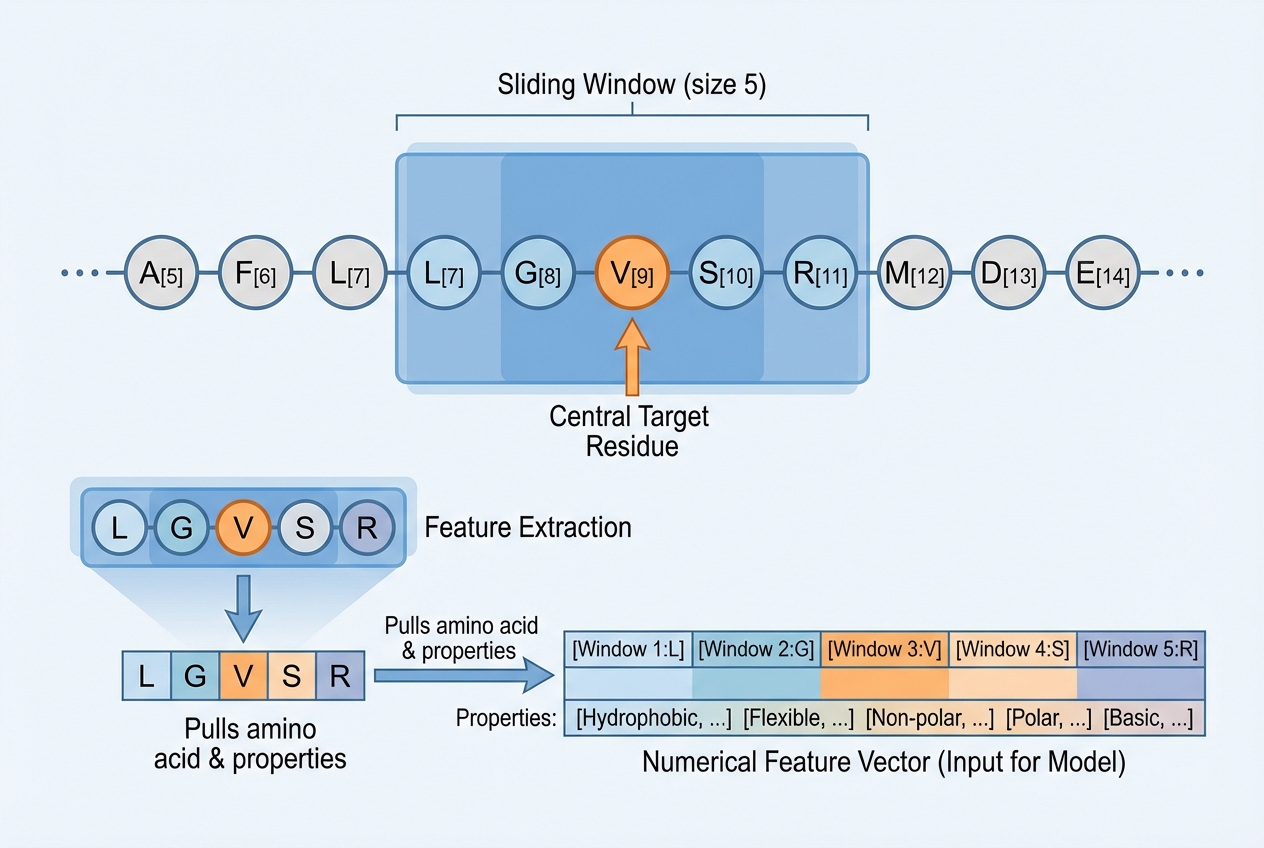
Sliding Window Approach

Partition proteins into polypeptides of length W with target residue at center. Window size typically ranges from 11 to 27 residues.

Biological Descriptors

Amino Acid Composition (AAC)

Di-peptide Composition

Physicochemical Properties

Sequence Motif Similarity Scores

Position-Specific Scoring Matrices

Structural Features (secondary structure)

Made byBobr AI

Major PTM Databases

Chart

dbPTM covers 130+ PTM types across 1000+ organisms; EPSD focuses on phosphorylation with 1.6M+ sites

Made byBobr AI

Key PTM Prediction Tools

MusiteDeep

Deep learning for multiple PTMs (phosphorylation, glycosylation, acetylation, methylation, ubiquitination)

GPS Suite

Group-based prediction system for phosphorylation, SUMOylation, palmitoylation, methylation

NetOGlyc / NetNGlyc

Neural network-based glycosylation site prediction tools

DeepUbi / iUbiq-Lys

Specialized ubiquitination site predictors with high accuracy

PhosphoSitePlus

Comprehensive database with integrated prediction capabilities

Made byBobr AI

Performance Assessment Metrics

Sensitivity (Recall)

TP / (TP + FN)

Ability to correctly identify PTM sites

Specificity

TN / (TN + FP)

Ability to correctly identify non-PTM sites

Accuracy

(TP + TN) / Total

Overall correctness of predictions

MCC

Matthews Correlation Coefficient - balanced measure for imbalanced datasets

AUC-ROC

Area Under ROC Curve - threshold-independent performance measure

K-Fold Cross Validation

Standard procedure: partition data into k subsets, train on k-1, test on remaining. Common values: k = 5 or 10.

Made byBobr AI

PTMs in Disease and Biological Processes

Associated Diseases

Neurodegenerative diseases (Alzheimer's, Parkinson's, Huntington's)

Various cancers and metabolic syndromes

Cardiovascular and inflammatory disorders

Diabetes and immune system diseases

Key Biological Processes

Apoptosis and cell cycle control

Signal transduction and protein-protein interactions

DNA repair and transcription regulation

Chromatin organization and protein degradation

Made byBobr AI

Practical Workflow: From Sequence to PTM Prediction

1

1. Obtain protein sequence (FASTA format from UniProt)

2

2. Select appropriate prediction tool based on PTM type

3

3. Submit sequence to web server or run local tool

4

4. Analyze predictions with confidence scores

5

5. Cross-validate with multiple tools for reliability

6

6. Integrate results into network/pathway analysis

💡 Always validate computational predictions with experimental data when possible

Made byBobr AI

Challenges in PTM Prediction

⚠️

Data Imbalance

Negative samples often vastly outnumber positive samples, causing classifier bias

Negative Sample Selection

Absence of evidence is not evidence of absence - unlabeled sites may be undiscovered PTMs

📊

Cross-Study Comparison

Different datasets and validation procedures make fair comparison difficult

🔧

Parameter Tuning Bias

Using same data for tuning and evaluation leads to overestimated performance

Made byBobr AI

Key Takeaways

1

PTMs are crucial regulatory mechanisms affecting protein function, localization, and interactions

2

Computational prediction tools are essential due to high cost of experimental identification

3

Systematic workflow: Data gathering → Feature extraction → Model training → Validation

4

Multiple databases and tools available - choose based on PTM type and organism

5

Always validate predictions and be aware of methodological limitations

6

PTM networks provide insights into disease mechanisms and biological processes

Made byBobr AI

Thank You

Questions & Discussion

Recommended Resources

dbPTM: http://dbptm.mbc.nctu.edu.tw

PhosphoSitePlus: https://www.phosphosite.org

Reference: Ramazi & Zahiri (2021) Database

Made byBobr AI
Bobr AI

DESIGNER-MADE
PRESENTATION,
GENERATED FROM
YOUR PROMPT

Create your own professional slide deck with real images, data charts, and unique design in under a minute.

Generate For Free

Predicting Post-Translational Modifications in Network Biology

Explore a systematic guide to PTM prediction: from data gathering and feature extraction to machine learning workflows and bioinformatics databases.

Systematic Post-Translational Modifications of Proteins

From Prediction to Network Biology

Bioinformatics & Computational Biology

What Are Post-Translational Modifications?

Covalent processing events that change protein properties by proteolytic cleavage or adding modifying groups (acetyl, phosphoryl, glycosyl, methyl) to amino acids

Over 400 different types of PTMs identified

Can be reversible or irreversible modifications

Occur in nucleus, cytoplasm, ER, and Golgi apparatus

Affect protein structure, function, localization, and interactions

The 10 Most Studied PTM Types

Phosphorylation – Kinase-mediated, affects Ser/Thr/Tyr

Acetylation – Lysine modification, histone regulation

Ubiquitylation – Protein degradation pathway

Methylation – Epigenetic regulation on Lys/Arg

Glycosylation – N-linked and O-linked sugar chains

SUMOylation – Nuclear protein regulation

Palmitoylation – Lipid-based membrane anchoring

Myristoylation – N-terminal fatty acid addition

Prenylation – C-terminal lipid modification

Sulfation – Tyrosine modification in secreted proteins

PTM Frequency Distribution (dbPTM Database)

Top 3 PTMs comprise over 90% of all reported modification sites (~827,000 out of ~908,000)

PTM Prediction Workflow Overview

1. Data Gathering

Collect positive and negative samples from PTM databases

2. Feature Extraction

Encode sequences using biological descriptors

3. Model Training

Train classifier using machine learning algorithms

4. Performance Assessment

Evaluate using k-fold cross validation

Step 1: Data Gathering Strategies

Positive Data Selection

Sequences with experimentally verified PTM sites from databases like dbPTM or UniProt

Negative Data Selection Strategies

Strategy 1: Random proteins with target residues not undergoing PTM

Strategy 2: Proteins where no target residues have experimental PTM evidence

Strategy 3: Non-modified target residues within positive dataset proteins

Dataset Filtering

Remove redundant sequences using CD-hit (identity threshold 40-100%)

Step 2: Feature Extraction Methods

Sliding Window Approach

Partition proteins into polypeptides of length W with target residue at center. Window size typically ranges from 11 to 27 residues.

Amino Acid Composition (AAC)

Di-peptide Composition

Physicochemical Properties

Sequence Motif Similarity Scores

Position-Specific Scoring Matrices

Structural Features (secondary structure)

Major PTM Databases

dbPTM covers 130+ PTM types across 1000+ organisms; EPSD focuses on phosphorylation with 1.6M+ sites

Key PTM Prediction Tools

MusiteDeep

Deep learning for multiple PTMs (phosphorylation, glycosylation, acetylation, methylation, ubiquitination)

GPS Suite

Group-based prediction system for phosphorylation, SUMOylation, palmitoylation, methylation

NetOGlyc / NetNGlyc

Neural network-based glycosylation site prediction tools

DeepUbi / iUbiq-Lys

Specialized ubiquitination site predictors with high accuracy

PhosphoSitePlus

Comprehensive database with integrated prediction capabilities

Performance Assessment Metrics

Sensitivity (Recall)

TP / (TP + FN)

Ability to correctly identify PTM sites

Specificity

TN / (TN + FP)

Ability to correctly identify non-PTM sites

Accuracy

(TP + TN) / Total

Overall correctness of predictions

MCC

Matthews Correlation Coefficient - balanced measure for imbalanced datasets

AUC-ROC

Area Under ROC Curve - threshold-independent performance measure

PTMs in Disease and Biological Processes

Associated Diseases

Neurodegenerative diseases (Alzheimer's, Parkinson's, Huntington's)

Various cancers and metabolic syndromes

Cardiovascular and inflammatory disorders

Diabetes and immune system diseases

Key Biological Processes

Apoptosis and cell cycle control

Signal transduction and protein-protein interactions

DNA repair and transcription regulation

Chromatin organization and protein degradation

Practical Workflow: From Sequence to PTM Prediction

1. Obtain protein sequence (FASTA format from UniProt)

2. Select appropriate prediction tool based on PTM type

3. Submit sequence to web server or run local tool

4. Analyze predictions with confidence scores

5. Cross-validate with multiple tools for reliability

6. Integrate results into network/pathway analysis

Always validate computational predictions with experimental data when possible

Challenges in PTM Prediction

Data Imbalance

Negative samples often vastly outnumber positive samples, causing classifier bias

Negative Sample Selection

Absence of evidence is not evidence of absence - unlabeled sites may be undiscovered PTMs

Cross-Study Comparison

Different datasets and validation procedures make fair comparison difficult

Parameter Tuning Bias

Using same data for tuning and evaluation leads to overestimated performance

Key Takeaways

PTMs are crucial regulatory mechanisms affecting protein function, localization, and interactions

Computational prediction tools are essential due to high cost of experimental identification

Systematic workflow: Data gathering → Feature extraction → Model training → Validation

Multiple databases and tools available - choose based on PTM type and organism

Always validate predictions and be aware of methodological limitations

PTM networks provide insights into disease mechanisms and biological processes

Thank You

Questions & Discussion

dbPTM: http://dbptm.mbc.nctu.edu.tw

PhosphoSitePlus: https://www.phosphosite.org

Reference: Ramazi & Zahiri (2021) Database

  • bioinformatics
  • post-translational-modifications
  • computational-biology
  • machine-learning
  • proteomics
  • ptm-prediction
  • network-biology