
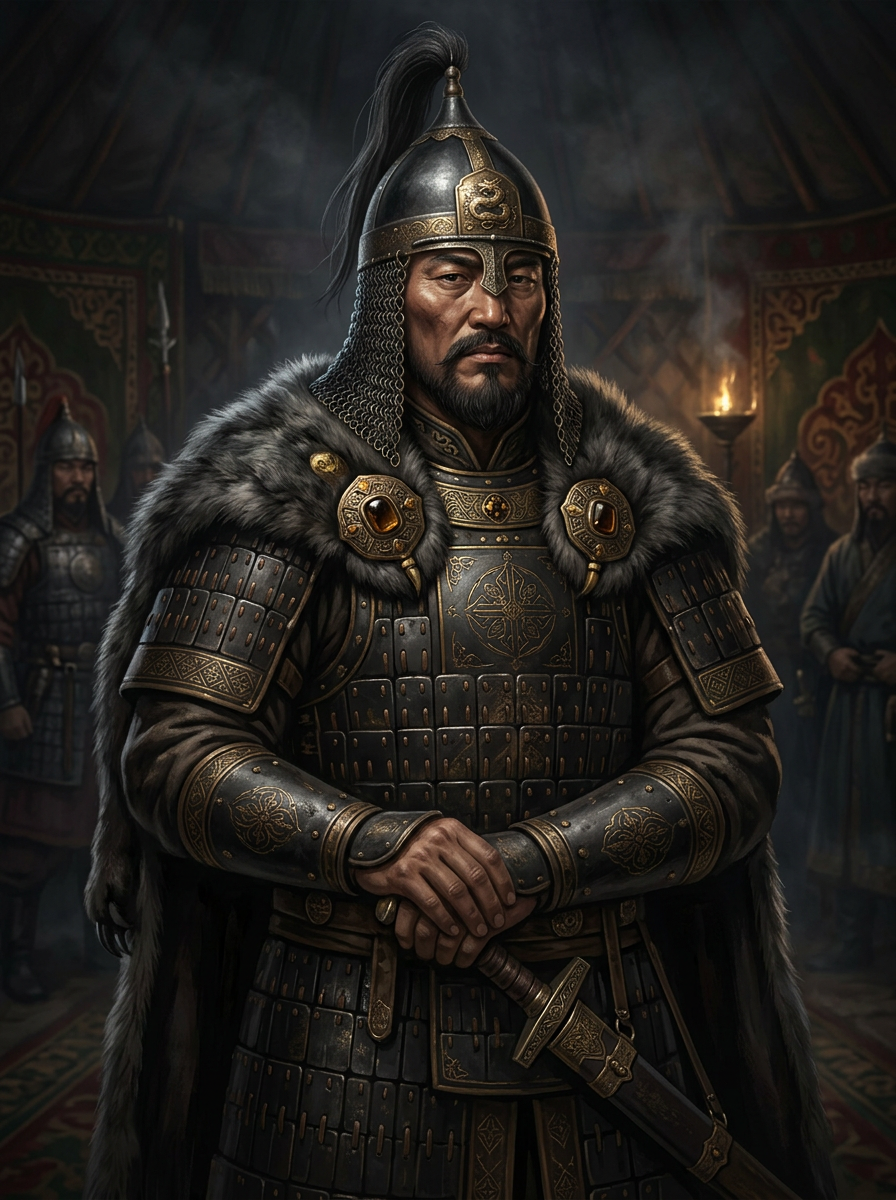
Batu Khan & the Golden Horde: History of the Mongol Empire
Explore the rise and fall of Batu Khan's Golden Horde. Learn about the Mongol conquest of Europe, their governance, trade, and lasting historical legacy.
BATU KHAN & THE GOLDEN HORDE
How one ruler changed Eastern Europe forever
A Historical Case Study
1207 – 1255
Who Was Batu Khan?
He led one of the most powerful military campaigns in history, sweeping through Russia, Poland, and Hungary to build a massive Eurasian empire.
Grandson of Genghis Khan
Led the Western Campaign (1236–1242)
Founded the Golden Horde empire
Ruled from the capital city Sarai
Introduction
THE WESTERN CAMPAIGN
Expanding the Empire
1236: WESTWARD EXPANSION
Batu Khan spearheaded a colossal Mongol army toward Eastern Europe, initiating an unprecedented campaign of conquest and shifting the balance of power.
RAPID CONQUEST
Within just a few years, they swiftly overtook and conquered vast territories spanning across Russia, Poland, and Hungary.
UNSTOPPABLE CAVALRY
The Mongol forces relied on incredibly fast, highly disciplined cavalry units that proved nearly impossible for defensive armies to halt.
1242: DOMINION SECURED
By 1242, the Mongols had established firm control over a massive new domain, reshaping the historical map of Europe forever.
Cultural Mix
Who Lived in the Golden Horde?
A Diverse Steppe
Mongols, Turks, Slavs, and Persians all lived together
Cultural Adoption
Over time, Mongols adopted Turkish language and Islamic religion
Blending Traditions
Local cultures blended with Mongol traditions
A Unique Synthesis
This created a unique new culture on the steppe
How Was the Golden Horde Governed?
THE SUPREME RULER
The Khan possessed absolute authority over the state—his spoken word acted as binding law across the empire.
LOCAL PRINCES & TRIBUTE
Local leaders, such as Russian princes, were permitted to govern their own lands internally IF they paid heavy taxes.
THE "BASKAKS" SYSTEM
A structured network of imperial tax collectors, known as 'baskaks', was established to ensure constant revenue.
GENGHIS KHAN'S YASA
Strict adherence was maintained to the 'Yasa', Genghis Khan's original comprehensive legal and military code.
PROTECTED TRADE ROUTES
Merchants enjoyed state protection, which directly contributed to thriving and highly secure Eurasian trade systems.
Imperial Administration
WHY DID THE GOLDEN HORDE FALL?
INTERNAL PROBLEMS
Constant power struggles between khans
Civil wars weakened the empire
Economic troubles and inflation
EXTERNAL THREATS
The Black Death (plague) killed millions
Timur (Tamerlane) invaded and destroyed major cities
Rise of the Moscow principality challenged Mongol power
Legacy of the Golden Horde
LONGEVITY AND STABILITY
The Golden Horde lasted over 200 years (1242–1502).
CULTURAL ARCHITECTS
It shaped the languages, cultures, and borders of Russia and Central Asia.
DUAL FOUNDATIONS
It showed how empires can be built through both war AND trade.
ENDURING FOOTPRINT
The Mongol influence can still be seen in culture, words, and traditions today.
The Golden Horde wasn't just a conquest — it was a civilization.
- batu-khan
- golden-horde
- mongol-empire
- european-history
- genghis-khan
- historical-case-study
- medieval-warfare