
Take-All Patch Diagnosis & IPM Management for Turf
Expert guide on managing Take-All Patch in creeping bentgrass. Learn IPM strategies for sustainable turf science and disease prevention.
Take-All Patch: Diagnosis & IPM Management
A Case Study on Creeping Bentgrass Greens
Integrated Pest Management | Sustainable Turf Science
Introduction: The Problem
Creeping bentgrass greens re-surfaced 2–3 years ago (converted from annual bluegrass)
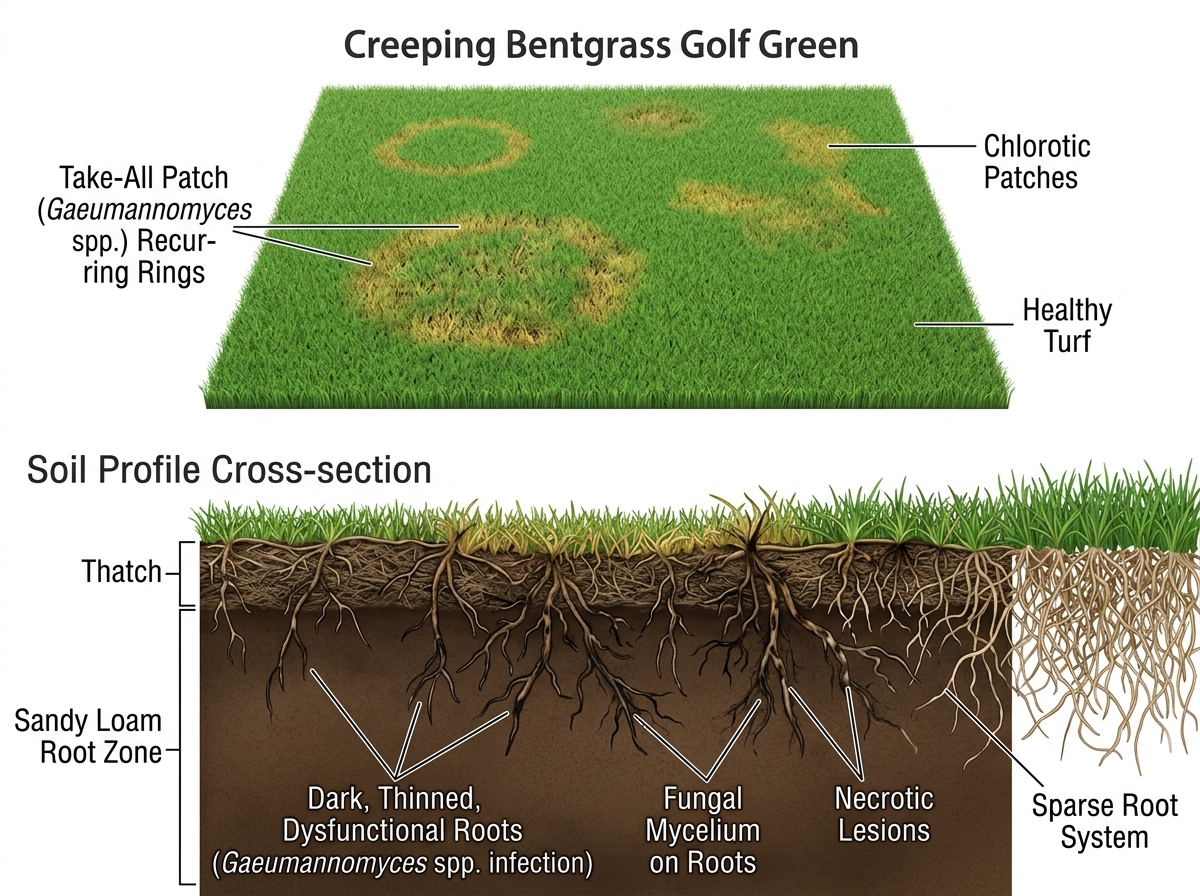
~2% of surface showing recurring circular patches of turf decline
Symptoms appear after rainfall events
Partial, temporary response to azoxystrobin fungicide
Annual bluegrass fills damaged areas — then also declines
Pattern suggests a complex, multi-factor issue
SITE HISTORY & SYMPTOMS | SUSTAINABLE TURF SCIENCE
Steps Toward Diagnosis
An Integrated Diagnostic Approach
Background Investigation
Field Inspection
Lab Testing (Assumed Results)
Integrated Pest Management | Sustainable Turf Science
<li style="margin-bottom: 22px; display: flex; align-items: flex-start;"><span style="color: #E2B13C; margin-right: 18px; font-size: 14px; margin-top: 5px;">■</span><span>When do symptoms first appear?</span></li><li style="margin-bottom: 22px; display: flex; align-items: flex-start;"><span style="color: #E2B13C; margin-right: 18px; font-size: 14px; margin-top: 5px;">■</span><span>Do patches recur in the same locations?</span></li><li style="margin-bottom: 22px; display: flex; align-items: flex-start;"><span style="color: #E2B13C; margin-right: 18px; font-size: 14px; margin-top: 5px;">■</span><span>How long do greens stay wet after rain/irrigation?</span></li><li style="margin-bottom: 22px; display: flex; align-items: flex-start;"><span style="color: #E2B13C; margin-right: 18px; font-size: 14px; margin-top: 5px;">■</span><span>Are affected areas shaded or low-lying?</span></li><li style="margin-bottom: 22px; display: flex; align-items: flex-start;"><span style="color: #E2B13C; margin-right: 18px; font-size: 14px; margin-top: 5px;">■</span><span>What was the renovation/grow-in process?</span></li>
<li style="margin-bottom: 22px; display: flex; align-items: flex-start;"><span style="color: #E2B13C; margin-right: 18px; font-size: 14px; margin-top: 5px;">■</span><span>Compare healthy vs. declining turf via soil plugs</span></li><li style="margin-bottom: 22px; display: flex; align-items: flex-start;"><span style="color: #E2B13C; margin-right: 18px; font-size: 14px; margin-top: 5px;">■</span><span>Check root depth, density, and color</span></li><li style="margin-bottom: 22px; display: flex; align-items: flex-start;"><span style="color: #E2B13C; margin-right: 18px; font-size: 14px; margin-top: 5px;">■</span><span>Look for foul odors (anaerobic conditions)</span></li><li style="margin-bottom: 22px; display: flex; align-items: flex-start;"><span style="color: #E2B13C; margin-right: 18px; font-size: 14px; margin-top: 5px;">■</span><span>Observe visible layering or excess organic matter</span></li><li style="margin-bottom: 22px; display: flex; align-items: flex-start;"><span style="color: #E2B13C; margin-right: 18px; font-size: 14px; margin-top: 5px;">■</span><span>Track water infiltration rates</span></li>
<li style="margin-bottom: 22px; display: flex; align-items: flex-start;"><span style="color: #E2B13C; margin-right: 18px; font-size: 14px; margin-top: 5px;">■</span><span>Elevated soil moisture in affected areas</span></li><li style="margin-bottom: 22px; display: flex; align-items: flex-start;"><span style="color: #E2B13C; margin-right: 18px; font-size: 14px; margin-top: 5px;">■</span><span>Organic matter accumulation / layering</span></li><li style="margin-bottom: 22px; display: flex; align-items: flex-start;"><span style="color: #E2B13C; margin-right: 18px; font-size: 14px; margin-top: 5px;">■</span><span>Slightly elevated rootzone pH</span></li><li style="margin-bottom: 22px; display: flex; align-items: flex-start;"><span style="color: #E2B13C; margin-right: 18px; font-size: 14px; margin-top: 5px;">■</span><span>Presence of <em style="color:#FFF;">Gaeumannomyces spp.</em> confirmed</span></li>
Final Diagnosis: Take-All Patch + Environmental Stress
Take-All Patch
Gaeumannomyces spp.
Timing: 2–3 years post-renovation — peak susceptibility window
Visual match: Circular, recurring patches intensifying after rain
Root dysfunction: Chlorosis, thinning, failure to uptake water/nutrients
Incomplete fungicide response — environmental stress is the co-driver
Both bentgrass AND annual bluegrass fail in same areas → rootzone issue
Likely elevated soil pH — increases disease severity
Tree-lined surroundings → reduced airflow & prolonged leaf wetness
Take-All Patch is the primary agent — but environmental stress is what allows it to persist.
FINAL DIAGNOSIS | AGRONOMIC ASSESSMENT
IPM-Friendly, Pesticide-Free Program
Breaking the Stress–Disease Cycle
Integrated Pest Management | Sustainable Turf Science
Moisture Management
Venting, aeration & topdressing to improve drainage and gas exchange
Airflow & Sunlight
Selective tree pruning/removal to reduce shade and leaf wetness duration
Fertility Management
Light, consistent nitrogen; acidifying fertilizers to lower pH toward bentgrass optimum
Organic Matter Control
Regular topdressing + aeration to dilute OM, improve infiltration and soil uniformity
Precision Irrigation
Moisture meters + hand-watering; avoid overwatering wet-prone areas
Bentgrass Recovery
Overseeding thin areas in spring/fall to rebuild density and outcompete annual bluegrass
Three-Year IPM Implementation Plan
Stabilize → Recover → Prevent
Integrated Pest Management | Sustainable Turf Science
Stabilization
Goal: Stop decline, identify drivers
<li style="color: #E2B13C;"><span style="color: #FFFFFF;">Soil & rootzone testing (pH, OM, structure)</span></li><li style="color: #E2B13C;"><span style="color: #FFFFFF;">Map all affected patch areas</span></li><li style="color: #E2B13C;"><span style="color: #FFFFFF;">Venting every 2–3 weeks + 1–2 deep aerations</span></li><li style="color: #E2B13C;"><span style="color: #FFFFFF;">Adjust irrigation with moisture meters</span></li><li style="color: #E2B13C;"><span style="color: #FFFFFF;">Begin hand-watering dry spots</span></li><li style="color: #E2B13C;"><span style="color: #FFFFFF;">Start tree pruning in worst areas</span></li><li style="color: #E2B13C;"><span style="color: #FFFFFF;">Light overseeding in thinnest patches</span></li>
Recovery
Goal: Rebuild turf health & root strength
<li style="color: rgba(226,177,60,0.8);"><span style="color: #DDE5ED;">Refine aeration timing based on turf response</span></li><li style="color: rgba(226,177,60,0.8);"><span style="color: #DDE5ED;">Increase venting during high-stress/wet periods</span></li><li style="color: rgba(226,177,60,0.8);"><span style="color: #DDE5ED;">Expand tree pruning/removal where airflow still limited</span></li><li style="color: rgba(226,177,60,0.8);"><span style="color: #DDE5ED;">Implement pH acidification fertilizer program</span></li><li style="color: rgba(226,177,60,0.8);"><span style="color: #DDE5ED;">More aggressive overseeding with bentgrass</span></li><li style="color: rgba(226,177,60,0.8);"><span style="color: #DDE5ED;">Evaluate drainage solutions (slit drains if needed)</span></li>
Prevention
Goal: Maintain, prevent recurrence
<li style="color: rgba(226,177,60,0.6);"><span style="color: #C1CDD9;">Aeration/venting/topdressing fully integrated into schedule</span></li><li style="color: rgba(226,177,60,0.6);"><span style="color: #C1CDD9;">Refined irrigation using moisture data</span></li><li style="color: rgba(226,177,60,0.6);"><span style="color: #C1CDD9;">Address tree regrowth proactively</span></li><li style="color: rgba(226,177,60,0.6);"><span style="color: #C1CDD9;">Continue seasonal monitoring (moisture, roots, patches)</span></li><li style="color: rgba(226,177,60,0.6);"><span style="color: #C1CDD9;">Targeted re-sodding of any remaining problem spots</span></li>
Advantages of the Program
Prevention Through Environmental Control
Addresses Root Causes, Not Just Symptoms
Improves the growing environment so turf becomes resilient on its own — not reliant on repeated fungicide cycles
Long-Term Turf Health & Consistency
Deeper rooting, better stress tolerance, more uniform playing surfaces — improved ball roll and firmness
Environmentally Responsible & Sustainable
Eliminates chemical runoff risk, aligns with sustainable golf management expectations, reduces costs
Builds a Resilient Turf System
Fewer major disruptions, more predictable maintenance — drainage and airflow improvements last beyond 3 years
Encourages Better Monitoring & Decision-Making
Moisture meters, patch mapping, and data tracking enable proactive management and faster responses
Integrated Pest Management | Sustainable Turf Science
Potential Pitfalls & Mitigations
Anticipating Challenges, Planning Solutions
Turf Management | Strategic Planning
Slow visible results — cultural practices take multiple seasons
Regular communication with photos & progress data; set realistic expectations early
Temporary playability disruption from aeration & topdressing
Schedule aeration/topdressing during low-play periods (early spring / late fall)
Tree removal controversy — members may resist aesthetic changes
Strategic, selective tree work with clear explanations of turf health impact
Structural problems may require reconstruction (layering, poor drainage design)
Early mapping & observation to identify structural issues and justify targeted solutions
Risk of inconsistent implementation by staff
Staff training, clear scheduling, and written maintenance protocols
Conclusion
INTEGRATED PEST MANAGEMENT | SUSTAINABLE TURF SCIENCE
- turf-management
- ipm-strategy
- golf-course-maintenance
- creeping-bentgrass
- sustainable-turf
- plant-pathology
- pesticide-free