















Australia in the Vietnam War: Pro-War vs Anti-War Analysis
Explore the social and political divide in Australia during the Vietnam War through a detailed analysis of PM Menzies' speech and 1970s protest movements.
Australia & The<br>Vietnam War
A Source Analysis: Divided Opinions on Australia's Involvement
Sources C & H — Pro-War vs Anti-War Perspectives
Introduction
Today I will be analysing two sources that display the differing viewpoints in Australia during the time of the Vietnam War. These two sources have shown how Australian Society had been separated between two categories of people — from those who supported the war and those who decided to oppose it.
SOURCE C — Pro-War
PM Menzies' Speech, 1965
SOURCE H — ANTI-WAR
Protest Photograph, 1970
Source C — Overview
"In … 1962 the Government decided, following upon a request from the Government of South Vietnam, that Australia should contribute militarily to the defence of South Vietnam. We sent at that time a group of about 30 military instructors to provide military training assistance.
The Australian Government is now in receipt of a request from the Government of South Vietnam for further military assistance. We have decided – and this has been done after close consultation with the Government of the United States – to provide an infantry battalion for service in South Vietnam …
We have not, of course, come to this decision without the closest attention to the question of defence priorities. We do not, and must not, overlook the point that our alliances, as well as providing guarantees and assurances for our security, make demands upon us …
Assessing all this, it is our judgment that our decision to commit a battalion in South Vietnam represents the most useful additional contribution which we can make to the defence of the region at this time. The takeover of South Vietnam would be a direct military threat to Australia and all the countries of South and South-East Asia. It must be seen as a thrust by China between the Pacific and Indian oceans."
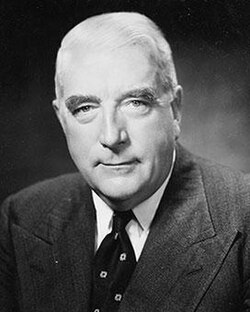
PM Menzies' announcement — 800 men of the 1st Battalion Royal Australian Regiment sent to Vietnam, 29 April 1965
Political Speech
29 April 1965
PM Robert Menzies
Pro-War / Government
SUPPORTS INVOLVEMENT
Source C — Analysis
PM Menzies' Speech, 29 April 1965
PM Robert Menzies, 1965
Menzies confirms Australia sent ~30 military advisors in 1962 and now commits an infantry battalion to South Vietnam.
Argues South Vietnam falling to communism would be a 'direct military threat to Australia' — using fear of communism to justify involvement.
Promotes the Domino Theory — the belief that if one country falls to communism, neighbouring countries would follow.
Emphasises Australia's alliance with the United States as a key reason — maintaining security for broader threats.
Perspective: Clearly pro-war — justifies involvement as a responsibility and necessary decision.
Gives direct insight into government reasoning and official policy
Only represents government view — no opposing opinions included
Source H — Overview
OPPOSES INVOLVEMENT
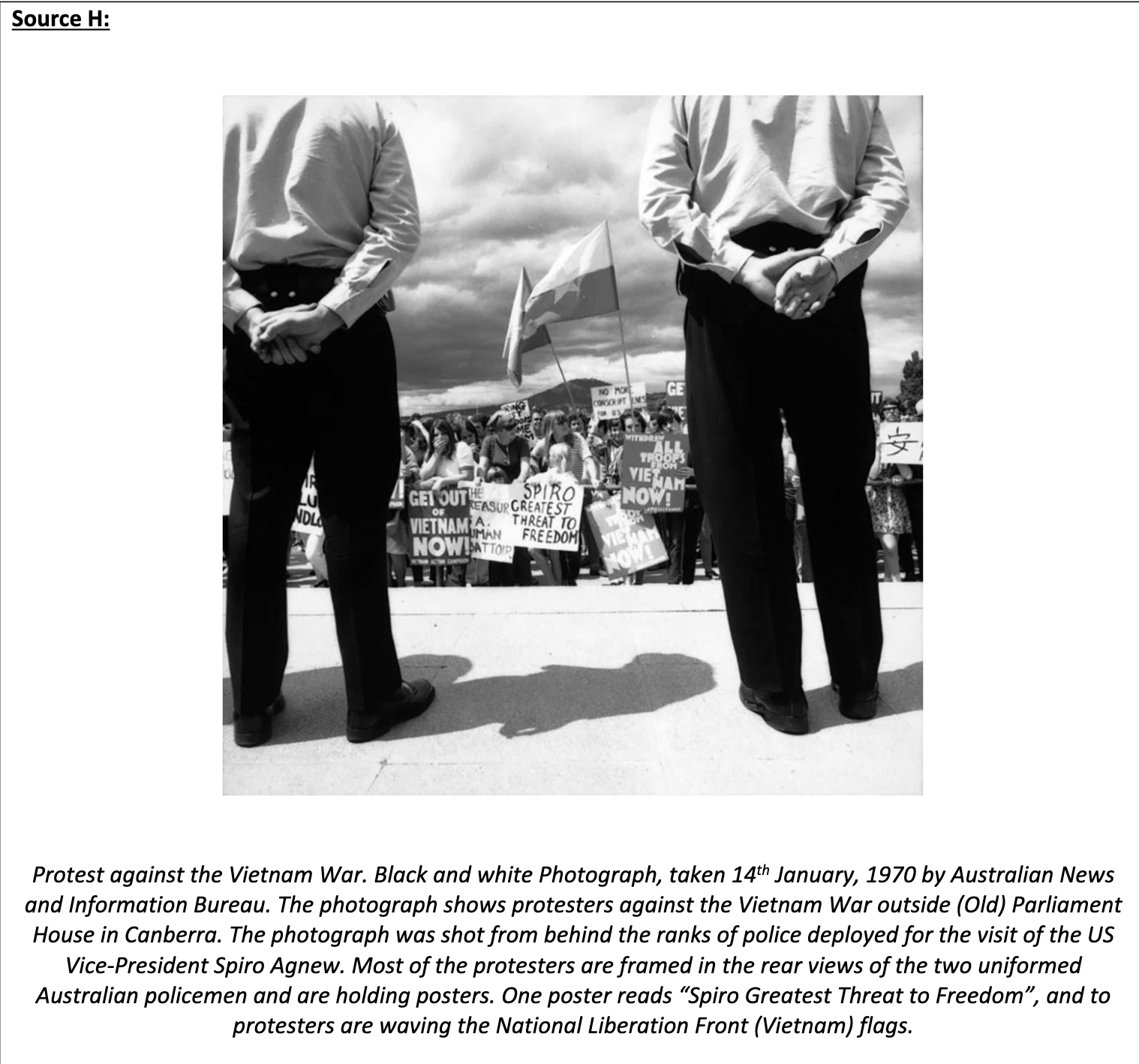
Protest against the Vietnam War. Black and white photograph, taken 14th January 1970 by Australian News and Information Bureau. The photograph shows protesters against the Vietnam War outside (Old) Parliament House in Canberra. Shot from behind the ranks of police deployed for the visit of US Vice-President Spiro Agnew.
Photograph
14 January 1970
Australian News and Information Bureau
Anti-War / Public
Source H — Analysis
Anti-War Protest Photograph, Canberra, 1970
Protesters hold signs reading 'GET OUT OF VIETNAM NOW!' and 'Spiro Greatest Threat to Freedom' — criticising both the war and the visiting US Vice-President.
Police are positioned in the foreground, emphasising the tension between authorities and protesters — showing how serious the disagreements had become.
Reflects the rising anti-war movement in Australia in the late 1960s and early 1970s.
Opposition grew due to increasing casualties, the use of conscription (seen as unjust and unfair), and graphic media coverage of war conditions.
As more Australians saw the true impacts of the war, public opinion shifted — leading to widespread protests across the country.
STRENGTHS:
Visually captures the intensity of public opposition and social tensions of the era
LIMITATIONS:
Only captures one protest, one viewpoint — does not represent supporters or neutral Australians
Comparing the Sources
SOURCE C: Pro-War
Political Speech
1965
PM Robert Menzies
Government supports war
Communist threat to Australia, alliance with USA, domino theory
One-sided government view, persuasive and exaggerated
SOURCE H: Anti-War
Protest Photograph
1970
Australian News and Information Bureau
Public opposes war
Protests rising, conscription unjust, war's human cost
Captures real public opposition but only one moment/protest
Together, these sources show Australia was deeply divided — government vs the people — during the Vietnam War era.
Conclusion
Overall, these two sources have clearly demonstrated that Australia was heavily divided during the Vietnam War era. As the government strongly supported involvement for reasons of security and alliance with the United States, many members of the Australian public strongly disagreed and protested against the government's actions.
This juxtaposition highlights the seriousness of the social and political tensions that occurred in Australia during this time.
Government viewed involvement as necessary to stop communism and maintain the US alliance.
The Australian public grew increasingly opposed, driven by casualties, conscription, and media coverage.
Australia's involvement in the Vietnam War remains one of the most divisive chapters in its modern history.
- vietnam-war
- australian-history
- source-analysis
- robert-menzies
- anti-war-protest
- history-education
- domino-theory