
The Melbourne Moratorium & Australia's Vietnam War Protest
Explore the 1970 Melbourne Moratorium: Australia's largest anti-war protest. Learn about conscription, archival sources, and the fight to end the Vietnam War.
AUSTRALIA 1970–1971
THE MELBOURNE<br>MORATORIUM
Protest, People & the Fight to End the Vietnam War
A Historical Investigation
HISTORICAL CONTEXT
Australia & the Vietnam War
FROM COMMITMENT TO CRISIS
1962
Australia sends military advisors to South Vietnam
1964
National Service Act introduces conscription for 20-year-old men
1965
First Australian combat troops deployed; public broadly supportive
1966–67
Casualties mount; media coverage grows critical
1968
Tet Offensive shocks the world; public opinion begins to shift
1969
US Moratorium protests inspire Australian activists
1970
Melbourne Moratorium, 8 May: largest protest in Australian history
Australia committed combat troops to Vietnam in 1965, backed by a controversial conscription system that would ultimately drag young men into an unpopular war.
Context: 1962–1970
By 1969, over 50,000 Australian personnel had served in Vietnam. More than 500 were killed. Public opinion was turning.
CONSCRIPTION 1964–1972
THE BIRTHDAY BALLOT
Under the National Service Act 1964, all 20-year-old men were required to register. Numbered marbles representing birthdays were drawn from a barrel — if your birthday came up, you were conscripted for 2 years of full-time military service.
800,000+
MEN REGISTERED
63,000
CALLED UP
~19,000
SERVED IN VIETNAM
200+
CONSCRIPTS KILLED
Many resisted — and faced imprisonment for refusing to serve.
MAY 4, 1970 — 4 DAYS BEFORE MELBOURNE
KENT STATE & THE GLOBAL WAVE
On 4 May 1970 — just four days before Melbourne's Moratorium — US National Guard troops shot and killed four student protesters at Kent State University, Ohio. The killings inflamed anti-war sentiment worldwide.
The US Moratorium movement of October–November 1969 had already inspired Australian activists. Hundreds of thousands of Americans marched, showing that mass peaceful protest could challenge a government's war policy.
"The Melbourne Moratorium did not happen in isolation — it was part of a global moral reckoning with the Vietnam War."
MELBOURNE — 8 MAY 1970
THE CITY STOOD STILL
Between 70,000 and 100,000 people flooded Melbourne's streets in the largest protest in Australian history to that date
70,000–100,000 marchers in Melbourne alone
150,000–200,000 nationwide on the same day
Marchers processed along Bourke & Swanston Streets before a mass sit-down
DEMOGRAPHICS OF DISSENT
WHO MARCHED?
The Melbourne crowd was notably diverse — not merely students and radicals, but a cross-section of Australian society:
University students & youth
Trade unionists & workers
Church groups & clergy
Professionals & academics
Mothers opposed to conscripting their sons
Older citizens marching publicly for the first time
Many participants saw the march as both a moral stand against killing in Vietnam and a defence of democratic rights at home.
Contemporary eyewitness accounts and footage confirm the breadth of participation.
KEY FIGURE
DR JIM CAIRNS
Labor MP & Chairman, Victorian Vietnam Moratorium Campaign
Jim Cairns was the central figure of the Melbourne Moratorium. A federal Labor MP and academic economist, he bridged moderate and radical factions, insisting on non-violent, broadly-based mobilisation. His personal authority gave the movement credibility with the wider public.
The Vietnam Moratorium Campaign (VMC) and the Congress for International Co-operation and Disarmament (CICD) coordinated the protest, uniting peace groups, civil liberties organisations, trade unions, and student bodies.
"Cairns transformed what could have been a fringe radical gathering into a mainstream democratic statement."
Organisers deliberately chose a strategy combining mass marching with a symbolic, peaceful sit-down.
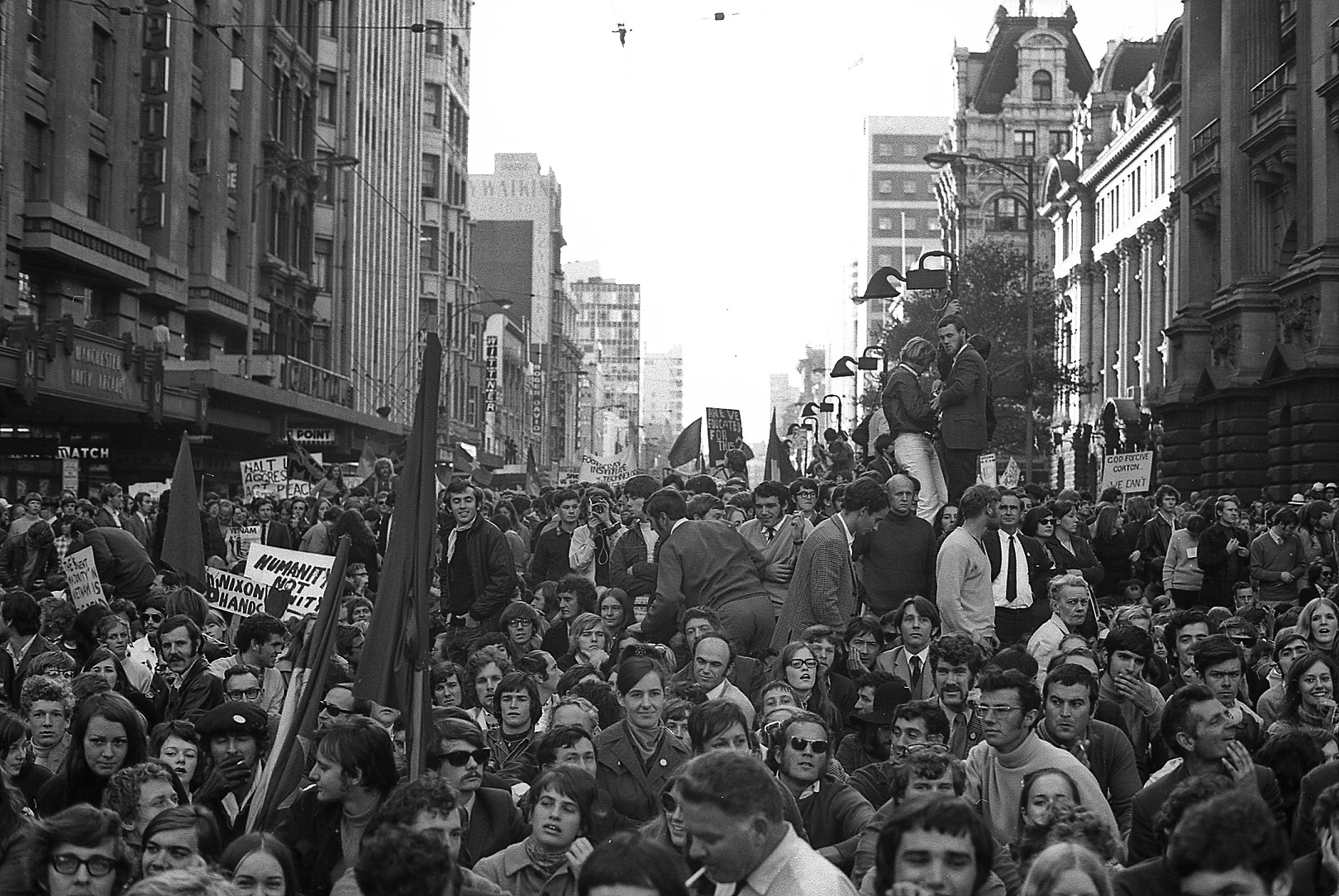
<strong>SOURCE 1:</strong> Crowd marching on Swanston Street, 8 May 1970. City of Melbourne Collection.
PRIMARY SOURCE ANALYSIS — PHOTOGRAPH
READING THE CROWD
The photograph shows an enormous crowd stretching the full width and length of Swanston Street. Placards and banners are visible. The crowd is densely packed, orderly, and multi-generational.
The sheer scale of the crowd communicates the breadth of public opposition to the war. The peaceful, disciplined nature of the march was a deliberate strategic choice by organisers.
As a City of Melbourne Collection photograph, this source is contemporaneous and authoritative. However, it captures one angle and moment — consider what it does NOT show (e.g. any confrontations, the full diversity of the crowd).
<strong>Historian's question:</strong> What does the choice to photograph from street level rather than above tell us about the perspective of the photographer?
SOURCE 2: 'Stop Work to Stop the War', Vietnam Moratorium Poster, Australian War Memorial Collection.
SOURCE 3: 'Stop the War! Vietnamization?', Vietnam Moratorium Poster, Australian War Memorial Collection.
PRIMARY SOURCE ANALYSIS — POSTERS
PROTEST POSTERS AS EVIDENCE
Imperatives like 'Stop Work', 'Stop the War' show decisive, non-negotiable demands -- a shift from earlier calls for negotiation.
The puppet imagery (Source 3) presents Australia as a US puppet -- a critique of the ANZUS alliance and Australian foreign policy dependence.
Designed for mass production and display, these posters were tools of political mobilisation -- simple, bold, easily read at a distance.
Posters represent the views of organisers, not necessarily all participants. They are persuasive documents, not neutral records.
These demonstrations give comfort to the enemies of our country and of our allies, and can only prolong the conflict in Vietnam.
— Prime Minister John Gorton, responding to the Moratorium, 1970
The marchers are being used by those who want a communist victory in Vietnam.
— Conservative press criticism, 1970
The Liberal-Country Party Government
OFFICIAL<br>OPPOSITION
The Gorton Government strongly condemned the Moratorium, framing protesters as naive, disloyal, or communist-influenced. Key government arguments:
Protests demoralised troops serving in Vietnam
Demonstrators were manipulated by radical or communist elements
Street occupation threatened public order
Australia's commitment to the US alliance must be upheld
Historians note this response reveals the government's anxiety about the scale and mainstream nature of the protest — it was no longer easy to dismiss as a fringe movement.
SIGNIFICANCE & LEGACY
A TURNING POINT IN AUSTRALIAN HISTORY
POLITICAL IMPACT
The Moratorium directly pressured the Gorton and McMahon governments. All Australian combat troops were withdrawn from Vietnam by end of 1971 -- driven in part by sustained public pressure.
SOCIAL CHANGE
The protests politicised a generation of Australians who had never marched before, showing that mainstream citizens -- not just radicals -- could challenge government foreign policy.
DEMOCRATIC RIGHTS
The Moratorium established that the right to march, occupy city streets peacefully, and dissent publicly was a fundamental democratic right -- a reference for all later Australian protest movements.
THE WHITLAM EFFECT
When Labor won the 1972 election, Whitlam abolished conscription, freed draft resisters, and completed the withdrawal from Vietnam. Historians credit the Moratorium as a key factor.
The Melbourne Moratorium is cited as a defining moment in Australia's social and political history -- a model of effective, peaceful democratic protest.
AFTERMATH & OUTCOME
IT'S TIME
When Gough Whitlam's Labor Party won the federal election on 2 December 1972, the Moratorium movement's core demands were finally met:
1971
All Australian combat troops withdrawn from Vietnam
Dec 1972
Whitlam elected; conscription immediately abolished
Dec 1972
Draft resisters and imprisoned conscientious objectors freed
Jan 1973
Remaining Australian personnel withdrawn from Vietnam
The Moratorium did not end the war alone — but it helped end Australia's part in it, and changed the country's relationship with protest, power and democracy forever.
The 1970 Melbourne Moratorium remains the largest single-day anti-war protest in Australian history.
CONCLUSION
MEMORY, LEGACY & LESSONS
The Melbourne Moratorium of 8 May 1970 demonstrated that ordinary Australians — students, workers, parents, clergy — could collectively challenge their government on a matter of life and death. The scale, diversity and discipline of the protest was unprecedented in Australian history.
As a historical source, the photographs, posters and eyewitness accounts of the Moratorium reveal the depth of public feeling against conscription and the Vietnam War, while also showing the deliberate strategic choices made by organisers to present a peaceful, democratic image.
Its legacy endures: the Moratorium helped end Australia's involvement in Vietnam, abolished conscription, and established mass peaceful protest as a legitimate tool of democratic expression — a lesson that resonates in every subsequent generation.
8 MAY 1970 · 18 SEPT 1970 · 30 JUNE 1971
The Melbourne Moratorium — A Defining Moment in Australian Democracy
- melbourne-moratorium
- vietnam-war
- australian-history
- protest-movement
- conscription
- jim-cairns
- gough-whitlam
- social-change