






Chronic Pain Management: Mindfulness & Nutrition Analysis
Explore mindfulness-based interventions and nutritional strategies for chronic pain management within a biopsychosocial osteopathic practice model.
Task 2 | Chronic Pain Management Strategies
Chronic Pain: Are We Treating Pain… or the
Person?
A Persuasive Analysis of Mindfulness-Based Interventions & Nutritional Strategies in Chronic Pain Management
My Position
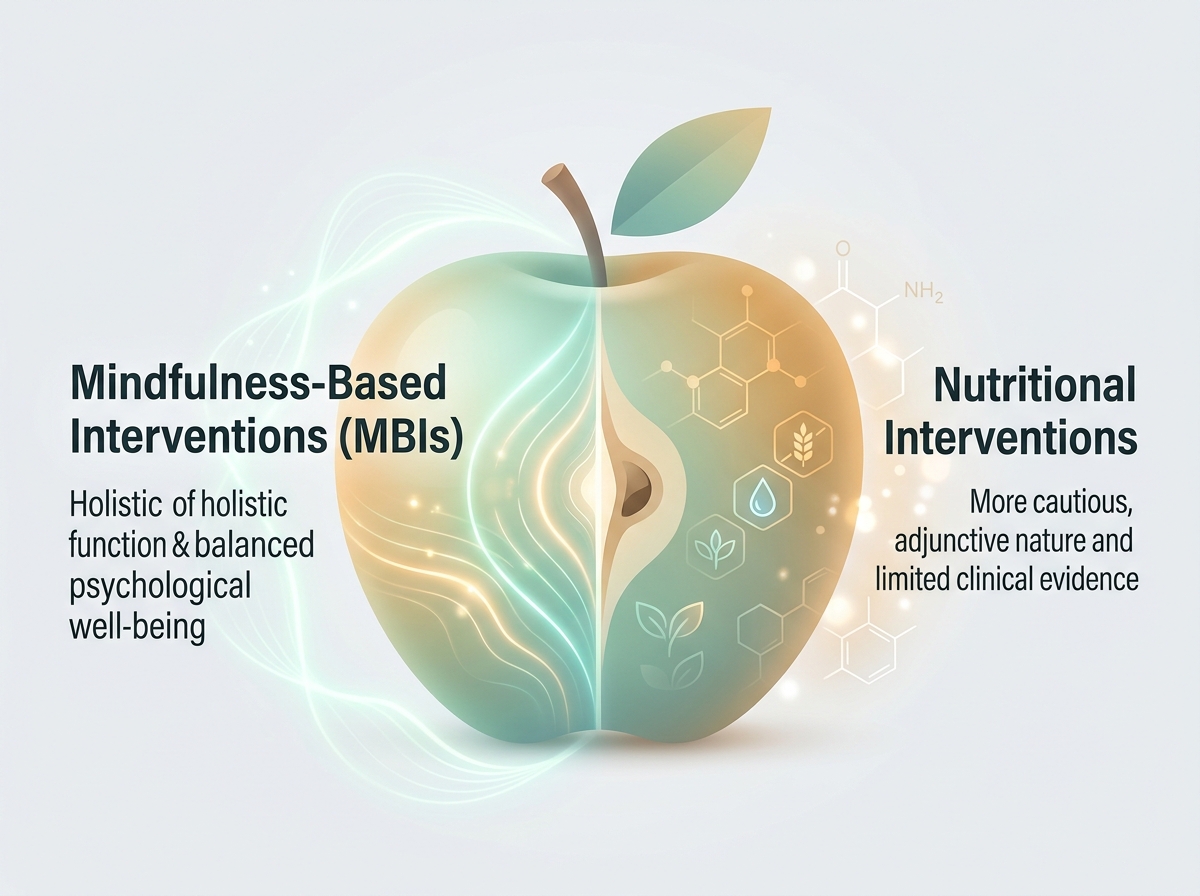
Mindfulness-Based Interventions (MBIs)
Moderate and consistent evidence supports improvements in function and psychological outcomes
Should be ACTIVELY INTEGRATED into chronic pain management
Nutritional Interventions
Biologically plausible but limited and inconsistent clinical evidence
Should be used CAUTIOUSLY as an adjunctive strategy
This distinction guides evidence-based decision-making in osteopathic practice.
Mindfulness
What Are Mindfulness-Based Interventions?
MBSR
Mindfulness-Based Stress Reduction
Structured 8-week program emphasising present-moment awareness
MBCT
Mindfulness-Based Cognitive Therapy
Combines mindfulness with cognitive techniques to disrupt maladaptive thought patterns
Mechanism
Pain Response Modification
Not targeting nociceptive input — modifying cognitive & emotional response to pain
Aligns with the Biopsychosocial Model — pain is influenced by cognitive, emotional, and social processes, not just tissue damage
(Bolton & Gillett, 2019)
🧠 MINDFULNESS
Evidence Strength for MBIs
American College of Physicians (Qaseem et al., 2017)
MBSR recommended as FIRST-LINE non-pharmacological treatment for chronic low back pain.
National Institution For Health and Care Excellence (NICE,2021)
Psychological interventions that improve coping and reduce distress in chronic primary pain.
Pain Intensity
Small/Moderate
Quality of Life
Consistent Impr.
Emotional Distress
Consistent Impr.
Pain Acceptance
Consistent Impr.
Primary benefit is NOT eliminating pain — it is improving how patients FUNCTION despite it.
🧠 MINDFULNESS
Critical Appraisal of MBI Evidence
Small sample sizes
Short follow-up periods
Heterogeneity in intervention protocols (Reiner et al., 2013)
Ongoing debate: Are benefits specific to mindfulness, or non-specific factors? (relaxation, expectancy, therapeutic alliance)
Extensive body of systematic reviews & meta-analyses
Consistent improvements in psychological & functional outcomes
Supported by major clinical guidelines
Clinically relevant even without full pain resolution
Despite limitations,
CONSISTENCY
of psychological & functional outcome improvements supports clinical relevance.
(Reiner et al., 2013)
🧠 MINDFULNESS
Relevance to Osteopathic Practice
Patient-Centred Care
Aligns with osteopathic philosophy of treating the whole person
🎯
Supports Self-Management
Empowers patients to manage persistent pain independently
💪
Enhances Engagement
Improves coping strategies and patient participation in care
🔄
Scope of Practice
Osteopaths may introduce principles; refer to trained facilitators for formal programs
📋
In chronic pain where complete resolution is unlikely, improving coping capacity IS the clinical goal.
🥗 NUTRITION
What Are Nutritional Interventions?
The Problem
Poor dietary patterns → obesity, cardiovascular disease, type 2 diabetes → linked to increased chronic pain prevalence and severity
The Mechanism
Chronic low-grade inflammation (↑CRP) associated with increased pain intensity. Pro-inflammatory diets may exacerbate symptoms (Rondanelli et al., 2018)
The Proposed Solution
Anti-inflammatory dietary patterns (Mediterranean diet, omega-3s, whole foods) proposed to reduce inflammation and improve pain-related outcomes
A lifestyle-based, modifiable approach to pain management through systemic health improvement
🥗 NUTRITION
Evidence for Nutritional Interventions
Anti-inflammatory diets (Mediterranean) show biological plausibility for reducing pain and systemic inflammation (Rondanelli et al., 2018)
Brain et al. (2019) — Systematic Review & Meta-Analysis
Nutritional interventions may reduce pain and inflammation
Results varied significantly across studies
Overall evidence quality: LOW to MODERATE
Ekma et al. (2020) — Review
Associations between diet and musculoskeletal pain evident
Causal relationships difficult to establish
High heterogeneity in study design
Strong biological plausibility ≠ Strong clinical evidence.
Diet MAY influence pain — but the evidence is not yet robust.
🥗 NUTRITION
Critical Appraisal of Nutritional Evidence
⚠️ Measurement Bias
Many studies rely on self-reported dietary intake (recall bias) and subjective pain outcomes → reduces reliability
⚠️ Intervention Complexity
Multiple simultaneous dietary changes make it difficult to isolate specific mechanisms or active components
⚠️ Limited Generalisability
Studies often focus on specific populations (obesity, metabolic disorders) — findings may not apply to broader chronic pain populations (Ekma et al., 2020)
⚠️ Causality Unclear
Associations between diet and pain evident, but causal relationships remain unestablished due to heterogeneous study designs
While emerging trends are promising, the evidence base is insufficient for strong independent clinical recommendations.
✅ Emerging trend: Dietary PATTERN approaches (not isolated nutrients) gaining traction in the literature
🥗 NUTRITION
Relevance to Osteopathic Practice
Health Promotion Role
Osteopaths well-positioned to identify modifiable lifestyle factors contributing to chronic pain
General Dietary Guidance
Can provide evidence-informed advice on anti-inflammatory dietary patterns as part of multimodal care
Scope of Practice
Complex nutritional management → refer to Dietitian or Accredited Practising Dietitian (APD)
Adherence Barrier
Sustained dietary change requires long-term behavioural modification; patient motivation is a key clinical consideration
Nutrition is an ADJUNCTIVE strategy — valuable for overall health promotion, not a standalone pain treatment.
MBIs
vs.
Nutritional Interventions
: A Comparative Analysis
Mindfulness-Based Interventions
Evidence Quality
✅ Moderate-High (systematic reviews, meta-analyses)
CLINICAL GUIDELINES
✅ ACP (2017), NICE NG193 (2021)
Primary Outcomes
✅ Psychological function, quality of life, pain acceptance
Pain Intensity Effect
⚡ Small to moderate
Osteopathic Integration
✅ Strong fit — patient-centred, self-management
Recommendation
✅ ACTIVELY INTEGRATE
Nutritional Interventions
⚠️ Low-Moderate (inconsistent results)
⚠️ No direct standalone endorsement
⚠️ Inflammation markers, general health
⚠️ Inconsistent, variable
✅ Fits health promotion role — refer for complex cases
⚠️ USE CAUTIOUSLY as adjunct
Both strategies have value — but evidence
STRENGTH
determines clinical priority.
🎯 FINAL ARGUMENT
Final Position
The Evidence Has Spoken.
🧠
Mindfulness-Based Interventions
ACTIVELY INTEGRATE into chronic pain management
Moderate-quality evidence | Consistent psychological & functional outcomes | Guideline-endorsed | Self-management focused
🥗
Nutritional Interventions
USE AS ADJUNCTIVE STRATEGY
Emerging evidence | Biologically plausible | Insufficient for standalone recommendations | Best combined with other approaches
Clinical decisions must be driven by the
STRENGTH
of evidence — not biological plausibility alone.
🧑⚕️ TAKEAWAY
Clinical Takeaway for Osteopathic Practice
Shift the Model
Move from a purely structural approach to a BIOPSYCHOSOCIAL model of chronic pain management.
Prioritise by Evidence
Integrate MBIs as a core component of care. Use nutrition as a supportive, adjunctive lifestyle strategy.
Expand Your Role
Osteopaths are uniquely positioned to guide patient education, self-management, and referral within multidisciplinary teams.
Effective chronic pain management requires treating the WHOLE PERSON — not just the pain.
References
Bawa, F. L. M., Mercer, S. W., Atherton, R. J., Clague, F., Keen, A., Scott, N. W., & Bond, C. M. (2015). Does mindfulness improve outcomes in patients with chronic pain? Systematic review and meta-analysis. <i>British Journal of General Practice</i>, <i>65</i>(635), e387–e400. https://doi.org/10.3399/bjgp15X685297
Brain, K., Burrows, T. L., Rollo, M. E., Chai, L. K., Clarke, E. D., Hayes, C., Hodson, F. J., & Collins, C. E. (2019). A systematic review and meta-analysis of nutrition interventions for chronic noncancer pain. <i>Journal of Human Nutrition and Dietetics</i>, <i>32</i>(2), 198–225. https://doi.org/10.1111/jhn.12601
Ekma, Ö., Yilmaz, S. T., Deliens, T., Clarys, P., Nijs, J., Coppieters, I., Polli, A., & Malfliet, A. (2020). Chronic musculoskeletal pain and nutrition: Where are we and where are we heading? <i>Journal of Clinical Medicine</i>, <i>9</i>(3), 702. https://doi.org/10.3390/jcm9030702
National Institute for Health and Care Excellence. (2021). <i>Chronic pain (primary and secondary) in over 16s: Assessment and management</i> (NG193). https://www.nice.org.uk/guidance/ng193
Qaseem, A., Wilt, T. J., McLean, R. M., & Forciea, M. A. (2017). Noninvasive treatments for acute, subacute, and chronic low back pain: A clinical practice guideline. <i>Annals of Internal Medicine</i>, <i>166</i>(7), 514–530. https://doi.org/10.7326/M16-2367
Reiner, K., Tibi, L., & Lipsitz, J. D. (2013). Do mindfulness-based interventions reduce pain intensity? A critical review of the literature. <i>Pain Medicine</i>, <i>14</i>(2), 230–242. https://doi.org/10.1111/pme.12006
Rondanelli, M., Faliva, M. A., Miccono, A., Naso, M., Nichetti, M., Riva, A., & Perna, S. (2018). Food pyramid for subjects with chronic pain: Foods and dietary constituents as anti-inflammatory and antioxidant agents. <i>Nutrition Research Reviews</i>, <i>31</i>(1), 131–151. https://doi.org/10.1017/S0954422417000270
- chronic-pain
- mindfulness
- mbsr
- nutrition
- osteopathy
- biopsychosocial-model
- pain-management
- clinical-guidelines