
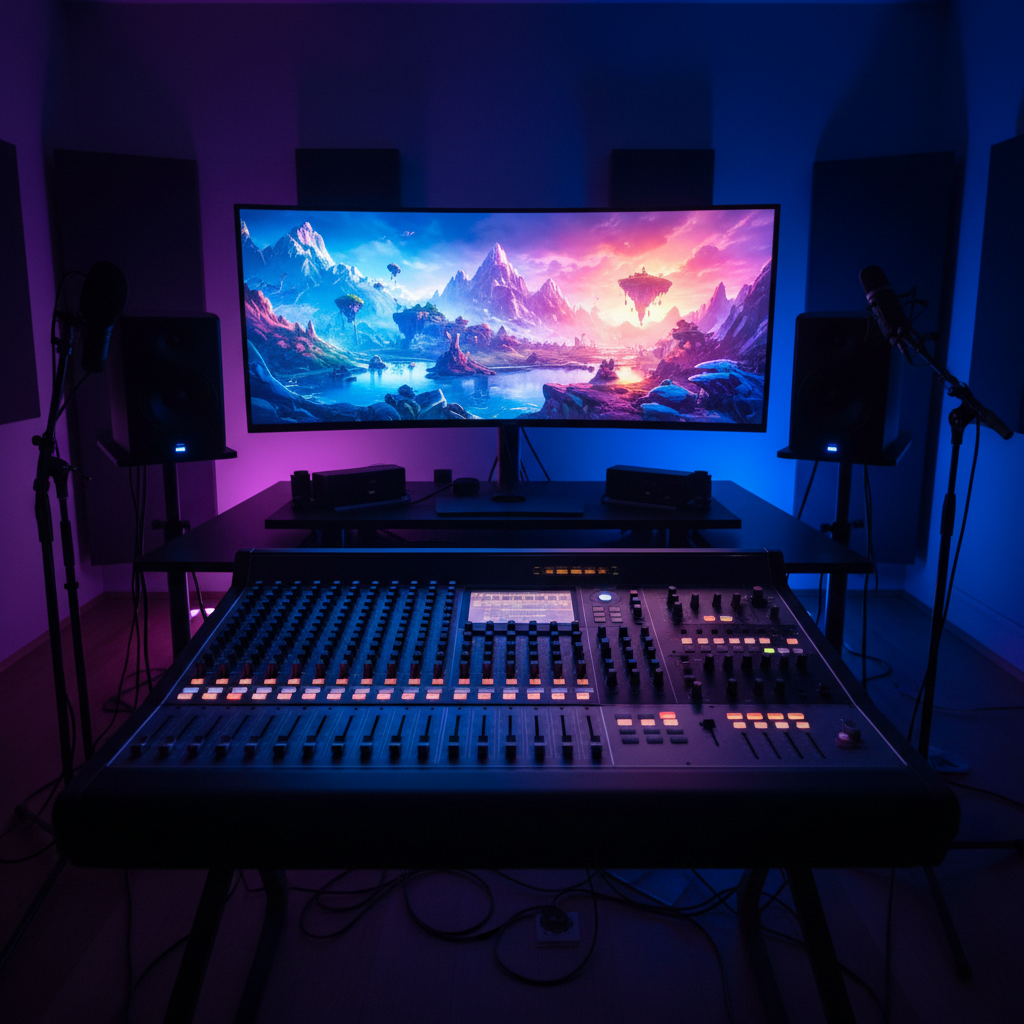






Game Audio Mastery with FMOD and Unity: Theory & Design
Master interactive game sound design with Unity and FMOD. Learn about middleware, linear vs. interactive audio, and building a professional portfolio.
Unlocking Game Audio
Unity, FMOD, and the Business of Interactive Sound
Linear vs. Interactive Audio
In film, sound happens at a fixed moment on a timeline. In games, sound is a response to player agency. We must design systems, not just waveforms. This shift requires understanding loops, randomization, and parameters that change in real-time.
The Tech Stack: Unity & FMOD
Unity: The Game Engine. Handles visuals, physics, and game logic. Typical 'host' for our audio.
FMOD: The Middleware. A dedicated audio engine that plugs into Unity. Allows complex behavior without writing C# code.
Why Middleware?: It bridges the gap between Composer and Programmer, allowing independent iteration.
The Business of Games
The video game industry now eclipses both film and music combined, creating massive demand for technical sound designers.
Games utilizing this workflow range from massive AAA open worlds to intricate indie masterpieces. FMOD is the industry standard for titles like Celeste, Hollow Knight, and Forza, enabling dynamic engine sounds, reactive music systems, and immersive spatial audio.
Built with FMOD & Unity
Course Outline: Foundation (Hour 1-2)
Hour 1: Awareness & Deconstruction. Breaking down SFX, Music, Ambience, UI, Footsteps, and VO. Why adaptive sound matters.
Hour 2: Engines & Middleware. Overview of the Unity interface and the FMOD Studio project structure. Understanding the signal flow.
Course Outline: Implementation (Hour 3-4)
Hour 3: Inside FMOD. Creating events, layering gunshots/footsteps, adding randomization, and setting up parameters.
Hour 4: Unity Integration. Hooking events to GameObjects, logic triggering (e.g., sound on enter zone), and testing in-game.
Course Outline: Design & Career (Hour 5-6)
Hour 5: Contextual Examples. Analysis of Ambience vs SFX priority, enemy cues, and level-based sound design.
Hour 6: Psychology & Industry. Music interactivity patterns, roles in the industry, and building a competitive reel.
Extended Session: The Lab (Hours 7-8)
For the extended workshop, we move from theory to practice. Students will perform 'Try-it-yourself' sound edits on provided assets, followed by Open Q&A and 1-on-1 micro feedback sessions on their implementations.
Great game audio is heard; perfect game audio is felt.
Design Philosophy
Building a Career Portfolio
Show linear redesigns: Take a gameplay clip, strip the audio, and redo it completely.
Demonstrate implementation: Don't just show the sound; show the FMOD project structure and logic.
Game Jams: The fastest way to get a shipped title on your resume and prove you can work in a team.
- game-audio
- fmod-tutorial
- unity-engine
- sound-design
- interactive-audio
- game-development
- audio-middleware