

Made byBobr AI

Heat Conduction in Cylindrical Coordinates: Key Concepts

Explore radial heat transfer analysis, critical radius of insulation, and heat generation in wires for industrial and electrical applications.

#heat-transfer#thermal-engineering#cylindrical-coordinates#physics#mechanical-engineering#thermodynamics
Watch
Pitch

Application of Heat Conduction in Cylindrical Coordinates

From Industrial Piping to Electrical Systems

Made byBobr AI

Radial Heat Conduction Analysis

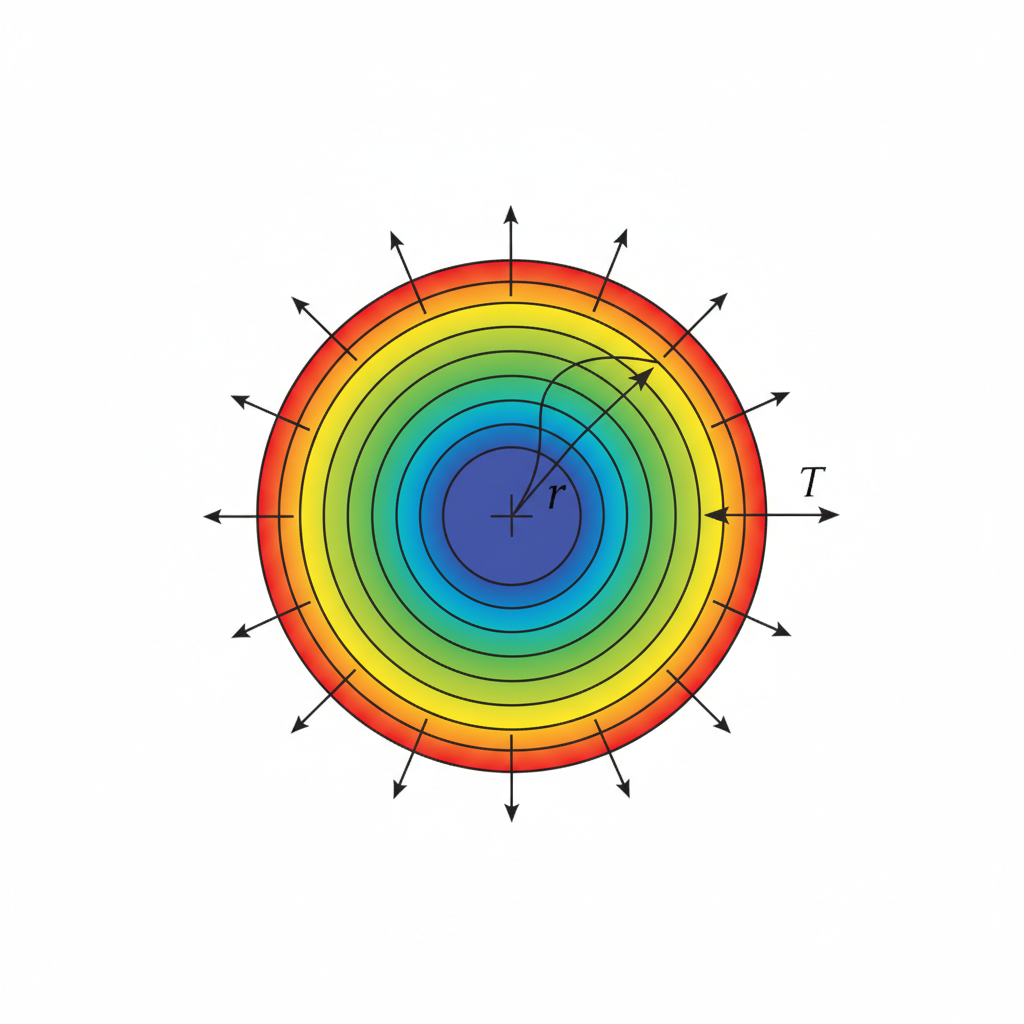
In cylindrical systems, heat transfer typically occurs in the radial direction. Unlike plane walls where temperature distribution is linear, steady-state conduction in a cylinder results in a logarithmic temperature profile. The governing equation is derived from Fourier's Law in cylindrical coordinates: q = -k(dT/dr).

Made byBobr AI

Critical Radius of Insulation

  • Concept: Adding insulation to a cylinder does not always decrease heat transfer.
  • Competing Effects: Insulation increases conduction resistance but decreases convection resistance by increasing the surface area.
  • Critical Radius (rc): Defined as rc = k/h. Heat loss is maximum at this radius.
  • Application: For electrical wires, we want r < rc to maximize cooling. For steam pipes, we want r > rc to insulate effectively.
Made byBobr AI

Application: Heat Generation in Wires

Electrical current flowing through a wire generates internal heat (S = I²R/V). Because the wire is cylindrical, heat must flow radially outward to the surface to dissipate. The temperature is highest at the center line and drops quadratically towards the surface. Key Result: T_center = T_surface + (q_gen * R²) / (4k) This analysis is crucial for determining the maximum current capacity (ampacity) of cables to prevent melting.
Made byBobr AI

Summary of Applications

Correctly applying cylindrical coordinates is vital for many industries:

  • Heat Exchangers: Designing effective shell-and-tube systems for power plants.
  • Nuclear Reactors: Managing heat removal from cylindrical fuel rods to prevent meltdowns.
  • Medical Engineering: Designing probes for tumor ablation where heat spreads radially in tissue.
  • Conclusion: Radial heat analysis is fundamental to thermal engineering safety and efficiency.
Made byBobr AI
Bobr AI

DESIGNER-MADE
PRESENTATION,
GENERATED FROM
YOUR PROMPT

Create your own professional slide deck with real images, data charts, and unique design in under a minute.

Generate For Free

Heat Conduction in Cylindrical Coordinates: Key Concepts

Explore radial heat transfer analysis, critical radius of insulation, and heat generation in wires for industrial and electrical applications.

Application of Heat Conduction in Cylindrical Coordinates

From Industrial Piping to Electrical Systems

Radial Heat Conduction Analysis

In cylindrical systems, heat transfer typically occurs in the radial direction. Unlike plane walls where temperature distribution is linear, steady-state conduction in a cylinder results in a logarithmic temperature profile. The governing equation is derived from Fourier's Law in cylindrical coordinates: q = -k(dT/dr).

Critical Radius of Insulation

Concept: Adding insulation to a cylinder does not always decrease heat transfer.

Competing Effects: Insulation increases conduction resistance but decreases convection resistance by increasing the surface area.

Critical Radius (rc): Defined as rc = k/h. Heat loss is maximum at this radius.

Application: For electrical wires, we want r < rc to maximize cooling. For steam pipes, we want r > rc to insulate effectively.

Application: Heat Generation in Wires

Electrical current flowing through a wire generates internal heat (S = I²R/V). Because the wire is cylindrical, heat must flow radially outward to the surface to dissipate. The temperature is highest at the center line and drops quadratically towards the surface. Key Result: T_center = T_surface + (q_gen * R²) / (4k) This analysis is crucial for determining the maximum current capacity (ampacity) of cables to prevent melting.

Summary of Applications

Correctly applying cylindrical coordinates is vital for many industries:

Heat Exchangers: Designing effective shell-and-tube systems for power plants.

Nuclear Reactors: Managing heat removal from cylindrical fuel rods to prevent meltdowns.

Medical Engineering: Designing probes for tumor ablation where heat spreads radially in tissue.

Conclusion: Radial heat analysis is fundamental to thermal engineering safety and efficiency.

  • heat-transfer
  • thermal-engineering
  • cylindrical-coordinates
  • physics
  • mechanical-engineering
  • thermodynamics