
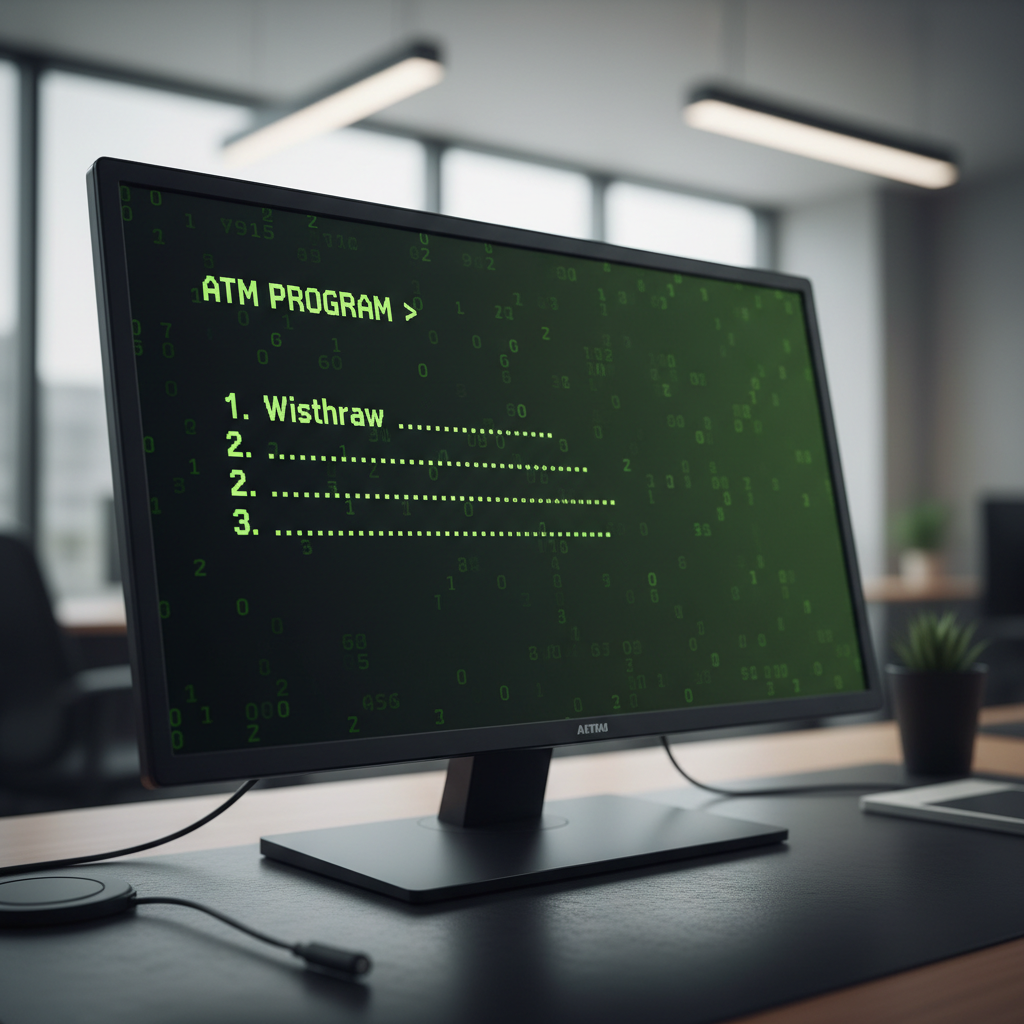
Java ATM Simulator: OOP Project for Students
A comprehensive Java mini-project covering ATM simulation, Object-Oriented Programming concepts, user authentication, and transaction modules.
ATM Interface Sytem
Course: BCS306A - Object Oriented Programming with Java
Student Name: [Your Name] | USN: [Your USN] Semester: 3rd | Section: [Sec]
Guide: Mrs. Prathima Mahapurush Smt. Kamala & Sri Venkappa M. Agadi College of Engineering and Technology
Introduction
The ATM Interface System is a console-based application designed to simulate the essential automated functionalities of a bank.
Purpose: To understand the implementation of Object-Oriented Programming (OOP) concepts in a real-world scenario.
The project focuses on creating a secure, menu-driven interface that handles user authentication and transaction processing reliably.
Problem Statement
Traditional banking requires physical presence during specific operational hours, leading to long waiting times and inefficiency for simple transactions. This project addresses the need for a 24/7 automated teller system that allows users to perform critical banking operations (withdrawals, deposits) instantly without human teller intervention.
Objectives
To develop a user-friendly Java application that mimics actual ATM logic.
To implement exception handling to manage invalid inputs (e.g., negative withdrawals).
To apply Encapsulation to protect user data (PIN and Balance).
To ensure logical accuracy in arithmetic operations during fund transfers.
Scope of the Project
The system covers the following modules: • User Authentication: Validates User ID and PIN. • Transaction Module: Handles Cash Withdrawals, Deposits, and Transfers. • Inquiry Module: Allows users to check current account balance. • Session Control: Secure exit and loop mechanisms for continuous usage.
Technologies Used
Programming Language: Java (JDK 17 or higher)
IDE: NetBeans / Eclipse / IntelliJ IDEA
Database: Simulated using Java Collections (HashMap/ArrayList) or File I/O
Core Concepts: OOP (Classes, Objects, Inheritance, Polymorphism), Exception Handling, Scanner Class
System Architecture & Flow
The architecture follows a sequential control flow: 1. Start -> Initialize Variables 2. User Login (PIN Check) 3. Main Menu Display 4. Switch Case -> Execute Logic (Withdraw/Deposit) 5. Update Balance 6. Loop until Exit
Implementation Logic
The application utilizes the 'Scanner' class for reading user inputs from the console.
Core Logic: A `while(true)` loop maintains the session, presenting the menu repeatedly until the user chooses to exit.
Validation: `if` conditions ensure withdrawal amounts do not exceed the current balance.
Variables: `private double balance` ensures data hiding, accessed only via getter/setter methods.
Output Screens
The console interface displays a clean menu. The user interacts by entering numerical options. Left: Main Menu Display Right: Transaction Success Message
Results
The System successfully compiles and runs on JDK environment without syntax errors.
Authentication module strictly prevents unauthorized access.
Balance updates are accurate; the system correctly persists values during the session runtime.
Conclusion
The ATM Mini Project successfully satisfies all functional requirements outlined in the problem statement.
It demonstrates the practical application of modular programming and OOP principles.
Future Enhancements: The project can be scaled to include a Graphical User Interface (Swing/JavaFX) and a persistent SQL database.
References
Herbert Schildt, 'Java: The Complete Reference', McGraw-Hill.
Oracle Java SE Documentation (docs.oracle.com).
VTU Syllabus for BCS306A - Object Oriented Programming with Java.
Thank You
Questions?
- java-project
- atm-simulator
- oop-concepts
- programming-guide
- student-project
- java-source-code
- software-architecture