


Mastering Double and Triple Integration: Concepts & Examples
Learn double and triple integration. Covers Fubini's Theorem, coordinate transformations (Polar, Cylindrical, Spherical), and solved volume examples.
Double and Triple Integration
Concepts, Techniques, and Solved Examples
Introduction to Multiple Integrals
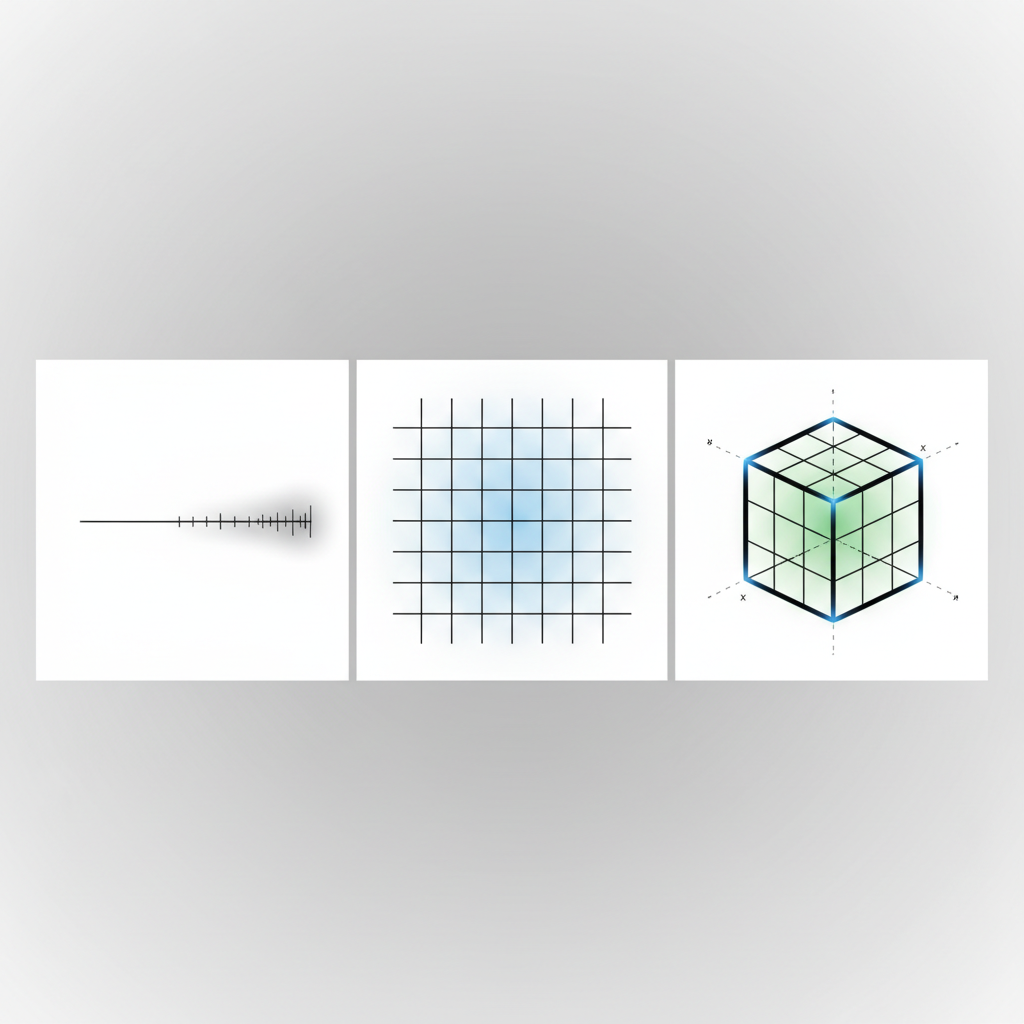
Multiple integration extends the concept of the definite integral to functions of several variables. While a single integral calculates the area under a curve, double and triple integrals allow us to calculate areas of regions, volumes of solids, and physical properties like mass and center of gravity in multidimensional space.
The Double Integral
Defined over a two-dimensional region D in the xy-plane.
Represents the volume under the surface z = f(x,y) and above the region D.
Notation: ∬ f(x,y) dA, where dA = dx dy or dy dx.
Can be computed as an iterated integral by integrating with respect to one variable while holding the other constant.
Fubini's Theorem
Fubini's Theorem states that if a function is continuous on a rectangular region, the double integral can be calculated as an iterated integral in either order. This means calculating ∫(∫ f(x,y) dy) dx yields the same result as ∫(∫ f(x,y) dx) dy.
Example: Double Integration
Problem: Evaluate ∫ from 0 to 2 [ ∫ from 0 to 1 (2x + y) dy ] dx
Step 1 (Inner): Integrate w.r.t y: [2xy + y²/2] from 0 to 1 → (2x(1) + 1/2) - 0 = 2x + 0.5
Step 2 (Outer): Integrate result w.r.t x: ∫ from 0 to 2 (2x + 0.5) dx
Step 3 (Solve): [x² + 0.5x] from 0 to 2 → (4 + 1) - 0 = 5
Triple Integrals
A triple integral extends integration to three dimensions over a solid region E. The notation is ∭ f(x,y,z) dV. If f(x,y,z) = 1, the integral specifically calculates the volume of the region E. It is also essential for calculating the total mass of an object with variable density.
Example: Triple Integration
Problem: Integrate f(x,y,z) = xyz over the unit cube [0,1]x[0,1]x[0,1]
Integral: ∫[0,1] ∫[0,1] ∫[0,1] xyz dz dy dx
Separable Limit Trick: Since limits are constant, split integrals: (∫ x dx) · (∫ y dy) · (∫ z dz)
Calculation: [x²/2]·[y²/2]·[z²/2] evaluated 0 to 1 → (1/2)·(1/2)·(1/2) = 1/8
Changing Coordinate Systems
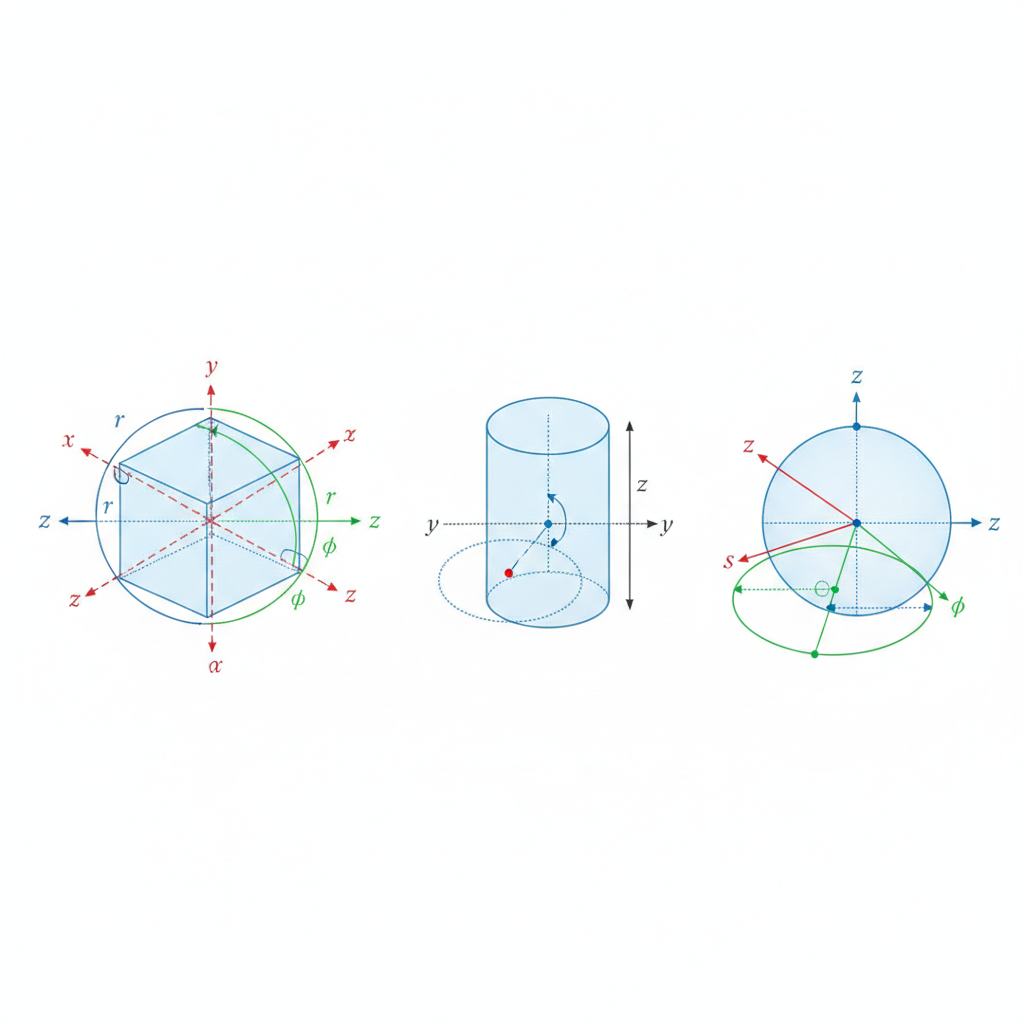
Integrating over circular or spherical regions is difficult in Cartesian (x,y,z) coordinates. We use alternate systems with a Jacobian correction factor: • Polar (2D): dA = r dr dθ • Cylindrical (3D): dV = r dz dr dθ • Spherical (3D): dV = ρ² sin(φ) dρ dθ dφ
The Jacobian is the scale factor that ensures area or volume is preserved when transforming between coordinate systems.
Key Concept in Change of Variables
Summary & Applications
Double Integrals: Used for finding area of regions and volume under surfaces.
Triple Integrals: Used for finding volume of solids and calculating mass/density.
Iterated Integrals: Multiple integrals are solved step-by-step from the inside out.
Coordinate transformation is a powerful tool for simplifying limits involving circles and spheres.
- calculus
- multivariable-calculus
- integration
- fubinis-theorem
- mathematics
- engineering-math
- multiple-integrals