




Mastering Triple Integration: Concepts and Coordinate Systems
Learn triple integration in rectangular, cylindrical, and spherical coordinates with a step-by-step volume calculation example using Fubini's Theorem.
Triple Integration
Concepts, Coordinate Systems, and Applications in Calculus
Definition of the Triple Integral
Just as a single integral finds the area under a curve, and a double integral finds the volume under a surface, a triple integral allows us to integrate a function w = f(x, y, z) over a bounded region in three-dimensional space. The result is often interpreted as hypervolume or, more physically, as the total mass of a solid with variable density.
Rectangular Coordinates (x, y, z)
Defined by limits on x, y, and z axes.
Differential element: dV = dx dy dz (or any permutation).
Best used for regions bounded by planes, such as rectangular boxes or pyramids.
Order of integration is typically determined by Fubini's Theorem.
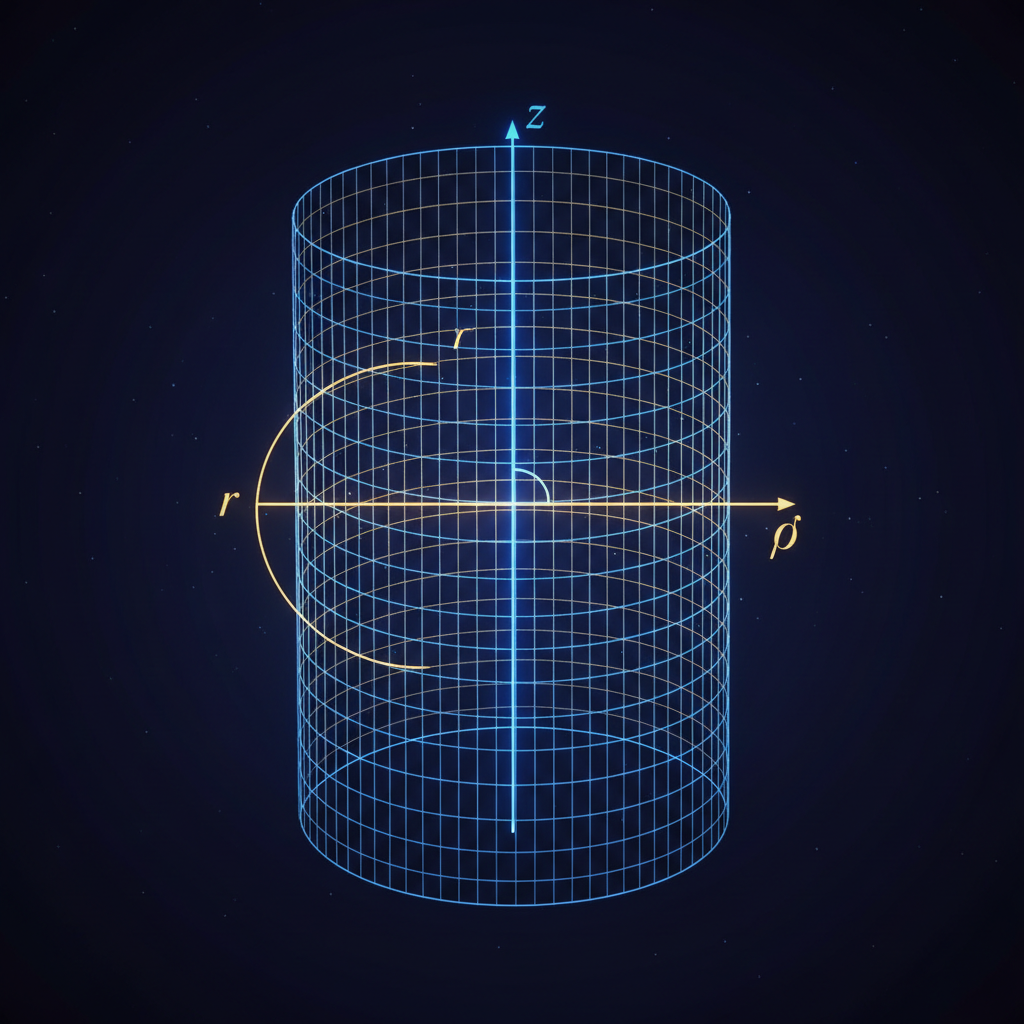
Cylindrical Coordinates
Useful for regions with symmetry about an axis (e.g., cylinders, paraboids). We convert x and y into polar coordinates while keeping z the same. <br><br><b>Transformation:</b><br>x = r cos(θ)<br>y = r sin(θ)<br>z = z<br><br><b>Volume Element:</b> dV = r dz dr dθ
Don't forget the Jacobian! In cylindrical coordinates, the extra 'r' in 'r dz dr dθ' is crucial for conservation of volume.
Important Note
Spherical Coordinates
Ideal for spheres, cones, or regions bounded by spheres. Defined by radius ρ (rho), azimuth angle θ (theta), and inclination angle φ (phi).<br><br>The Volume Element includes a more complex Jacobian factor:<br><b>dV = ρ² sin(φ) dρ dφ dθ</b>
Fubini's Theorem
Allows computing a triple integral as an iterated integral.
If f is continuous on the rectangular box, the order of integration (dx dy dz, dz dy dx, etc.) does not change the result.
For general regions, the limits of integration for the inner variables will depend on the outer variables.
Example Problem
Find the volume of the solid E bounded by the parabolic cylinder z = 1 - y² and the planes z = 0, x = 0, and x = 2.
Solution Walkthrough
1. Set Limits: x runs from 0 to 2. Since z = 1 - y² and z ≥ 0, y runs from -1 to 1. z runs from 0 to 1 - y².
2. Setup Integral: ∫(0 to 2) ∫(-1 to 1) ∫(0 to 1-y²) 1 dz dy dx.
3. Integrate z: Results in ∫(0 to 2) ∫(-1 to 1) (1 - y²) dy dx.
4. Final Answer: Evaluating the inner dy gives 4/3. Integrating dx from 0 to 2 gives Volume = 8/3.
Applications: Mass, Center of Gravity, Flux
- calculus
- triple-integration
- multivariable-calculus
- cylindrical-coordinates
- spherical-coordinates
- fubinis-theorem
- math-tutorial