


Systemic Supervision: Authority, Ethics & Collaboration
Explore professional systemic supervision practices including Mason’s Six Steps, safe uncertainty, and balancing authority with collaborative inquiry.
Systemic Supervision: Navigating Authority, Ethics & Collaboration
Restructuring the Supervisory Dilemma | Panel Presentation
Candidate No: [Insert Number] | Systemic Family Therapy Training
The Supervisory Dilemma
Developmental Starting Point
Organized around 'Collaboration' as non-intervention. Fear of hierarchy leading to flat, descriptive supervision.
The Shift: Intentional Authority
Realization: Authority is required to protect safety, locate responsibility, and create 'Safe Uncertainty'.
Theoretical Spine & Context
Barry Mason’s Six Steps
Used as the primary reflexive spine to structure inquiry.
Hawkins & Shohet (7-Eyed Model)
Rotation of lenses (Eye 5: Supervisory Relationship, Eye 6: Supervisor-System).
Burnham, Hardy & Reynolds
Ethical reflexivity, cultural responsiveness (Social GRACES), and accountability.
Step 1: Framing & Contracting
“I’m wondering… what held your attention… what you might have heard in terms of the interactions and the language?”
Constituting the 'Learning Community' (Todd & Storm)
Deliberately framing the space around experience vs. opinion
Hawkins & Shohet Eye 1 (Focus on Work) & Eye 6 (Supervisor-System)
Step 2: Protecting Difference & Slowing
Reframing the 'Radiator' Moment
Resisting the urge to synthesize or 'solve' quickly. Holding multiple descriptions (Andersen's Polyphony).
Safe Uncertainty
Step 3: Supervising 'Positioning' & Process
“There was a point you were following a certain line… and then you shifted. I’m wondering what happened there?”
Engaging Eye 4 (Supervisee) & Eye 5 (Supervisory Relationship)
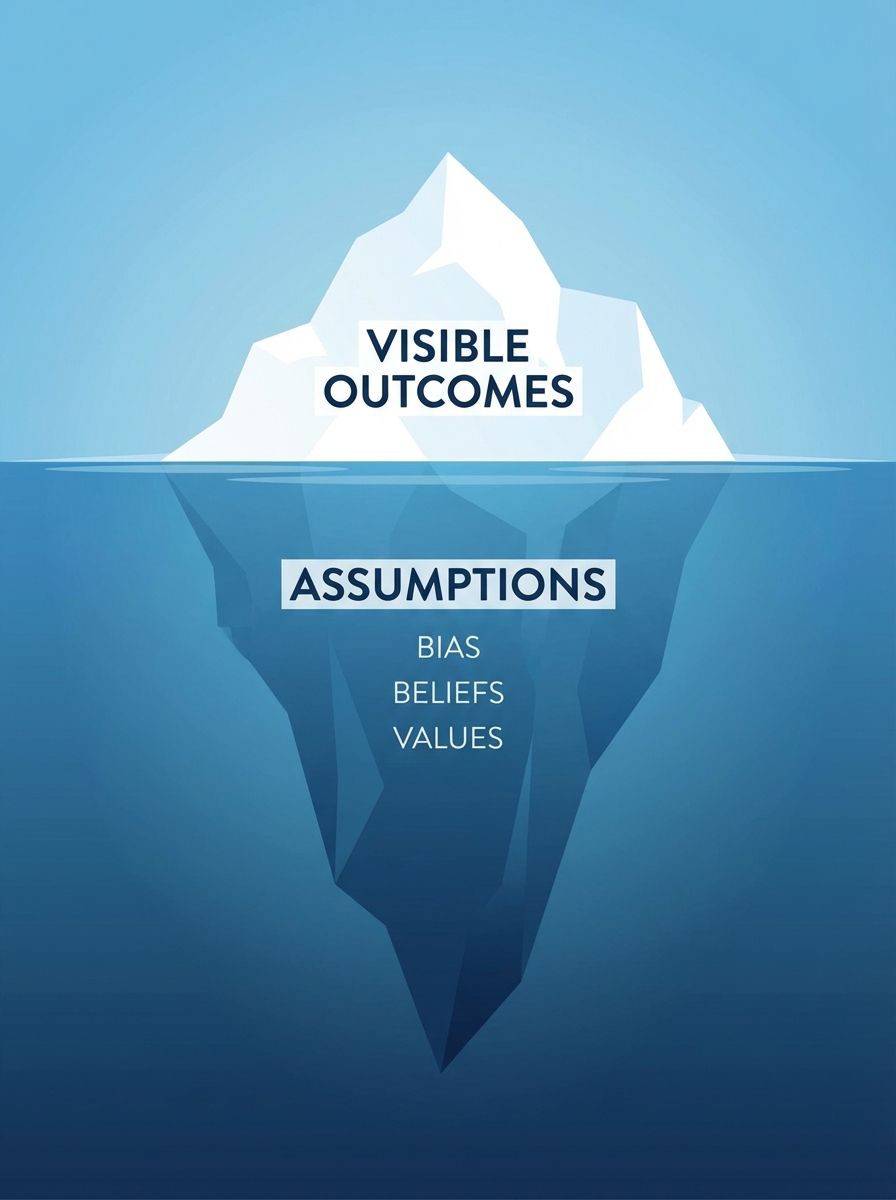
Step 4: Surfacing Assumptions & Bias
The 'Elephant in the Room': Addressing unspoken anxieties.
Rifa: “Where’s that bias come from, Prakash?”
Deconstructing 'Body Language' as a subjective cultural construction rather than objective truth (Hardy & Bobes).
Step 5: Re-Locating Responsibility
Moving from Individual Blame to Relational Context
Example: Deconstructing the 'Absent Father' vs. 'Sacrificing Mother' narrative.
Question: “Were these roles assumed or discussed?”
Accountability without Blame (Vikki Reynolds) | Systemic Neutrality
Learning Forward
Consolidating Supervisee Development
Moving from 'Advice Giving' to 'Facilitating Ownership'.
Future Action
Question: 'What might you take forward from this discussion?' (Mason's Step 6)
Meta-Reflection: Supervisory Identity
Authority & Collaboration are not opposites.
Authority is the mechanism for ethical responsibility and safety.
From 'Knowing' to 'Inquiring with Intent'.
A move towards Culturally Responsive & Justice-Oriented Supervision.
- systemic-therapy
- clinical-supervision
- mental-health
- 7-eyed-model
- professional-development
- therapy-training
- ethics