




Made byBobr AI

Firmware Encryption Attacks: Mitigating CBC Malleability

Learn how malleability attacks target AES-CBC in encrypted firmware updates and why authenticated encryption (AEAD) is essential for IoT security.

#firmware-security#aes-cbc-attack#arm-microcontroller#embedded-security#cybersecurity#code-injection#aead
Watch
Pitch
Abstract digital illustration of a microcontroller chip with a lock symbol overlay, dark blue technical background, schematic lines

Practical Evaluation of Code Injection in Encrypted Firmware Updates

A critical analysis of malleability attacks on AES-CBC in ARM Microcontrollers

Based on research by O. Guillen, D. Schmidt, & G. Sigl (IEEE, 2016)

Made byBobr AI

The False Sense of Security in Firmware Updates

  • Many bootloaders rely on symmetric encryption (e.g., AES-CBC) for updates.
  • Assumption: Confidentiality implies security.
  • Reality: Without integrity checks, encrypted data can be manipulated.
  • The Threat: Attacks can inject code without knowing the key.
Conceptual illustration of a data packet moving through a digital tunnel, being intercepted and modified, cybersecurity style
Made byBobr AI

Mechanism of Attack: CBC Malleability

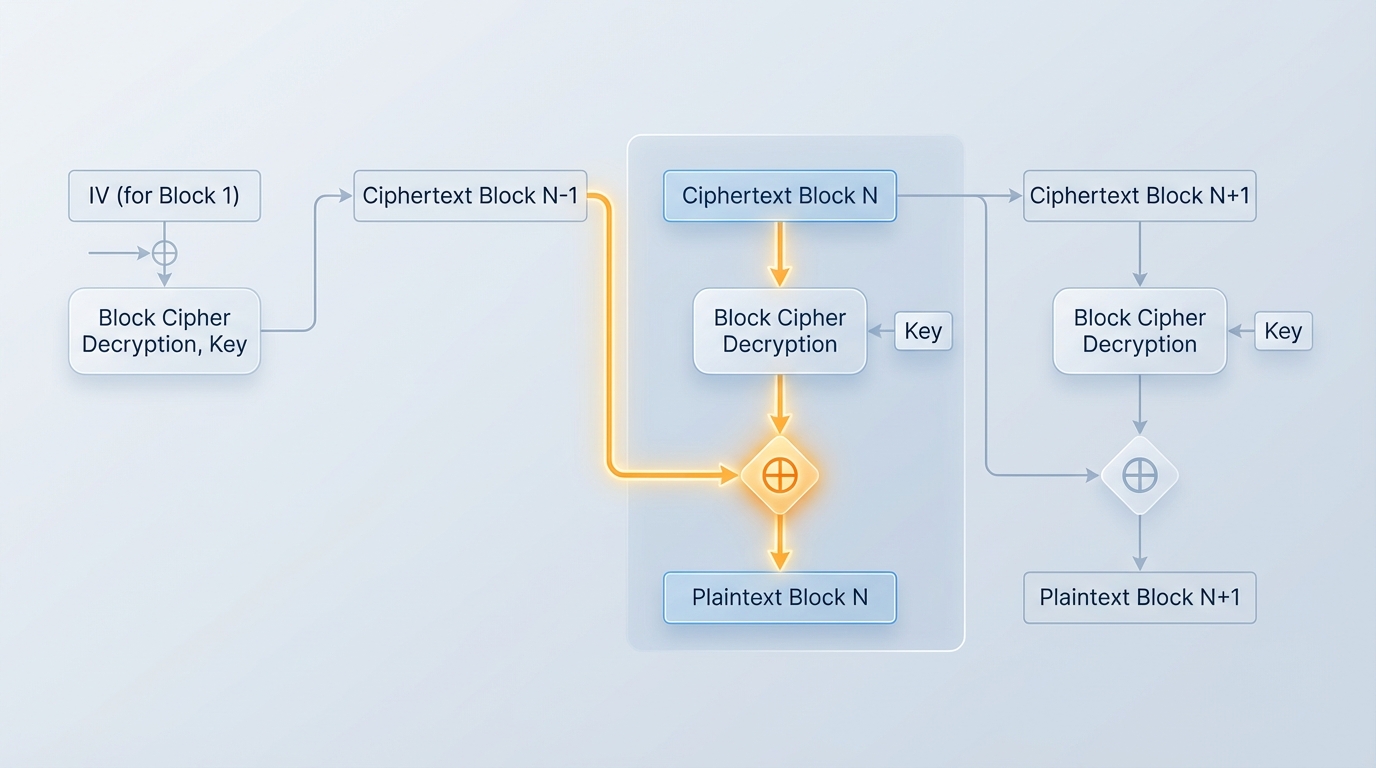
In Cipher Block Chaining (CBC) mode, decryption of a block depends on the previous ciphertext block. Modifying a bit in Ciphertext Block N-1 produces a predictable bit flip in Plaintext Block N.

Technical diagram showing CBC decryption mode, highlighting the XOR operation between Ciphertext Block N-1 and the decrypted Block N
Made byBobr AI

Targeting the ARM Exception Vector Table (EVT)

  • To flip bits intelligently, the attacker needs Known Plaintext.
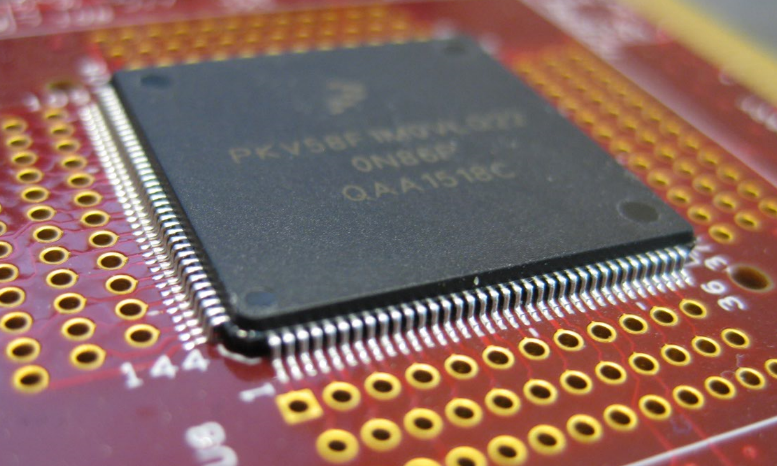
  • On ARM Cortex-M, the EVT is at a fixed location (often 0x00000000).
  • It contains 'Reserved' vectors that are always initialized to zero.
  • These 12-20 bytes of known zeros serve as the canvas for code injection.
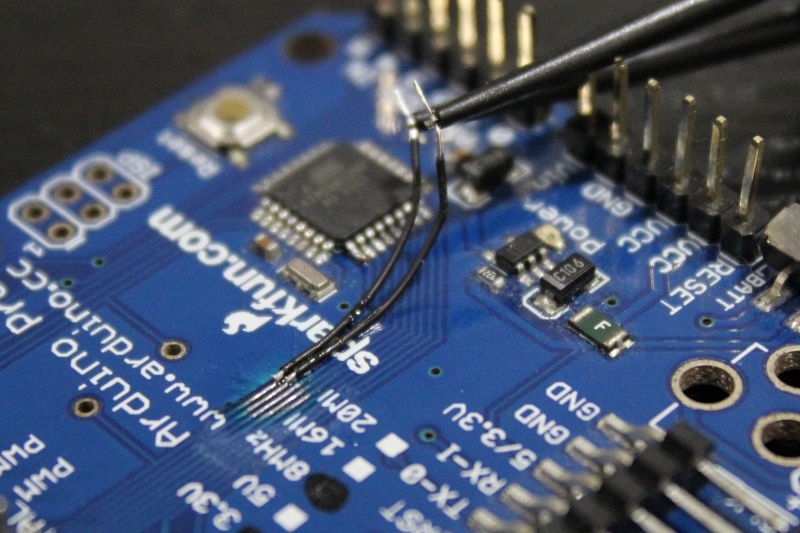
Close up photo of an ARM Cortex-M microcontroller on a circuit board, high quality macro photography
Made byBobr AI

The Copy-and-Paste Attack Strategy

The 'Reserved' EVT space (12 bytes) is too small for a full malicious payload. The attacker uses a 'Copy-and-Paste' technique to expand the available space.

1. Identify the 'Control Block' (Ciphertext N-1) and 'Target Block' (Ciphertext N).
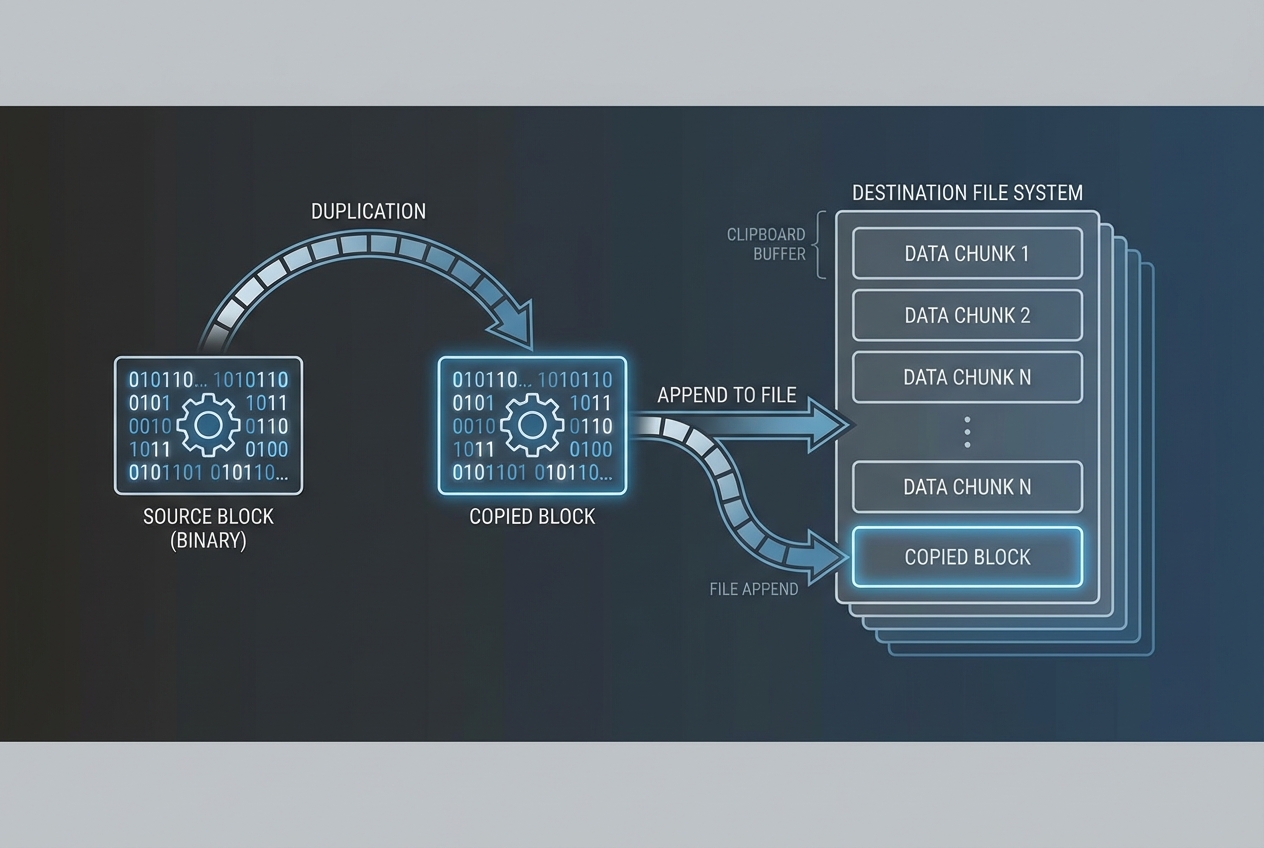
2. Replicate these ciphertext blocks repeatedly at the end of the firmware image.
3. This creates a chain of writable memory sections, interspersed with 'garbage' blocks caused by the decryption corruption.
Diagram showing blocks of digital data being duplicated and appended to a file structure, conceptual representation of copy and paste in binary data
Made byBobr AI

Engineering the Injection: The 'Jump' Technique

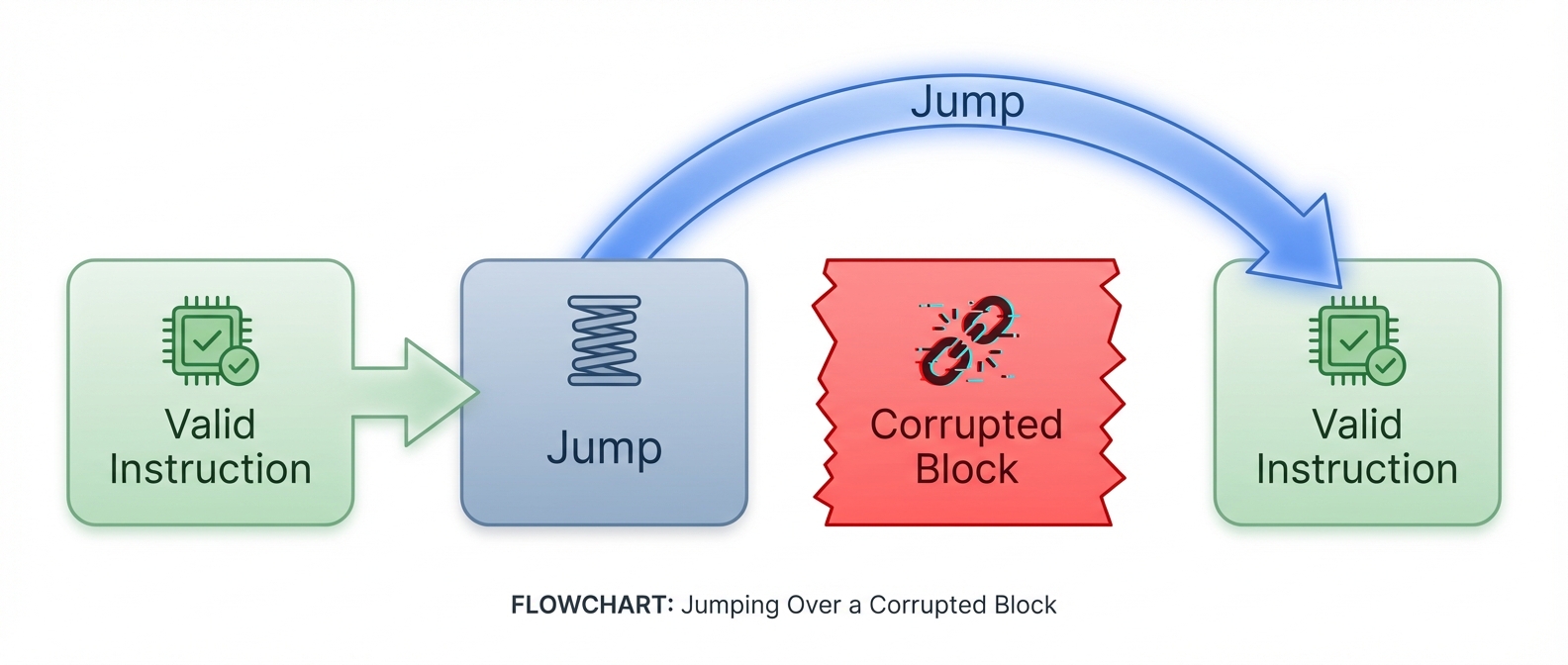
When the 'Control Block' is modified to write code into the 'Target Block', the 'Control Block' itself decrypts to random garbage. The code must jump over this corruption.

Flowchart diagram, horizontal, steps: 'Valid Instruction' arrow to 'Jump' arrow over 'Corrupted Block' arrow to 'Valid Instruction'
Made byBobr AI

Triggering Execution

The malicious payload is injected, but the CPU won't run it automatically. To force execution, the attacker modifies the EVT again.

Icon representing a hardware interrupt signal or electric pulse on a chip schematic
1. Locate the IRQ Vector (e.g., Button Press Interrupt).
2. Bit-flip the vector address to point to the injected code location.
3. Physically interact with the device (press the button) to trigger the jump.
Made byBobr AI

Proof of Concept & Extraction

The researchers targeted an Infineon XMC4500 (ARM Cortex-M4). The injected payload acted as a custom SPI transmitter, bit-banging memory contents out via GPIO pins.

Result: Full firmware extraction (including secret keys) was achieved using a standard logic analyzer connected to the modified pins.
Saleae logic analyzer connected to a microcontroller development board, close up photography
Made byBobr AI

Mitigation: Authenticated Encryption

Confidentiality fails without Integrity.

The Solution: Use Authenticated Encryption with Associated Data (AEAD) modes.

Examples: AES-GCM or AES-CCM.

These modes produce an authentication tag. If the ciphertext is modified (malleability attack), the tag verification fails, and the bootloader rejects the update before execution.

Illustration of a digital shield with a checkmark, representing cyber security integrity
Made byBobr AI

Key Takeaways

Encryption (Secrecy) does not guarantee Integrity.
Known plaintext (EVT) allows attackers to break CBC implementations.
Secrets can be extracted without the key by injecting dumper code.
Always use Authenticated Encryption for Firmware Updates.
Made byBobr AI
Bobr AI

DESIGNER-MADE
PRESENTATION,
GENERATED FROM
YOUR PROMPT

Create your own professional slide deck with real images, data charts, and unique design in under a minute.

Generate For Free

Firmware Encryption Attacks: Mitigating CBC Malleability

Learn how malleability attacks target AES-CBC in encrypted firmware updates and why authenticated encryption (AEAD) is essential for IoT security.

Practical Evaluation of Code Injection in Encrypted Firmware Updates

A critical analysis of malleability attacks on AES-CBC in ARM Microcontrollers

Based on research by O. Guillen, D. Schmidt, & G. Sigl (IEEE, 2016)

The False Sense of Security in Firmware Updates

<ul><li>Many bootloaders rely on symmetric encryption (e.g., AES-CBC) for updates.</li><li><strong>Assumption:</strong> Confidentiality implies security.</li><li><strong>Reality:</strong> Without integrity checks, encrypted data can be manipulated.</li><li><strong>The Threat:</strong> Attacks can inject code <em>without</em> knowing the key.</li></ul>

Mechanism of Attack: CBC Malleability

In Cipher Block Chaining (CBC) mode, decryption of a block depends on the previous ciphertext block. Modifying a bit in Ciphertext Block N-1 produces a predictable bit flip in Plaintext Block N.

Targeting the ARM Exception Vector Table (EVT)

To flip bits intelligently, the attacker needs <strong>Known Plaintext</strong>.

On ARM Cortex-M, the EVT is at a fixed location (often 0x00000000).

It contains 'Reserved' vectors that are always initialized to zero.

These 12-20 bytes of known zeros serve as the canvas for code injection.

The Copy-and-Paste Attack Strategy

The 'Reserved' EVT space (12 bytes) is too small for a full malicious payload. The attacker uses a 'Copy-and-Paste' technique to expand the available space.

1. Identify the 'Control Block' (Ciphertext N-1) and 'Target Block' (Ciphertext N).

2. Replicate these ciphertext blocks repeatedly at the end of the firmware image.

3. This creates a chain of writable memory sections, interspersed with 'garbage' blocks caused by the decryption corruption.

Engineering the Injection: The 'Jump' Technique

When the 'Control Block' is modified to write code into the 'Target Block', the 'Control Block' itself decrypts to random garbage. The code must jump over this corruption.

Triggering Execution

The malicious payload is injected, but the CPU won't run it automatically. To force execution, the attacker modifies the EVT again.

1. Locate the IRQ Vector (e.g., Button Press Interrupt).

2. Bit-flip the vector address to point to the injected code location.

3. Physically interact with the device (press the button) to trigger the jump.

Proof of Concept & Extraction

The researchers targeted an Infineon XMC4500 (ARM Cortex-M4). The injected payload acted as a custom SPI transmitter, bit-banging memory contents out via GPIO pins.

<strong>Result:</strong> Full firmware extraction (including secret keys) was achieved using a standard logic analyzer connected to the modified pins.

Mitigation: Authenticated Encryption

Confidentiality fails without Integrity.

<strong>The Solution:</strong> Use Authenticated Encryption with Associated Data (AEAD) modes.

<strong>Examples:</strong> AES-GCM or AES-CCM.

These modes produce an authentication tag. If the ciphertext is modified (malleability attack), the tag verification fails, and the bootloader rejects the update before execution.

Key Takeaways

Encryption (Secrecy) does not guarantee Integrity.

Known plaintext (EVT) allows attackers to break CBC implementations.

Secrets can be extracted without the key by injecting dumper code.

<strong>Always use Authenticated Encryption for Firmware Updates.</strong>

  • firmware-security
  • aes-cbc-attack
  • arm-microcontroller
  • embedded-security
  • cybersecurity
  • code-injection
  • aead