










Made byBobr AI

OpenMP and SYCL: A Guide to Heterogeneous Computing

Explore the evolution of OpenMP and SYCL for GPU offloading, parallel computing models, and a decision matrix for selecting the right programming standard.

#openmp#sycl#parallel-computing#gpu-offloading#hpc#c++#heterogeneous-computing#cuda
Watch
Pitch

Evolution of OpenMP

From CPU to Heterogeneous Computing

ACADEMIC BRIEFING

The Paradigm Shift

OpenMP has evolved from a simple directive-based model for multicore CPUs into a complex heterogeneous framework. It now provides a unified interface to offload computation to diverse hardware accelerators.

Full Accelerator Support: GPUs, FPGAs, DSPs
+
Key Constructs: target, teams, distribute
v1.0
The CPU Era: Focused on shared-memory thread parallelism.
v4.0
Offloading Milestone: Device constructs allow code execution on accelerators.
v5.x
Modern Standard: Advanced memory management and deep hardware integration.
1997
OpenMP 1.0
2008
OpenMP 3.0
2013: Offloading
OpenMP 4.0
2018
OpenMP 5.0
Future
Exascale Systems
"OpenMP is a unified standard for modern heterogeneous clusters, spanning beyond simple CPU parallelism."
Made byBobr AI

Classical CPU Parallelism

Core Foundations of OpenMP

CPU MULTI-THREADING

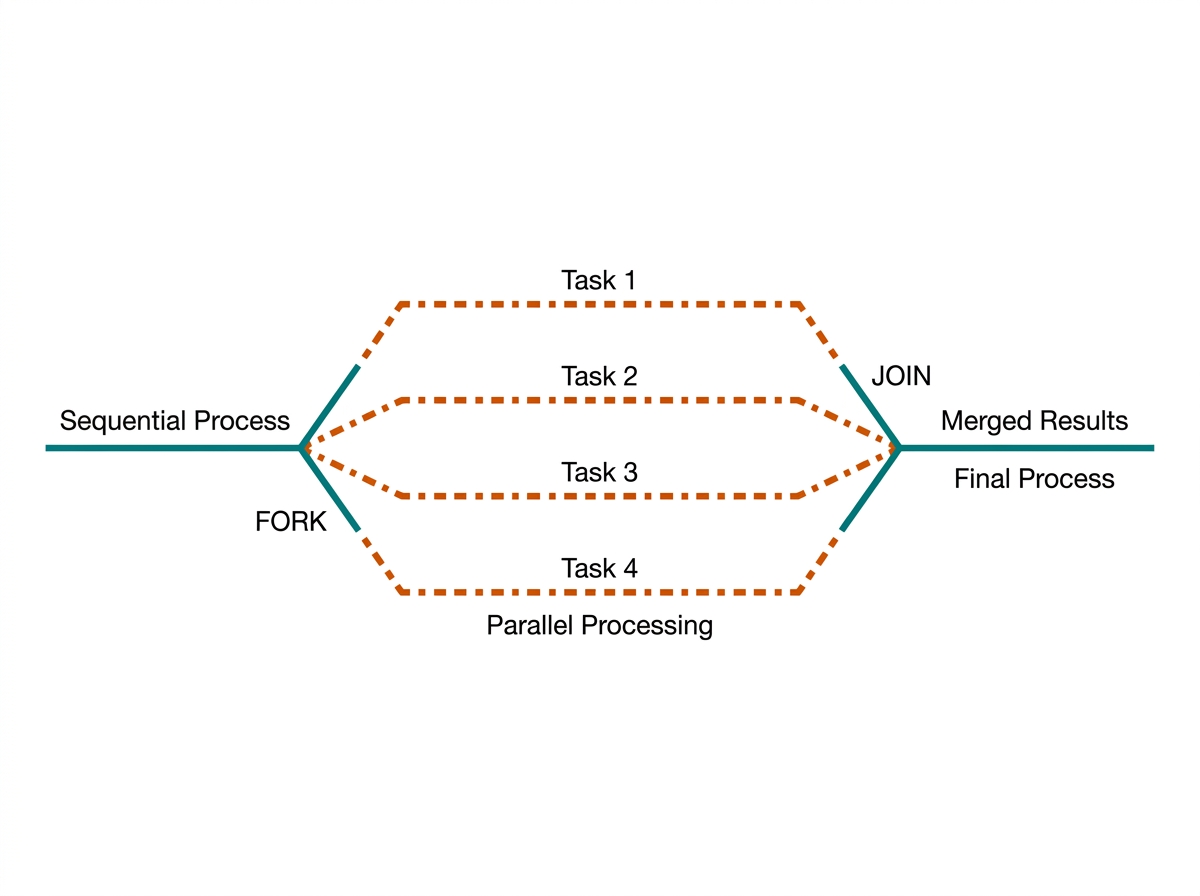
The Fork-Join Model

  • Shared Memory: All threads access a common address space.
  • Master Thread: "Forks" a team of workers for parallel regions.
  • Directives: Compiler-managed thread creation and synchronization.
Execution Flow
parallel_sum.cpp
#include <omp.h>
#include <vector>

void parallel_sum(std::vector<double>& a, ...) {
    #pragma omp parallel for
    for (int i = 0; i < a.size(); ++i) {
        a[i] += b[i];
    }
}
#pragma omp parallel
Defines the parallel region; activates a team of threads.
#pragma omp for
Work-sharing construct; distributes loop iterations across threads.
"Simple directives enable powerful thread-level parallelism on multi-core CPUs."
Made byBobr AI

OpenMP Target Offload for GPUs

Directive-Based Heterogeneous Computing

ADVANCED GPU PROGRAMMING

Key Constructs

  • The 'target' construct: Transfers control from host to device.
  • Hierarchical Parallelism: teams for thread blocks, distribute for loop scheduling across teams.
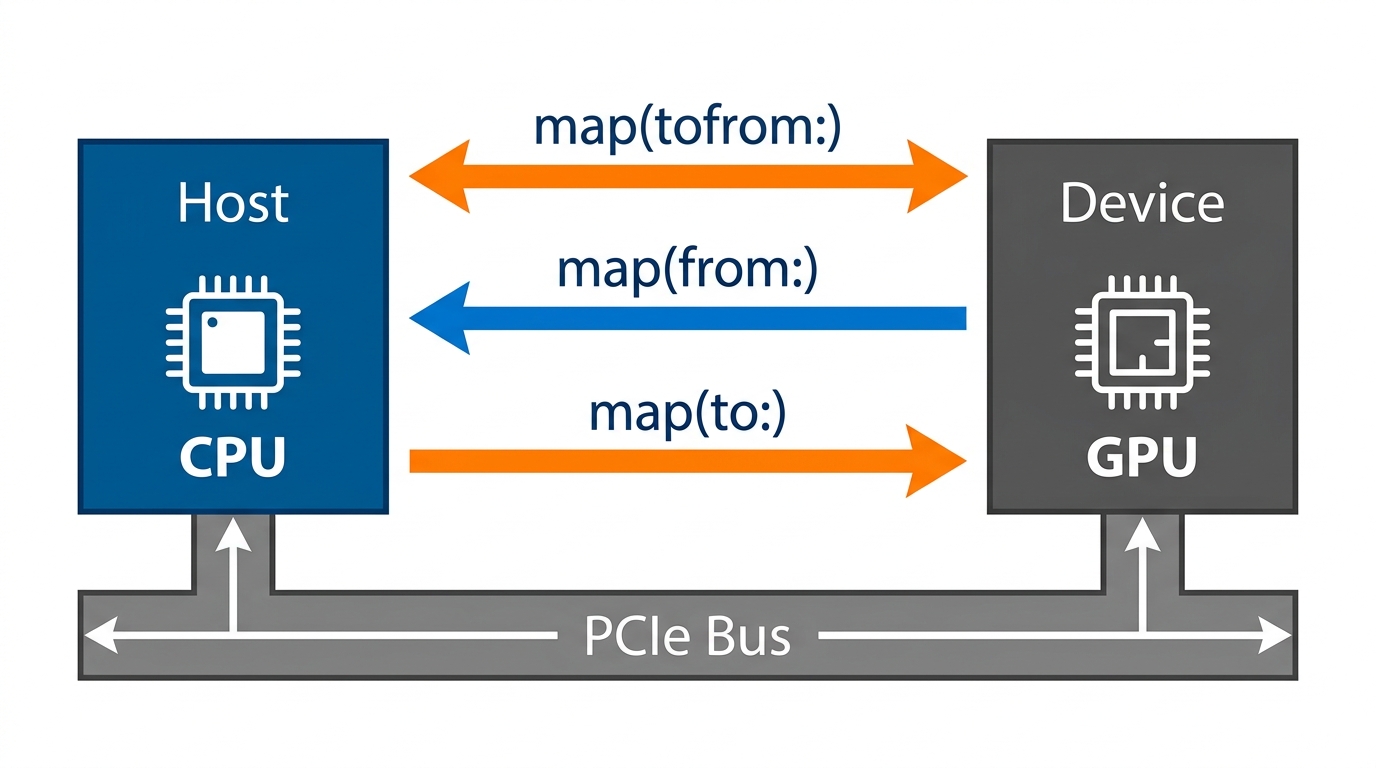
  • Data Management: Precise control via map(to:...), map(from:...), and map(tofrom:...).
C++ (OpenMP 4.5+)
// Offload to GPU with Data Mapping #pragma omp target teams distribute parallel for \ map(to: b[0:N]) map(tofrom: a[0:N]) for (int i = 0; i < N; ++i) { a[i] += b[i]; }

Host-Device Memory Model

Host (CPU)
Device (GPU)

Memory Mapping: OpenMP handles the complexity of moving data across the PCIe bus, ensuring variables are synchronized between the host RAM and device memory only when necessary.

"OpenMP Target Offload brings directive-based ease of use to GPU computing."
Made byBobr AI

Comparing Standards

OpenMP vs. OpenACC for Accelerators

TECHNICAL COMPARISON
Feature OpenMP OpenACC
Origins Academic / Industry Consortia Cray, PGI, NVIDIA
Design Philosophy General purpose, multifaceted & complex Directive-based, prescriptive for accelerators
Hardware Support Widest range (CPU, GPU, DSP, FPGA) Primarily NVIDIA GPUs (historically)
Implementation GCC, Clang, Intel, IBM, AOMP NVHPC (PGI), GCC, HPE

Use OpenMP for: Maximum portability across diverse architectures and legacy CPU code.

Use OpenACC for: Rapid, high-level porting to NVIDIA GPUs with less boilerplate.

"While OpenACC paved the way for high-level offloading, OpenMP 5.x now provides a standardized path for future-proof systems."
Made byBobr AI

Introduction to SYCL

Modern, Standard-Driven C++ for Heterogeneity

KHRONOS STANDARD

The Programming Model

An industry-standard, single-source C++ programming model, allowing developers to write high-performance code for diverse accelerators in a single file.

Key Advantage

Pure C++ approach with no non-standard pragmas. Uses modern C++ features (templates, lambdas) for heterogeneity.

Modern Abstraction

Abstracts the low-level complexities of OpenCL into a high-level, object-oriented framework.

Accelerators

Unified C++

Ecosystem: Managed by Khronos Group; serves as the foundation for Intel oneAPI.

"SYCL provides a modern, standard-driven C++ pathway to performance on any accelerator."
Made byBobr AI

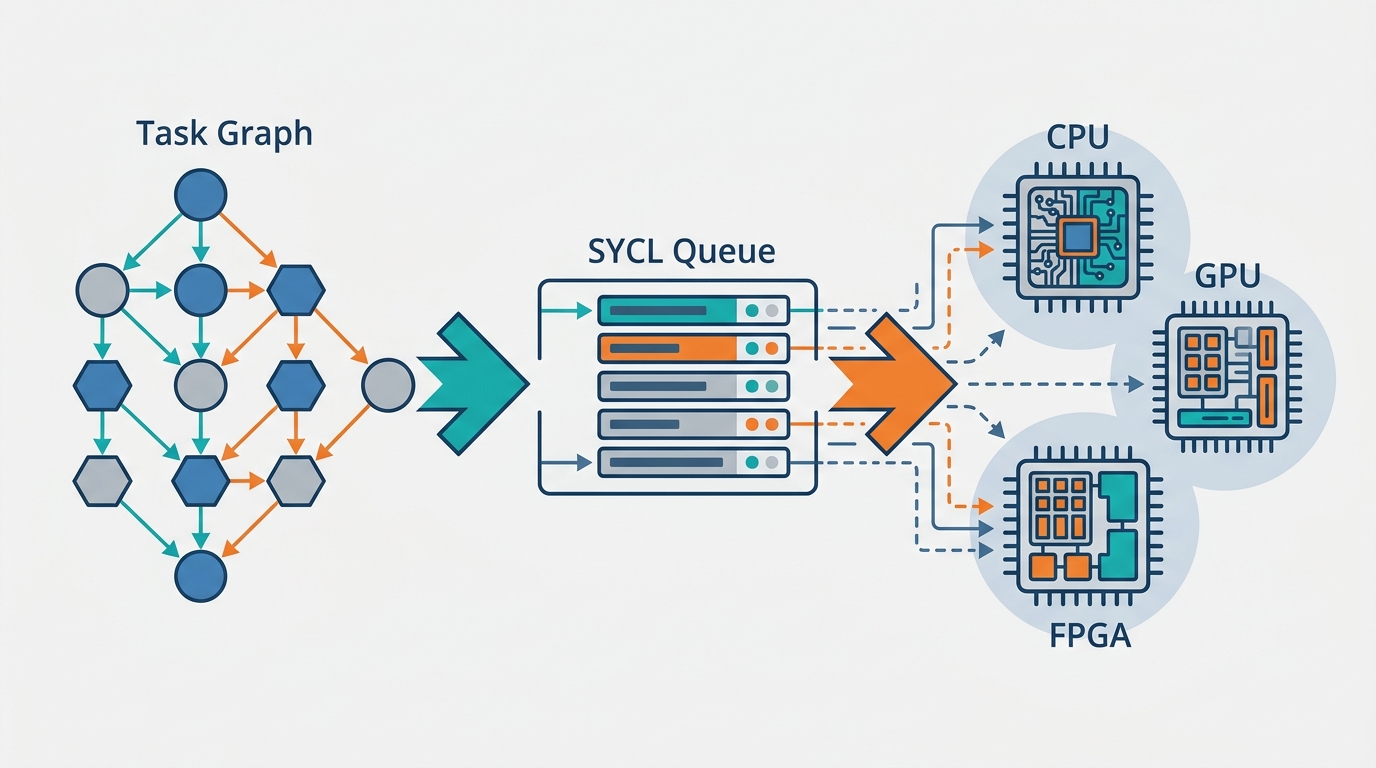
SYCL Execution Model

Asynchronous Task Dispatching & Hardware Offload

TECHNICAL ARCHITECTURE

High-Level Dispatch Workflow

1. Construct Graph 2. Submit to Queue 3. Parallel Execution
sycl::queue

The primary interface for submitting command groups. Manages dependencies and schedules tasks on the runtime.

sycl::device

Abstracts a hardware unit. Targets include CPUs, GPUs, and FPGAs through various backends (OpenCL, CUDA, Level Zero).

parallel_for

Launches kernels across an iteration space. Supports simple ranges or sophisticated multidimensional nd_range partitions.

Hardware Agnostic
"Queues and task graphs allow SYCL to manage asynchronous kernels efficiently."
Custom Accelerators
Made byBobr AI

SYCL Memory Models

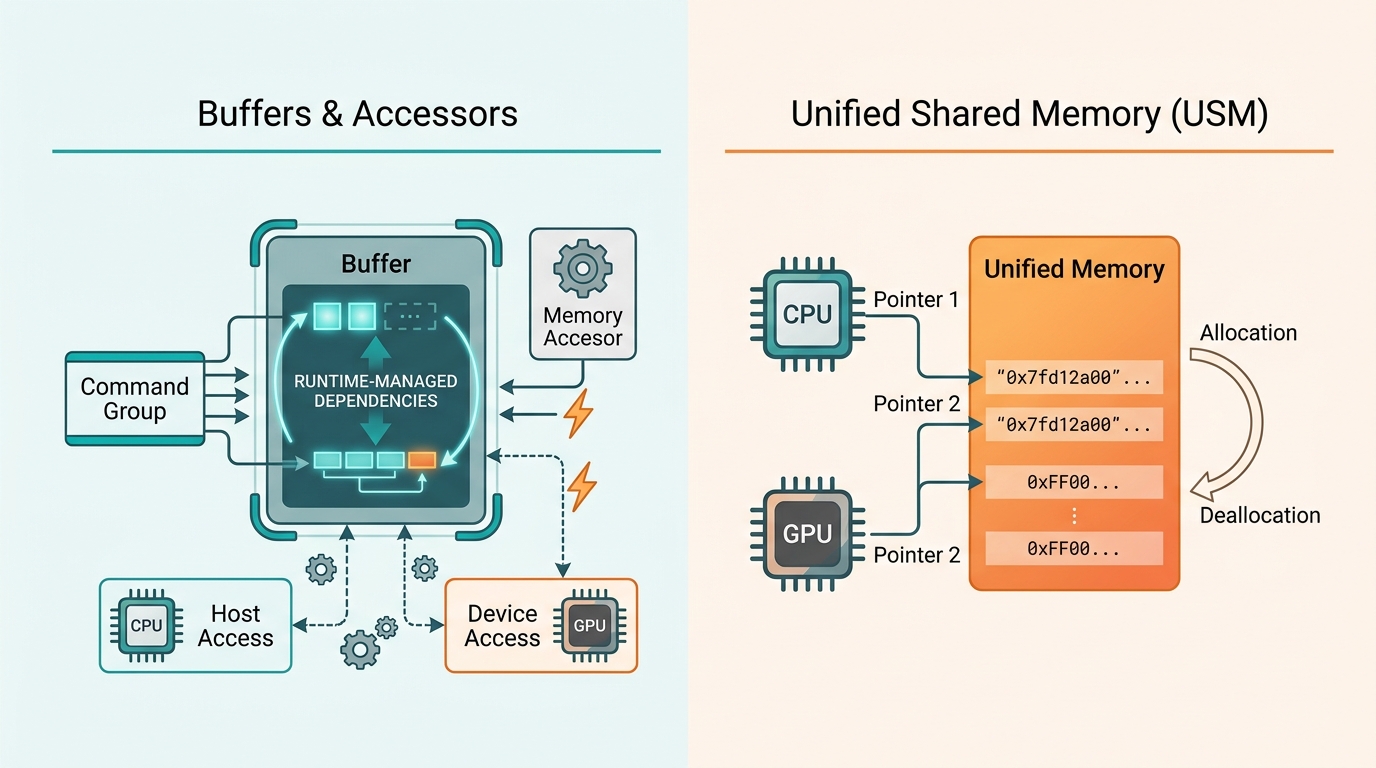
Buffers & Accessors vs. Unified Shared Memory

TECHNICAL DEEP DIVE

Buffers & Accessors

  • Abstract Data Management: Data is encapsulated in a "Buffer" object, detached from specific hardware.
  • Runtime Dependency Tracking: SYCL graph-based scheduler automatically handles read/write hazards.
  • Implicit Movement: Data moves to the device only when an accessor is requested in a command group.

Unified Shared Memory

  • Pointer-Based: Uses familiar malloc_device and malloc_shared.
  • Legacy Support: Easier porting for C/C++ codebases relying on raw pointers and manual memory management.
  • Explicit Control: Gives developers direct control over shared virtual memory and synchronization.
Recommendation: Use Buffers for high-level safety and automatic dependencies; use USM for porting pointer-heavy legacy code.
Made byBobr AI

Positioning SYCL in the Ecosystem

Portability vs. Abstraction vs. Performance

COMPARATIVE ANALYSIS
Level of Abstraction
Hardware Portability / Vendor Neutrality
CUDA

Vendor-locked (NVIDIA). Peak hardware-specific performance. Low-level control.

SYCL

Standard C++: Multi-vendor (Intel, AMD, NVIDIA). Modern C++ abstractions with DPC++.

Kokkos

C++ library. Performance-portable across nearly all HPC architectures. High-level data structures.

SYCL balances standard C++ syntax with broad multi-vendor hardware support
Made byBobr AI

The Memory Bottleneck

Feeding the Hardware Beast

PERFORMANCE ANALYSIS
HBM Bandwidth PCIe Narrow Neck Compute Engine

"The real winner is who feeds the hardware most efficiently."

Compute vs. Throughput

Memory Bound
GPUs are often bound by latency and bandwidth, not FLOPS capacity.
Transfer Cost
PCIe overhead creates massive latency compared to local HBM speed.
PCIe Gen 4: ~31.5 GB/s vs HBM3: ~819 GB/s+
Data movement consumes 100x more energy than math.
Takeaway: Optimize data movement first; the computation is often the "free" part on modern GPUs.
Made byBobr AI

Decision Matrix

Navigating the Ecosystem: Which Model to Choose?

STRATEGY GUIDE

Maximum Performance on NVIDIA?

CUDA

Native performance with deep control over hardware.

Multi-Vendor Modern C++?

SYCL

Standard C++ for diverse accelerators and vendors.

Legacy Code & Quick Porting?

OpenMP / OpenACC

Directive-based approach for minimal C++/Fortran changes.

P3

Extreme Performance Portability?

Kokkos

Abstraction layer for many-core and heterogeneous systems.

Selection Guide: Base your choice on hardware targets, code lifespan, and existing codebase maturity.
Made byBobr AI
Bobr AI

DESIGNER-MADE
PRESENTATION,
GENERATED FROM
YOUR PROMPT

Create your own professional slide deck with real images, data charts, and unique design in under a minute.

Generate For Free

OpenMP and SYCL: A Guide to Heterogeneous Computing

Explore the evolution of OpenMP and SYCL for GPU offloading, parallel computing models, and a decision matrix for selecting the right programming standard.