









Critique of Contingency Theory: Hidden Language Assumptions
Explore a critical analysis of Contingency Theory testing based on Schoonhoven (1981). Learn how hidden assumptions influence organizational 'fit' and performance research.
Problems with Contingency Theory: Testing Assumptions Hidden within Language
Key Citation: Schoonhoven, C. B. (1981). Administrative Science Quarterly, 26(3), 349–377.
The Research Problem
Contingency theory relies on the 'fit' between structure and environment.
Schoonhoven argues empirical tests are methodologically flawed.
Hidden language assumptions bias hypothesis formulation and testing.
Core Concern: Are we testing the theory, or are we testing assumptions built into how we define 'fit'?
Research Objectives & Questions
Critical evaluation of empirical tests, focusing on language assumptions.
1. What implicit assumptions underlie the concept of 'Fit'?
2. How do assumptions influence measurement and interpretation?
3. Do stats tests represent true contingency relationships?
4. Are positive findings evidence or artifacts?
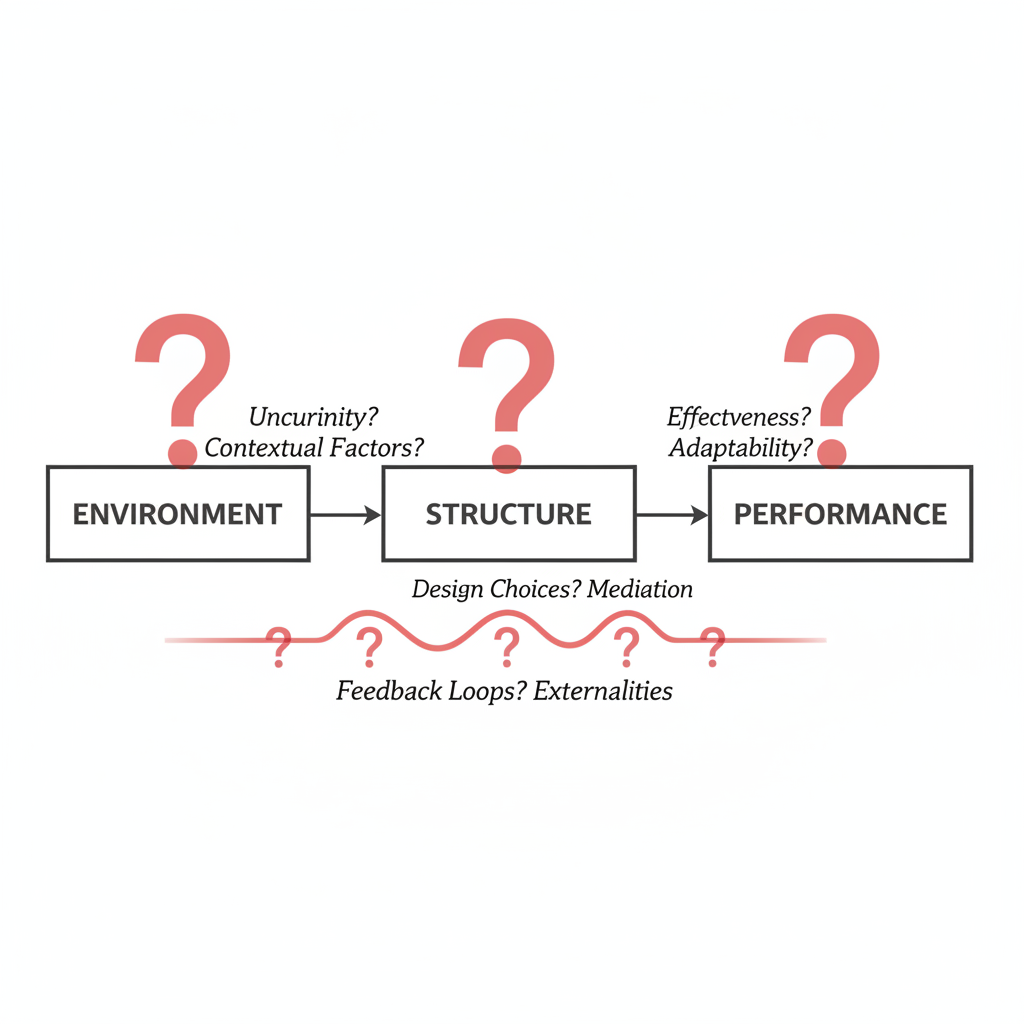
Conceptual Model: Traditional vs. Critique
Traditional Contingency View
Environment (E) → Organizational Structure (S) → Performance (P). Fit maximizes effectiveness.
Schoonhoven’s Critique
- Assumes single optimal structure - Assumes linear/symmetric misfit - Assumes 'fit' is merely an interaction term
Defining Key Concepts
Contingency Theory
No 'one best way.' Effectiveness depends on alignment between internal/external conditions.
Environment
Operationalized as uncertainty, complexity, dynamism. Often criticized as oversimplified.
Fit
Degree of alignment. Critically: Poorly defined and often assumed rather than demonstrated.
Organizational Structure
Formalization, Centralization, Complexity. Often treated as static but is adaptive.
Theoretical Landscape
Primary Theory: Structural Contingency Theory (Roots: Burns & Stalker, Lawrence & Lorsch, Woodward). Supporting Perspectives: • Organizational Design Theory • Systems Theory • Social Science Methodological Critique Note: Schoonhoven does not reject contingency theory; she seeks to refine and strengthen it by addressing construct validity and causal inference.
Hidden Assumptions: Part I
1. Fit Is Always Beneficial
Presumes alignment always improves performance. Ignores strategic choice, power dynamics, and organizational inertia.
2. High Symmetry of Misfit
Assumes deviations in either direction (too much vs. too little) are equally harmful. This is rarely justified theoretically.
Hidden Assumptions: Part II
3. Environment Determines Structure
Implies one-way causality. Overlooks managerial agency and feedback loops (Structure can impact Environment).
4. Statistical Interaction = Theoretical Fit
Interaction effects are treated as proof of contingency. This is a logical leap, not a theoretical necessity. Is it an artifact?
Logical Arguments & Hypothesis Critique
Hypothesis 1 (Implicit in Literature)
"Performance depends on E-S fit." CRITIQUE: Assumes correct specification of variables. Empirical support often reflects model construction, not true contingency.
Hypothesis 2 (Methodological Counter-Argument)
"Apparent contingency effects may be artifacts." SUPPORT: Interaction terms, deviation scores, and median splits can artificially generate significant results or mask main effects.
Conclusion & Contributions
Key Contributions
• Shift focus from results to the logic of testing. • Highlight importance of explicit assumptions. • Demand for conceptual clarity over blind statistical testing.
Implications
• Researchers must justify statistical techniques theoretically. • Contingency theory requires refinement, not just more data. • Interaction terms ≠ Fit.
"How we test a theory shapes what we believe about it."
- contingency-theory
- organizational-behavior
- management-science
- research-methodology
- structural-contingency
- organizational-design
- schoonhoven-critique