





Made byBobr AI

Graph Coloring Theory & Chromatic Numbers Explained

Learn about graph coloring, the Four Color Theorem, greedy algorithms, and real-world applications like scheduling and register allocation.

#graph-theory#chromatic-numbers#four-color-theorem#computer-science#algorithms#discrete-mathematics#scheduling
Watch
Pitch
Graph Theory • CS & Engineering

Graph Coloring, Chromatic
Numbers & the Four
Color Problem

An Introduction to Coloring Theory in Graph Theory

Undergraduate Graph Theory | Lecture Series
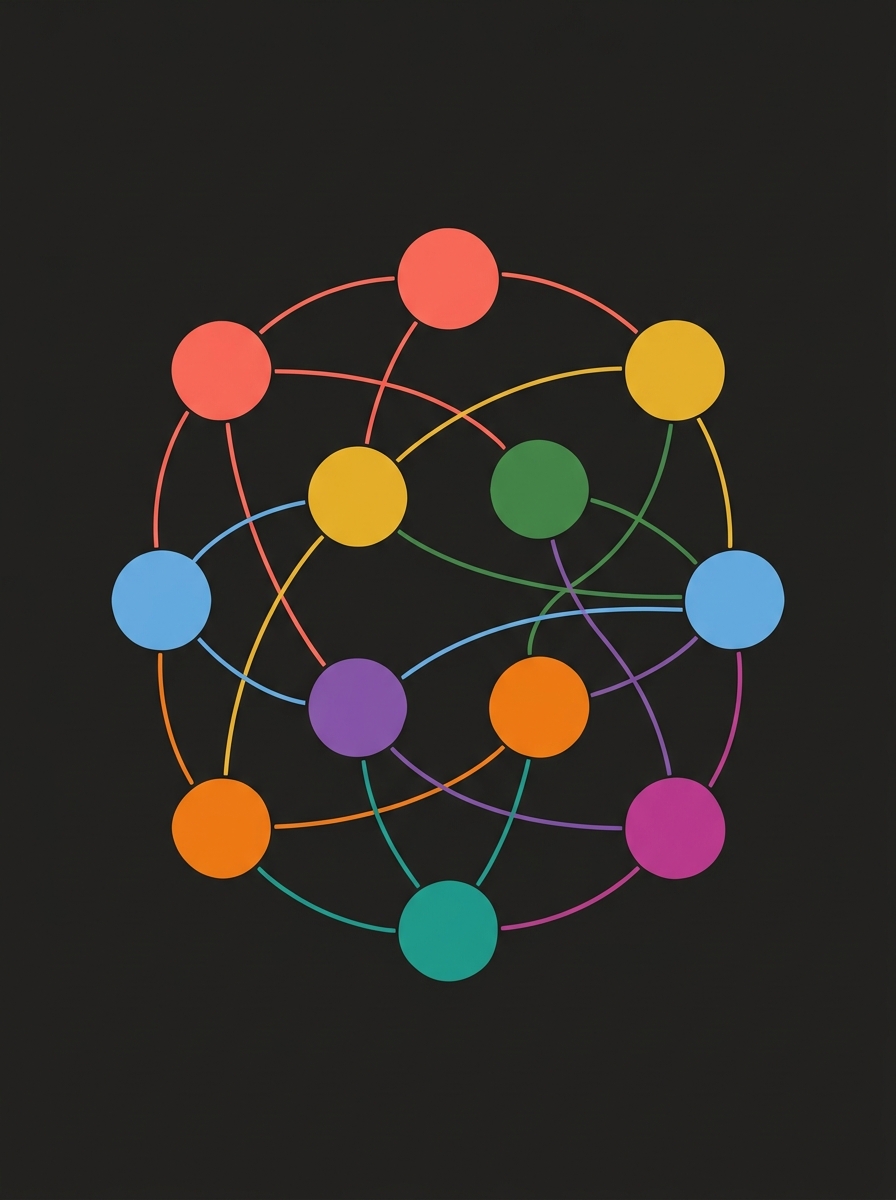
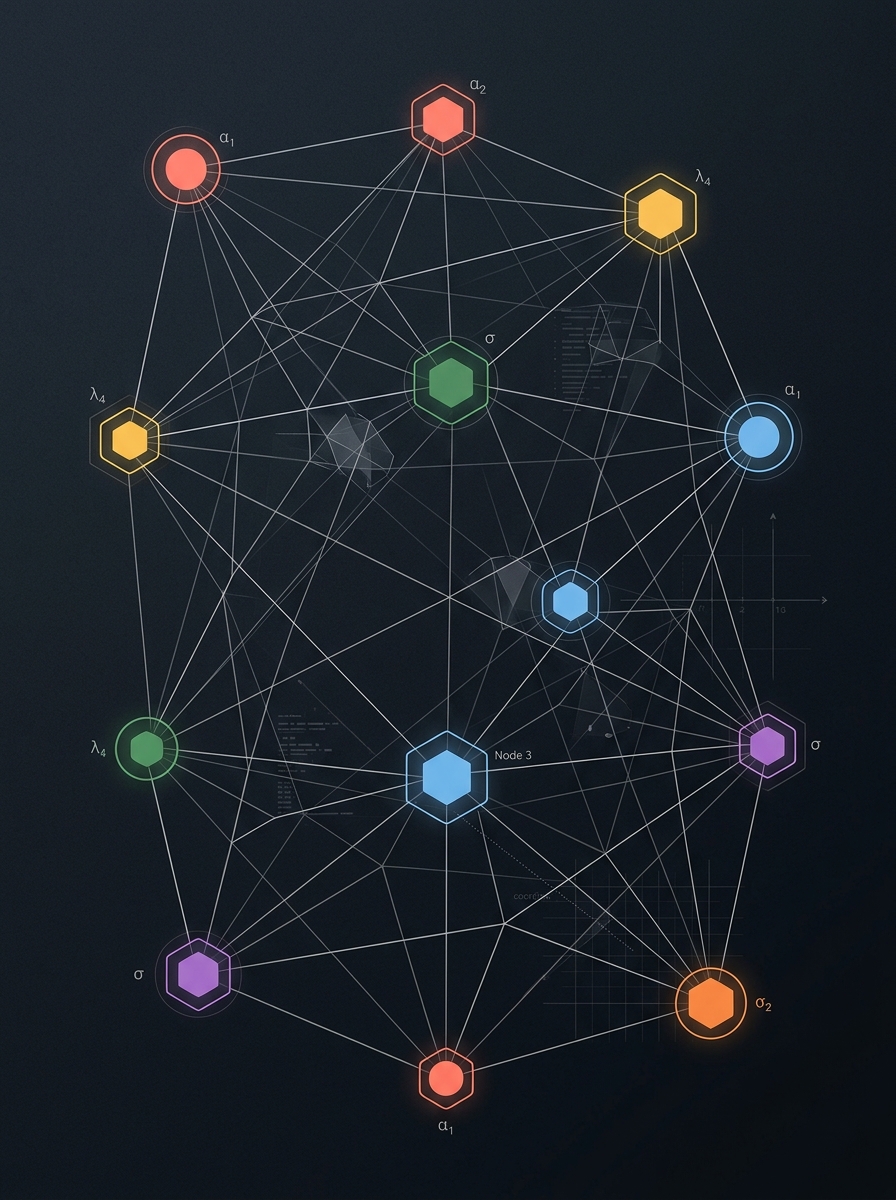
Graph Illustration
Made byBobr AI
Table of Contents

What We'll
Cover Today

A step-by-step roadmap through the definitions, algorithms, theorems, and practical applications of graph coloring.

1
What is Graph Coloring?
Definitions & intuition
2
Chromatic Numbers
Measuring coloring efficiency
3
Greedy Coloring Algorithm
Step-by-step walkthrough
4
Special Graph Classes
Bipartite, planar, complete graphs
5
The Four Color Theorem
History & significance
6
Proving & Disproving Colorings
Tools & techniques
7
Real-World Applications
Maps, scheduling, compilers
Made byBobr AI

What is Graph Coloring?

A graph coloring is an assignment of labels (called 'colors') to elements of a graph such that no two adjacent elements share the same color.
Intuition
Imagine you're coloring a map — neighboring countries must always have different colors. Graph coloring is the mathematical version of this puzzle.
No two adjacent vertices may share the same color.
Types of Coloring
  • Vertex coloring (most common)
  • Edge coloring
  • Face coloring
Graph Illustration
A valid 3-coloring of a simple graph
Made byBobr AI

Worked Example: Coloring a Graph Step by Step

Step 1: Draw the graph — 4 nodes: A, B, C, D. Edges: A-B, B-C, C-D, D-A, A-C
Step 2: Start at node A — assign Color 1 (Red/Coral)
Step 3: Move to B — adjacent to A, assign Color 2 (Green)
Step 4: Move to C — adjacent to A and B, assign Color 3 (Blue). Move to D — adjacent to A and C, assign Color 2 (Green). Done!
✓ Valid 3-coloring achieved!
Try it yourself: can you color it with only 2 colors? Why not?
A B C D

χ(G) = 3 for this graph

We used 3 colors and could not do it in 2.

Made byBobr AI

Chromatic Numbers — χ(G)

Definition

The chromatic number χ(G) of a graph G is the minimum number of colors needed to properly color its vertices.
χ(G) = min colors for a valid coloring
It's not how many colors you CAN use — it's how few you NEED.

Key Values

χ(G) = 1
Graph has no edges (empty graph)
χ(G) = 2
Graph is bipartite
χ(G) = 3
Needs 3 colors (e.g., odd cycles)
χ(G) = n
Complete graph Kₙ

Graph Examples

P₄
χ = 2
K₃
χ = 3
K₄
χ = 4
Key Insight: Finding χ(G) exactly is NP-hard in general — but we have powerful bounds and special cases!
Made byBobr AI

The Greedy Coloring Algorithm

How It Works

1
Order all vertices: v₁, v₂, ..., vₙ
(any order)
2
Assign the smallest available color to v₁
(Color 1)
3
For each next vertex vᵢ:
Look at all already-colored neighbors
Assign the smallest color NOT used by any neighbor
4
Repeat until all vertices are colored
Time Complexity: O(V + E)
Does NOT always find χ(G)
Result depends on vertex ordering!

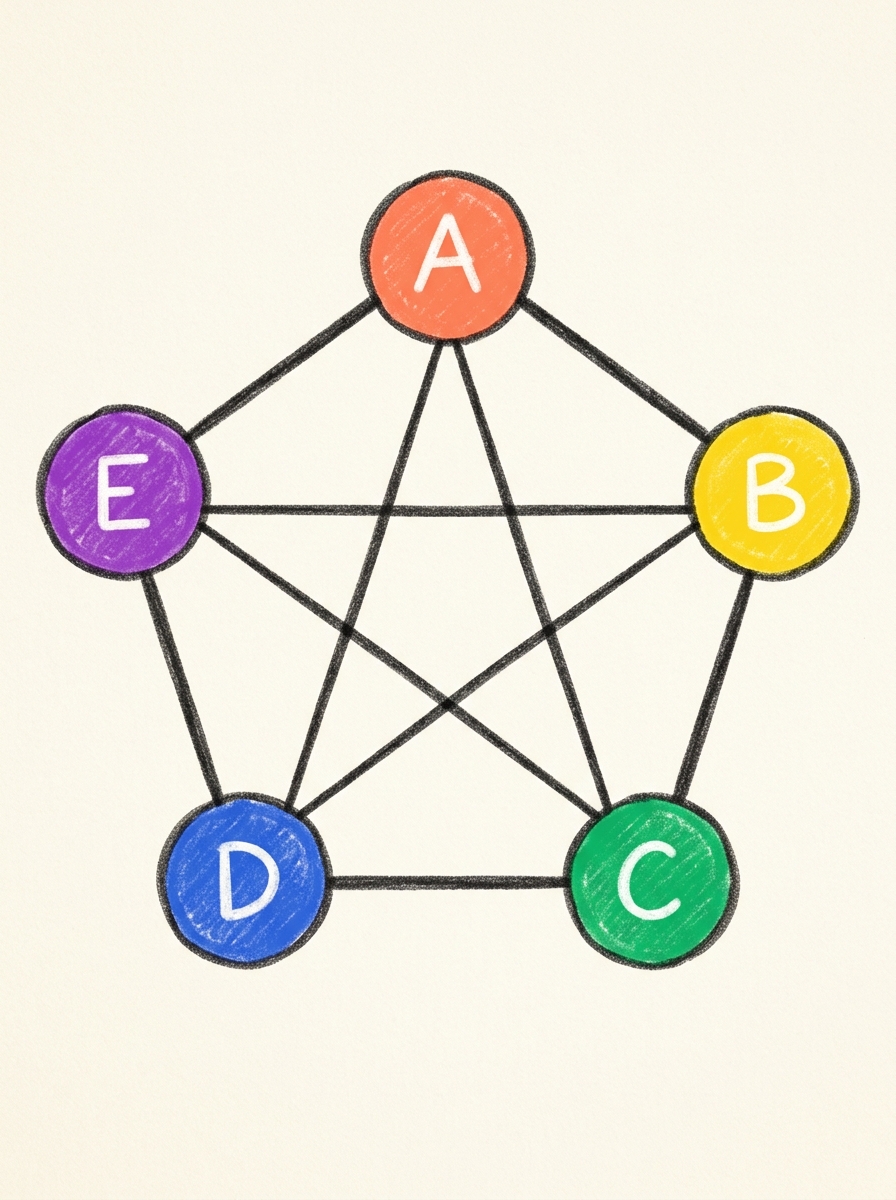
Worked Trace on C₅ Graph

Start
A B C D E
Midway
A B C D E
Complete
A B C D E
A greedy trace on a cycle C₅ — result: 3 colors (but χ(C₅)=3 ✓)
LIMITATIONS: Greedy may use more colors than optimal. For C₅, it matches χ — but this isn't always guaranteed.
Made byBobr AI

Special Graph Classes & Their Chromatic Numbers

Complete Graph Kₙ

χ(Kₙ) = n
Every pair adjacent → every node needs unique color

Bipartite Graph

χ = 2
Two sides, no intra-side edges → just 2 colors suffice

Cycle Cₙ (even)

χ = 2
Even cycles are bipartite → 2-colorable

Cycle Cₙ (odd)

χ = 3
Odd cycles force a third color — can you see why?

Tree

χ = 2
Trees are bipartite — always 2-colorable

Planar Graph

χ ≤ 4
The Four Color Theorem guarantees this!
Pattern: The more connections a graph has, the more colors it needs.
Made byBobr AI
The Four Color Theorem

Every Planar Map Can Be Colored with Just 4 Colors

The Statement
Any map drawn on a plane can be colored using at most 4 colors such that no two adjacent regions share the same color.
1852
Francis Guthrie first poses the problem while coloring a map of England
1879
Alfred Kempe publishes a 'proof' (later found flawed)
1890
Percy Heawood shows Kempe's proof has a gap
1976
Appel & Haken finally prove it — using a computer for the first time in math history!
1997
Robertson et al. produce a cleaner computer-assisted proof
FUN FACT: The Four Color Theorem was the first major theorem proved using a computer.
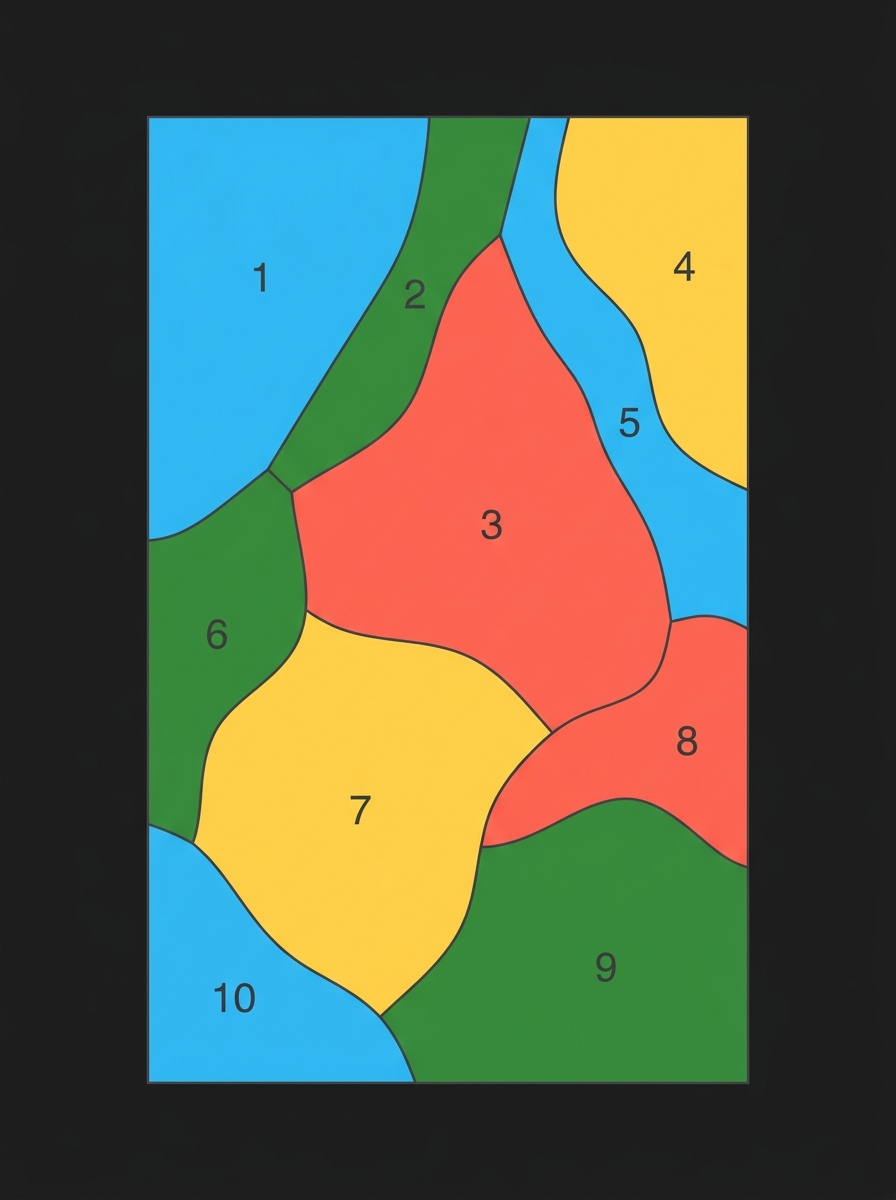
Colorful planar map illustration
A 4-colored planar map — no two bordering regions share a color
Made byBobr AI

Why Is It So Hard to Prove?

The Challenge

  • You can't just check examples — there are infinitely many possible planar graphs.
  • A valid proof must work for ALL planar maps, not just specific ones.

Kempe's Flawed Proof (1879)

  • Alfred Kempe introduced 'Kempe chains' — swapping color sequences to free up a color slot.
  • His argument worked for most cases... but Percy Heawood found a specific graph in 1890 where it failed.
  • The flaw: Kempe assumed two separate chain swaps were independent — they weren't.

Appel & Haken's Breakthrough (1976)

  • Reduced ALL planar graphs to 1,936 'unavoidable configurations'.
  • Used a computer to verify each configuration — took 1,200 hours of CPU time!
  • Controversial at first: "Can we trust a proof a human can't fully read?"

Appel & Haken's Strategy: Reduce to finite cases

ALL PLANAR GRAPHS Configuration 1 Verified by computer Configuration 2 Verified by computer Configuration 3 Verified by computer Configuration 4 Verified by computer Configuration 1,936 Verified by computer

Every planar graph contains at least one of these unavoidable configurations.

Key Takeaway The proof exists, but no simple human-readable proof has been found yet.
Made byBobr AI

Bounding the Chromatic Number

Lower Bounds
χ(G) ≥ ω(G)
The clique number ω(G) is the size of the largest complete subgraph (clique). You need at least as many colors as the size of the largest clique.
Example
If G contains K₄ (4 mutually adjacent nodes) → χ(G) ≥ 4
Upper Bounds
χ(G) ≤ Δ(G) + 1
Δ=3
Δ(G) is the maximum degree (most edges at any single node). Brooks' Theorem: χ(G) ≤ Δ(G) for most graphs (except complete graphs and odd cycles).
Example
If max degree = 3, then χ(G) ≤ 4 (or often ≤ 3 by Brooks)
clique lower bound
ω(G) χ(G) Δ(G) + 1
degree upper bound
Note Icon
Note: The gap between ω(G) and χ(G) can be arbitrarily large — Mycielski graphs have χ → ∞ but ω = 2!
Made byBobr AI

Real-World Applications

Map Coloring Icon

Map Coloring

Color regions of a geographic map so no two adjacent countries/states share a color. The classic motivation for the Four Color Theorem.

Exam Scheduling Icon

Exam / Job Scheduling

Represent exams as nodes; connect exams with shared students. Coloring gives a conflict-free schedule — colors = time slots.

Compiler Icon

Compiler Register Allocation

Variables in a program are nodes; connect those that conflict (live at same time). Colors = CPU registers. Minimize registers used.

Frequency Tower Icon

Frequency Assignment

Mobile towers are nodes; edges = overlapping coverage areas. Colors = radio frequencies. Prevent signal interference.

Sudoku Grid Icon

Sudoku Solving

A 9×9 Sudoku grid is a graph where cells in the same row/col/box are adjacent. Solving = graph coloring with χ = 9.

Chemical Storage Icon

Chemical Storage

Chemicals are nodes; edges = dangerous if stored together. Colors = storage rooms. Minimize rooms while preventing reactions.

Graph Coloring turns real-world conflict problems into elegant mathematical ones.
Made byBobr AI

Deep Dive: Exam Scheduling with Graph Coloring

The Problem Setup

A university has 5 exams: Math, Physics, CS, Chemistry, History. Some students are enrolled in multiple courses. Exams with shared students CANNOT be scheduled at the same time.

Conflicts:
Math–Physics, Math–CS, Physics–Chemistry, CS–Chemistry, Chemistry–History, History–Math
Step 1: Build the conflict graph
nodes = exams, edges = conflicts
Step 2: Color the graph
use greedy coloring:
Math → Slot 1 (coral)
Physics → conflicts with Math → Slot 2 (green)
CS → conflicts with Math → Slot 2 (green) [no conflict with Physics]
Chemistry → conflicts with Physics, CS → Slot 3 (blue)
History → conflicts with Chemistry, Math → Slot 2 (green)
Result: 3 time slots needed — χ(G) = 3!

The Graph Visualization

Math Physics Chemistry History CS

Allocated Schedule

Slot 1
Math
Slot 2
Physics
CS
History
Slot 3
Chemistry
This approach is used by real universities and software tools for automated scheduling!
Made byBobr AI

How Hard Is Graph Coloring?

Complexity Results

2-Coloring (Bipartite Check) ✓ Polynomial — Easy!
Solvable in O(V+E) time using BFS/DFS. Check if graph is bipartite — if yes, χ=2.
3-Coloring ✗ NP-Complete — Hard!
Determining if χ(G) ≤ 3 is NP-Complete. No efficient algorithm is known for all graphs.
k-Coloring (k ≥ 3) ✗ NP-Complete — Hard!
For any fixed k ≥ 3, deciding if χ(G) ≤ k is NP-Complete.
Approximation
We can approximate χ(G) within a factor, but not arbitrarily close unless P=NP.
The Big Picture: Graph coloring is one of Karp's original 21 NP-complete problems (1972).
NP
3-Coloring
4-Coloring
k-Coloring
P
2-Coloring
P = NP ?

Why does this matter?

Efficient algorithms exist for special graph classes — trees, planar graphs, interval graphs — even if the general problem is hard.

Key Insight: Knowing a graph's structure (planar, bipartite, sparse) unlocks faster solutions.
Made byBobr AI
SUMMARY

Key Takeaways

Graph coloring assigns colors to vertices so no two adjacent vertices share a color
The chromatic number χ(G) is the minimum colors needed
Greedy coloring is simple but may not find the optimal χ(G)
Bipartite graphs: χ=2. Odd cycles: χ=3. Complete graphs: χ=n
The Four Color Theorem: every planar map needs at most 4 colors
Graph coloring solves scheduling, register allocation, frequency assignment & more

What's Next?

Edge Coloring & Vizing's Theorem
List Coloring & Choosability
Fractional Chromatic Numbers
Graph Coloring Algorithms & Approximation
Undergraduate Graph Theory | Lecture Series

Thank You!

Questions?

Made byBobr AI
Bobr AI

DESIGNER-MADE
PRESENTATION,
GENERATED FROM
YOUR PROMPT

Create your own professional slide deck with real images, data charts, and unique design in under a minute.

Generate For Free

Graph Coloring Theory & Chromatic Numbers Explained

Learn about graph coloring, the Four Color Theorem, greedy algorithms, and real-world applications like scheduling and register allocation.

Graph Theory • CS & Engineering

Graph Coloring, Chromatic<br>Numbers & the Four<br>Color Problem

An Introduction to Coloring Theory in Graph Theory

Undergraduate Graph Theory | Lecture Series

Table of Contents

What We'll<br>Cover Today

A step-by-step roadmap through the definitions, algorithms, theorems, and practical applications of graph coloring.

What is Graph Coloring?

Definitions & intuition

Chromatic Numbers

Measuring coloring efficiency

Greedy Coloring Algorithm

Step-by-step walkthrough

Special Graph Classes

Bipartite, planar, complete graphs

The Four Color Theorem

History & significance

Proving & Disproving Colorings

Tools & techniques

Real-World Applications

Maps, scheduling, compilers

What is Graph Coloring?

A <b>graph coloring</b> is an assignment of labels (called 'colors') to elements of a graph such that no two adjacent elements share the same color.

Imagine you're coloring a map — neighboring countries must always have different colors. Graph coloring is the mathematical version of this puzzle.

No two adjacent vertices may share the same color.

A valid 3-coloring of a simple graph

Worked Example: Coloring a Graph Step by Step

Draw the graph — 4 nodes: A, B, C, D. Edges: A-B, B-C, C-D, D-A, A-C

Start at node A — assign Color 1 (Red/Coral)

Move to B — adjacent to A, assign Color 2 (Green)

Move to C — adjacent to A and B, assign Color 3 (Blue). Move to D — adjacent to A and C, assign Color 2 (Green). Done!

✓ Valid 3-coloring achieved!

Try it yourself: can you color it with only 2 colors? Why not?

χ(G) = 3 for this graph

We used 3 colors and could not do it in 2.

Chromatic Numbers — χ(G)

Definition

minimum number of colors needed to properly color its vertices.

χ(G) = min colors for a valid coloring

It's not how many colors you CAN use — it's how few you NEED.

Key Values

χ(G) = 1

Graph has no edges (empty graph)

χ(G) = 2

Graph is bipartite

χ(G) = 3

Needs 3 colors (e.g., odd cycles)

χ(G) = n

Complete graph Kₙ

Graph Examples

P₄

χ = 2

K₃

χ = 3

K₄

χ = 4

Key Insight:

Finding χ(G) exactly is NP-hard in general — but we have powerful bounds and special cases!

Mention that chromatic number is a key graph invariant studied in combinatorics.

The Greedy Coloring Algorithm

How It Works

Order all vertices: v₁, v₂, ..., vₙ

(any order)

Assign the smallest available color to v₁

(Color 1)

For each next vertex vᵢ:

Look at all already-colored neighbors

Assign the smallest color NOT used by any neighbor

Repeat until all vertices are colored

Time Complexity: O(V + E)

Does NOT always find χ(G)

Result depends on vertex ordering!

Worked Trace on C₅ Graph

A greedy trace on a cycle C₅ — result: 3 colors (but χ(C₅)=3 ✓)

Greedy may use more colors than optimal. For C₅, it matches χ — but this isn't always guaranteed.

Special Graph Classes & Their Chromatic Numbers

Complete Graph Kₙ

χ(Kₙ) = n

Every pair adjacent → every node needs unique color

Bipartite Graph

χ = 2

Two sides, no intra-side edges → just 2 colors suffice

Cycle Cₙ (even)

χ = 2

Even cycles are bipartite → 2-colorable

Cycle Cₙ (odd)

χ = 3

Odd cycles force a third color — can you see why?

Tree

χ = 2

Trees are bipartite — always 2-colorable

Planar Graph

χ ≤ 4

The Four Color Theorem guarantees this!

Pattern: The more connections a graph has, the more colors it needs.

The Four Color Theorem

Every Planar Map Can Be Colored with Just 4 Colors

The Statement

Any map drawn on a plane can be colored using at most 4 colors such that no two adjacent regions share the same color.

1852

Francis Guthrie first poses the problem while coloring a map of England

1879

Alfred Kempe publishes a 'proof' (later found flawed)

1890

Percy Heawood shows Kempe's proof has a gap

1976

Appel & Haken finally prove it — using a computer for the first time in math history!

1997

Robertson et al. produce a cleaner computer-assisted proof

The Four Color Theorem was the first major theorem proved using a computer.

A 4-colored planar map — no two bordering regions share a color

Why Is It So Hard to Prove?

The Challenge

You can't just check examples — there are infinitely many possible planar graphs.

A valid proof must work for ALL planar maps, not just specific ones.

Kempe's Flawed Proof (1879)

Alfred Kempe introduced 'Kempe chains' — swapping color sequences to free up a color slot.

His argument worked for most cases... but Percy Heawood found a specific graph in 1890 where it failed.

The flaw: Kempe assumed two separate chain swaps were independent — they weren't.

Appel & Haken's Breakthrough (1976)

Reduced ALL planar graphs to 1,936 'unavoidable configurations'.

Used a computer to verify each configuration — took 1,200 hours of CPU time!

Controversial at first: "Can we trust a proof a human can't fully read?"

Appel & Haken's Strategy: Reduce to finite cases

Every planar graph contains at least one of these unavoidable configurations.

The proof exists, but no simple human-readable proof has been found yet.

Bounding the Chromatic Number

Lower Bounds

χ(G) ≥ ω(G)

The clique number <strong style="color: #E8533F;">ω(G)</strong> is the size of the largest complete subgraph (clique). You need at least as many colors as the size of the largest clique.

If G contains K₄ (4 mutually adjacent nodes) → χ(G) ≥ 4

Upper Bounds

χ(G) ≤ Δ(G) + 1

<strong style="color: #2E7D32;">Δ(G)</strong> is the maximum degree (most edges at any single node). Brooks' Theorem: χ(G) ≤ Δ(G) for most graphs (except complete graphs and odd cycles).

If max degree = 3, then χ(G) ≤ 4 (or often ≤ 3 by Brooks)

clique lower bound

ω(G)

χ(G)

Δ(G) + 1

degree upper bound

The gap between ω(G) and χ(G) can be arbitrarily large — Mycielski graphs have χ → ∞ but ω = 2!

Real-World Applications

Map Coloring

Color regions of a geographic map so no two adjacent countries/states share a color. The classic motivation for the Four Color Theorem.

Exam / Job Scheduling

Represent exams as nodes; connect exams with shared students. Coloring gives a conflict-free schedule — colors = time slots.

Compiler Register Allocation

Variables in a program are nodes; connect those that conflict (live at same time). Colors = CPU registers. Minimize registers used.

Frequency Assignment

Mobile towers are nodes; edges = overlapping coverage areas. Colors = radio frequencies. Prevent signal interference.

Sudoku Solving

A 9×9 Sudoku grid is a graph where cells in the same row/col/box are adjacent. Solving = graph coloring with χ = 9.

Chemical Storage

Chemicals are nodes; edges = dangerous if stored together. Colors = storage rooms. Minimize rooms while preventing reactions.

Graph Coloring turns real-world conflict problems into elegant mathematical ones.

Deep Dive: Exam Scheduling with Graph Coloring

The Problem Setup

A university has 5 exams: Math, Physics, CS, Chemistry, History. Some students are enrolled in multiple courses. Exams with shared students CANNOT be scheduled at the same time.

Math–Physics, Math–CS, Physics–Chemistry, CS–Chemistry, Chemistry–History, History–Math

Step 1: Build the conflict graph

nodes = exams, edges = conflicts

Step 2: Color the graph

use greedy coloring:

<b>Math</b> &rarr; Slot 1 <span style="color:#888888; font-size: 20px;">(coral)</span>

<b>Physics</b> &rarr; conflicts with Math &rarr; Slot 2 <span style="color:#888888; font-size: 20px;">(green)</span>

<b>CS</b> &rarr; conflicts with Math &rarr; Slot 2 <span style="color:#888888; font-size: 20px;">(green)</span> <span style="font-size: 18px;">[no conflict with Physics]</span>

<b>Chemistry</b> &rarr; conflicts with Physics, CS &rarr; Slot 3 <span style="color:#888888; font-size: 20px;">(blue)</span>

<b>History</b> &rarr; conflicts with Chemistry, Math &rarr; Slot 2 <span style="color:#888888; font-size: 20px;">(green)</span>

Result: 3 time slots needed — χ(G) = 3!

The Graph Visualization

This approach is used by real universities and software tools for automated scheduling!

How Hard Is Graph Coloring?

Complexity Results

2-Coloring (Bipartite Check)

Solvable in O(V+E) time using BFS/DFS. Check if graph is bipartite — if yes, χ=2.

✓ Polynomial — Easy!

3-Coloring

Determining if χ(G) ≤ 3 is NP-Complete. No efficient algorithm is known for all graphs.

✗ NP-Complete — Hard!

k-Coloring (k ≥ 3)

For any fixed k ≥ 3, deciding if χ(G) ≤ k is NP-Complete.

✗ NP-Complete — Hard!

Approximation

We can approximate χ(G) within a factor, but not arbitrarily close unless P=NP.

The Big Picture: Graph coloring is one of Karp's original 21 NP-complete problems (1972).

Efficient algorithms exist for special graph classes — trees, planar graphs, interval graphs — even if the general problem is hard.

Key Insight: Knowing a graph's structure (planar, bipartite, sparse) unlocks faster solutions.

SUMMARY

Key Takeaways

Graph coloring assigns colors to vertices so no two adjacent vertices share a color

The chromatic number χ(G) is the minimum colors needed

Greedy coloring is simple but may not find the optimal χ(G)

Bipartite graphs: χ=2. Odd cycles: χ=3. Complete graphs: χ=n

The Four Color Theorem: every planar map needs at most 4 colors

Graph coloring solves scheduling, register allocation, frequency assignment & more

What's Next?

Edge Coloring & Vizing's Theorem

List Coloring & Choosability

Fractional Chromatic Numbers

Graph Coloring Algorithms & Approximation

Undergraduate Graph Theory | Lecture Series

Thank You!

Questions?