










Mastering English Modals and Present Perfect Tense
Learn essential English grammar rules for modal verbs (must, should, can) and the present perfect tense with clear examples and practice exercises.
English Grammar Essentials
Modals & Present Perfect Tense
Have to vs. Must (Obligation)
<ul><li style='margin-bottom:20px;'><strong>Have to:</strong> General obligation. Something necessary due to a situation.<br><span style='color:#319795;'>Example: Everyone has to go home by 5 p.m.</span></li><li style='margin-bottom:20px;'><strong>Must:</strong> Stronger, formal, or personal authority. Often used for written rules.<br><span style='color:#319795;'>Example: You must take your medicine.</span></li><li style='margin-bottom:20px;'><strong>Tip:</strong> 'Must' is rarely used in casual speech for facts. Use 'Have to'.</li></ul>
Logic & Deduction: Must
<ul><li style='margin-bottom:20px;'>Use <strong>Must</strong> when you are sure something is true based on evidence.</li><li style='margin-bottom:20px;'>It is the only logical conclusion.</li><li style='margin-bottom:20px; background:#EDF2F7; padding:15px; border-radius:10px;'><strong>Example:</strong><br>Suzy left an hour ago, so she <strong>must be</strong> home now.<br><em>(It is logically impossible for her not to be there.)</em></li><li style='color:#E53E3E;'><strong>Note:</strong> In this specific meaning, you cannot use 'have to'.</li></ul>
Advice: Should
<ul><li style='margin-bottom:25px;'><strong>Should</strong> is used to give advice or say something is a good idea.</li><li style='margin-bottom:25px;'><strong>Examples:</strong><br>• You <strong>should</strong> tell your sister you're sorry.<br>• You <strong>should</strong> finish your homework first.</li><li style='margin-top:20px; font-weight:bold; color:#D69E2E;'>Practice Question:</li><li style='list-style:none;'>"It's raining outside. You ______ take an umbrella."<br>(A) must (B) should (C) has to</li></ul>
Possibility: Can vs. Could
<div style='margin-bottom:30px;'><h3 style='color:#2C7A7B;'>Can</h3><p>Use when something is likely or generally possible.</p><p style='background:#E6FFFA; padding:10px; border-left:5px solid #2C7A7B;'>"This <strong>can</strong> be very tricky."</p></div><div><h3 style='color:#2C7A7B;'>Could</h3><p>Use when something is less likely or just a possibility.</p><p style='background:#E6FFFA; padding:10px; border-left:5px solid #2C7A7B;'>"This <strong>could</strong> be very tricky." (Maybe, maybe not)</p></div>
Ability: Can vs. Be Able To
<ul><li style='margin-bottom:20px;'><strong>Can:</strong> Use for ability in the Present Tense only.<br><em>"I can help him."</em></li><li style='margin-bottom:20px;'><strong>Could:</strong> Past ability.<br><em>"I could run fast when I was young."</em></li><li style='margin-bottom:20px;'><strong>To be able to:</strong> Can be used in ALL tenses (Past, Future, Present Perfect).<br><em>"Luckily, I <strong>was able to</strong> help him."</em></li></ul>
Requests & Permission
<div style='display:grid; grid-template-columns: 1fr 1fr; gap:20px;'><div style='background:#EBF8FF; padding:20px; border-radius:8px;'><strong>Asking Permission</strong><br>Can = Informal<br>Could = Polite<br>Ex: <em>"Can I stay out late?"</em></div><div style='background:#EBF8FF; padding:20px; border-radius:8px;'><strong>Polite Requests</strong><br>Combination with 'Please'<br>Could is more formal than Can.<br>Ex: <em>"Could I have a glass of water, please?"</em></div></div><p style='margin-top:20px; font-weight:bold; color:#2B6CB0;'>Practice:</p><p>You are talking to a teacher. Which is better?</p><ul><li>A) Can I leave?</li><li>B) Could I leave? (Better/Politer)</li></ul>
Present Perfect: The Form
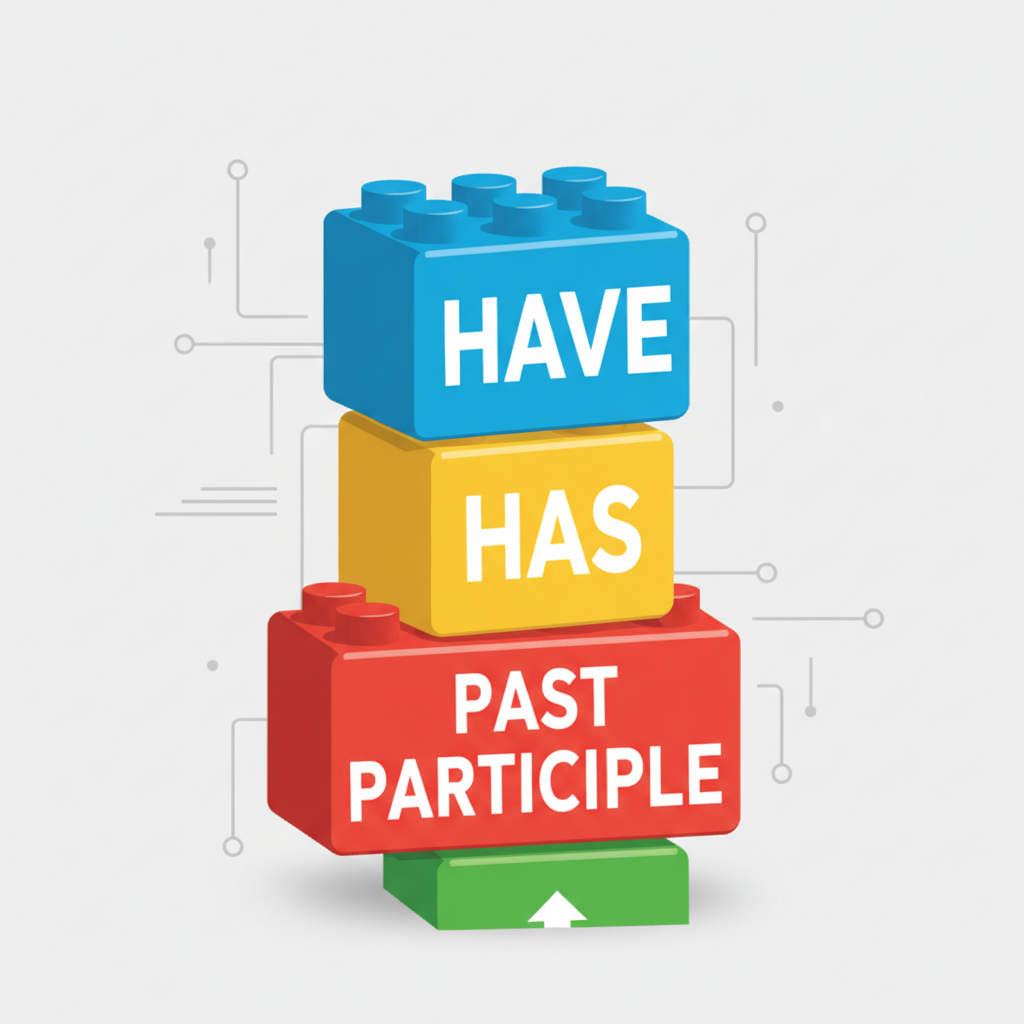
<p style='font-size:28px; font-weight:bold; color:#2C7A7B; margin-bottom:20px;'>Have / Has + Past Participle</p><ul><li style='margin-bottom:15px;'><strong>Regular Verbs (+ed):</strong><br>Work -> Worked<br><em>"We have tried to reach him."</em></li><li style='margin-bottom:15px;'><strong>Irregular Verbs (Memorize!):</strong><br>See -> Seen<br>Be -> Been<br><em>"I haven't seen him in ages."</em></li></ul>
Usage 1: Started in Past, continues
<p>We use Present Perfect for actions that started in the past and are still true now.</p><div style='margin-top:20px; border:2px solid #CBD5E0; border-radius:10px; padding:20px; background:white;'><strong>Keywords:</strong><br><ul><li><strong>For:</strong> Duration / Length of time<br><em>"We have lived here <strong>for</strong> three years."</em></li><li><strong>Since:</strong> Starting point<br><em>"He hasn't worked here <strong>since</strong> 2015."</em></li></ul></div>
Usage 2: Result Now
<p style='margin-bottom:20px;'>Something happened in the past, but the result is important <strong>NOW</strong>.</p><p style='font-size:22px; background:#FED7D7; padding:15px; border-radius:8px; color:#9B2C2C;'>Example:<br><strong>"He has broken his leg."</strong></p><p style='margin-top:10px;'><em>Result now: He cannot walk or come on the trip.</em></p><p style='margin-top:30px; border-top:2px solid #eee; padding-top:10px;'>If the time is specific (e.g., "Yesterday"), use Past Simple!</p>
Usage 3: Life Experiences
<p>When the exact time is not known or not important.</p><ul><li style='margin-bottom:20px;'>"We <strong>haven't been</strong> to Spain before."</li><li style='margin-bottom:20px;'>"<strong>Have</strong> you <strong>heard</strong> the news?"</li></ul><p style='margin-top:30px; color:#2C7A7B; font-weight:bold;'>Practice:</p><p>Fill in the blank:<br>I _______ (see) that movie three times.</p><p style='font-size:20px; color:#4A5568;'>(Answer: have seen)</p>
Review & Practice
<ol><li style='margin-bottom:30px;'><strong>Obligation:</strong> I ______ (must/should) finish this, it's the law!</li><li style='margin-bottom:30px;'><strong>Permission:</strong> ______ (Can/Must) I have a cookie, please?</li><li style='margin-bottom:30px;'><strong>Present Perfect:</strong> She ______ (live) in London since 2010.<br><span style='font-size:20px; color:#718096;'>(Answer: has lived)</span></li></ol>
- english-grammar
- esl-learning
- modal-verbs
- present-perfect
- english-lessons
- grammar-practice