
Java's Phases: An Attractive Journey to Market Leadership with Graphical Insights
1
Java: Phases of Evolution & Market Capture
From Inception to Enterprise Dominance (1995–2026)
2
Market Capture Trajectory
- Inception (1995-2010): Rapid growth due to 'Write Once, Run Anywhere' portability.
- Acceleration (2010-2020): Android boom and Fortune 500 adoption (90%) solidified the base.
- Resilience (2021-2026): Cloud-native features and Virtual Threads drive a resurgence to ~16% share.
3
Phase 1: The Foundations
Before mastering frameworks, Java developers begin with the core syntax and architecture.
Key Components:
• Architecture: JDK, JRE, and the JVM (Write Once, Run Anywhere).
• Data Types: Primitives (int, double) vs. Reference Types.
• Control Flow: Loops, conditionals (switch-case), and operators.
• Memory: Understanding Stack vs. Heap storage.
Key Components:
• Architecture: JDK, JRE, and the JVM (Write Once, Run Anywhere).
• Data Types: Primitives (int, double) vs. Reference Types.
• Control Flow: Loops, conditionals (switch-case), and operators.
• Memory: Understanding Stack vs. Heap storage.

4
Phase 2: Object-Oriented Paradigm
Encapsulation: Protecting data with access modifiers (private, public) and getters/setters.
Inheritance: Reusing code via the 'extends' keyword and method overriding.
Polymorphism: Flexibility through overloading (compile-time) and overriding (runtime).
Abstraction: Hiding implementation details using Abstract Classes and Interfaces.
5
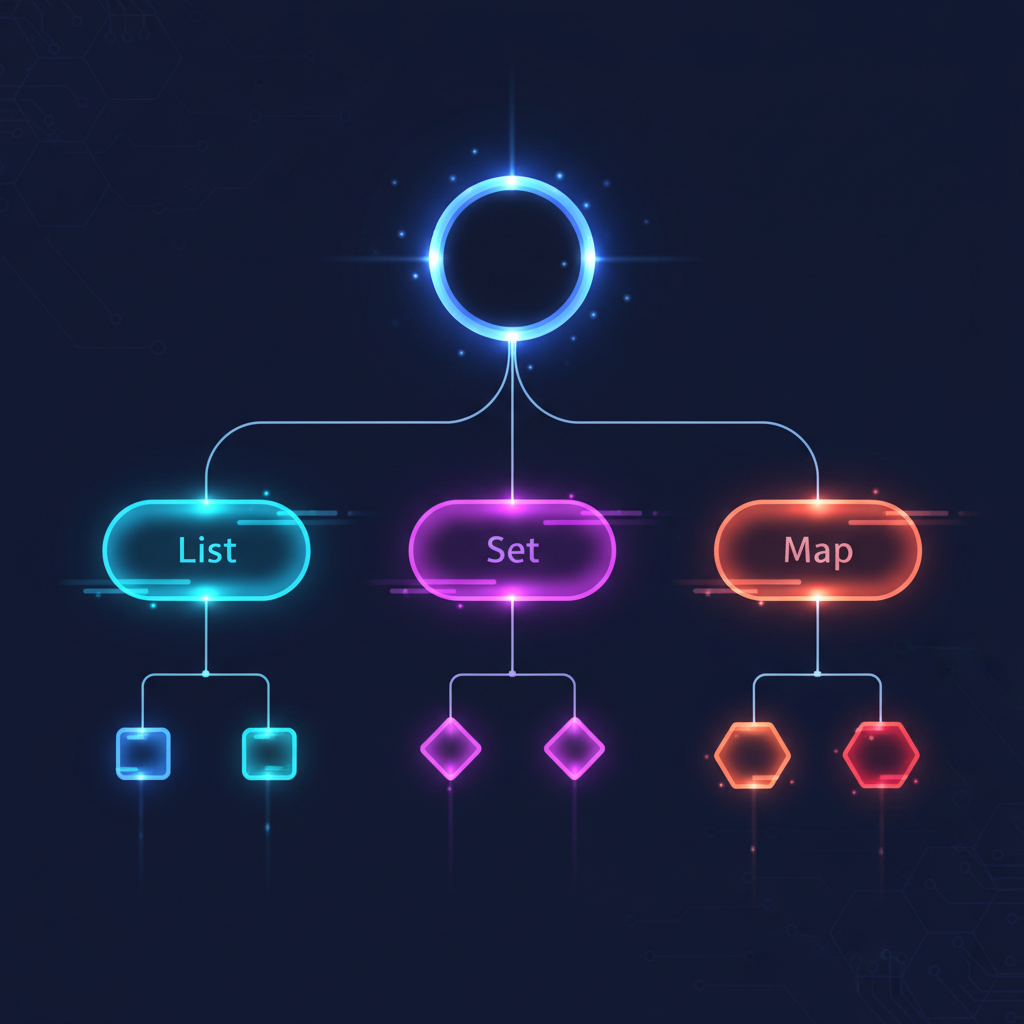
Phase 3: Collections Framework
Managing groups of objects is critical for any enterprise application.
Key Hierarchies:
• List: Ordered collections (ArrayList, LinkedList).
• Set: Unique elements (HashSet, TreeSet).
• Map: Key-value pairs (HashMap, TreeMap). Note: Map is distinct from the Collection interface root.
Key Hierarchies:
• List: Ordered collections (ArrayList, LinkedList).
• Set: Unique elements (HashSet, TreeSet).
• Map: Key-value pairs (HashMap, TreeMap). Note: Map is distinct from the Collection interface root.
6
Phase 4: Advanced Core Concepts
Reaching professional proficiency requires understanding concurrency and robustness.
• Multithreading: Thread lifecycle, Runnable interface, Synchronization.
• Concurrency API: ExecutorService, Thread Pools, and Futures.
• Exception Handling: Try-catch flows and custom exceptions.
• Reflection: Inspecting classes and methods at runtime.
• Multithreading: Thread lifecycle, Runnable interface, Synchronization.
• Concurrency API: ExecutorService, Thread Pools, and Futures.
• Exception Handling: Try-catch flows and custom exceptions.
• Reflection: Inspecting classes and methods at runtime.

7
Modern Features Adoption (LTS)
Modern Java is defined by its Long-Term Support (LTS) releases:
• Java 8: Lambda expressions & Streams.
• Java 17: Records & Seagled Classes (61% adoption).
• Java 21: Virtual Threads (Project Loom) for massive concurrency.
• Future: Structured Concurrency in Java 25.
• Java 8: Lambda expressions & Streams.
• Java 17: Records & Seagled Classes (61% adoption).
• Java 21: Virtual Threads (Project Loom) for massive concurrency.
• Future: Structured Concurrency in Java 25.
8
Phase 6: Professional Ecosystem
Spring Boot: The industry standard for microservices, offering auto-configuration and embedded servers.
Build Tools: Maven (pom.xml) and Gradle ensure consistent dependency management.
ORM / Hibernate: Mapping Java objects to database tables efficiently (JPA).
Testing: JUnit 5 and Mockito for robust unit and integration testing.
9

2026 Trends & Future Outlook
Java remains a top 4 language in 2025 by adapting to modern needs.
• Cloud-Native: Optimizations for Kubernetes and serverless (Quarkus, Spring Native).
• AI Integration: Libraries connecting Java services to ML models.
• Performance: Project Valhalla and compact headers increasing memory efficiency.
• Adoption: #1 choice for enterprise backends.
• Cloud-Native: Optimizations for Kubernetes and serverless (Quarkus, Spring Native).
• AI Integration: Libraries connecting Java services to ML models.
• Performance: Project Valhalla and compact headers increasing memory efficiency.
• Adoption: #1 choice for enterprise backends.
10
“Java has captured and maintained a significant share of the market through continuous evolution, enterprise dominance, and adaptations like virtual threads.”
- 2025 Market Analysis
Java: Phases of Evolution & Market Capture
From Inception to Enterprise Dominance (1995–2026)
Made withbobr.ai
1 / 10