
Efficient Inventory Management for Sports Equipment: A School Project
DAV PUBLIC SCHOOL
Inventory Management of Sports Equipment
Submitted to: [Teacher's Name] | Submitted by: [Your Name]
Class: [Your Class] | Section: B | Roll No: [Your Roll No]
Certificate
This is to certify that the student of Section B has successfully completed the project titled 'Inventory Management of Sports Equipment' under my guidance. The project is original and has been carried out as per the school curriculum requirements and guidelines.
Teacher's Signature: ____________________
Principal's Signature: ____________________
Acknowledgement
I would like to express my sincere gratitude to my teacher for guiding me throughout this project. Their insights were invaluable in understanding the complexities of store management.
I also thank the school library staff for providing useful resources, and my parents for their constant support. Special thanks to my classmates in Section B who helped with ideas during discussions. This project taught me a lot about real-world organization in sports.
Index
- 1. Introduction to the Project
- 2. Objectives & Scope
- 3. Problems in Traditional Management
- 4. Modern Solutions & Features
- 5. Market Overview & Data
- 6. Competition & Financials
- 7. Conclusion & Bibliography
Introduction to the Project
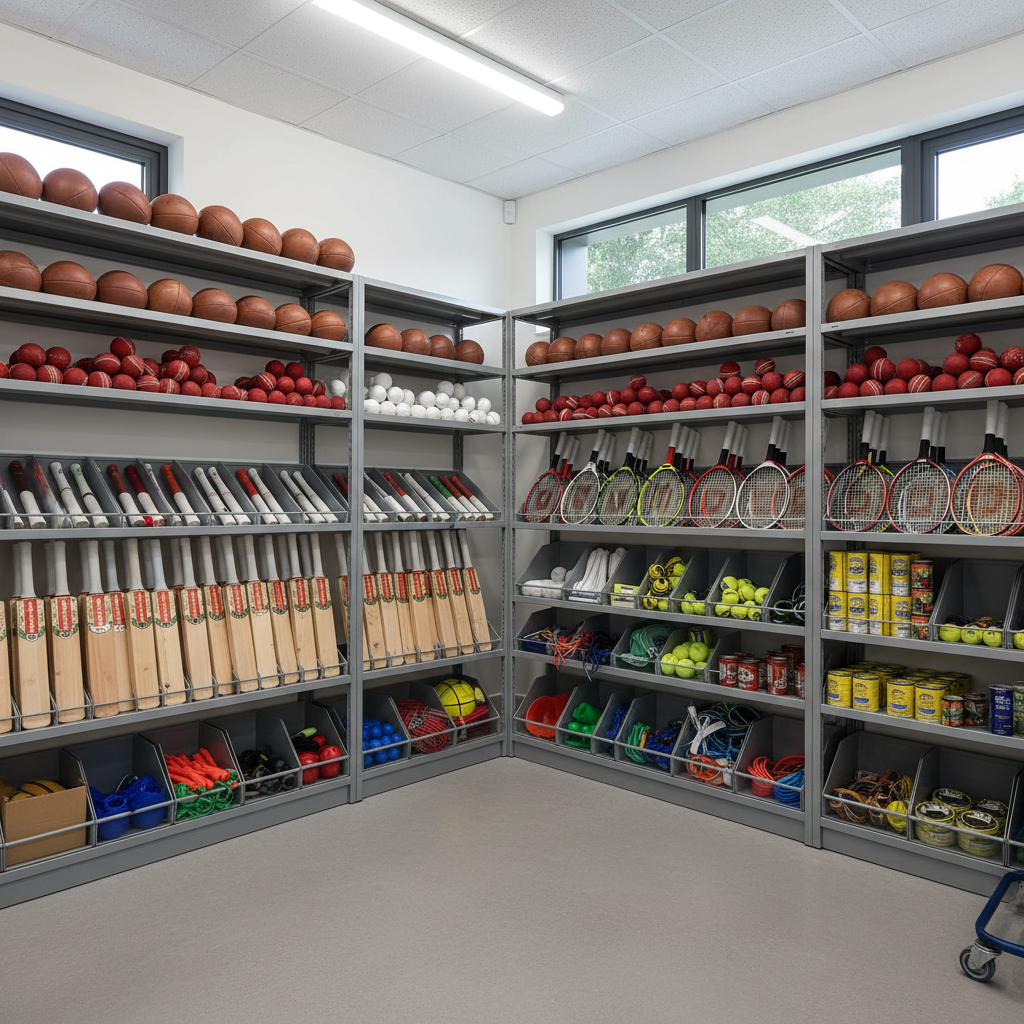
Inventory management of sports equipment involves tracking items like balls, racquets, helmets, jerseys, and fitness gear in schools, clubs, or stores.
Poor management leads to lost items, extra costs, and delays in sports activities. This project explores challenges, solutions using tech like RFID and software, and how schools can implement it efficiently to ensure equipment is ready for practice and matches.
Objectives and Scope
Problem in Traditional Inventory Management
- Damage to Labels: Stickers get dirty or damaged on sports gear, causing scan errors during checkout.
- Time Intensive: Manual lists require staff to handle each item individually, which wastes valuable coaching time.
- High Loss Rate: Without simple check-in systems, items like helmets or balls are often not returned by students.
- No Real-Time Visibility: Teachers cannot instantly see if they have enough equipment for a class session.
Modern Solutions & Features
Impact of Technology: Efficiency Analysis
Research shows that RFID systems reduce inventory counting time by up to 80% compared to manual methods. This allows sports staff to focus on training rather than counting.
Competition & Go-to-Market Strategy
Competitive Landscape
- Competitor - GAO RFID: Strength is auto-scanning without installation; Weakness is the requirement for expensive tags.
- Competitor - EZO: Strength is excellent mobile checkout; Weakness is subscription fees.
- Competitor - Manual/Excel: Strength is zero cost; Weakness is high error rate and no alerts.
Financial Projections: Cost vs. Savings
Implementing a system costs approximately $500 initially (software + tags). However, by reducing equipment loss by 25%, the school saves an estimated $1000 annually. The break-even point is achieved in less than one year.
Conclusion & Bibliography
Good inventory management keeps sports running smoothly at DAV Public School. By adopting simple technology, we can achieve zero losses and ensure every student has access to equipment.
Bibliography:
1. GAO RFID - Asset Tracking Systems
2. Unleashed Software - Inventory Management
3. Teamworks - Athlete Management Platforms
DAV PUBLIC SCHOOL
Inventory Management of Sports Equipment
Submitted to: [Teacher's Name] | Submitted by: [Your Name]
Class: [Your Class] | Section: B | Roll No: [Your Roll No]