
Mastering Statistical Inference: Key Concepts & Example Sums

Statistical Inference I
Module 4: Estimation, Hypothesis Testing & Examples
What is Statistical Inference?
Statistical inference is the process of using data analysis to infer properties of an underlying population probability distribution. It allows us to draw conclusions about a large population based on a smaller sample.

Point vs. Interval Estimation
1. Point Estimation: A single value calculated from sample data (e.g., Sample Mean x̄) used to estimate the population parameter (μ).
2. Interval Estimation: A range of values (e.g., Confidence Interval) within which the parameter is expected to lie with a certain probability.
Confidence Intervals
A Confidence Interval (CI) proposes a range of plausible values for an unknown parameter. For a 95% CI, if we were to take 100 different samples and compute a CI for each, we expect 95 of those intervals to contain the true population mean.
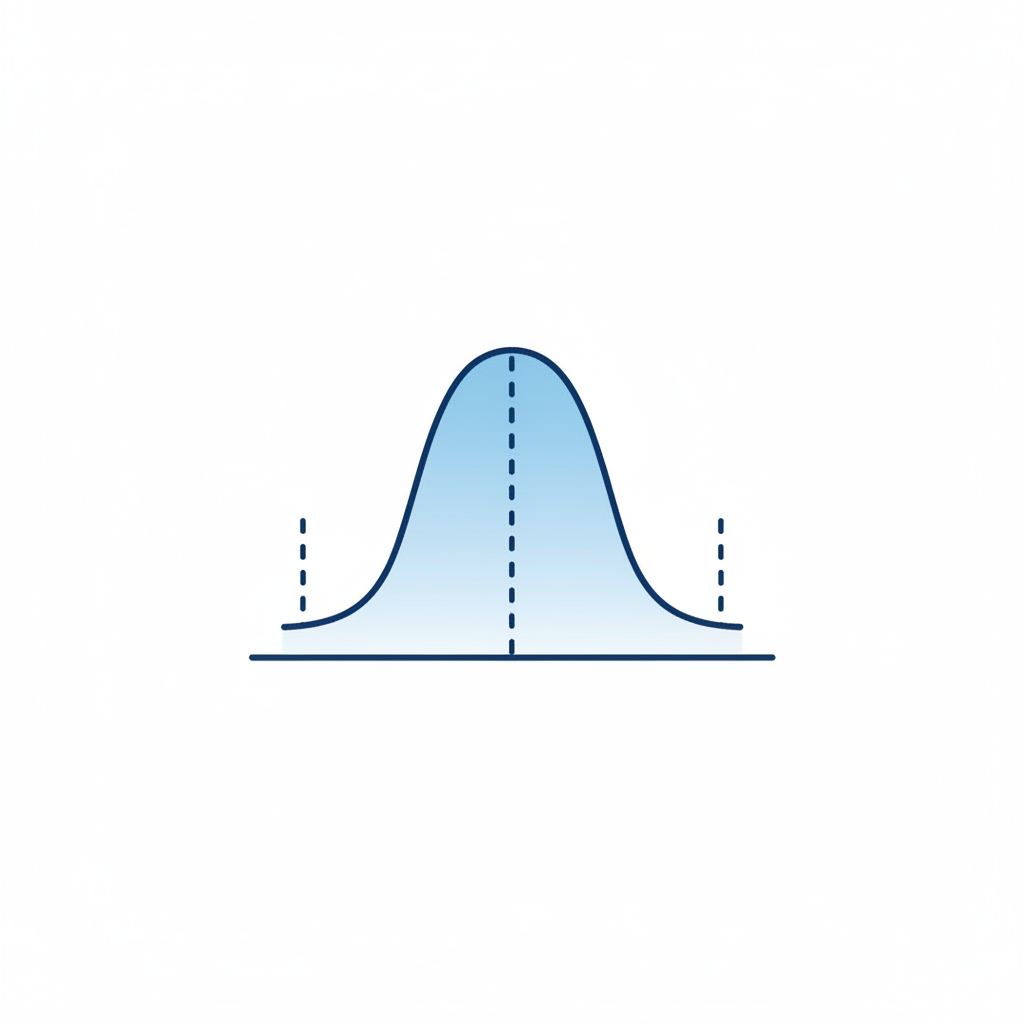
Example Sum 1: Finding 95% CI
- Problem: A sample of 64 students has a mean score of 50 with a known standard deviation of 8. Find the 95% confidence interval for the population mean.
- Step 1: Calculate Standard Error (SE) = σ / √n = 8 / √64 = 8 / 8 = 1.0
- Step 2: Z-value for 95% confidence is 1.96
- Step 3: Margin of Error (E) = Z * SE = 1.96 * 1.0 = 1.96
- Result: CI = Mean ± E = 50 ± 1.96 ⇒ [48.04, 51.96]
Hypothesis Testing Basics
Hypothesis testing evaluates two mutually exclusive statements about a population:
Null Hypothesis (H₀): Theoretical statement of no effect or no difference.
Alternative Hypothesis (H₁): Statement trying to be proven (there is an effect).
We use sample data to determine if there is sufficient evidence to reject H₀.

Types of Errors in Testing
- In decision making, we can make two types of errors:
- Type I Error (α): Rejecting the Null Hypothesis when it is actually true (False Positive).
- Type II Error (β): Failing to reject the Null Hypothesis when it is actually false (False Negative).
- Significance Level (α): The probability of committing a Type I error (commonly 0.05).
Example Sum 2: One-Sample Z-Test
- Claim: Population mean IS 100. Sample: n=36, x̄=104, σ=12. Test at α=0.05.
- Hypothesis: H₀: μ = 100 vs H₁: μ ≠ 100 (Two-tailed)
- Test Statistic Z = (x̄ - μ) / (σ/√n) = (104 - 100) / (12/6) = 4 / 2 = 2.0
- Critical Value: For α=0.05 (two-tailed), Z_crit = ±1.96
- Conclusion: Since Z (2.0) > 1.96, we Reject H₀. The mean is significantly different from 100.